Best AI Overviews trackers compared for SEO teams
SE Ranking is the best AI Overviews tracker for most SEO teams. It checks AI Overview citations against the same keyword list as your rankings, and AI Mode comes with a paid add-on. Ahrefs Brand Radar suits research teams that can pay for a 6-platform index. Semrush fits teams already working in Semrush. Otterly.AI is the cheapest way to start, and Profound is built for enterprise budgets. Snoika fits teams that want tracking and gap-closing pages from one provider.
 Artem LozinskyOperations and product, Snoika · 8 min read













Top AI Overviews trackers compared
The 7 tools below all track Google AI Overviews. Some count keywords or prompts, while others use index data. They also differ in whether AI Mode costs extra and who they're built for. Prices come from vendor pages and dated third-party reviews published in 2026. Plans change, so check the vendor's page on the day you buy.
| Tool | Entry price (2026) | AI Overviews | AI Mode | Unit tracked | Best fit |
|---|---|---|---|---|---|
| SE Ranking | From $103.20/mo annual | Yes | Yes, via AI Search add-on | Keywords plus prompts | SEO teams that want AI Overviews next to rankings |
| Semrush | $99/mo per domain | Yes | Yes | 25 prompts at base | Existing Semrush users |
| Ahrefs Brand Radar | $199/mo per index on top of an Ahrefs plan | Yes | Yes | Prompt index plus custom prompts | Research and competitor analysis |
| Otterly.AI | $29/mo for 15 prompts | Yes | Paid add-on | Prompts, daily | Small teams running a first test |
| Peec AI | €89/mo Starter | Yes | Counts toward a 3-engine cap | Prompts, daily | Brands that want unlimited seats |
| Profound | Custom enterprise pricing | Yes | Enterprise plan | Prompts, daily | Large brands with procurement budgets |
| Snoika | Plans listed on snoika.com/pricing | Yes | Not in published coverage | Weekly prompt sets | Teams that want tracking plus published pages |
SE Ranking
- Entry price (2026)
- From $103.20/mo annual
- AI Overviews
- Yes
- AI Mode
- Yes, via AI Search add-on
- Unit tracked
- Keywords plus prompts
- Best fit
- SEO teams that want AI Overviews next to rankings
Semrush
- Entry price (2026)
- $99/mo per domain
- AI Overviews
- Yes
- AI Mode
- Yes
- Unit tracked
- 25 prompts at base
- Best fit
- Existing Semrush users
Ahrefs Brand Radar
- Entry price (2026)
- $199/mo per index on top of an Ahrefs plan
- AI Overviews
- Yes
- AI Mode
- Yes
- Unit tracked
- Prompt index plus custom prompts
- Best fit
- Research and competitor analysis
Otterly.AI
- Entry price (2026)
- $29/mo for 15 prompts
- AI Overviews
- Yes
- AI Mode
- Paid add-on
- Unit tracked
- Prompts, daily
- Best fit
- Small teams running a first test
Peec AI
- Entry price (2026)
- €89/mo Starter
- AI Overviews
- Yes
- AI Mode
- Counts toward a 3-engine cap
- Unit tracked
- Prompts, daily
- Best fit
- Brands that want unlimited seats
Profound
- Entry price (2026)
- Custom enterprise pricing
- AI Overviews
- Yes
- AI Mode
- Enterprise plan
- Unit tracked
- Prompts, daily
- Best fit
- Large brands with procurement budgets
Snoika
- Entry price (2026)
- Plans listed on snoika.com/pricing
- AI Overviews
- Yes
- AI Mode
- Not in published coverage
- Unit tracked
- Weekly prompt sets
- Best fit
- Teams that want tracking plus published pages
SE Ranking: best for keyword-based tracking
SE Ranking wins for SEO teams because it puts AI Overview presence inside a rank tracker they already understand. It also estimates potential traffic from AI Overviews, which Google Search Console doesn't report. The Core plan includes 2,000 keywords tracked daily and 100 AI prompts. Wider AI engine coverage requires an add-on to the base plan, and the AI Search add-on starts at $71.20 a month on annual billing. In-house teams and agencies can use it to report rankings and AI visibility side by side.
Semrush: best for teams already on Semrush
Semrush makes sense when your team already runs keyword research and reporting there. Its brand performance reports read 5 AI surfaces, which include AI Overviews and AI Mode. The base toolkit tracks 25 prompts, and 50 more cost $60 a month. Rework's comparison says that "that per-domain multiplier never gets cheaper as you add brands." Semrush has also moved AI visibility into bundled plans, with the SEO + AI Search Starter at $199 a month when HoneyB checked on 2 October 2026.
Ahrefs Brand Radar: best for research at scale
Brand Radar is the strongest choice when you need market-wide data instead of your own short prompt list. Ahrefs says its index covers 481M real prompts across AI platforms, so you can look up any brand without setting anything up. You need an Ahrefs subscription first, so full coverage comes to at least $828 per month, and Brand Radar has no free trial. Enterprise SEO teams and analysts who already pay for Ahrefs meet that subscription requirement.
Otterly.AI: best low-cost starting point
Otterly is the cheapest way to see whether AI Overviews cite you at all. Every plan covers four base engines, AI Overviews among them, and includes unlimited team members. Google AI Mode is extra, from $9 a month on Lite up to $149 on Premium. SEO Stuff's review cautions that "Fifteen prompts is a sample." Small businesses and consultants can use Otterly to gather proof before they commit budget.
Peec AI: best for simple team dashboards
Peec gives every paid plan unlimited seats, so whole marketing teams can read the same data. Its entry plan tracks 50 prompts across 3 of 7 engines that you pick at onboarding. The Pro plan costs €205 for 150 prompts. A team that adds ChatGPT to AI Overviews and AI Mode has used its whole engine allowance. With Peec, mid-size brands get shared reporting at the expense of wider engine coverage.
Profound: best for enterprise programs
Profound is the enterprise option, and since September 2026 it's priced that way. The company removed its self-serve plans around its Series D. Brands now get a free trial or a custom Enterprise plan covering up to nine engines. Agencies can still sign up at $99 a month plus $399 per client workspace. With no public brand price, budgeting means a sales call. Large brands get SSO and wide engine coverage with Profound.
Keyword capacity that matters
The capacity that matters is how many queries each tool checks per engine at each refresh. The headline keyword count tells you much less. Vendors count in different units, and those units decide your real allowance. Ahrefs, for example, says 5 prompts on 1 platform use 150 checks a month, and Claude uses 8 checks per update. In SE Ranking, one prompt tracked across five AI engines uses five checks.
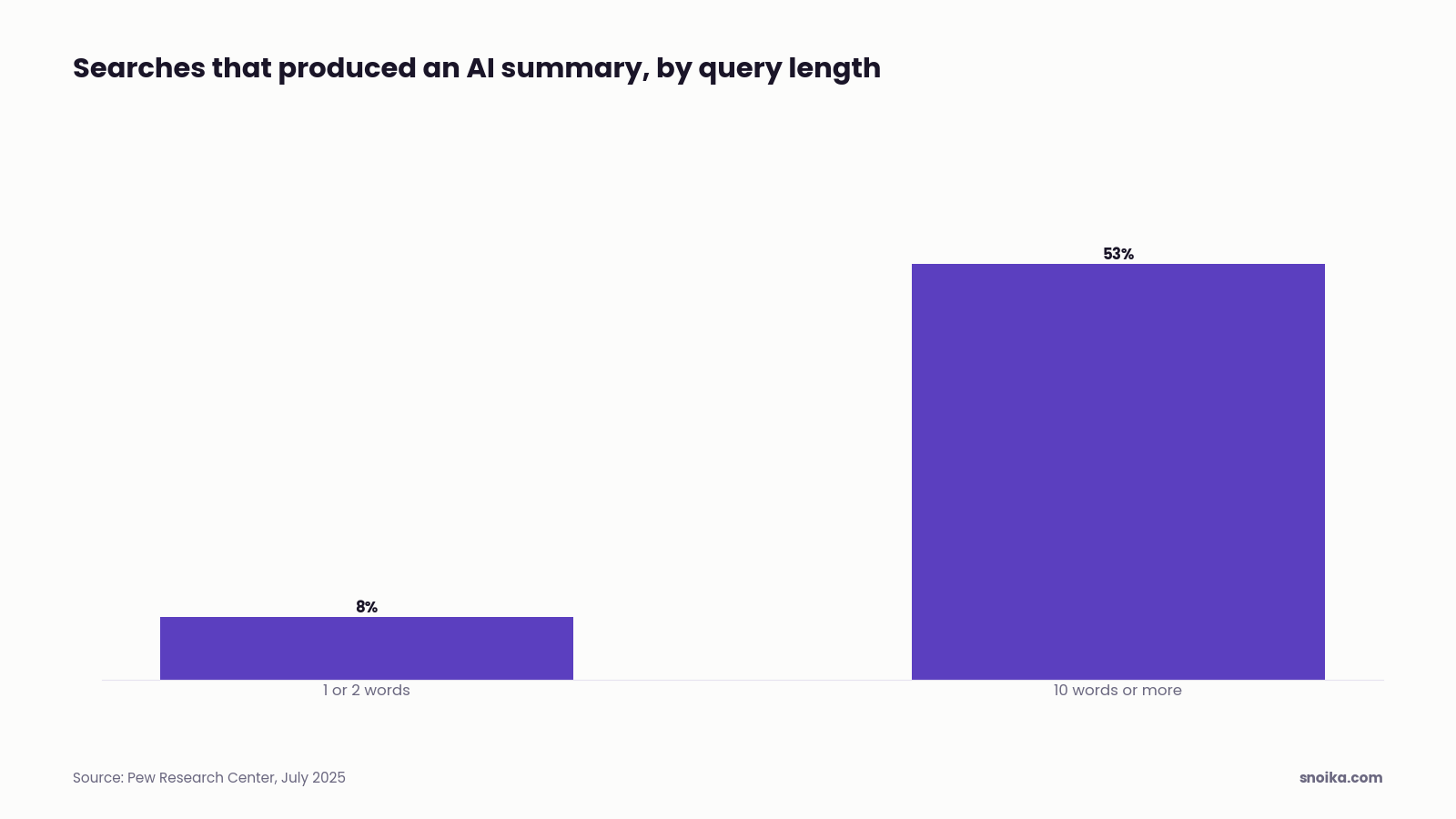
Your query set needs to be longer than your SEO keyword list. Pew Research Center found that 8% of one- or two-word searches produced an AI summary, while the figure for searches of 10 words or more was 53%. So AI Overviews favor long questions beyond the scope of your rank tracker's query set.
Before you compare plans, multiply your query count by the number of engines, then by refreshes per month. A 100-query set on three engines with daily refresh needs about 9,000 checks a month, which rules out every entry tier on this page. If the number shocks you, cut the list down to the queries that bring in pipeline.
Citation detail to look for
A useful tracker shows which of your URLs got cited and where each sat in the overview. It also shows which competitor URLs sat beside yours. URL detail matters because citations move quickly. Ahrefs found that 45.5% of citations change when an AI Overview updates, and an overview has a 70% chance of changing between one observation and the next.
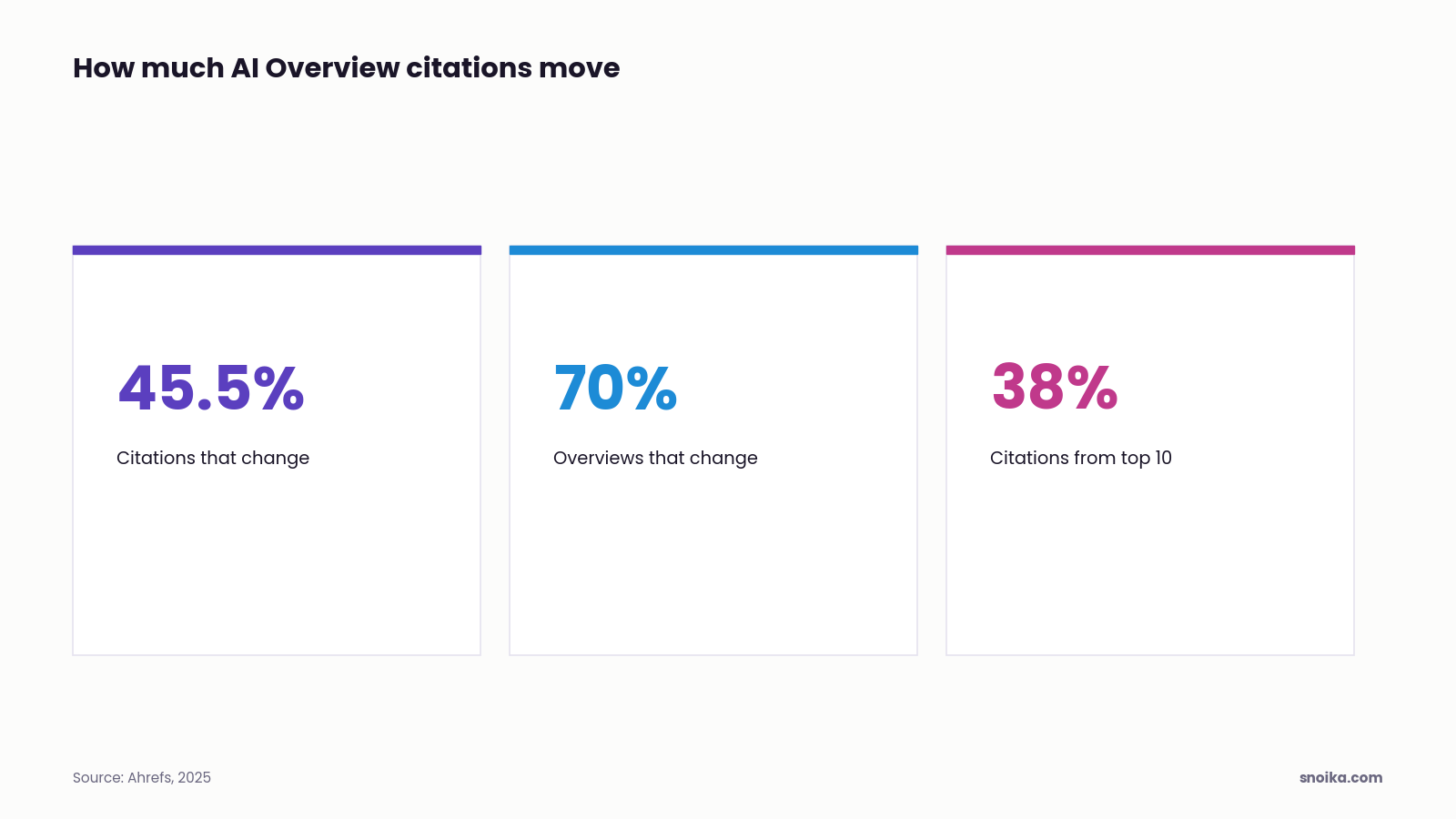
In an updated Ahrefs study, only 38% of AI Overview citations came from pages ranking in the organic top 10. That's why a tracker has to read the overview itself. It can't assume your top-3 pages get cited.
Use daily refreshes on a fixed query set as the first of three steps for citation tracking at scale. Keep dated snapshots so you can see when a citation was lost. And pipe the data out through an API instead of copying it from a dashboard. Otterly adds API and MCP access from its Standard plan, and SE Ranking's top tier includes 300k API credits. In any trial, check that the tool separates a brand mention from a linked citation and keeps the full text of each overview.
AI Mode coverage
Ahrefs Brand Radar and Semrush track AI Mode on their standard plans or add-ons. SE Ranking also offers AI Mode tracking. Otterly sells it as an add-on, and Profound keeps it for enterprise clients. Peec counts it as one of your three chosen engines. Coverage matters because AI Mode and AI Overviews cite different pages for the same question. An Ahrefs study found they cited the same URLs 13.7% of the time, even though their answers meant much the same thing.
Sundar Pichai, Alphabet's CEO, told investors in July 2025 that AI Mode had over 100 million monthly active users in the U.S. and India. Search Console counts AI features together with classic results inside the "Web" search type.
During a trial, check whether the tool reports AI Mode and AI Overviews as separate lines. A combined "Google AI" score hides the gap you most need to see. Also check whether AI Mode uses the same prompt list, or whether you have to set it up again.
Free vs paid trackers
Free tools show today's AI Overview citations, while paid trackers add history and competitor comparisons to show how those citations change. AIRanked's checker gives 3 free checks on signup, then charges $9 for 200 credits. RankScope's free checker runs 5 buyer-intent prompts across ChatGPT and Perplexity as well as Google's AI Overviews and AI Mode. A one-off result like that is a baseline, and it can't show a trend.
Don't expect Google to fill the gap for free. Lily Ray, VP of SEO Strategy and Research at Amsive, has described how people asked Google directly for AI Overview reporting. She wrote that the answer is always "It's not on our roadmap" or "We don't understand why you'd need that."
Use free checks to decide whether AI Overviews matter in your niche. Once they do, you'll need the history and competitor tracking that only paid plans keep.
Metrics B2B SEOs need
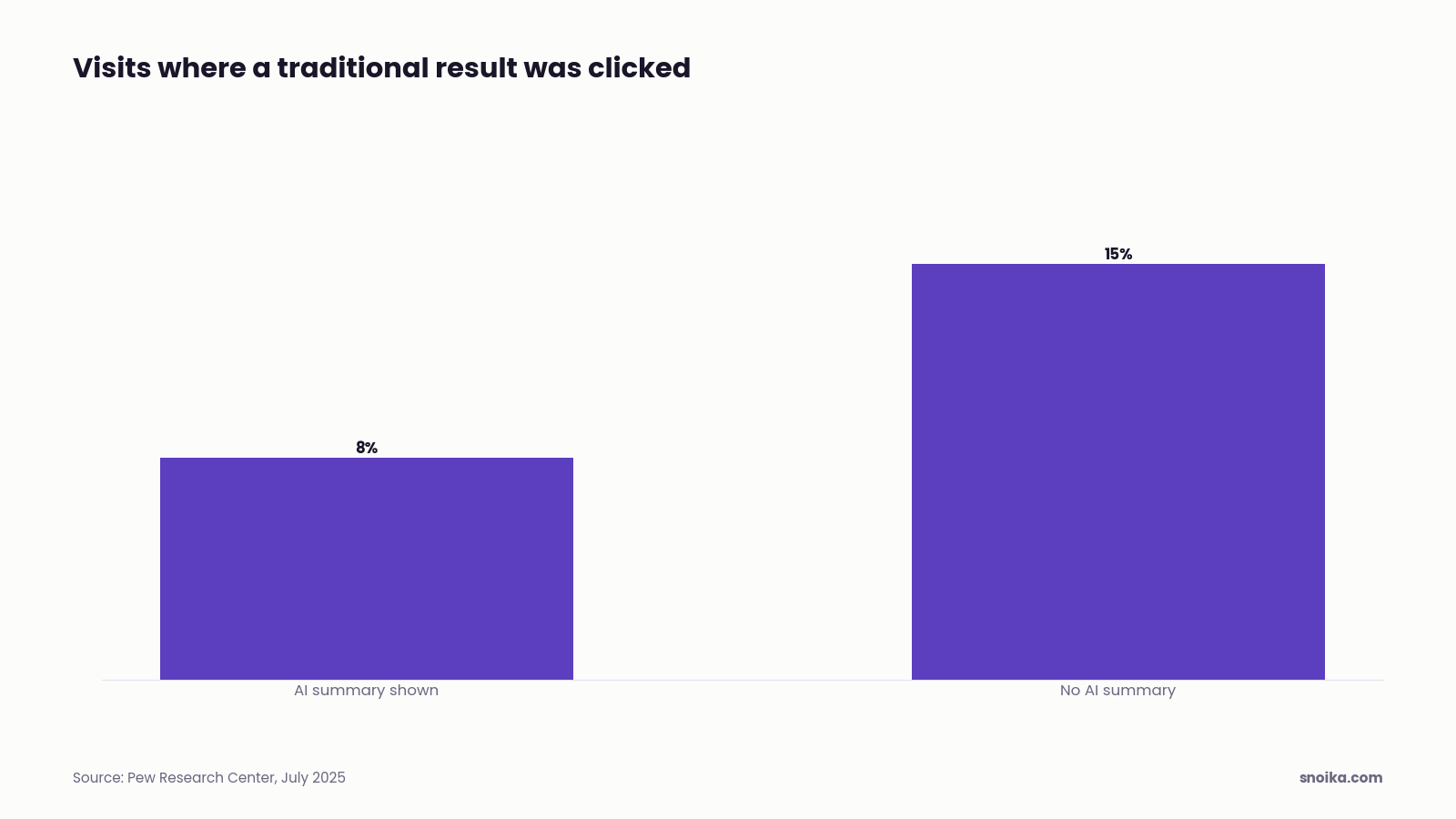
B2B SEOs need metrics that show their presence in the answer, because clicks no longer measure it. Pew found that users who saw an AI summary clicked a traditional result in 8% of visits, against 15% when no summary appeared. A buyer can shortlist you after reading your name in an overview without ever clicking.
Require these metrics from any tracker:
- AI Overview trigger rate: the share of your query set that shows an overview at all.
- Citation rate: how often your URLs appear as linked sources.
- Mention rate: how often your brand is named, with or without a link.
- Share of voice: your mentions against named competitors on the same queries.
- Sentiment: whether the overview describes you accurately and favorably.
Vendors define these terms differently, so agree on definitions before you report numbers. Lily Ray made the same point in an AMA on Reddit. Since tools use different metrics, she said, "it's important to align with clients on which ones they agree are important." For B2B, weight your comparison and pricing queries above informational ones. Those are the queries where a missing citation costs deals.
Pricing tiers worth knowing
The four pricing models for AI Overview trackers divide into usage fees per prompt or per check and fees per index or per domain. Entry tiers run from $29 to $199 a month, and full coverage costs several hundred. Each model scales differently, so a tool that's cheap at 15 queries can be expensive at 500.
Per-prompt pricing gets cheaper as you buy more. Otterly works out at $1.93 per prompt on Lite and $1.22 on Premium. Per-check pricing grows with each engine you add. SE Ranking's add-on runs $89 for 200 checks monthly, up to $345 for 1,000. Ahrefs prices per platform index, and Semrush per domain. Agencies feel that last model hardest, since every new client adds another fee.
With annual billing, SE Ranking takes 20% off its add-on, and Otterly's annual plans are about 15% less. Before you compare headline prices, price your own query set across every engine you need, even those sold as add-ons. That total is the number to compare.
How Snoika tracks AI Overviews
Snoika uses weekly prompt sets to track mentions and citations in Google AI Overviews and ChatGPT. It also tracks sentiment and share of voice. It reports the same metrics a B2B team needs from the dedicated trackers above.
Most tools on this list stop at the report. Otterly gives recommendations and leaves the fixing to your team, and Ahrefs Brand Radar is a research product. Snoika also creates and publishes the pages that close those gaps, on the client's own domain. When a competitor's URL keeps getting cited for a comparison query, the next step is a page built to answer that query, and Snoika writes and publishes it.
A weekly refresh is coarser than the daily checks Otterly and Peec run. Profound also checks daily, and AI Overview citations shift between observations. Snoika covers AI Overviews and ChatGPT. Plans are listed on snoika.com/pricing.
Picking from this list
Pick by the unit you'll track, then by budget. Export your 50 highest-value queries, weighted toward comparison and pricing questions, and run them through a free checker first. If AI Overviews show up on fewer than a handful of them, wait before you buy. If they appear across your query set, trial the tool whose unit matches your list. For keyword-heavy teams, try SE Ranking; for teams that care about prompts, try Otterly or Peec. Run the trial for at least two weeks before you sign. Citations shift enough for a single week to make any AI Overviews tracker look better or worse than it is.
FAQ
Run daily checks on a fixed query set and keep dated snapshots of cited URLs. Use an API to export results instead of copying dashboard data. Confirm that the tracker distinguishes linked citations from unlinked brand mentions.
Look for explicit AI Mode coverage in the plan details, because AI Overviews coverage doesn't guarantee it. Access may require a paid add-on or an enterprise plan. During a trial, confirm that the tool reports AI Mode separately from AI Overviews.
Listed entry tiers range from $29 to $199 a month, but they measure usage differently. Compare costs for the same query set and refresh schedule. Include required subscriptions and AI Mode add-ons in the total, and check whether each domain adds another fee.
Test an ai overviews tracker for at least two weeks using the same queries throughout. Citations change between observations, so a single week can give a misleading impression. Check whether the history lets you identify when specific URLs gained or lost citations.
Search Console can't replace a dedicated tracker for separate AI Overview reporting. It groups AI features with classic results under the Web search type. Use free checks for an initial citation snapshot, or paid tracking when you need citation history and competitor comparisons.
Keep reading
All articles