AI rank tracker guide
An AI rank tracker records how often assistants like ChatGPT and Google AI Overviews mention or cite your brand when they answer a fixed set of prompts. If you only want to see where you stand today, a free one-time grader is enough. If you report to a team every month, buy a tracker that reruns the same prompts on a schedule and saves the sources behind each answer. Agencies and companies with more than one brand also need per-brand pricing and API access.
 Artem LozinskyOperations and product, Snoika · 9 min read

























AI answers need different tracking
AI answers need their own tracking because the assistant writes the answer itself and fewer people click through to the pages underneath. Classic rank trackers record where a URL sits on a results page. Clicks are where that position used to pay off, and those clicks are shrinking. Seer Interactive studied 3,119 informational queries and found that organic click-through rate on queries with AI Overviews fell 61%, from 1.76% to 0.61% between June 2024 and September 2025.
On Alphabet's Q2 2025 earnings call, CEO Sundar Pichai said AI Overviews had over 2 billion monthly users. OpenAI CEO Sam Altman told the DevDay audience in October 2025 that "more than 800 million people use ChatGPT every week." Both products answer the buyer's question before a list of links ever appears.
So your page can rank third and still be missing from the summary printed above it. You need to know whether the answer names you and links to you. Before you pay for anything, search your 10 most important buying questions by hand. See how many of them trigger an AI answer at all.
How AI rank signals differ
AI rank tracking samples answers that change every time, while Google rank tracking reads one list that stays put for a given keyword when the location and device stay the same. Google returns the same 10 blue links when you repeat a query twice in an hour, while ChatGPT gives two different answers to the same question. Because of that variation, an AI tracker runs each prompt several times and reports a rate.
In SparkToro's test, 600 volunteers ran 12 identical prompts almost 3,000 times across ChatGPT and Claude as well as Google's AI. AI tools returned the same list of brands fewer than 1 in 100 times, and the same list in the same order fewer than 1 in 1,000 times. Rand Fishkin, SparkToro's co-founder, drew a blunt conclusion that Search Engine Journal quoted: "any tool that gives a 'ranking position in AI' is full of baloney." Across repeated runs in the same test, the share of answers that included a brand stayed stable.
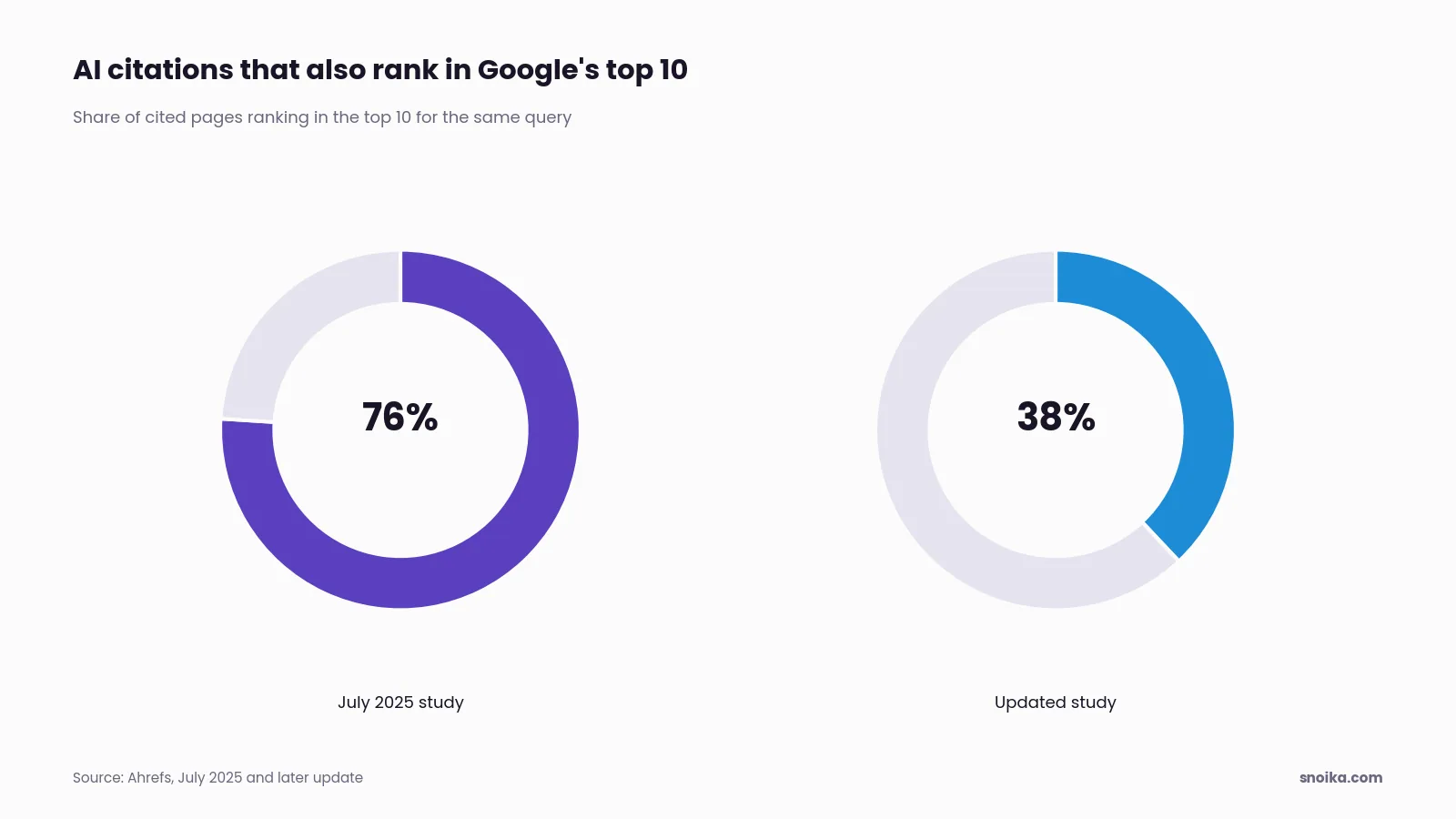
Good Google rankings help, but they don't guarantee a citation. Ahrefs analyzed 863,000 keyword results pages and found that only 38% of cited pages also ranked in Google's top 10 for the same query. That figure was 76% in the company's July 2025 version of the study.
| Attribute | Google rank tracking | AI rank tracking |
|---|---|---|
| Unit tracked | Keyword | Prompt (a full question) |
| Output | Ordered list of URLs | Written answer that names brands and sources |
| Repeatability | Same result for the same query and location | Different answer on most runs |
| Main metric | Position 1 to 100 | Share of answers that mention you |
| Sources shown | Every result is a link | Citations are optional and vary by assistant |
Unit tracked
- Google rank tracking
- Keyword
- AI rank tracking
- Prompt (a full question)
Output
- Google rank tracking
- Ordered list of URLs
- AI rank tracking
- Written answer that names brands and sources
Repeatability
- Google rank tracking
- Same result for the same query and location
- AI rank tracking
- Different answer on most runs
Main metric
- Google rank tracking
- Position 1 to 100
- AI rank tracking
- Share of answers that mention you
Sources shown
- Google rank tracking
- Every result is a link
- AI rank tracking
- Citations are optional and vary by assistant
What varies most is where the assistant gets its information. HubSpot's documentation notes that its free grader reads ChatGPT and Gemini answers from training data, while Perplexity searches the live web. If an assistant answers from training data, a page you published last week won't show up in its answers for a while. Check which mode each engine in your tracker uses before you read meaning into a sudden change.
Metrics that matter
Five metrics tell you whether AI answers help or hurt your brand. Mention rate comes first, and the other four explain it. Each one answers a different question, so a report that shows only one of them leaves you guessing.
Mention rate (visibility)
Mention rate is the share of tracked answers that name your brand. Peec AI's methodology defines it as responses that mention the brand divided by all tracked responses, times 100. The number applies only to your prompt set as tested on your chosen engines and in your chosen locations, so 40% across 50 prompts means something different from 40% across 500.
Share of voice
Share of voice is your mentions as a portion of all brand mentions in the same answers. It shows whether you're gaining ground or the whole category is just appearing more often. If your mention rate goes up while a competitor's goes up faster, your share of voice drops. That's the warning sign you'd miss without it.
Sentiment
Sentiment shows whether the answer describes you positively, neutrally or negatively. A mention that calls your product "expensive and hard to set up" counts toward visibility and still costs you deals. Read the flagged answers yourself. Automated scoring misreads sarcasm and comparisons.
Citations
A citation is a link or source that the assistant attaches to its answer. Separate citations of your own domain from third-party pages that mention you, such as review sites or directories. Each needs a different fix. A missing domain citation calls for work on your own pages, while a missing third-party mention calls for outreach and PR.
Answer position
Answer position is where your brand appears inside the answer when it appears at all. Peec AI reports position as the average order of the brand relative to the other brands it detects, so a lower number is better. Scalenut's review of Peec says the metric shows whether you appear near the top of an answer or get pushed below competitors. Use position as a supporting signal. Given the SparkToro results, an average over dozens of runs tells you more than a single run's order.
Picking an AI tracker
Choose the tracker whose prompt volume and engine coverage match the decisions you'll make with the data. A founder checking one product needs 25 prompts on 2 engines, while an agency with 12 clients needs hundreds of prompts and per-brand reports. The table shows published entry prices in 2026. Check each vendor's page before you buy, because these prices change.
| Tool and plan | Price | Prompts included | Engines | Best fit |
|---|---|---|---|---|
| HubSpot AI Search Grader | Free, one-time | Pre-set queries | ChatGPT, Perplexity, Gemini | First snapshot |
| HubSpot AEO | $50 per month | 25 | ChatGPT, Perplexity, Gemini | Small teams on a budget |
| Otterly.AI Lite | $29 per month | 15 | 4 base engines | Testing a short prompt list |
| Peec AI Starter | €89 per month | 25 | ChatGPT, Perplexity, AI Overviews | In-house marketing teams |
| Semrush AI Visibility Toolkit | $99 per month per domain | 25 | ChatGPT, Google AI, Perplexity, Gemini | Teams already using Semrush |
| Snoika | Plans on the pricing page | 10 tested weekly | 1 | Trying a weekly prompt set |
HubSpot AI Search Grader
- Price
- Free, one-time
- Prompts included
- Pre-set queries
- Engines
- ChatGPT, Perplexity, Gemini
- Best fit
- First snapshot
HubSpot AEO
- Price
- $50 per month
- Prompts included
- 25
- Engines
- ChatGPT, Perplexity, Gemini
- Best fit
- Small teams on a budget
Otterly.AI Lite
- Price
- $29 per month
- Prompts included
- 15
- Engines
- 4 base engines
- Best fit
- Testing a short prompt list
Peec AI Starter
- Price
- €89 per month
- Prompts included
- 25
- Engines
- ChatGPT, Perplexity, AI Overviews
- Best fit
- In-house marketing teams
Semrush AI Visibility Toolkit
- Prompts included
- 25
- Engines
- ChatGPT, Google AI, Perplexity, Gemini
- Best fit
- Teams already using Semrush
Snoika
- Price
- Plans on the pricing page
- Prompts included
- 10 tested weekly
- Engines
- 1
- Best fit
- Trying a weekly prompt set
The best free AI rank tracker for a one-off check is HubSpot's AI Search Grader. It needs no account and takes about 2 minutes to score your visibility and sentiment, along with your position against competitors. The grader gives you a single snapshot; for free tracking over weeks, use a trial that saves its history. HubSpot AEO gives you 25 prompts free before it moves to the paid tier, and Snoika's Free Trial tests 10 prompts every week.
Paid plans cost more than the sticker price suggests. Otterly charges extra for Claude and Gemini on every tier, with a separate charge for Google AI Mode too. Peec sells engines beyond its core three as add-ons. Semrush's toolkit sits on top of a Semrush subscription. Before you compare prices, work out what each plan costs with all the engines you need. Then check four things in a demo:
- Whether the tool reads the logged-out web interface or calls the model's API
- How many times it runs each prompt before it reports a rate
- Whether you can export raw answers alongside the summary scores
- Whether you can set prompts by country and language
Gaps most SEO tools miss
SEO suites that added AI features miss how a real user sees the answer. The biggest gap is how a tool collects its data. A study by SurferSEO compared API responses with the ChatGPT web interface across 1,000 prompts and found only 24% brand overlap between the two methods. The web interface adds system instructions and live browsing. Those change which brands appear, so a cheaper API-based tracker can measure a market your buyers never see.
Google's own data covers only part of the picture. On 3 June 2026, Search Console added a dedicated view of impressions within generative AI features such as AI Overviews and AI Mode. It reports impressions only, with no clicks or queries, and it covers only Google's own products. It can't tell you whether the Overview named your brand in the text or showed a competitor's page beside yours.
A tracker that runs every prompt in English from one country misses differences in language and location, because an assistant answers a German buyer in Munich differently from a US buyer in Boston. For prompt discovery, keyword tools show what people type into Google but offer little coverage of the longer, conversational questions people ask assistants. Ask any vendor where its suggested prompts come from.
Setting up your first campaign
Start your first prompt monitoring campaign with a fixed prompt set and a short competitor list, then collect 4 weeks of baseline data before you change anything. Follow these steps in order:
- Write 25 to 50 prompts in the words your buyers use. Mix category questions ("best e-signature tool for small law offices") with comparison questions. Add questions about problems buyers face. Brand-name prompts belong in a separate set.
- Pick the 2 or 3 engines your buyers use. For most B2B categories, that's ChatGPT and Google AI Overviews. Add Perplexity or Gemini tracking if your audience leans that way.
- List 3 to 5 competitors by name so the tool can calculate share of voice from day 1.
- Set the country and language for each prompt group. Duplicate the set for each market you sell in.
- To track your brand in Google AI Overviews, use two sources. Open Search Console's generative AI report for impression counts, and run the same questions through an AI Overviews tracker to see whether the Overview names or cites you.
- Run the set weekly for 4 weeks without editing a prompt. If you change prompts mid-baseline, your comparison resets.
- Record a baseline mention rate and share of voice for each prompt group. Write down which sources the engines cite most.
Keep your prompt list in a shared document with a date next to each version. When a stakeholder asks why visibility moved in March, the change log will answer them faster than the dashboard can.
Reading your AI ranking report
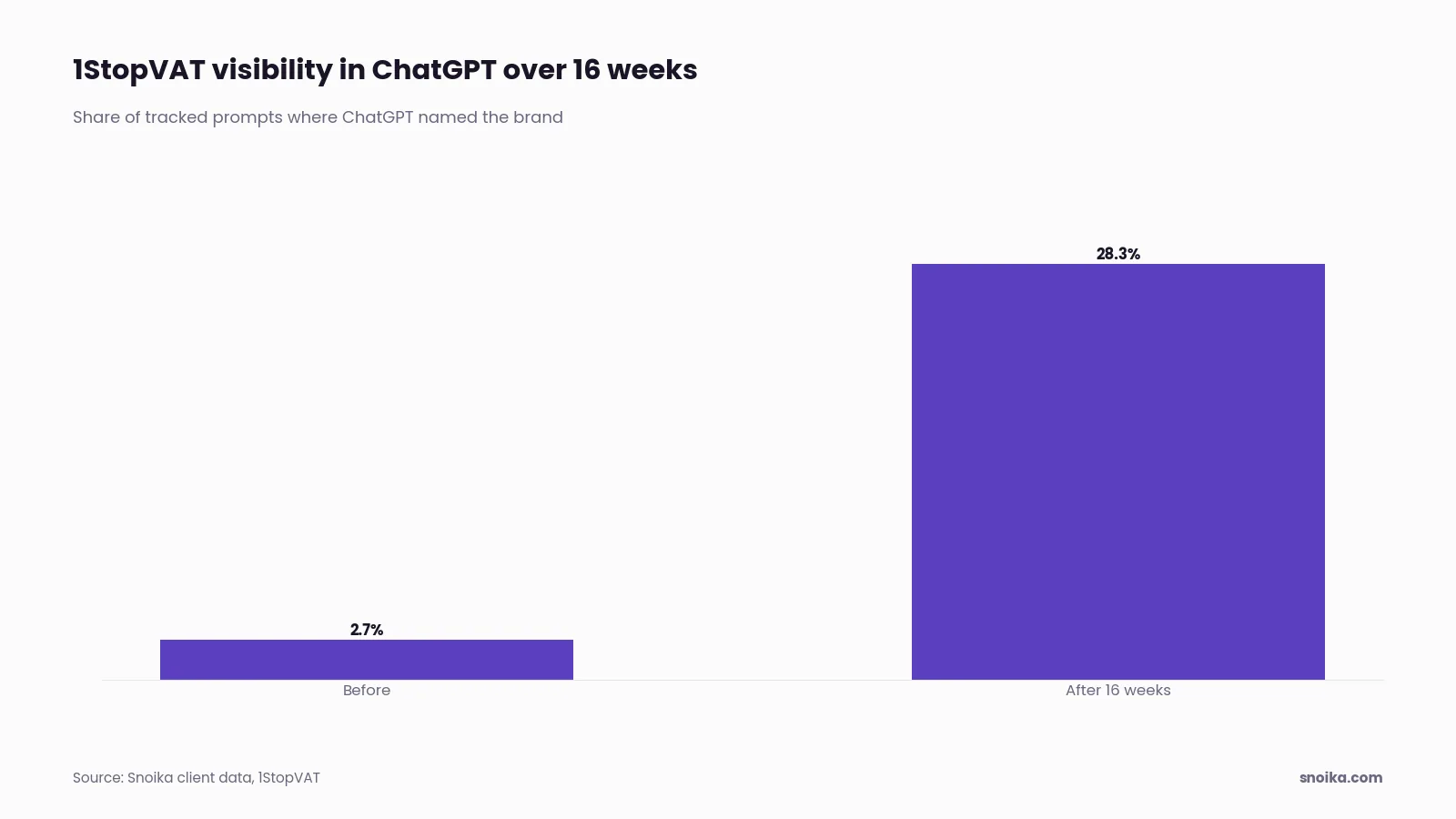
Read an AI ranking report as a trend over several weeks, because a single week can swing on chance alone. If a mention rate moves from 30% to 34% on 25 prompts, that change can be noise. A move from 3% to 28% across 16 weeks is not. Snoika's founder Anton Vedeshin reported to Startup Reporter 1StopVAT's move from 2.7% to 28.3% ChatGPT visibility in 16 weeks. Movement that size shows up even with the variation SparkToro measured.
Start with share of voice, then go down to prompt groups. If your overall rate rises but one group (say, comparison prompts) falls, competitors are winning the buyers closest to a purchase. Next, open the cited sources for the prompts where you're missing. If the same 3 review sites appear again and again, you'll get further by earning a place on them than by rewriting your own pages.
Then read the raw answers for 5 to 10 prompts each month. Scores can hide what an answer actually says, like an outdated price or a feature you retired. Those errors come from somewhere, so trace each one to the source the assistant cited. Finally, connect the report to traffic. GA4 shows referral sessions from chatgpt.com and perplexity.ai, and that's the closest you'll get to proof that AI visibility brings visitors.
How Snoika tracks visibility
Snoika's AI search visibility tool uses weekly prompt sets to track mentions and share of voice in ChatGPT and Google AI Overviews, where most AI search traffic happens. It also measures sentiment and citations in those answers. The weekly cadence follows from the variation described above. A fixed set rerun each week gives a trend line.
During onboarding at the start of each engagement, the team learns about the client's category and buyers as it establishes the client's goals. It asks for access to GA4 and Google Search Console, along with Google Tag Manager. That access lets the team set visibility tracking data next to traffic data, which is the connection the previous section recommends.
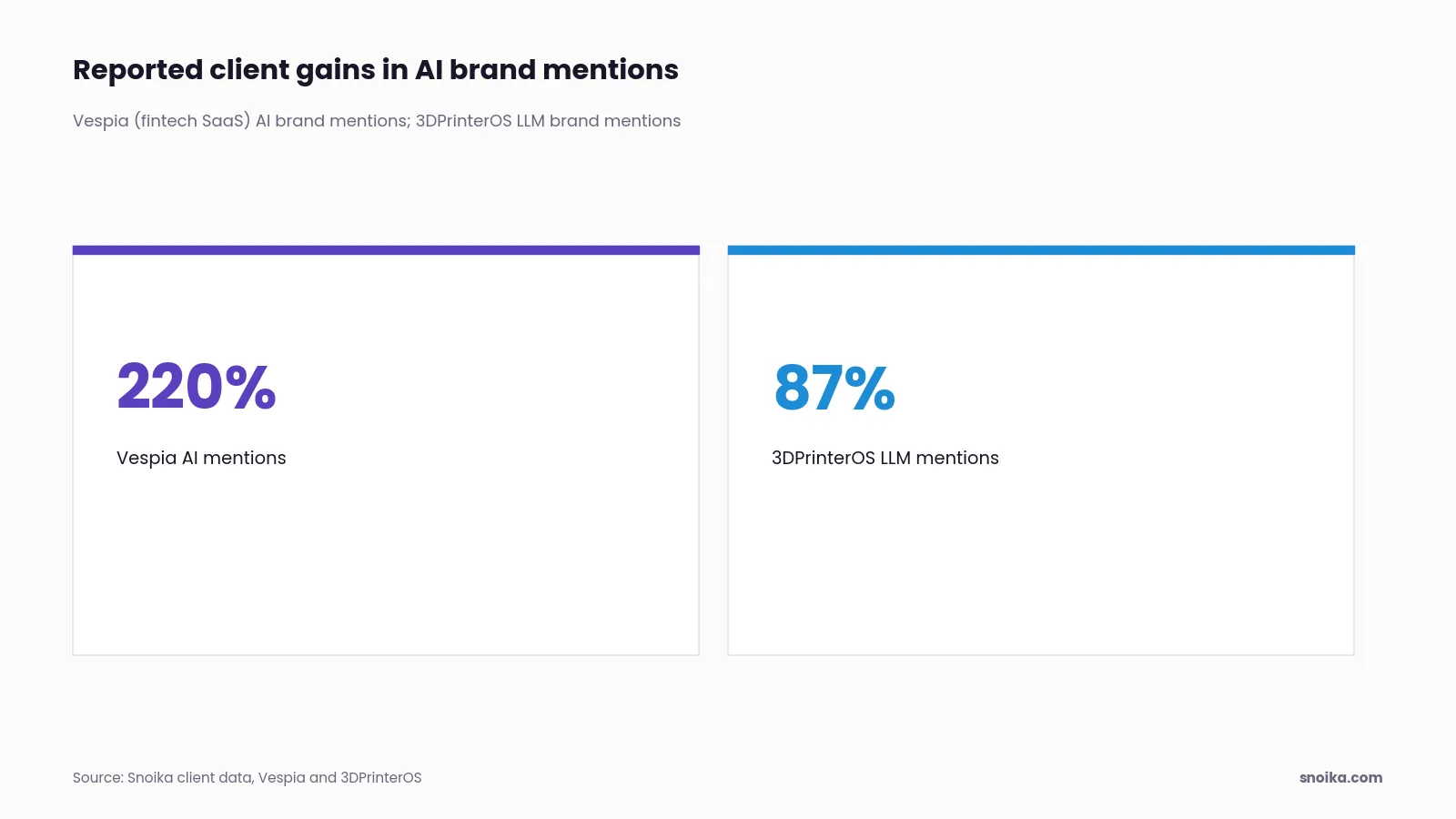
A monthly AI visibility report is included. Subscribers get advanced competitor tracking and a dedicated account manager. Enterprise has custom pricing for multi-brand management, with custom integrations and API access. Booking a call arranges API access, so a team can pull visibility data into its own dashboards. Reported client outcomes include Vespia, a fintech SaaS, which recorded a 220% increase in AI brand mentions, and 3DPrinterOS, which reported an 87% increase in LLM brand mentions.
Checklist before you buy
Run a free grader on your brand this week, then write your 25 core prompts before you open a single pricing page. To choose a plan, count the prompts and multiply that count by your markets and the engines you need. That total tells you which tier fits. Ask each vendor for a raw answer export from a trial run, and compare it with what you see in ChatGPT when you're logged out. An AI rank tracker is only as useful as the answers it records. Snoika runs weekly prompt sets across ChatGPT and Google AI Overviews and reviews the results with you. To see it with your own prompts, Book a demo.
FAQ
For a one-time check, HubSpot’s AI Search Grader is the guide’s recommended free ai rank tracker. It takes about two minutes and needs no account. It doesn’t track changes over time, so ongoing comparisons need a trial that saves results.
Use a tracker that supports AI Overviews to check whether answers mention or cite your brand. Pair those results with Search Console’s generative AI impression report. Keep prompts unchanged for four weeks so you can establish a baseline.
Peec AI reports your average position relative to other brands in tracked answers. HubSpot’s free grader also shows your position against competitors in a single snapshot. Treat position as a supporting measure because the order can change between runs.
Google rank tracking measures where a URL appears in search results. AI tracking measures how often generated answers mention or cite your brand across repeated prompts. Because answers vary, compare mention rates over time rather than treating one answer’s order as a fixed ranking.
Check engine add-on charges and any required base subscription. Then compare plans using the same prompt count across your target markets. Multi-brand reporting or API access can also affect which tier fits, so the entry price may not reflect your requirements.