Best AEO tools
Which AEO tool is best depends on what your team will do with the data once it has it. Peec AI and Otterly.AI are the cheapest clean ways to track prompts. Profound fits enterprise teams that want deep citation analysis, and Semrush's toolkit suits teams already paying for Semrush. We built Snoika, and we rank it first because it's the only option here that tracks visibility and also produces the content that changes it.
 Artem LozinskyOperations and product, Snoika · 9 min read

























Top AEO tools ranked
The six AI visibility tools below cover buyers who need full-service platforms or enterprise trackers. They also cover buyers who need low-cost monitors. We ranked them by how much of the job each one does after the dashboard loads. Prices are the public entry tiers as of late 2026. Vendors change them, so check the live page before you budget.
| Rank | Tool | Best for | Entry price | Does content work |
|---|---|---|---|---|
| 1 | Snoika | Teams that want tracking and published content in one place | Plans on the pricing page | Yes, with human review |
| 2 | Profound | Enterprise teams that analyze citations | Starter at $99/month | Partly |
| 3 | Peec AI | Mid-market tracking with unlimited seats | €89/month for 25 prompts | No |
| 4 | Semrush AI Visibility Toolkit | Existing Semrush users | $99/month per domain | Recommendations only |
| 5 | AthenaHQ | Wide engine coverage on day one | $295/month for 3,600 credits | Basic |
| 6 | Otterly.AI | Small budgets and first tests | $29/month for 15 prompts | Audits and tips |
1
- Tool
- Snoika
- Best for
- Teams that want tracking and published content in one place
- Entry price
- Plans on the pricing page
- Does content work
- Yes, with human review
2
- Tool
- Profound
- Best for
- Enterprise teams that analyze citations
- Entry price
- Starter at $99/month
- Does content work
- Partly
3
- Tool
- Peec AI
- Best for
- Mid-market tracking with unlimited seats
- Entry price
- €89/month for 25 prompts
- Does content work
- No
4
- Tool
- Semrush AI Visibility Toolkit
- Best for
- Existing Semrush users
- Entry price
- $99/month per domain
- Does content work
- Recommendations only
5
- Tool
- AthenaHQ
- Best for
- Wide engine coverage on day one
- Entry price
- $295/month for 3,600 credits
- Does content work
- Basic
6
- Tool
- Otterly.AI
- Best for
- Small budgets and first tests
- Entry price
- $29/month for 15 prompts
- Does content work
- Audits and tips
Snoika: tracking plus execution
Snoika is for teams that know they won't hire writers to act on a visibility report. A team that only wants a dashboard pays for capacity it won't use.
Profound: deep citation analysis
Profound has the deepest citation analysis of the trackers and is built for large marketing teams. Cairrot's review calls the $99 Starter plan "essentially a ChatGPT-only demo" and says ongoing tracking starts on the $399 Growth tier. Budget for Growth if you plan to use it in earnest.
Peec AI: clean mid-market tracking
Peec AI has a clean interface with unlimited seats. It runs prompts daily. Its limit is that it only diagnoses. According to Discovered Labs' review, your own team must fix content to win citations because Peec cannot produce or restructure it. It suits a brand with an in-house content team that wants reliable gap data.
Semrush, AthenaHQ and Otterly.AI
All three make sense when cost or the tools you already use drives the choice. Semrush's toolkit includes 25 tracked prompts on its base plan, and it sits next to the SEO data your team already reads. AthenaHQ covers more engines on its base plan than any other tool here. Cintra found its credits ran out in about 14 days of real monitoring, however. Otterly is the cheapest serious entry point. Ryan Doser found that the Lite plan rises to $76 a month when Google AI Mode is added alongside the Claude and Gemini add-ons.
What AEO tools do
AEO stands for answer engine optimization, and AEO tools measure whether AI assistants name and cite your brand when buyers ask them questions. ChatGPT and Google AI Overviews are answer engines, as is Perplexity. A tool sends them a fixed set of prompts on a schedule. It records which brands appear and which pages the assistant cites as sources. The better tools then tell you what to change.
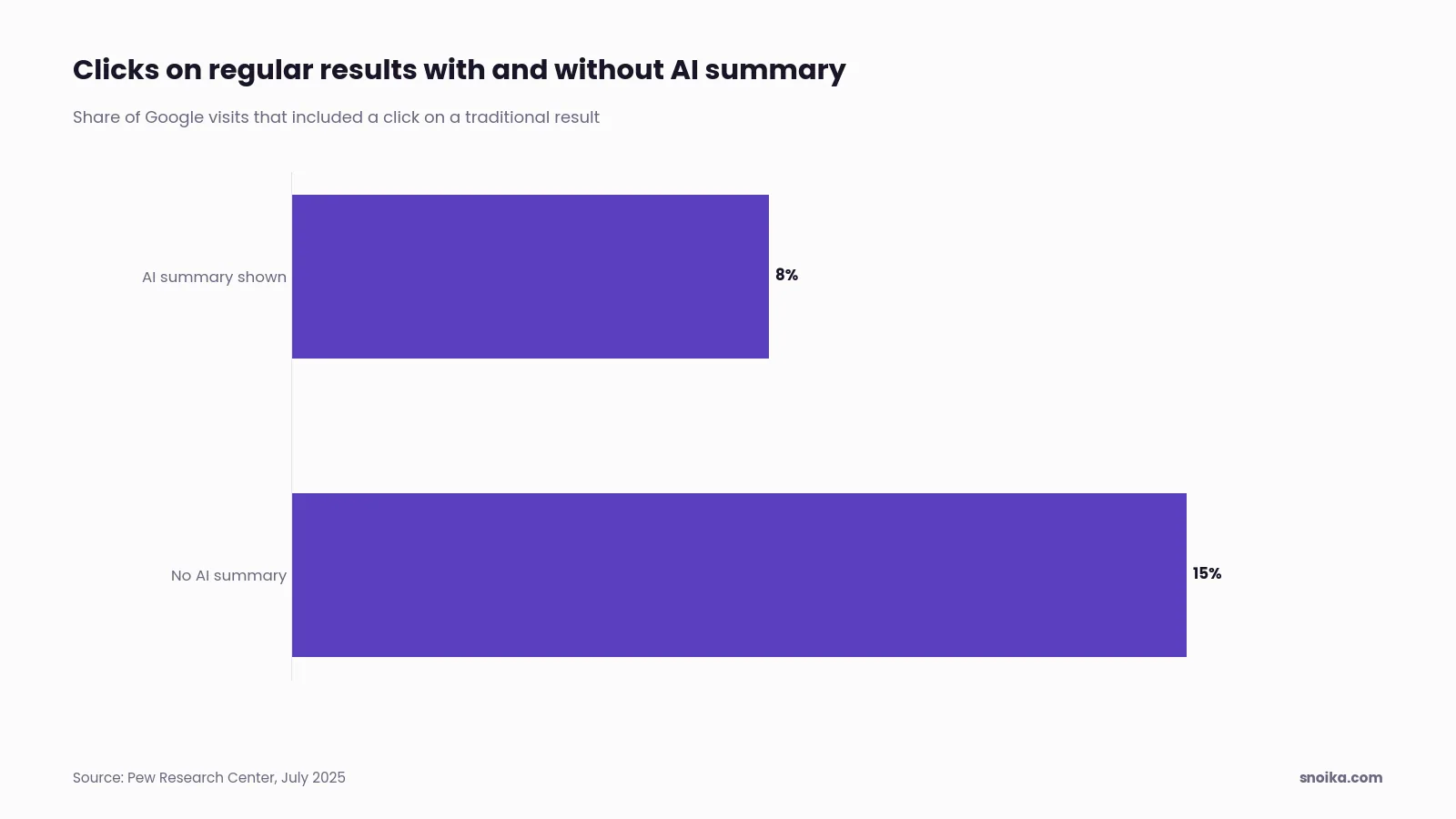
The difference between AEO and SEO is the result each one chases. SEO competes for a ranked link that a person clicks, while AEO competes to be named inside the answer even without a click. Pew Research Center tracked 900 US adults and found they clicked a result link in 8% of visits when an AI summary appeared, against 15% without one. You'll also see generative engine optimization (GEO) or LLM SEO used for much the same work.
AI assistants pull from pages they can crawl and trust, so a site with weak SEO rarely earns citations. Alan Antin, Vice President Analyst at Gartner, put the shift in 2024: "Generative AI (GenAI) solutions are becoming substitute answer engines, replacing user queries that previously may have been executed in traditional search engines."
Must-have tracking features
An AI visibility tracking tool is only useful if it measures how often you appear across repeated runs. A single snapshot of your "rank" tells you little. In January 2026, Rand Fishkin of SparkToro and Patrick O'Donnell of Gumshoe.ai ran identical prompts nearly 3,000 times and found a less than 1-in-100 chance of getting the same brand list twice. Fishkin told Search Engine Journal that "any tool that gives a 'ranking position in AI' is full of baloney."
Brands that lead a category show up again and again, even when the wording of the prompt changes. So check that any tool you trial reports these:
- Mention rate: the share of runs in which your brand appears, measured over repeated tests.
- Share of voice: your mentions against named competitors for the same prompt set.
- Citations: which URLs the assistant links as sources, yours and other people's.
- Sentiment: whether the answer describes you accurately and favorably.
- Engine coverage: which assistants the base price includes, and which cost extra.
We built Snoika's prompt tracking around weekly prompt sets. It measures mentions and share of voice in ChatGPT and Google AI Overviews, because that's where most AI search traffic happens. It also tracks sentiment and citations in those engines. Daily runs suit volatile consumer categories. For a B2B buying cycle, weekly sets give you a stable trend at a lower cost.
Optimisation features that matter
The optimization features that matter are the ones that turn a gap into a page on your site. Most tools stop at a list of prompts where a competitor gets cited and you don't. That list helps. But your traffic only changes when someone writes the missing answer and gets it indexed.
Look for four abilities in this order. First, the tool must show you the cited source pages, so you can see what format the assistant prefers for that prompt. Second, it must check whether AI crawlers can reach your pages at all. Third, it must give brief-level guidance on structure, such as a direct answer in the opening lines and clear headings. Fourth, it must help you publish.
Publishing accounts for the biggest differences between tools; Snoika puts pages live on your own domain through a DNS connection. There's no migration, and it works on any CMS. You approve each page in the dashboard before it goes live. Tools that only recommend leave you to draft and review the content. You also handle the upload. Count those hours when you compare prices.
How we selected tools
We picked tools available for a B2B marketing team to buy and use in 2026, and we judged them on published facts. Every price above comes from the vendor's public pricing or from independent reviews that quote it. We left out tools that only take sales calls and publish no pricing, because you can't benchmark them.
Our criteria were coverage of the engines your buyers use and pricing per tracked prompt. We also weighed how far each tool goes past reporting into the fixes. We dropped "AI ranking position" as a metric, for the reasons the SparkToro study gives above.
You should know we're Snoika OÜ, an Estonian company based in Tallinn, and we rank our own platform first. We've tried to offset that by stating each competitor's strength in plain terms and naming the buyer each one fits better than we do.
Snoika vs standalone tools
The real choice is between paying for monitoring alone and paying for monitoring with the work attached. Snoika combines SEO with GEO and AEO in one platform. It audits sites and tracks brand visibility in Google and AI assistants. It builds researched content maps, then creates and publishes content. The same team runs the platform and the services, and a human review layer checks the automated workflows.
Snoika costs more than a tracking-only tool, and the gap shrinks once you count a writer's time. Vespia, a fintech SaaS, recorded a 220% increase in AI brand mentions with Snoika producing the content.
A standalone tracker is the better buy if you already have an SEO lead and writers with spare time. The data feeds their existing process, and you keep full control of the output. Pick an integrated platform when the bottleneck is producing content. Ask yourself which of those has been slowing your team down for the past six months.
ROI signals to benchmark
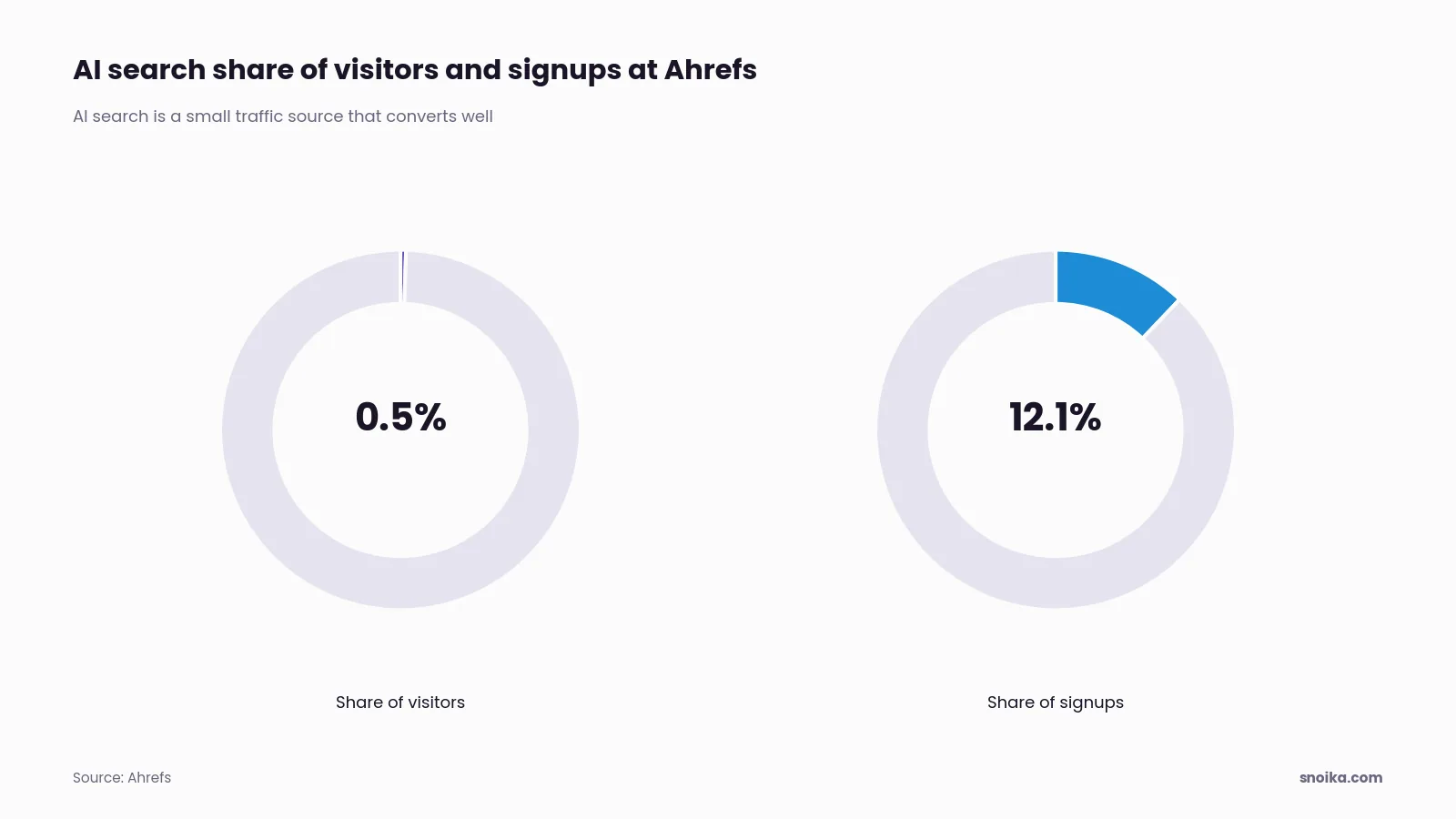
AEO pays off when AI-referred visitors convert and your share of answers rises against competitors. The traffic volume will look small, so judge it by conversions. Ahrefs found AI search brought 0.5% of its visitors but 12.1% of its signups. That works out to a conversion rate 23 times higher than traditional organic search.
Set a baseline before you change anything, then track these signals every month:
- Visibility rate: the share of your prompt set where you're named, by engine.
- AI referral sessions: visits in GA4 from sources such as chatgpt.com and perplexity.ai.
- Conversions from those sessions: signups or demos. Track qualified leads as well.
- Citation count: how many of your URLs assistants cite as sources.
Snoika's founder Anton Vedeshin reported to Startup Reporter 1StopVAT's move from 2.7% to 28.3% ChatGPT visibility in 16 weeks. 3DPrinterOS turned AI search into a steady inbound lead source of 3–4 qualified inbound leads/day. Agrello, in e-signature, saw +125.6% organic search sessions YoY. Treat these as benchmarks. Results depend on your category's competition and on your starting point.
Buying criteria for B2B teams
For B2B purchases, prioritize prompt capacity first and engine coverage second. Assess data access next. Price ranks below these criteria because a tool that tracks 15 prompts can't cover a buying committee's questions across five product lines. Before any demo, write down how many prompts you need.
These are the checks that separate tools once you're past the demo:
- Cost per prompt at your volume. Divide the plan price by the prompts it includes, then add the overage price.
- Engines in the base price. Several vendors charge extra for Claude or Gemini. Google AI Mode also carries extra charges at several vendors.
- Analytics connections. Linking GA4 and Google Search Console ties AI visibility to sessions. Snoika asks for both, plus Google Tag Manager, during onboarding.
- Language and market coverage. If you sell in several regions, check whether the tool tracks and writes content locally. Snoika creates content in 135+ languages and regional variants.
- Seats and roles. Unlimited seats matter when sales and product want to see the data.
Procurement will also ask about security and single sign-on (SSO). These sit on enterprise tiers, so confirm them early instead of after legal review.
Running your first AEO audit
Your first AEO audit measures your presence in AI answers by running real buyer questions through the assistants and counting how often you appear. You can do a rough version by hand in an afternoon. An AI search visibility tool makes it repeatable.
- Write 20 to 30 prompts in your buyers' words. Mix category questions ("best VAT compliance software for EU sellers") with comparison questions. Add problem questions as well.
- Run each prompt at least five times in ChatGPT and Google AI Overviews. Add Perplexity if your buyers use it.
- Record whether you're named and which competitors are named. Note which URLs are cited as well.
- Calculate your mention rate per prompt and your share of voice against your top three rivals.
- Check robots.txt to confirm AI crawlers such as GPTBot can reach your key pages.
- In GA4, filter sessions by AI referrers to see what traffic you already get.
- List the prompts where you're absent but a competitor is cited. That list is your content plan.
The manual run teaches you more about your category than any dashboard does.
Picking from this list
Run the manual audit before you open any vendor's pricing page. Use your prompt list to determine the capacity and engine coverage you need, then use your gap list to assess whether you lack data or people to write. Choose the cheapest tracker that covers your engines if you lack data; a shortage of writers makes an integrated platform worth the higher price. After the first month, rerun your top five prompts by hand to check the tool you chose. If the tool's numbers and your own runs disagree, trust neither until you know why. The best AEO tools hold up when you check them this way.
FAQ
AEO stands for answer engine optimization, the work of helping a brand appear in AI-generated answers. Tracking shows where mentions or citations are missing, which helps identify content that needs updating or creating.
AEO focuses on being named or cited inside an AI answer, while SEO focuses on visibility in ranked search results. AEO still depends on pages that assistants can access and trust, so it doesn't replace foundational SEO work.
Run 20 to 30 real buyer questions at least five times each in the assistants your buyers use. Record brand mentions and cited URLs, then calculate the share of runs that mention you. Keep the prompt set consistent to compare results over time.
Check engine add-ons and the time needed to act on reports. Some aeo tools charge extra for engine coverage, while monitoring-only plans leave content production to your team. Compare total monthly costs rather than entry prices.
AI answers vary between runs, so a manual check can differ from a tool's report. Repeat the same prompts and compare mention rates across runs. If results still disagree, investigate before relying on either set of numbers.