
AI writing patterns report: how eight telltale patterns disappeared from Snoika content
Snoika's content evaluator scored 666 articles written with Snoika, from our first articles to autumn 2026, against sixteen AI writing patterns and eighteen text measures. Average quality rose from 58.5 to 82.3 out of 100. Rule-of-three series fell from 20.4 to 3.7 per article. Em dashes dropped from 3.1 per article to 0. These figures are for editors and researchers who need counted, citable data on AI writing tells.
 Anton VedeshinFounder, Snoika · 15 min read · updated 2026Statistics verified by Snoika























Method
We scored 666 finished articles written with Snoika with one evaluator and one formula, then grouped them into four periods by date. The first two periods cover our first articles (32) and articles from before April 2026 (32). The later periods cover spring and summer 2026 (486) and autumn 2026 (116). The groups are uneven in size. Each figure in this report carries its period, so you can always see how many articles stand behind it.
Every article, even the oldest, was rescored with the current formula. This was the most important methodological decision because scores retained from an older formula would leave the cause of a later rise unclear: a change in the scoring rules or a change in the writing. Because one formula covers all 666 articles, the periods compare like for like.
An AI judge reads each finished article and counts every instance of each pattern. It works from written definitions with example triggers. We report counts in two ways, per article and per 1,000 words. You need both because later articles cover more page types and lengths, and a long article collects more hits simply by being long. Per 1,000 words, a 3,000-word guide and an 800-word page sit on the same footing.
The data describe general content quality only. There are no client names in it, and we didn't split results by client. If you reuse a figure, quote it with its period and sample size. A number like 82.3 means little without "116 articles, autumn 2026" next to it.
What counts as a pattern
An AI writing pattern is a phrasing habit that language models repeat far more often than people do. The key word is frequency. A human writer uses an em dash or a list of three now and then, and nobody notices. A model will use the same device in every paragraph, and that repetition is what readers learn to spot as a tell.
Snoika checks sixteen patterns. This report follows eight of them in detail, one section each, because those eight have the clearest record across all four periods. The remaining checks identify other recognisable habits of generated text.
Each pattern has a written definition and a set of example triggers. That's what makes the count repeatable. "Sounds robotic" is an opinion that two editors will apply differently. "A negation tacked onto the end of a sentence, such as ', no surprises'" is a rule the judge applies the same way to article 1 and article 666. If you want AI writing patterns examples for training your own editors, the definitions in each section below work as a starting checklist.
How quality is scored
The quality score combines two sub-scores, one for text measures and one for pattern hits, and gives the pattern side 75% of the weight. Both sub-scores start from penalty points. A text measure outside its human range adds one point. Each pattern hit adds at least one. Points are then divided by article length, so the score reflects how dense the problems are and not how long the article is.
Text measures and their human ranges
Eighteen linguistic measures feed the text sub-score. Snoika's linguists set the human range for each one from human-written reference text. An article inside the range on a measure gets no point for it, whatever its exact value.
| Group | Measure | What it counts | Human range |
|---|---|---|---|
| Rhythm | Burstiness | Standard deviation of sentence length in words | 5 to 10 |
| Rhythm | Sentence length variance | Spread of sentence lengths | 30 to 100 |
| Rhythm | Paragraph length | Average words per paragraph | 35 to 60 |
| Vocabulary | Type-token ratio | Unique words divided by all words | 0.40 to 0.55 |
| Vocabulary | Hapax ratio | Words used exactly once divided by all words | 0.25 to 0.40 |
| Vocabulary | Repeated word pairs | Pairs used three or more times | At most 17 per 1,000 words |
| Vocabulary | Repeated three-word phrases | Phrases used twice or more | At most 7 per 1,000 words |
| Grammar | Nominalization | Share of verbs turned into nouns (-tion, -ment, -ness, -ity) | 1.0% to 3.9% |
| Grammar | Pronoun-noun ratio | Pronouns against longer content words | 0.06 to 0.12 |
| Grammar | Single-clause sentences | Share of all sentences | 20% to 50% |
| Grammar | Complex sentences | Share with two or more clauses | 35% to 65% |
| Openers | Opener variety | Different first words divided by sentences | 0.55 to 0.80 |
| Openers | AI-style openers | Sentences that open with the, this, these, it, in, when, as, for or by | At most 22% |
| Connectives | Contrast words | However, although, yet, despite | 3 to 10 per article |
| Connectives | Cause words | Because, since, therefore, as a result | 4 to 14 per article |
| Argument arc | Sentiment balance | Positive against negative wording per word | 0 to 0.08 |
| Tense | Tense shifts | Changes of tense from one sentence to the next | At least 18 per article |
| Tense | Tense consistency | Share of the main tense | 55% to 70% |
Rhythm
- Measure
- Burstiness
- What it counts
- Standard deviation of sentence length in words
- Human range
- 5 to 10
Rhythm
- Measure
- Sentence length variance
- What it counts
- Spread of sentence lengths
- Human range
- 30 to 100
Rhythm
- Measure
- Paragraph length
- What it counts
- Average words per paragraph
- Human range
- 35 to 60
Vocabulary
- Measure
- Type-token ratio
- What it counts
- Unique words divided by all words
- Human range
- 0.40 to 0.55
Vocabulary
- Measure
- Hapax ratio
- What it counts
- Words used exactly once divided by all words
- Human range
- 0.25 to 0.40
Vocabulary
- Measure
- Repeated word pairs
- What it counts
- Pairs used three or more times
- Human range
- At most 17 per 1,000 words
Vocabulary
- Measure
- Repeated three-word phrases
- What it counts
- Phrases used twice or more
- Human range
- At most 7 per 1,000 words
Grammar
- Measure
- Nominalization
- What it counts
- Share of verbs turned into nouns (-tion, -ment, -ness, -ity)
- Human range
- 1.0% to 3.9%
Grammar
- Measure
- Pronoun-noun ratio
- What it counts
- Pronouns against longer content words
- Human range
- 0.06 to 0.12
Grammar
- Measure
- Single-clause sentences
- What it counts
- Share of all sentences
- Human range
- 20% to 50%
Grammar
- Measure
- Complex sentences
- What it counts
- Share with two or more clauses
- Human range
- 35% to 65%
Openers
- Measure
- Opener variety
- What it counts
- Different first words divided by sentences
- Human range
- 0.55 to 0.80
Openers
- Measure
- AI-style openers
- What it counts
- Sentences that open with the, this, these, it, in, when, as, for or by
- Human range
- At most 22%
Connectives
- Measure
- Contrast words
- What it counts
- However, although, yet, despite
- Human range
- 3 to 10 per article
Connectives
- Measure
- Cause words
- What it counts
- Because, since, therefore, as a result
- Human range
- 4 to 14 per article
Argument arc
- Measure
- Sentiment balance
- What it counts
- Positive against negative wording per word
- Human range
- 0 to 0.08
Tense
- Measure
- Tense shifts
- What it counts
- Changes of tense from one sentence to the next
- Human range
- At least 18 per article
Tense
- Measure
- Tense consistency
- What it counts
- Share of the main tense
- Human range
- 55% to 70%
Several of these measures describe common AI sentence structure better than any single pattern does. Generated text repeats sentences of the same length and the same subject-first opening. It also sticks to one tense, and burstiness, opener variety and tense shifts catch exactly that.
Pattern points and weights
Each pattern hit adds one point, and the more serious patterns carry extra weight. A vague attribution counts twice, because an unsourced claim damages trust more than a stray intensifier does. A text locked in one perspective adds ten points at once. That weight reflects what perspective lock is. It describes the whole article, and a reader feels it across every paragraph.
How the two sub-scores combine
The text-measure sub-score is 100 / (1 + density / 24). The pattern sub-score is 100 / (1 + density / 70). In each case, density means that side's points per 1,000 words. The quality score is 25% of the first plus 75% of the second, on a 0 to 100 scale. Both curves halve the sub-score when density reaches the constant. So 24 text points per 1,000 words gives a text sub-score of 50, and 70 pattern points per 1,000 words gives a pattern sub-score of 50. Neither sub-score ever reaches zero.
Take a 1,523-word article with ten measures out of range and 45 pattern points. Its text density is 6.57 points per 1,000 words, which gives a text sub-score of 78.5. Its pattern density is 29.5, which gives a pattern sub-score of 70.3. Weighted together, the article scores 72.4. A reduction of 15 pattern points would move that article's score further than fixes to three text measures, because the pattern side carries three times the weight.
Quality over time
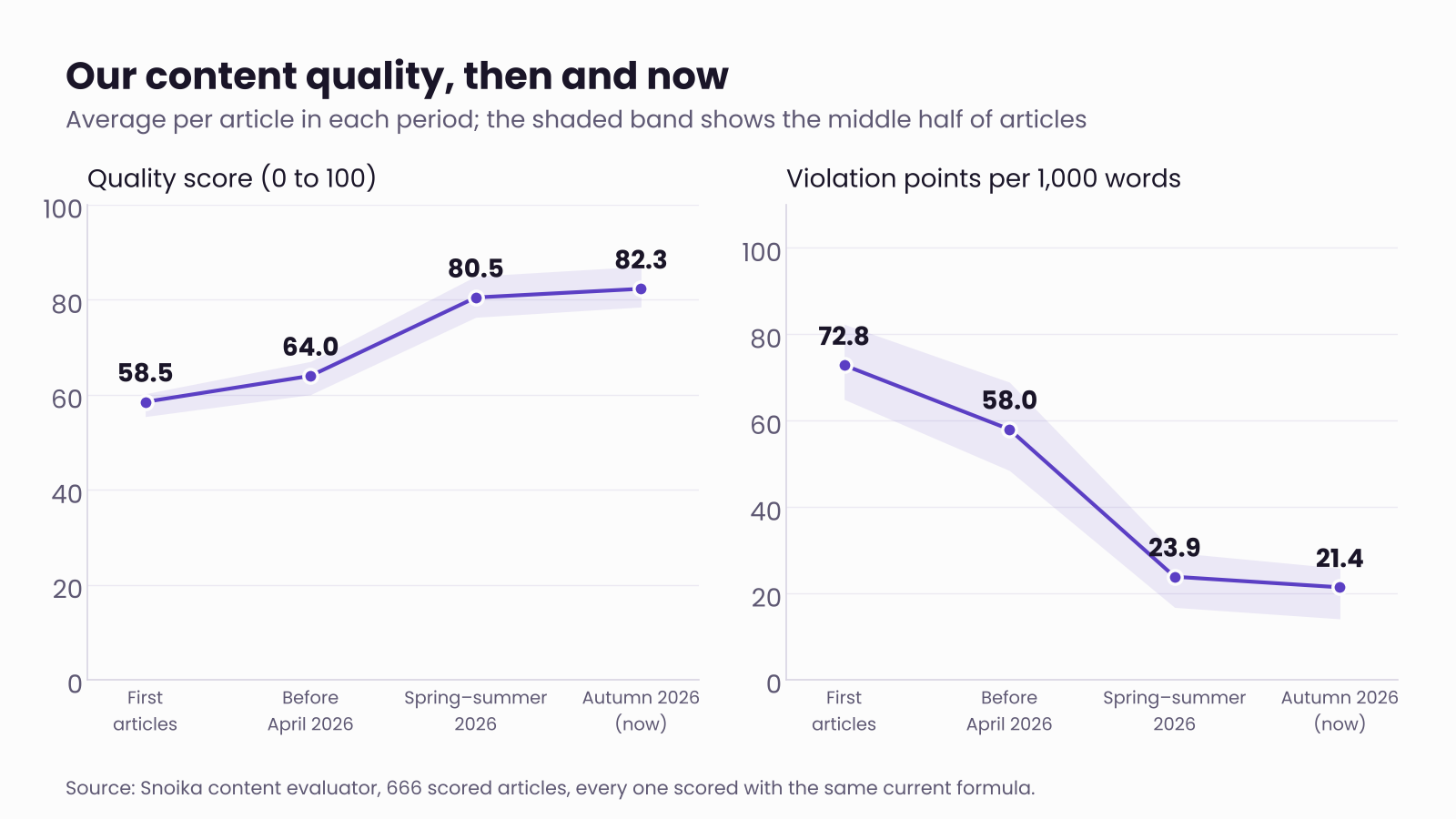
Average quality rose from 58.5 in our first articles to 82.3 in autumn 2026, and violation density fell from 72.8 to 21.4 points per 1,000 words. Violation density here means all points per 1,000 words, text measures and patterns together. The table sets the four periods side by side.
| Period | Articles | Average quality score | Violation density (points per 1,000 words) | Share scoring 80 or more |
|---|---|---|---|---|
| First articles | 32 | 58.5 | 72.8 | 0% |
| Before April 2026 | 32 | 64.0 | 58.0 | 0% |
| Spring and summer 2026 | 486 | 80.5 | 23.9 | 55% |
| Autumn 2026 | 116 | 82.3 | 21.4 | 72% |
First articles
- Articles
- 32
- Average quality score
- 58.5
- Violation density (points per 1,000 words)
- 72.8
- Share scoring 80 or more
- 0%
Before April 2026
- Articles
- 32
- Average quality score
- 64.0
- Violation density (points per 1,000 words)
- 58.0
- Share scoring 80 or more
- 0%
Spring and summer 2026
- Articles
- 486
- Average quality score
- 80.5
- Violation density (points per 1,000 words)
- 23.9
- Share scoring 80 or more
- 55%
Autumn 2026
- Articles
- 116
- Average quality score
- 82.3
- Violation density (points per 1,000 words)
- 21.4
- Share scoring 80 or more
- 72%
The largest step comes between the second and third periods, when the average jumped from 64.0 to 80.5. That's the period when the first dedicated pattern checks went live, and five of them were in place by June 2026. The move from spring and summer to autumn is smaller, 1.8 points on the average. Gains shrink at the top. The patterns left in autumn are the ones that resist automatic fixes, and the next sections show which they are.
Article by article, the 30-article rolling average rose from 58.1 to 82.8. The rolling view shows that the rise extended beyond a handful of strong articles.
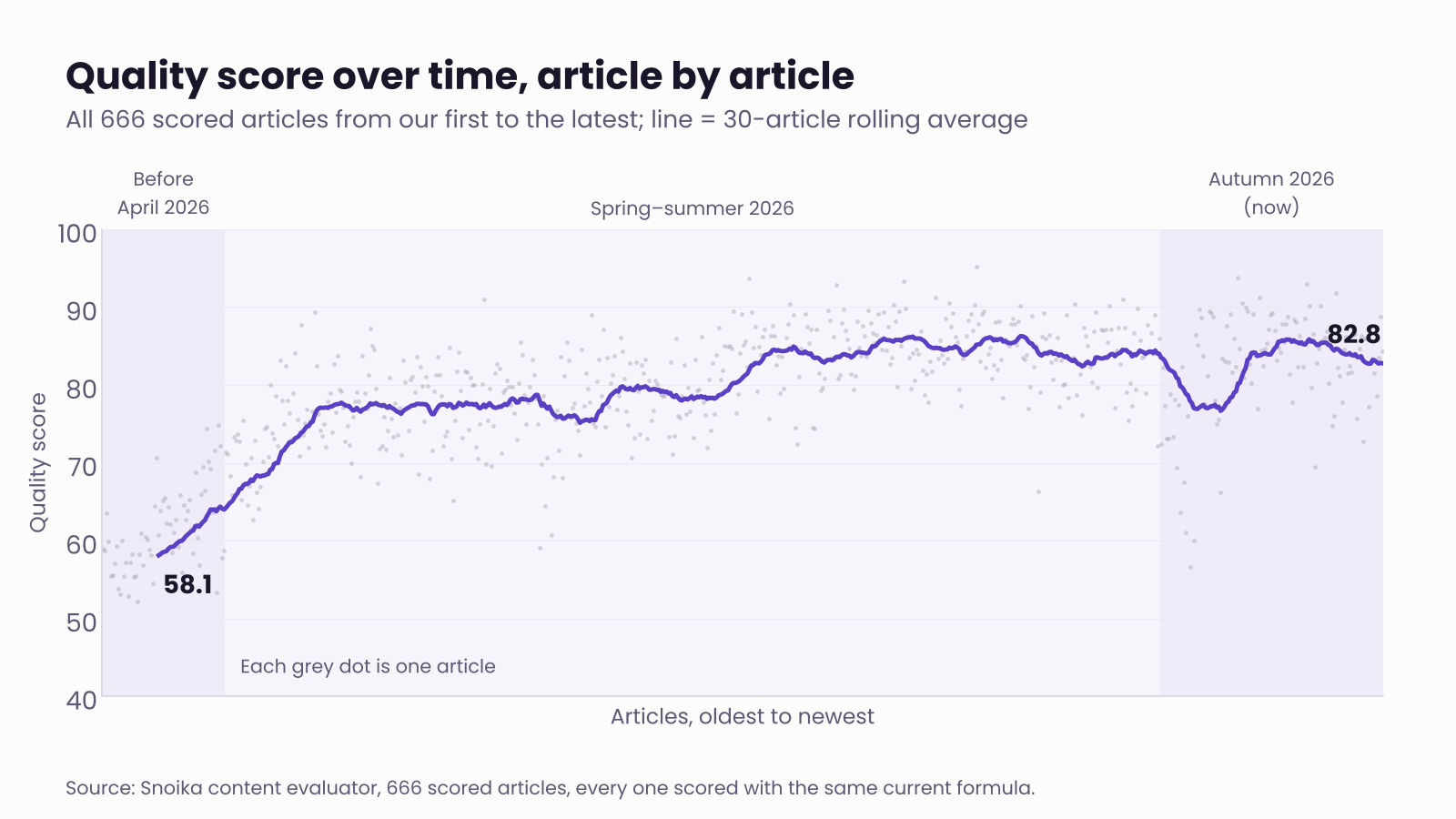
If you judge consistency, look at the share of articles scoring 80 or more before you look at the average. An average of 82.3 leaves the spread unspecified. A share of 72% tells you that close to three in four autumn articles clear the bar.
Rule of three
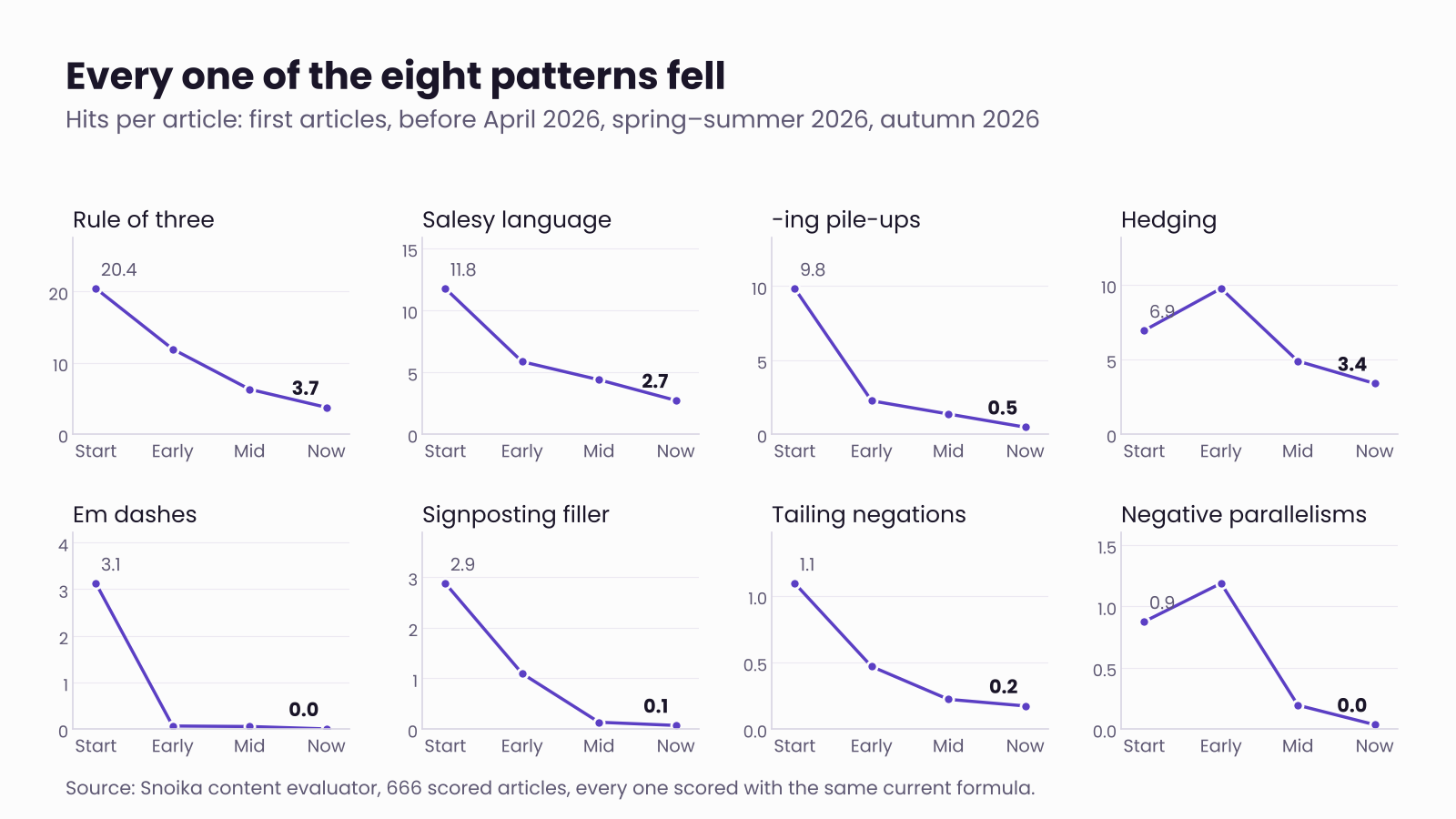
Articles in our first batch held 20.4 rule-of-three series each on average, and an autumn 2026 article holds 3.7. A series here means exactly three items. The count fell in every period, first from 20.4 to 11.9. It then dropped to 6.3 before it reached 3.7. Per 1,000 words it dropped from 13.9 to 1.95.
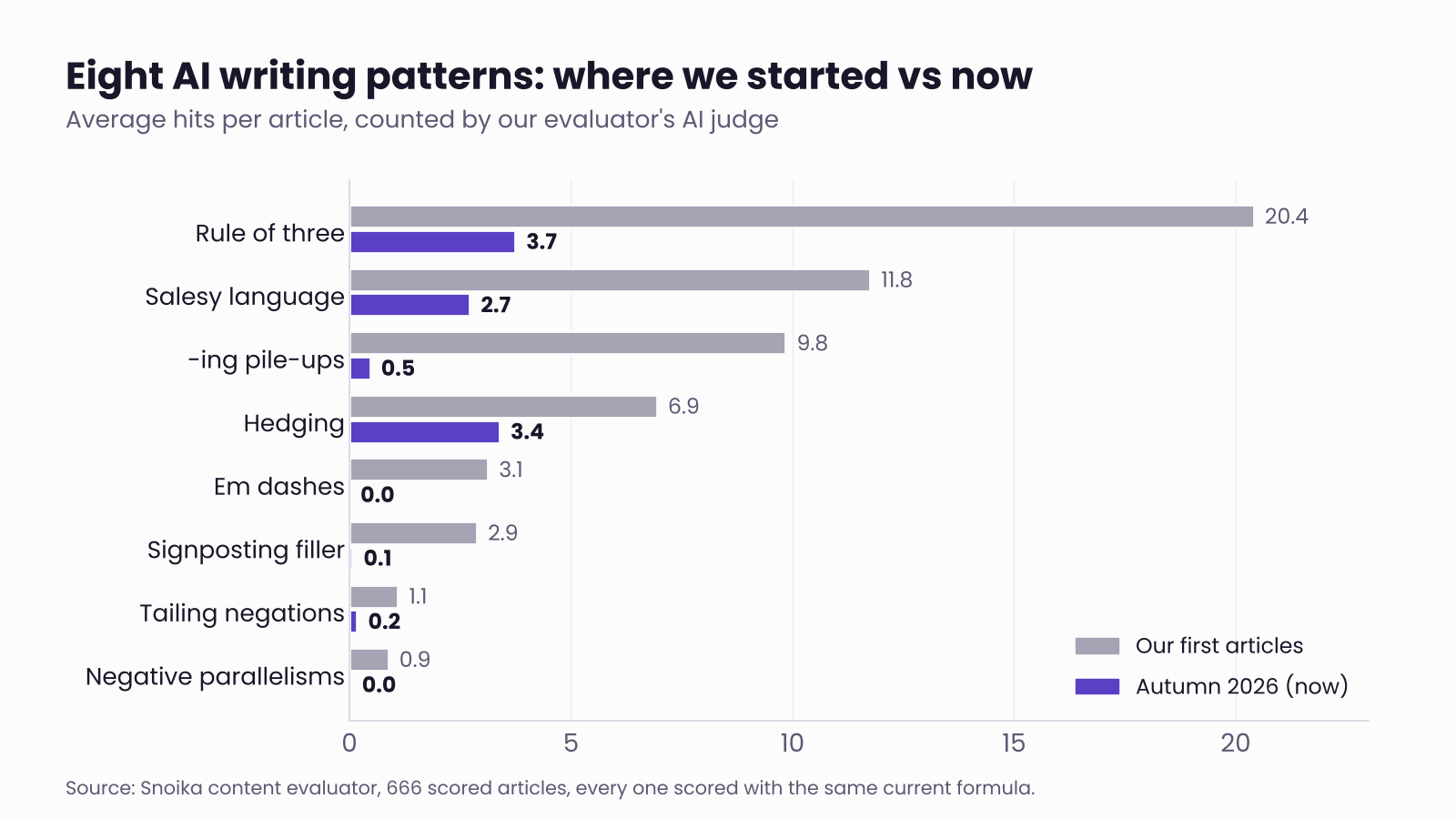
So the pattern fell steeply, yet it's still the most frequent one left. Only 8% of autumn articles contain no three-item series at all, up from 0% at the start. A dedicated rule-of-three check has been in place since June 2026, and the writing rules forbid three-item series outright.
The pattern survives both controls because triplets are everywhere in ordinary writing, and models reach for them by default. Three adjectives sound complete. Three clauses give a sentence a cadence. A rewrite that breaks one series creates another two lines later because the model that fixes the sentence carries the same habit as the model that wrote it. The pattern also hides in places a reader doesn't see as a list, such as three verbs in a row or three prepositional phrases.
When you edit your own drafts, search for the comma and "and" combination and count the items each time. Keep two of them or move the third into its own sentence. One triplet on a page is harmless, but twenty make a recognisable fingerprint.
-ing pile-ups
Pile-ups of -ing phrases fell from 9.8 per article in our first articles to 0.5 in autumn 2026. The pattern covers -ing phrases tacked onto a sentence, such as "highlighting the importance of" or "showcasing the potential of". The count first fell from 9.8 to 2.3. It then dropped to 1.4 before it reached 0.5. Per 1,000 words, it fell from 6.7 to 0.23.
The zero-hit figure shows how complete the change is. No first article was free of -ing pile-ups. In autumn 2026, 72% of articles contain none.
These phrases are a tell because they add a claim without a subject. When "highlighting the importance of planning" follows "The new policy cuts costs", the sentence asserts that something highlights something without identifying who does it. The phrase sounds like analysis while it carries no information a reader can check. Models use it to stretch a plain sentence into one that seems more thoughtful.
Give the claim a doer and a verb, or delete it. "The new policy cuts costs. The finance team planned it for a year" says more in fewer words. A dedicated -ing check was running by June 2026.
Em dashes
Em dash counts fell from 3.1 per article in our first articles to 0.06 before April 2026. The count held at 0.05 in spring and summer before it reached 0 in autumn 2026. Per 1,000 words the figure went from 2.15 to 0. Only 9% of our first articles had no em dash. Every autumn article has none.
Most of the drop happened before April 2026, months before the dedicated pattern checks were in place in June. The writing rules forbid em dashes, and an em dash is a single character, so a rule against it is unambiguous. The model either writes the character or it doesn't. Detection is just as plain, which is why this is the one pattern that reached 100% zero-hit articles.
Em dashes aren't wrong in human writing. Editors and novelists use them well. They became an AI tell through volume, because models use them for every aside and every dramatic pause. Three per article, across a site of hundreds of pages, makes a visible signature.
When you remove them by hand, choose the replacement by what the dash was doing. An aside becomes a pair of commas or parentheses. A dramatic pause before a point becomes a full stop and a new sentence.
Signposting filler
Signposting filler fell from 2.9 phrases per article in our first articles to 0.07 in autumn 2026. These phrases, such as "let's dive into" and "it's worth noting", announce a point before they state it. Across the first two periods, the count fell from 2.9 to 1.1. It reached 0.13 in the third period and 0.07 in the fourth. Per 1,000 words, the drop is from 1.89 to 0.03, and the share of articles with none rose from 41% to 94%.
A phrasing check for signposting arrived in September 2026. Yet the count had already reached 0.13 by spring and summer, so the writing rule did most of the work before the check existed. A plain prohibition works well on fixed phrases, and a detector catches the variants a rule doesn't name.
Signposting hurts because it delays the point. "It's worth noting that the study had limits" makes the reader process five words before the claim starts. Delete the phrase and the sentence almost always stands on its own: "The study had limits." If it doesn't, the sentence had no point to signpost.
Negative parallelisms
Negative parallelisms fell from 0.9 per article in our first articles to 0.03 in autumn 2026, after a rise to 1.2 before April 2026. The pattern covers constructions that introduce an affirmation through a preceding negation. The count dropped from 1.2 to 0.19 in spring and summer. It reached 0.03 in autumn. Per 1,000 words, it went from 0.60 to 0.02.
This pattern was never frequent, and 47% of our first articles had none. In autumn 2026 that share is 97%. But a low count doesn't mean low impact. A single sentence that rejects the label "product" in favour of "movement" is enough for a reader to recognise generated copy, because the construction is so closely tied to AI output.
The rise before April 2026 is worth a note. Other patterns were falling in that period, and negative parallelisms went the other way. Our data don't show why. They show that the count fell sharply once the dedicated check was in place by June 2026.
To fix one by hand, keep the positive half and drop the contrast. A sentence that contrasts speed with accuracy becomes a direct statement about accuracy, with the evidence for it.
Tailing negations
Tailing negations fell from 1.1 per article in our first articles to 0.17 in autumn 2026. The pattern is a clipped negation tacked onto the end of a sentence, such as ", no guessing" or ", no surprises". The count first fell from 1.1 to 0.5. It then dropped to 0.22 before it reached 0.17. Per 1,000 words, it dropped from 0.73 to 0.08.
The share of articles with none rose from 56% to 91%. That leaves this as the most stubborn of the rare patterns. Between spring and summer and autumn, the count moved only from 0.22 to 0.17, while negative parallelisms fell by more than five times over the same period.
The fragment survives because it sits comfortably inside product descriptions. "Fixed monthly price, no surprises" reads like ordinary marketing copy, and the line between a tailing negation and a legitimate short phrase is thinner than it is for an em dash. Our judge counts the fragment form only, where a full clause would carry the meaning.
Rewrite it as a real clause with a subject. "The price stays the same each month" tells the reader what happens, where ", no surprises" only tells them what doesn't.
Salesy language
Salesy language fell from 11.8 phrases per article in our first articles to 2.7 in autumn 2026. The pattern covers appeals to peace of mind and prompts that pressure readers to act or promise business growth. The count first fell from 11.8 to 5.8. It then dropped to 4.4 before it reached 2.7. Per 1,000 words it dropped from 8.1 to 1.4.
The per-article count fell by more than three quarters. Even so, only 8% of autumn articles are free of it, the same zero-hit share as rule of three. Salesy language is still present in most articles, and that makes it the third of the patterns that remain.
The difficulty is that a benefit claim and a sales line sit close together. "The tool saves time" describes a feature. "Imagine the hours you'll win back" sells it. Commercial pages have to explain benefits, so the writing can't avoid the subject, and the judge has to decide where description turns into pitch. A detector that flags fixed phrases catches "don't miss out" every time. The detector catches fixed phrases more reliably than softer phrasing.
Ask whether the sentence states a fact a reader can check. If it appeals to a feeling or invents a scene, replace it with the fact behind it.
Hedging
Hedging fell from 6.9 hedges per article in our first articles to 3.4 in autumn 2026, after a peak of 9.8 before April 2026. The pattern counts words such as may and might where a direct statement would fit. After the peak, the count fell to 4.9 in spring and summer. It reached 3.4 in autumn. Per 1,000 words, it went from 4.7 to 1.7.
Hedging is the second most frequent pattern left, and only 18% of autumn articles contain none. That's up from 0%. It's also one of two patterns among the eight that rose in the second period. As other patterns came under control before April 2026, hedges increased. One reading is that a model told to avoid bold, salesy claims softens its statements instead, though the data alone can't confirm that.
Hedging is harder to remove than an em dash because a real hedge is sometimes the honest choice. When the evidence is uncertain, "may" is accurate. The definition counts a hedge only where a direct statement would fit, so the judge has to weigh each one. That judgment will never be as clean as a character count.
For your own drafts, ask one question of every hedge. Check whether you know the claim is true, and state it directly if you do. Otherwise, explain what's unknown and why. That tells the reader more than "potentially" ever will.
Patterns over time
Rule of three led our first articles at 20.4 hits per article. Salesy language ranked next at 11.8. Pile-ups of -ing phrases ranked below salesy language at 9.8. Hedging followed at 6.9. In autumn 2026, rule of three is still first at 3.7. Hedging follows at 3.4, ahead of salesy language at 2.7. The ranking at the top barely changed, while the counts fell sharply.
| Pattern | First articles (32) | Before April 2026 (32) | Spring and summer 2026 (486) | Autumn 2026 (116) |
|---|---|---|---|---|
| Rule of three | 20.4 | 11.9 | 6.3 | 3.7 |
| -ing pile-ups | 9.8 | 2.3 | 1.4 | 0.5 |
| Em dashes | 3.1 | 0.06 | 0.05 | 0 |
| Signposting filler | 2.9 | 1.1 | 0.13 | 0.07 |
| Negative parallelisms | 0.9 | 1.2 | 0.19 | 0.03 |
| Tailing negations | 1.1 | 0.5 | 0.22 | 0.17 |
| Salesy language | 11.8 | 5.8 | 4.4 | 2.7 |
| Hedging | 6.9 | 9.8 | 4.9 | 3.4 |
Rule of three
- First articles (32)
- 20.4
- Before April 2026 (32)
- 11.9
- Spring and summer 2026 (486)
- 6.3
- Autumn 2026 (116)
- 3.7
-ing pile-ups
- First articles (32)
- 9.8
- Before April 2026 (32)
- 2.3
- Spring and summer 2026 (486)
- 1.4
- Autumn 2026 (116)
- 0.5
Em dashes
- First articles (32)
- 3.1
- Before April 2026 (32)
- 0.06
- Spring and summer 2026 (486)
- 0.05
- Autumn 2026 (116)
- 0
Signposting filler
- First articles (32)
- 2.9
- Before April 2026 (32)
- 1.1
- Spring and summer 2026 (486)
- 0.13
- Autumn 2026 (116)
- 0.07
Negative parallelisms
- First articles (32)
- 0.9
- Before April 2026 (32)
- 1.2
- Spring and summer 2026 (486)
- 0.19
- Autumn 2026 (116)
- 0.03
Tailing negations
- First articles (32)
- 1.1
- Before April 2026 (32)
- 0.5
- Spring and summer 2026 (486)
- 0.22
- Autumn 2026 (116)
- 0.17
Salesy language
- First articles (32)
- 11.8
- Before April 2026 (32)
- 5.8
- Spring and summer 2026 (486)
- 4.4
- Autumn 2026 (116)
- 2.7
Hedging
- First articles (32)
- 6.9
- Before April 2026 (32)
- 9.8
- Spring and summer 2026 (486)
- 4.9
- Autumn 2026 (116)
- 3.4
*Hits per article, by period.*
The second table compares the first and last periods per 1,000 words, together with the share of articles that had no hit at all. Read the two right-hand columns first. They separate the patterns that are gone from the ones that have only thinned out.
| Pattern | Per 1,000 words, first articles | Per 1,000 words, autumn 2026 | Articles with zero hits, first | Articles with zero hits, autumn 2026 |
|---|---|---|---|---|
| Em dashes | 2.15 | 0 | 9% | 100% |
| Negative parallelisms | 0.60 | 0.02 | 47% | 97% |
| Signposting filler | 1.89 | 0.03 | 41% | 94% |
| Tailing negations | 0.73 | 0.08 | 56% | 91% |
| -ing pile-ups | 6.7 | 0.23 | 0% | 72% |
| Hedging | 4.7 | 1.7 | 0% | 18% |
| Rule of three | 13.9 | 1.95 | 0% | 8% |
| Salesy language | 8.1 | 1.4 | 0% | 8% |
Em dashes
- Per 1,000 words, first articles
- 2.15
- Per 1,000 words, autumn 2026
- 0
- Articles with zero hits, first
- 9%
- Articles with zero hits, autumn 2026
- 100%
Negative parallelisms
- Per 1,000 words, first articles
- 0.60
- Per 1,000 words, autumn 2026
- 0.02
- Articles with zero hits, first
- 47%
- Articles with zero hits, autumn 2026
- 97%
Signposting filler
- Per 1,000 words, first articles
- 1.89
- Per 1,000 words, autumn 2026
- 0.03
- Articles with zero hits, first
- 41%
- Articles with zero hits, autumn 2026
- 94%
Tailing negations
- Per 1,000 words, first articles
- 0.73
- Per 1,000 words, autumn 2026
- 0.08
- Articles with zero hits, first
- 56%
- Articles with zero hits, autumn 2026
- 91%
-ing pile-ups
- Per 1,000 words, first articles
- 6.7
- Per 1,000 words, autumn 2026
- 0.23
- Articles with zero hits, first
- 0%
- Articles with zero hits, autumn 2026
- 72%
Hedging
- Per 1,000 words, first articles
- 4.7
- Per 1,000 words, autumn 2026
- 1.7
- Articles with zero hits, first
- 0%
- Articles with zero hits, autumn 2026
- 18%
Rule of three
- Per 1,000 words, first articles
- 13.9
- Per 1,000 words, autumn 2026
- 1.95
- Articles with zero hits, first
- 0%
- Articles with zero hits, autumn 2026
- 8%
Salesy language
- Per 1,000 words, first articles
- 8.1
- Per 1,000 words, autumn 2026
- 1.4
- Articles with zero hits, first
- 0%
- Articles with zero hits, autumn 2026
- 8%
The eight patterns split into two groups. Em dashes and negative parallelisms are each absent from at least 91% of autumn articles. Signposting and tailing negations also meet that threshold. They have a fixed form, so a rule names them precisely and a detector finds them reliably. Rule of three and hedging remain in most articles. Salesy language does too, and each of these patterns overlaps with legitimate writing enough to require editorial judgment. Pile-ups of -ing phrases sit between the two groups at 72%.
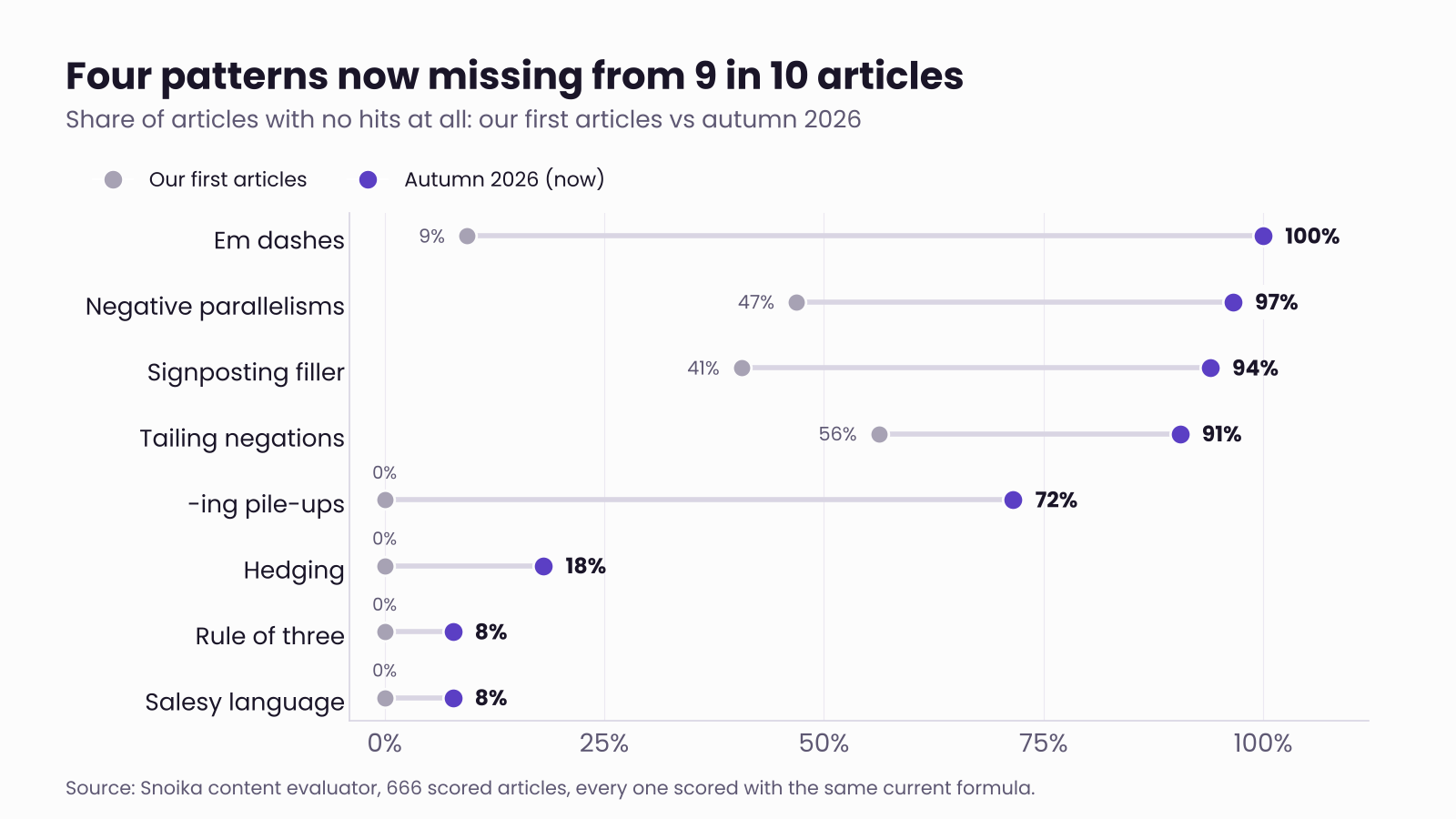
One pattern outside the eight belongs in this picture. Vague attributions average 3.1 per article in autumn 2026. Since each one counts twice, they add 6.2 points per article to the pattern score, more than any single one of the eight. If you're deciding where an editor's time goes next, unsourced claims are the first place to look.
What removed them
Automatic checks removed the patterns that have a fixed form, and they reduced the ones that need judgment, though they didn't remove them. In our data, the same system that took em dashes out of every autumn article still leaves rule-of-three series in 92% of them.
Detectors and the rewrite pass
Each pattern became a dedicated check. Detectors read every draft and quote each offending sentence word for word. One rewrite pass then fixes only those sentences, before human review.
The word-for-word quote is the part that makes this work. A general instruction such as "make this sound less like AI" leads a model to rewrite whole paragraphs, and fresh text brings fresh patterns. A rewrite limited to quoted sentences leaves the clean text alone.
FAQ
Rule-of-three series and hedging were the most common ai writing patterns in the 116 autumn 2026 articles, averaging 3.7 and 3.4 instances per article, respectively. These findings describe this dataset, not generated articles generally.
The report found an average of 20.4 three-item series per article in the first 32 articles, compared with 3.7 across 116 autumn 2026 articles. Counts vary by article length, so comparisons should also use the figures per 1,000 words.
Automatic checks can remove fixed-form patterns, but patterns requiring judgment remain harder to eliminate. The report describes detectors that quote offending sentences for a targeted rewrite before human review. Rule-of-three series and unnecessary hedging persisted despite checks.
Em dash counts reached zero across 116 autumn 2026 articles after dedicated checks were in place by June. However, most of the decline preceded those checks: averages had already fallen from 3.1 in the first 32 articles to 0.06 in the 32 before April 2026.
Use pattern counts per 1,000 words rather than raw counts per article, because longer articles have more opportunities for hits. Apply the same pattern definitions and scoring formula across groups, as the report did when rescoring all 666 articles.