
AI SEO statistics
AI SEO statistics show how AI assistants and Google's AI Overviews change the way people find brands and decide whether to click. They also show what's left for search engine optimization (SEO) to do. The 2026 data shows that AI answers now reach billions of searchers and take a large share of the clicks that top-ranked pages used to get. And business buyers rely on them well before they speak to a vendor.
 Anton VedeshinFounder, Snoika · 8 min read · updated 2026Statistics verified by Snoika
























AI search by the numbers
Four figures give the scale of AI search in 2026. Each comes from the company or research firm that measured it, and none of them is a projection.
User counts tell you about reach, while survey data tells you about habits. Together, the figures show that people are searching more than before, but fewer of those searches send a visitor to your site. So when you plan, check whether a figure counts people or search activity, and distinguish queries from clicks before you put it next to another one.
AI Overviews reach
AI Overviews reached over 2 billion monthly users in more than 200 countries and 40 languages by mid-2025. On the queries where they appear, they take roughly half the clicks the top result used to get. Pichai gave the 2 billion monthly users figure on Alphabet's Q2 2025 earnings call, up from 1.5 billion in May. A Pew Research Center panel of 900 US adults found that 18% of Google searches produced an AI summary in March 2025.
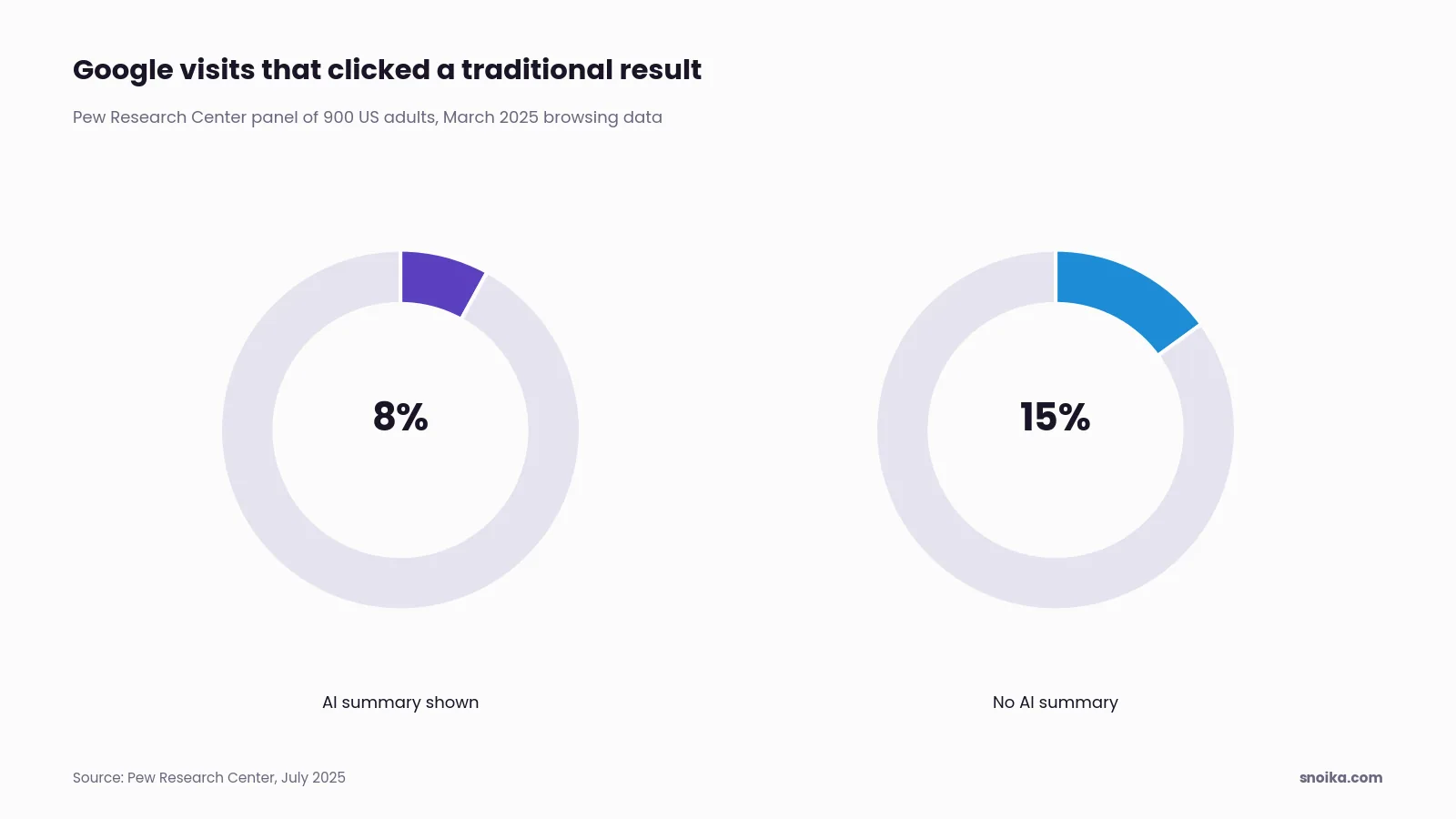
How many clicks they take depends on who measured it and when:
| Study | Click finding | Date |
|---|---|---|
| Study of 300,000 keywords | 58% lower clickthrough rate for position 1 | December 2025 data |
| Same study, first run | 34.5% fewer clicks for position 1 | April 2025 |
| Seer Interactive, 3,119 queries | 61% drop in organic click-through rate | June 2024 to September 2025 |
| Pew Research Center | Clicks on 8% of visits vs 15% without a summary | March 2025 |
Study of 300,000 keywords
- Click finding
- 58% lower clickthrough rate for position 1
- Date
- December 2025 data
Same study, first run
- Click finding
- 34.5% fewer clicks for position 1
- Date
- April 2025
Seer Interactive, 3,119 queries
- Click finding
- 61% drop in organic click-through rate
- Date
- June 2024 to September 2025
Pew Research Center
- Click finding
- Clicks on 8% of visits vs 15% without a summary
- Date
- March 2025
The loss grew as Google rolled AI Overviews out to more countries, which is why the two runs of the keyword study are so far apart. In Pew's data, as summarized by ODSC, 53% of searches with 10 or more words triggered a summary, against 8% of one- or two-word searches. To see your own exposure, look at your informational and long-tail queries first. That's where the summaries appear and where your click-through rate (CTR) falls.
AI referral traffic shifts
AI assistants send about 1 visit in every 100 today, but those visits convert at a higher rate than search traffic. An SEO platform's 2026 benchmarks report covered 13,770 domains from May to September 2025. It found that AI referrals made up 1.08% of all website traffic, and that share grew about 1% each month. The share ranged from 0.25% for communication services, the lowest, to 2.80% for information technology sites, the highest.
The platform's VP of Services and Thought Leadership put it this way: "AI visibility is becoming its own performance channel, one that signals which brands are trusted enough to enter the answer." A Microsoft Clarity study reported by Digiday supports that view with a 1.66% sign-up conversion rate from AI platforms, against 0.15% from search.
Before you trust these numbers for your own site, check your attribution. The Digital Bloom estimated that 70.6% of AI traffic arrives without a referrer header. In Google Analytics 4 (GA4), that traffic shows up as direct. This is why our client onboarding asks for GA4 access. We also request access to Google Search Console and Google Tag Manager. With all three, we can tie AI visibility to the traffic a brand already measures and stop treating it as a separate guess.
AI search market share
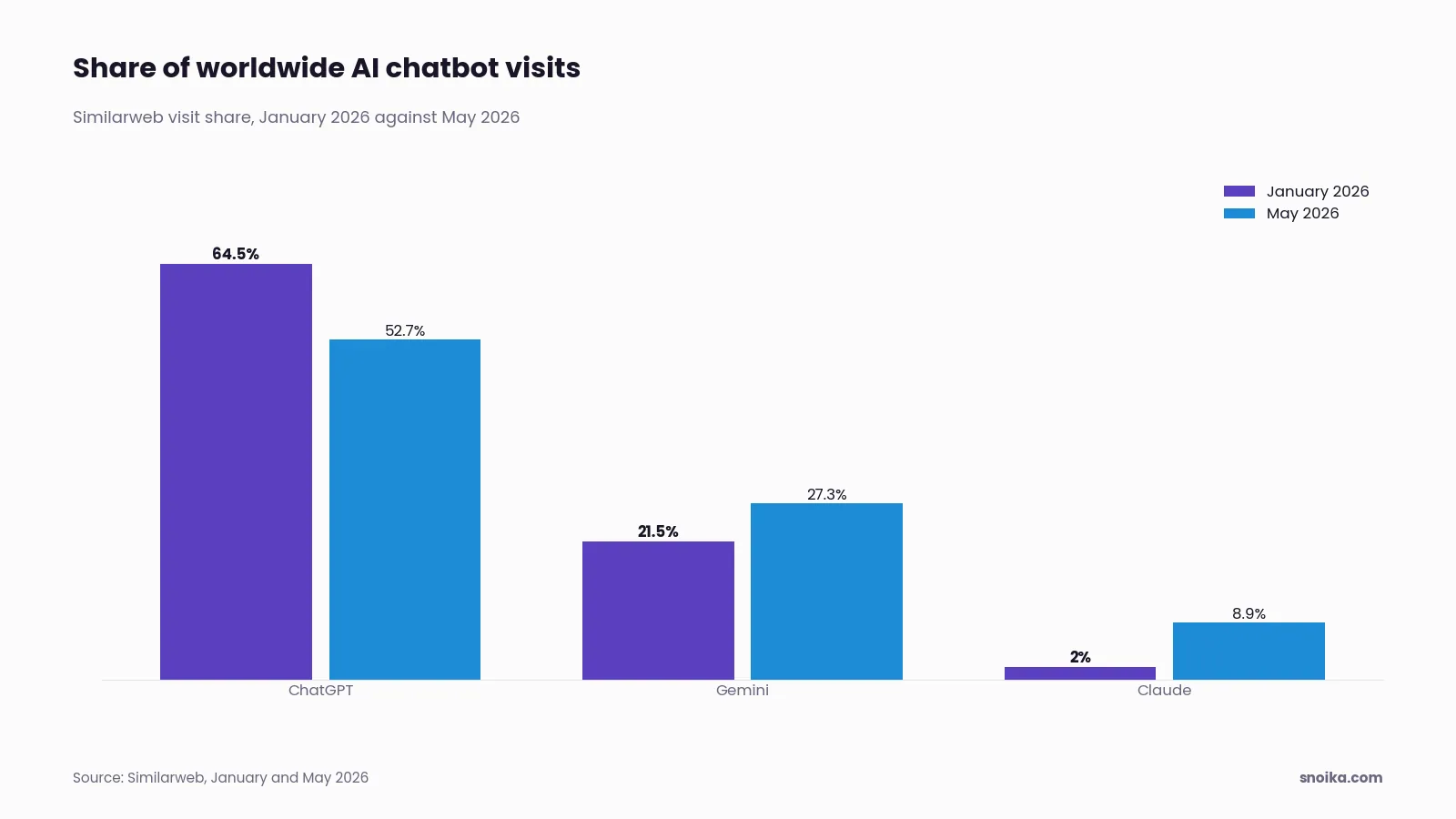
ChatGPT still has the biggest share of AI assistant traffic worldwide, but it lost about a third of its lead in 2026 as Gemini grew. Similarweb tracks visits to AI chatbot websites worldwide. Its January figures come from the firm's first 2026 tracker. Its May figures come from PPC Land's report of a 52.7% ChatGPT share.
| Platform | January 2026 | May 2026 |
|---|---|---|
| ChatGPT | 64.5% | 52.7% |
| Gemini | 21.5% | 27.3% |
| Claude | 2.0% | 8.9% |
ChatGPT
- January 2026
- 64.5%
- May 2026
- 52.7%
Gemini
- January 2026
- 21.5%
- May 2026
- 27.3%
Claude
- January 2026
- 2.0%
- May 2026
- 8.9%
For referral share, a different measure from visit share, ChatGPT sent 87.4% of AI referral traffic in the same benchmark sample, which leaves out Google's AI Overviews. One analysis of May 2026 Similarweb data puts ChatGPT at 58.3% in the United States, while Claude's US share was higher than its worldwide share.
These numbers guide our tracking of ChatGPT and Google AI Overviews, where most AI search traffic happens. We measure mentions and share of voice with weekly prompt sets. Those sets also track sentiment and citations. If you track on your own, rank the platforms by your own referral data rather than by worldwide visit share.
Buyer behaviour in AI search
Business buyers now start software research in AI chatbots and build their shortlists there. Then they check those answers against people and product trials before they decide. G2 surveyed 1,076 B2B software buyers in March 2026. It found that 51% of B2B software buyers begin in an AI chatbot. The same survey found that 71% rely on chatbots for software research, up from 60%.
In G2's 2025 Buyer Behavior Report, 17.1% of respondents named generative AI chatbots as a shortlist source, which put chatbots at the top of the list. Software review sites came second, at 15.1%.
Buyers don't take AI answers on trust, though. TrustRadius surveyed 1,862 technology buyers in January 2026. Product demos and free trials outranked AI recommendations in influence on the final choice. User reviews also had more influence than AI recommendations. So check two things: whether AI answers name you, and whether the sources those answers lean on would hold up when a buyer checks them.
B2B adoption rates
About 94% of business-to-business (B2B) buyers use generative AI tools such as ChatGPT during a purchase. In one of two independent 2025 surveys, Forrester's Buyers' Journey Survey found that 94% of business buyers use AI in their buying process, up from 89% a year earlier. 6sense's 2025 Buyer Experience Report asked nearly 4,000 buyers and found that the same share used large language models (LLMs).
Both surveys ask about AI tools in general across several assistants. Forrester also found that twice as many buyers now call generative AI a more meaningful information source than they did the year before. So reliance grew faster than adoption did.
McKinsey's 2025 State of AI survey found that 88% of respondents work at organizations that use AI in at least one business function. Marketing budgets lag behind this adoption, as INFUSE's Voice of the Marketer 2026 found that only 21% of marketers plan to invest in answer engine optimization (AEO) and generative engine optimization (GEO). Buyers have already moved, and most marketing plans haven't caught up.
AI citations vs rankings
SEO still matters with AI search because AI Overviews mostly cite pages that rank. But a top-10 position no longer guarantees a citation. And when an AI answer names a brand, rankings are only part of the reason.
Rankings still feed citations
A July 2025 study of 1.9 million citations found that 76% of AI Overview citations came from pages in the top 10. A March 2026 follow-up looked at 863,000 searches. Only 37.9% of cited pages ranked in the top 10, though 69.1% still ranked somewhere in the top 100. The two studies sampled citations in different ways, so part of the drop comes from method. Google's move to Gemini 3 as the AI Overview model in January 2026 is the other likely cause. Gemini 3 splits a query into sub-queries and pulls pages from deeper in the results.
How often vendors get named
AI assistants name a brand in most of their answers, but the rate depends on the assistant. An analysis of 1.8 million AI responses found that ChatGPT names brands in 73.6% of responses, while Google AI Overviews do so in 48.5%. Claude names one in 97.3% of answers. Set a separate benchmark for each assistant. One blended mention rate hides these gaps.
What predicts brand visibility
Mentions on other websites predict AI visibility better than links do. In an SEO platform's study of 75,000 brands, branded web mentions had a correlation of 0.664 with AI Overview visibility, against 0.218 for backlinks. Seer Interactive found that brands cited in AI Overviews earned a 35% higher organic CTR than brands left out of the same summaries.
What this means for pipeline
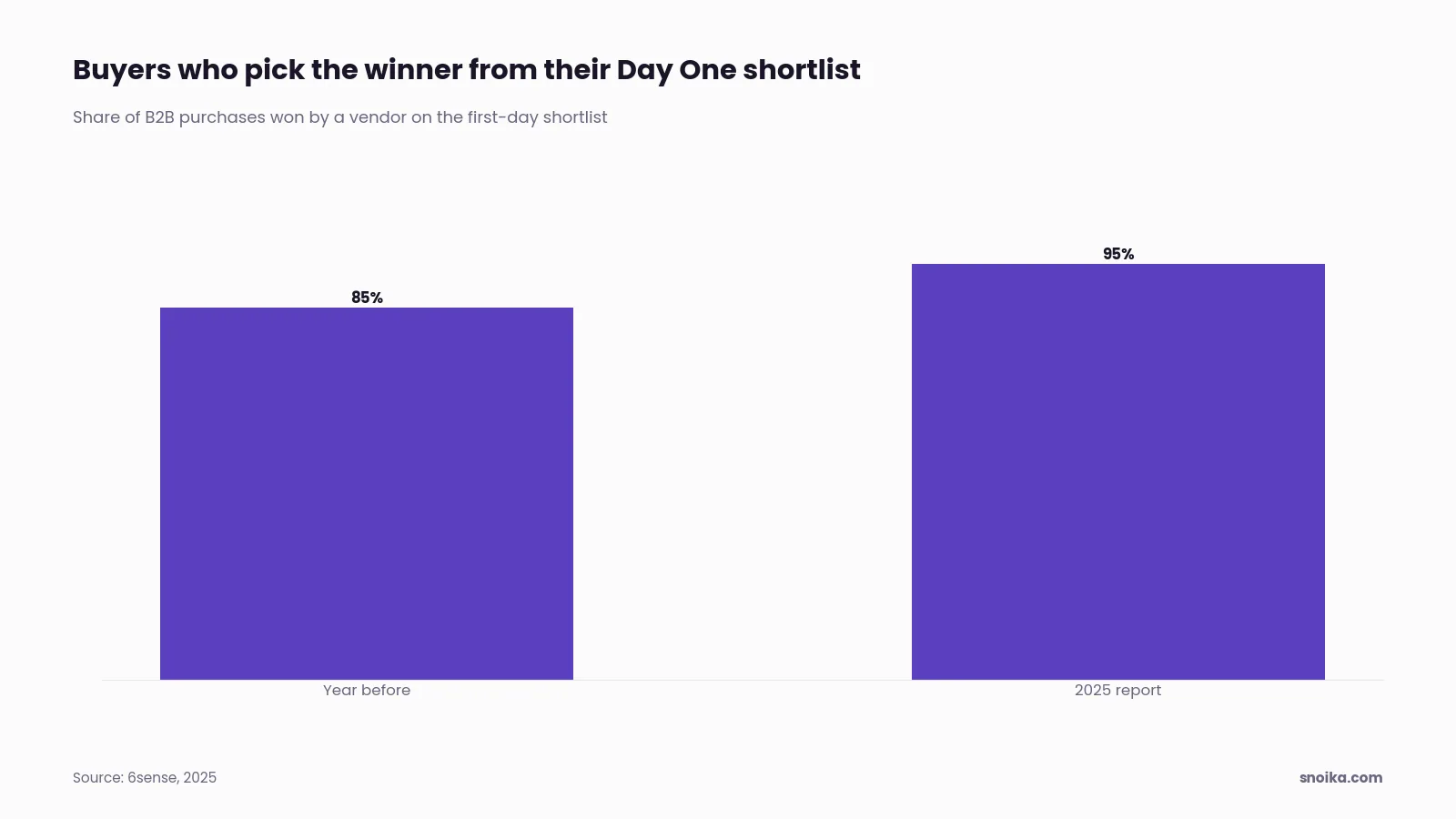
AI visibility affects pipeline long before the first sales call, because buyers shape their shortlist in AI answers and seldom add names later. 6sense found that buyers pick the winner from their Day One shortlist 95% of the time, up from 85% the year before. A separate SEO platform study found the average AI search visitor is 4.4 times as valuable as an organic visitor, measured by conversion rate.
In our client work, 3DPrinterOS achieved #1 visibility in ChatGPT for industry-specific queries and turned AI search into a steady inbound lead source with 3–4 qualified inbound leads/day.
You can link AI visibility to pipeline in five steps:
- 011Write buyer promptsList the questions your buyers ask when they compare vendors in your category. Use their wording.
- 022Record a baselineRun those prompts in ChatGPT and AI Overviews. Note where you're mentioned and which sources the answers cite.
- 033Fix attributionSet up AI referral channels in GA4 and watch direct traffic for rises that line up with changes in your AI visibility.
- 044Ask new leadsAdd "where did you first hear about us" to your forms. AI assistants show up there before they show up in analytics.
- 055Repeat weeklyAI answers change week to week, so a single check goes stale fast.
Sources behind each figure
Every figure on this page comes from a linked research source, and the two tables list them in the order they appear. The first covers search reach, clicks and traffic. Most AI search research is run by companies that sell search or analytics tools. That doesn't make a figure wrong. But you should read the method before you repeat the number.
| Reach figure | Source | Date |
|---|---|---|
| 800M ChatGPT weekly users | OpenAI, via TechCrunch | October 2025 |
| 80% rely on AI summaries | Bain & Company survey | December 2024 |
| 2B AI Overviews users | Alphabet earnings call | July 2025 |
| 58% lower position-1 CTR | Study of 300,000 keywords | December 2025 data |
| 61% organic CTR drop | Seer Interactive | September 2025 |
| 1.08% AI referral share | SEO platform benchmarks report | May to September 2025 |
| 52.7% ChatGPT visit share | Similarweb, via PPC Land | May 2026 |
800M ChatGPT weekly users
- Source
- OpenAI, via TechCrunch
- Date
- October 2025
80% rely on AI summaries
- Source
- Bain & Company survey
- Date
- December 2024
2B AI Overviews users
- Source
- Alphabet earnings call
- Date
- July 2025
58% lower position-1 CTR
- Source
- Study of 300,000 keywords
- Date
- December 2025 data
61% organic CTR drop
- Source
- Seer Interactive
- Date
- September 2025
1.08% AI referral share
- Source
- SEO platform benchmarks report
- Date
- May to September 2025
52.7% ChatGPT visit share
- Source
- Similarweb, via PPC Land
- Date
- May 2026
The buyer and citation figures come from survey firms and large-scale citation studies.
| Buyer figure | Source | Date |
|---|---|---|
| 51% start in a chatbot | G2 | March 2026 |
| 94% of buyers use AI | Forrester, 6sense | 2025 |
| 37.9% of citations in top 10 | Study of 863,000 searches | March 2026 |
| 73.6% ChatGPT brand mentions | Study of 1.8 million responses | February 2026 |
| 95% Day One shortlist wins | 6sense | 2025 |
51% start in a chatbot
- Source
- G2
- Date
- March 2026
94% of buyers use AI
- Source
- Forrester, 6sense
- Date
- 2025
37.9% of citations in top 10
- Source
- Study of 863,000 searches
- Date
- March 2026
73.6% ChatGPT brand mentions
- Source
- Study of 1.8 million responses
- Date
- February 2026
95% Day One shortlist wins
- Source
- 6sense
- Date
- 2025
Before you use any of these numbers, check three things in its method. Is it a survey of stated behavior or a panel of measured behavior? Which countries does it cover? Does it count visits or queries? Check whether it counts clicks instead. Pew's panel tracks what people actually do in the browser, while Bain's figures come from what consumers say they do. Both are useful, but a measured click rate and a survey answer can't be compared directly.
How to use these figures
Use these AI SEO statistics to set up a baseline for your own measurements. Industry averages hide wide differences. The 2026 benchmarks report alone shows AI referral share ranging from 0.25% to 2.80% by sector. The figure that should drive your budget is how often AI answers name you for the prompts your buyers actually type, compared with your closest competitors.
So start with 20 to 30 buyer prompts this week. Record who gets named, then run the same prompts again next month. If your share of mentions stays flat while competitors' share grows, you'll see it in your shortlists before you see it in your traffic.