
ChatGPT usage statistics
About 900 million people use ChatGPT every week. That's the short answer to how many people use ChatGPT, and it comes from the count OpenAI announced in February 2026. The figure is more than double the 400 million weekly users the company reported a year earlier. Sensor Tower reported that the mobile app alone also passed 1 billion monthly users in May 2026. We've grouped the figures below by theme, with each one's source and date.
 Anton VedeshinFounder, Snoika · 8 min read · updated 2026Statistics verified by Snoika
























ChatGPT usage for marketers
Marketers now use ChatGPT as a writing tool inside their own workflow and as a channel where buyers discover brands. HubSpot's 2026 State of Marketing Report, based on a survey of more than 1,500 marketers worldwide, shows both uses in its data. Use of the tool is close to universal. Budgets for the channel are only starting to move.
| Statistic | Figure | Source |
|---|---|---|
| Marketers using AI for content | 80% of marketers | HubSpot, 2026 |
| Top planned budget increase | AI chatbots at 37.7% | HubSpot, 2026 |
| Lost search traffic to AI tools | Nearly 30% of marketers | HubSpot, 2026 |
Marketers using AI for content
- Figure
- 80% of marketers
- Source
- HubSpot, 2026
Top planned budget increase
- Figure
- AI chatbots at 37.7%
- Source
- HubSpot, 2026
Lost search traffic to AI tools
- Figure
- Nearly 30% of marketers
- Source
- HubSpot, 2026
HubSpot's respondents named AI chatbots such as ChatGPT as their first priority for higher spend, ahead of paid social and video. So marketers have moved past asking whether to write with AI. Their question now is whether their brand shows up when a buyer asks an AI assistant for advice.
Before you reuse any of these numbers, check what they measure. HubSpot's 80% covers all AI tools, so it doesn't tell you how many marketers use ChatGPT specifically. If you need a figure for ChatGPT alone, look for a survey that names it in the question.
Weekly active users
ChatGPT has 900 million weekly active users. That's OpenAI's latest official count, which TechCrunch reported on 27 February 2026 alongside the company's funding announcement. It was a jump of 100 million from October 2025. OpenAI also said it had 50 million paying subscribers at that point.
| Date | Weekly active users | Source |
|---|---|---|
| Nov 2023 | About 90 million users | OpenAI |
| Feb 2025 | 400 million | OpenAI via DemandSage |
| Jul 2025 | Nearly 680 million | OpenAI |
| Oct 2025 | 800 million | OpenAI via TechCrunch |
| Feb 2026 | 900 million | OpenAI via TechCrunch |
Nov 2023
- Weekly active users
- About 90 million users
- Source
- OpenAI
Feb 2025
- Weekly active users
- 400 million
- Source
- OpenAI via DemandSage
Jul 2025
- Weekly active users
- Nearly 680 million
- Source
- OpenAI
Oct 2025
- Weekly active users
- 800 million
- Source
- OpenAI via TechCrunch
Feb 2026
- Weekly active users
- 900 million
- Source
- OpenAI via TechCrunch
Growth was slow through 2024 and then sped up sharply in early 2025. OpenAI's own chart shows weekly users at about 300 million in January 2025 and about 510 million in March. The steepest climb in the product's history came in those few months.
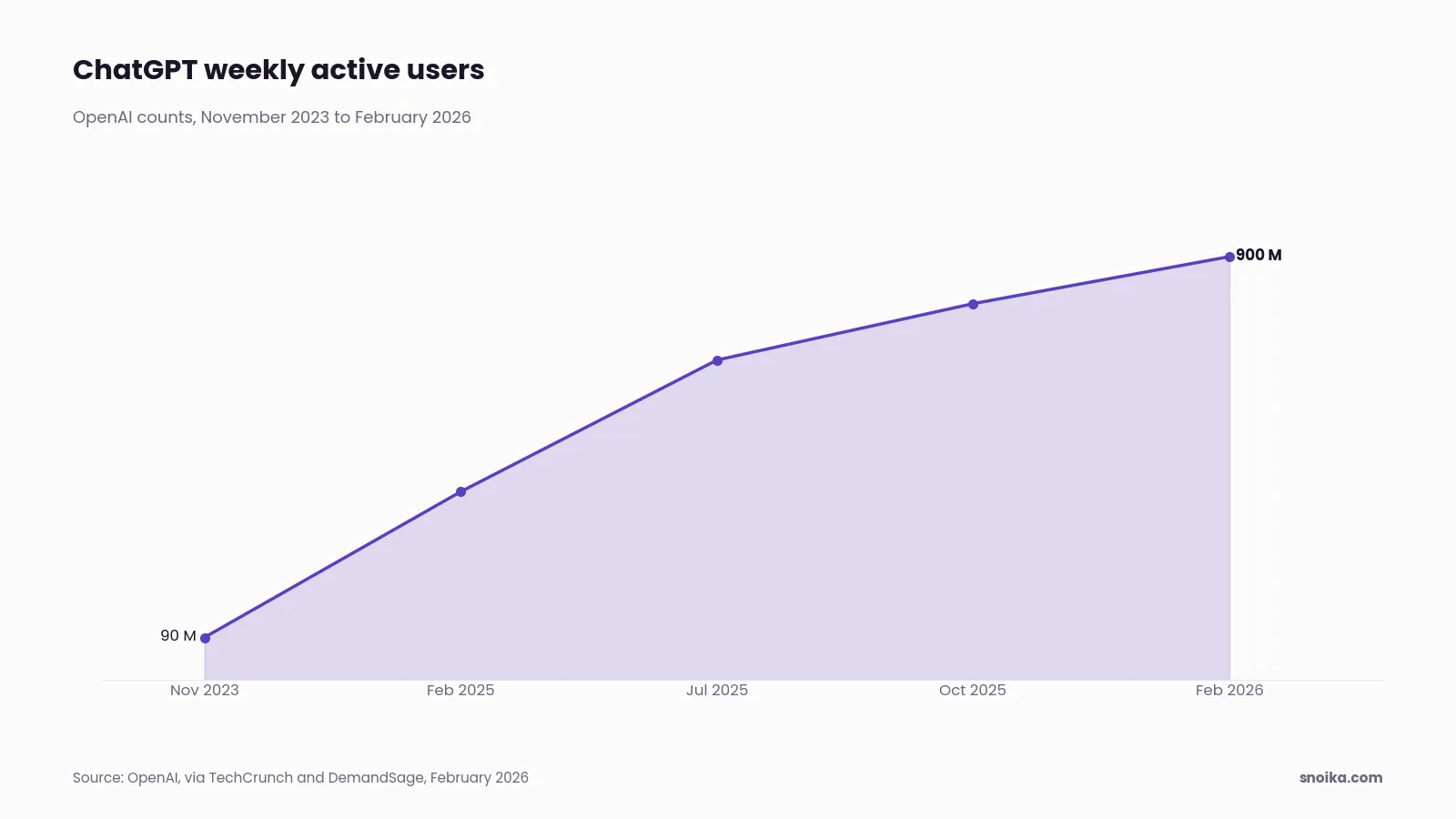
Three different metrics get quoted as "users," and they don't measure the same thing. Weekly active users count people on the web as well as those who use the mobile or desktop app. Sensor Tower's 1 billion monthly users counts mobile app users only. Monthly visits count sessions, which means one person can make dozens of them. When two sources disagree, check which metric each used before you decide one of them is wrong.
ChatGPT as a search engine
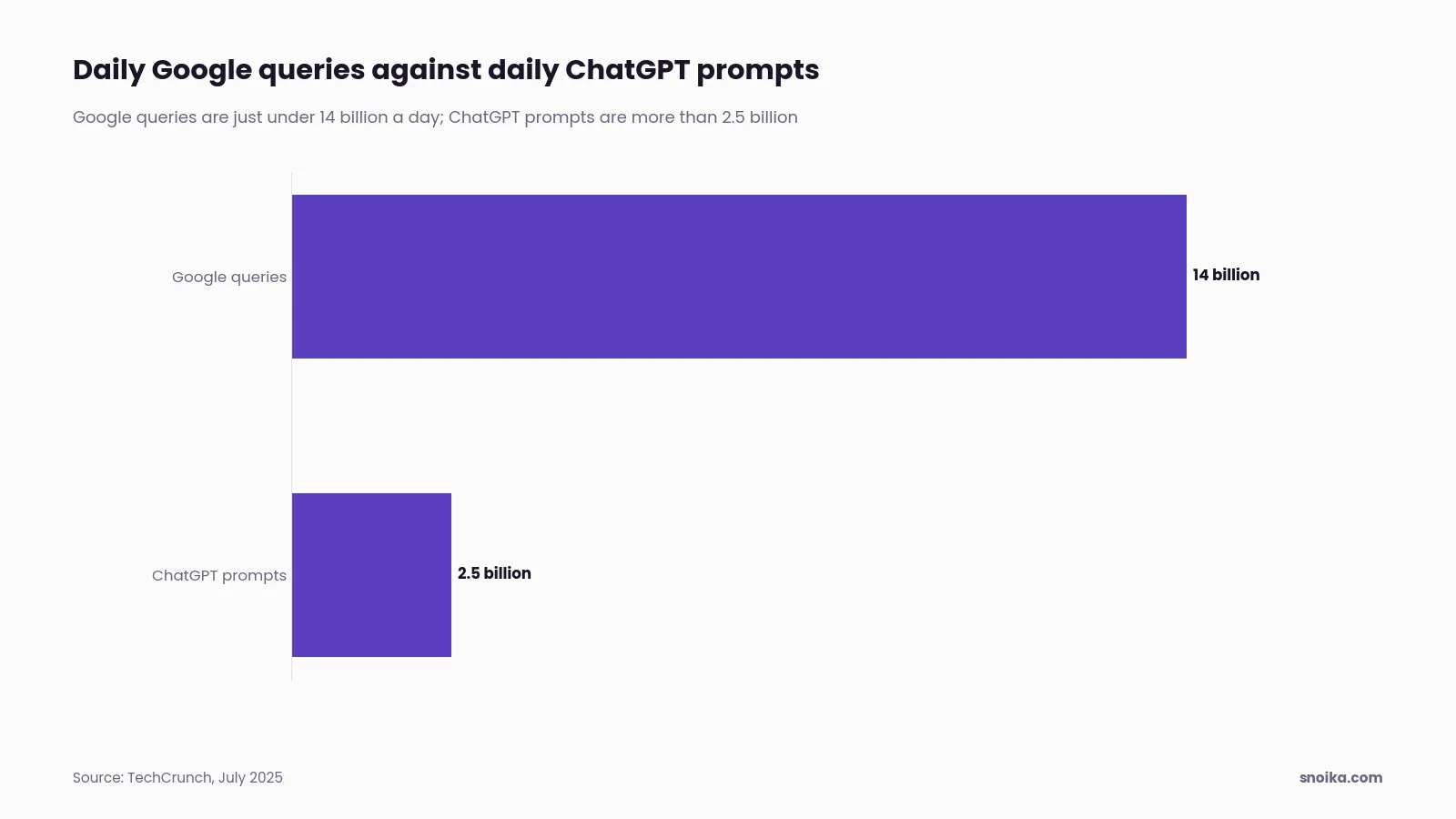
ChatGPT handles more than 2.5 billion prompts a day. OpenAI gave that figure to Axios in July 2025, and about 330 million prompts of them came from users in the US. Sam Altman, OpenAI's CEO, had put the number at about 1 billion in December 2024, so daily volume more than doubled in roughly eight months.
A prompt isn't the same as a search. The best breakdown of what people actually ask comes from "How People Use ChatGPT," a September 2025 National Bureau of Economic Research (NBER) working paper by OpenAI researchers and Harvard economist David Deming. They found that Seeking Information grew from 14% to 24% of all messages between July 2024 and July 2025. Practical Guidance, which covers how-to questions and recommendations, made up about 29%.
So about a quarter of ChatGPT traffic looks like classic search, and a larger share looks like asking an advisor. A rough calculation from these two figures puts search-like prompts at around 600 million a day. That's our estimate. It's also built on a count from July 2025, and weekly users have grown since then. Treat any "searches per day" figure as a floor, and check its date before you quote it.
ChatGPT vs Google usage
Google still handles far more queries than ChatGPT. Alphabet has said Google receives 5 trillion queries a year, which works out to just under 14 billion daily by TechCrunch's math. That's about 5 times ChatGPT's prompt count, and only part of ChatGPT's volume is search in the first place.
For B2B buyers, ChatGPT is taking over the research step where buyers compare vendors. Forrester's Buyers' Journey Survey found that 94% of business buyers used AI in their buying process in 2025, up from 89% a year earlier. Twice as many buyers named generative AI or conversational search their most meaningful source as named any other source, vendor websites and sales reps included.
Buyers add AI on top of what they already use. A late-2025 Gartner survey of 645 B2B buyers found that 69% of buyers still turn to a sales rep to check what AI told them, and that buyers use 7 information sources on average. Forrester's numbers combine ChatGPT use with use of other AI tools, such as Gemini and Copilot.
Referral traffic from ChatGPT
ChatGPT sends most B2B sites about 1% to 3% of their total traffic. An SEO platform's 2026 AEO/GEO benchmarks report studied 13,770 domains between May and September 2025 and found that AI referrals made up 1.08% of website traffic. Information technology sites were highest at 2.80%. ChatGPT sent about 87% of AI referrals in the same study.
| Measure | Figure | Source |
|---|---|---|
| Industrials sites, AI share | 1.25% of traffic | SEO platform benchmarks, 2026 |
| ChatGPT share of B2B AI referrals | 62.6% in Mar, Apr 2026 | B2B brand panel, 2026 |
| AI visits with no referrer | 70.6% of AI traffic | The Digital Bloom, 2026 |
Industrials sites, AI share
- Figure
- 1.25% of traffic
- Source
- SEO platform benchmarks, 2026
ChatGPT share of B2B AI referrals
- Figure
- 62.6% in Mar, Apr 2026
- Source
- B2B brand panel, 2026
AI visits with no referrer
- Figure
- 70.6% of AI traffic
- Source
- The Digital Bloom, 2026
ChatGPT's share depends on whose sites are measured. One panel of mostly B2B brands shows ChatGPT falling from 89% of AI referrals to 62.6% in eight months, while Claude climbed to 18.5%. A separate July 2026 traffic report puts ChatGPT at 92.4% of referrals. Software and developer audiences lean toward Claude, so their split looks different from a retailer's.
Raw referral counts also understate ChatGPT's real influence. Most AI visits arrive without a referrer, so Google Analytics 4 (GA4) files them under direct traffic. The benchmark platform's VP of Services and Thought Leadership says of AI referrals: "It will never rival traditional organic search traffic." He argues that the metric to watch is whether your brand gets into the answer at all. Check your direct traffic trend next to your referral line before you conclude the channel is too small to matter.
Who uses ChatGPT most
Younger adults use ChatGPT most. By mid-2025, slightly more of its users were women than men. Usage drops steadily with age, though older groups are catching up. Most of what people ask has nothing to do with work.
Users by age
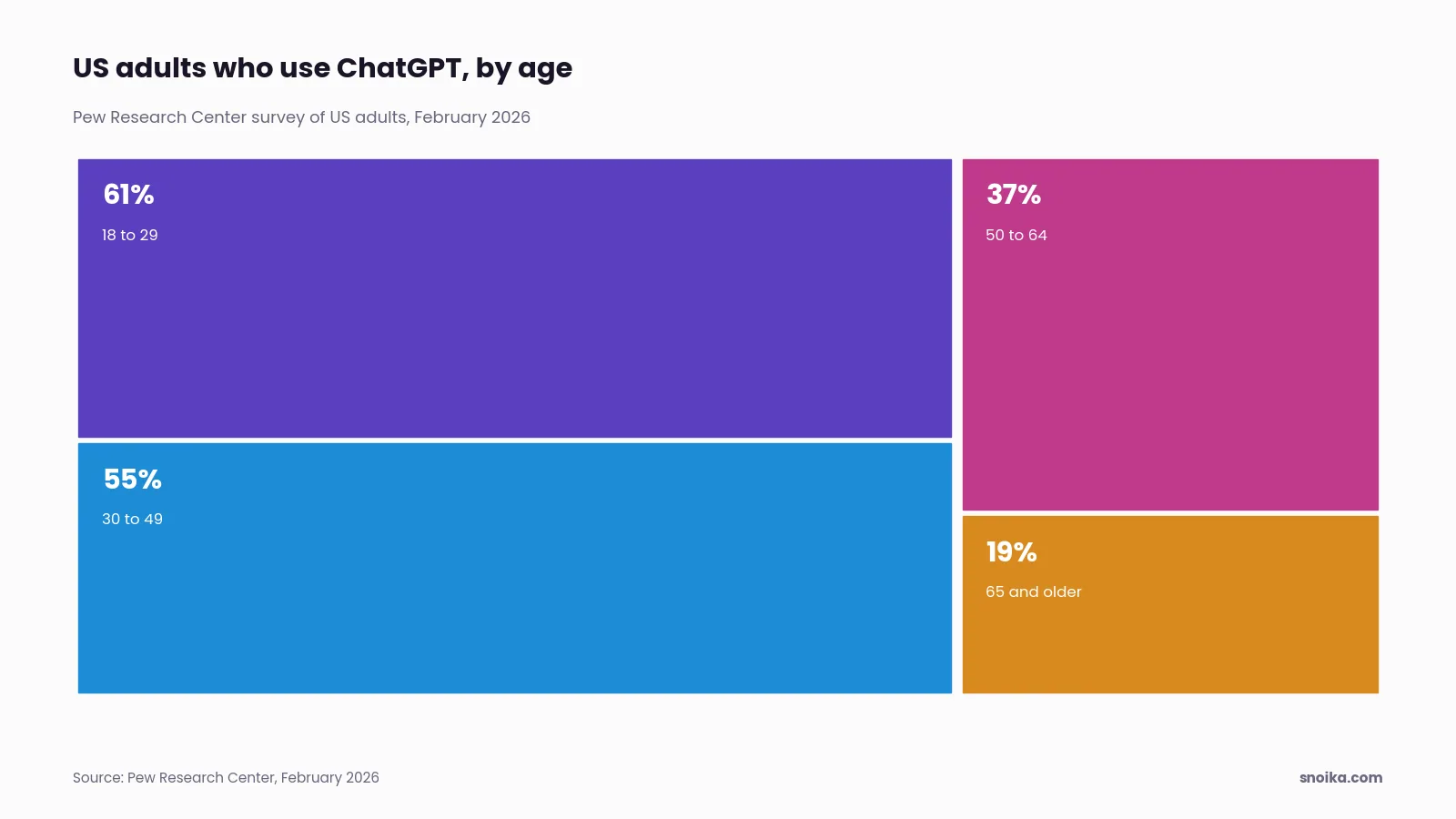
Pew Research Center's February 2026 survey of US adults found that 44% use ChatGPT, up from 34% a year earlier.
| Age group | Share using ChatGPT, 2026 | Source |
|---|---|---|
| 18 to 29 | 61% of adults | Pew, 2026 |
| 30 to 49 | 55% | Pew, 2026 |
| 50 to 64 | 37% | Pew, 2026 |
| 65 and older | 19% | Pew, 2026 |
18 to 29
- Share using ChatGPT, 2026
- 61% of adults
- Source
- Pew, 2026
30 to 49
- Share using ChatGPT, 2026
- 55%
- Source
- Pew, 2026
50 to 64
- Share using ChatGPT, 2026
- 37%
- Source
- Pew, 2026
65 and older
- Share using ChatGPT, 2026
- 19%
- Source
- Pew, 2026
The fastest growth is among people in their 30s and 40s. Their share jumped 14 points in a year. That's the age group that holds most B2B buying roles.
Users by gender
The early gender gap has closed. The NBER paper tracked users with classifiable first names and found that the share with names classified as feminine rose from 37% to 52% between January 2024 and July 2025. Men use ChatGPT more for technical help, while women use it more for writing and practical guidance.
Work versus personal use
Personal use dominates and is growing faster than work use. Non-work messages rose from about 53% to 73% of consumer messages between June 2024 and June 2025. Users under 26 send nearly half of all adult messages, and only about 23% of their messages relate to work. Among users aged 26 to 55, the work share rises to 29% to 31%.
Users by country
The US sends the most traffic to ChatGPT, at 18.53% of visits, with India second at 9.79%. India also passed 100 million weekly users. NBER found that the fastest growth over the past year came from low- and middle-income countries.
Is ChatGPT usage declining
ChatGPT's absolute usage remains at least steady as its share of AI chatbot traffic declines. Similarweb's worldwide panel shows ChatGPT's share of generative AI web visits falling from about 76% to 53% between June 2025 and May 2026. Gemini rose to around 27% over the same period. ChatGPT's total visits stayed roughly flat, because the category grew around it.
The month-to-month figures that make headlines reflect seasonality more than a real drop. ChatGPT logged 5.51 billion visits in April 2026, down 3.84% from March. Something similar happened in June 2023, when Reuters reported a 9.7% traffic drop and Similarweb's David Carr put it down to the novelty wearing off. Weekly users then grew roughly tenfold.
Competition does pull time away from ChatGPT. Sensor Tower told Reuters that US ChatGPT users who installed Claude in early 2026 spent 5% less time on ChatGPT the following month. When you read a "decline" story, check whether it measures share or absolute users and whether it counts the web only or apps too. A third check is whether the month falls in a school holiday.
What it means for B2B
For B2B companies, the vendor shortlist now forms inside AI answers before a buyer ever talks to sales. Forrester's 2026 data shows 55% of buyers compare vendors in AI tools, and 47% build their internal business case there. 6sense's 2025 Buyer Experience Report found the winning vendor was already on the buyer's first-day shortlist 95% of the time.
Our tracking uses weekly prompt sets to measure mentions and share of voice in ChatGPT and Google AI Overviews, where most AI search traffic happens. We also measure sentiment and citations. With a client's GA4 and Google Search Console access, we connect those visibility numbers to the traffic the client already reports on.
Getting cited by ChatGPT
ChatGPT cites pages from sources it already trusts when they put data-backed answers early. Competition is tight even after a page gets retrieved. A study of 548,534 pages found that ChatGPT cites only 15% of retrieved pages and discards the rest.
- 011Answer in the first thirdA February 2026 analysis found that 44% of ChatGPT citations come from the first third of a page. Put the direct answer at the top of each section.
- 022Add sourced figuresAn analysis of 216,524 pages found that articles with 19 or more data points averaged 5.4 citations, against 2.8 for pages with little data.
- 033Earn third-party coverageIn a study of 366,087 citations, the top 20 sources took 67.3% of citations in OpenAI's models. Coverage in trusted publications counts as much as your own pages.
- 044Publish in buyers' languagesA buyer in Germany prompts in German. We create content in 135+ languages and regional variants so each market gets a page written in its own language.
- 055Retest on a scheduleAnswers change from week to week. Run the same buyer prompts on a regular schedule and record whether you're cited.
The pages we create go live on your own domain through a DNS connection. You review and approve each one before it's published. This approach works in narrow, technical categories too. 1StopVAT, in tax and fintech, saw 10x growth in ChatGPT visibility in 7 weeks.
How to use these figures
Before you quote any number on this page, decide which question it needs to answer. Use weekly active users when someone asks how many people use ChatGPT. Use prompt counts for questions about volume and Similarweb share for questions about competition. Put the source and date next to every figure you reuse, because most of these numbers are less than a year old and get revised.
To measure your own position, write 20 questions your buyers would ask ChatGPT about your category. Run them this week and note which brands it names. That baseline tells you more about your pipeline than any global total.