
Why AI brand mentions go to competitors
AI brand mentions go to competitors when those brands are easier for a model to retrieve and better backed by sources it already trusts. An assistant like ChatGPT builds its answer from what other pages say about your category. When reviews and comparison articles name your rival and leave you out, the model repeats that pattern. The gap has specific causes, and you can measure it.
 Artem LozinskyOperations and product, Snoika · 7 min read

























Why competitors win AI mentions
ChatGPT names your competitors instead of you because they receive more web coverage in places the model treats as evidence. Ahrefs studied 75,000 brands and found that branded web mentions correlate with AI Overview visibility at 0.664 for mentions, compared with 0.218 for backlinks. Its 3 strongest factors were all off-site. What others write about you counts for more than what your own pages say.
Academic research points the same way. In September 2025, researchers at the University of Toronto compared AI search with Google across industries and languages. They found a systematic and overwhelming bias toward earned media (third-party, authoritative sources) over brand-owned content. So rewriting your homepage won't fix a gap caused by missing outside coverage.
An assistant's 4 failure points include an inability to fetch your pages or identify what you sell. It also fails when it finds no outside evidence for you or cannot link you to the buyer's question. From the outside, every one of these failures looks the same, because all you see is a competitor's name. Before you spend money on a fix, find out which one is happening to you.
How AI assistants select brands
Assistants use training knowledge and pages retrieved for the current prompt as their 2 sources for brand choices. Search-enabled assistants fetch a set of pages and then name the brands those pages keep repeating. A brand that turns up in 6 of the 8 retrieved sources gets named, while one that turns up once goes unmentioned.
A 2024 Vercel analysis of real crawler traffic found that OpenAI's GPTBot fetched JavaScript in 11.5% of requests and never executed it. Google's Gemini is the exception, since it uses Googlebot's rendering. If your product details load through client-side JavaScript, most AI crawlers get an empty page.
Large language models identify competitors by co-occurrence. When "alternatives to X" pages and comparison tables keep putting 2 brands side by side, the model files them as rivals. If you never appear next to the category leaders, the model doesn't treat you as one of them.
SparkToro found less than a 1 in 100 chance that ChatGPT or Google's AI returns the same list of brands twice for the same prompt. According to the SparkToro write-up, "These tools are probability engines: they're designed to generate unique answers every time." So a single test proves nothing. For a quick technical check, load your key pages with JavaScript turned off and read what's left.
The citation gap audit
A citation gap audit compares the brands and URLs that assistants cite for your buying prompts with the places you appear. It tells you whether the assistant can access your pages and recognize your brand. It also checks for outside evidence and a match with the buyer's intent. You can run a first version in a spreadsheet in about a day.
Which prompts to test
Start with 20 to 50 unbranded prompts buyers use before they've heard of you. Pair "best tool for [job]" prompts with "[competitor] alternatives" prompts. Add direct comparisons and problem questions. Then add one direct brand prompt, such as "What does [your brand] do?", to test recognition. Run each prompt at least 10 times in fresh sessions. If you're missing in 7 runs out of 10, that's a finding. One miss is noise.
What to record for each answer
For every run, log the same fields so you can compare answers later:
- Which brands are named, and in what order
- Which URLs are cited as sources
- Whether your brand appears, and in which sentence
- How the assistant describes your brand and its category
- Whether the description is neutral or expresses a positive or negative view
How to read the gap
Group competitor-owned URLs and your own URLs separately. Sort the remaining cited URLs into editorial or review sources, with a separate group for forums. Each source that names a competitor but not you goes on your gap list, and that list becomes your outreach and content plan. If the brand prompt returns a vague answer or puts you in the wrong category, you have a recognition problem, and that comes before anything else. If the assistant cites your page but still recommends someone else, your content answers a different question from the one the buyer asked.
Signals that lift brand visibility
AI recommends your business by name when the brand is stated clearly and backed by specific, checkable facts. Repeat the pattern on your site and across third-party pages. Write one sentence that describes what you are within your category and who you serve. Then use it word for word on your site and on your directory and review profiles. Consistent wording helps the model connect all those mentions to one entity.
The Princeton GEO study (Aggarwal et al. KDD 2024) found that adding statistics and quotations can lift visibility by up to 40% in generative engines. The study also found gains from cited sources. The authors also found that results vary by domain, so test what works in your own category.
Off-site signals carry the most weight, as the Ahrefs data above shows. Brand names in link anchors and coverage in trade publications both help. So does a fair presence on review platforms. 3DPrinterOS reported an 87% increase in LLM brand mentions to Startup Reporter.
How to track ChatGPT mentions
Track ChatGPT mentions with a fixed prompt set that you run every week, and report how often you're named as a percentage of runs. Ranking positions don't hold still, because answers change every time. Rand Fishkin, cofounder of SparkToro, said that "any tool that gives a 'ranking position in AI' is full of baloney." Mention rate across repeated runs is the figure that holds up.
OpenAI CEO Sam Altman said in October 2025 that ChatGPT had reached 800 million weekly users. Beyond mention rate, measure your share of voice against named competitors and the sentiment of each description. Track which of your URLs get cited. Snoika's AI visibility tool measures those 4 figures in ChatGPT and Google AI Overviews, where most AI search traffic happens, with weekly prompt sets.
If you track by hand, use logged-out sessions so your chat history doesn't skew the answers. Keep the prompt wording fixed from week to week. If you change a prompt, you've started a new data series.
Cross-assistant coverage gaps
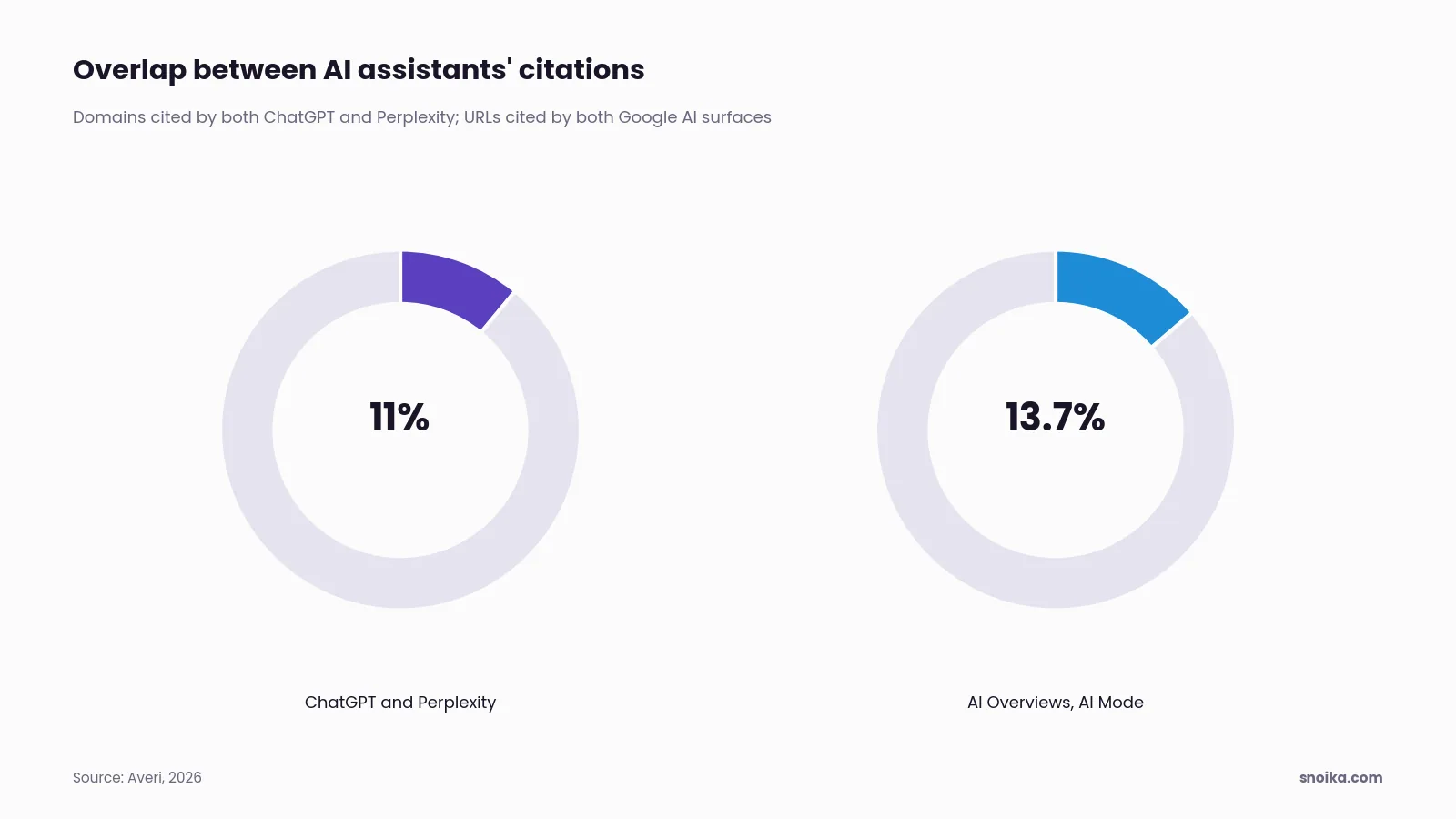
Each assistant draws on its own pool of sources, so a brand that shows up in one can be missing from another. Averi analyzed 680 million citations and found that only 11% of domains) are cited by both ChatGPT and Perplexity. The same analysis found that Google AI Overviews and AI Mode cite the same URLs only 13.7% of the time.
| Assistant | Source it leans on most | What to check |
|---|---|---|
| ChatGPT | Wikipedia and encyclopedic content (47.9% of top citations) | Whether a neutral reference page describes your brand |
| Perplexity | Reddit (46.7% of top citations) | Whether real users mention you in category threads |
| Google AI Overviews | YouTube and multimedia content (23.3% of top citations) | Whether video reviews or demos name your product |
| Gemini | Google's index, with JavaScript rendering | Whether your pages rank in classic Google results |
ChatGPT
- Source it leans on most
- Wikipedia and encyclopedic content (47.9% of top citations)
- What to check
- Whether a neutral reference page describes your brand
Perplexity
- Source it leans on most
- Reddit (46.7% of top citations)
- What to check
- Whether real users mention you in category threads
Google AI Overviews
- Source it leans on most
- YouTube and multimedia content (23.3% of top citations)
- What to check
- Whether video reviews or demos name your product
Gemini
- Source it leans on most
- Google's index, with JavaScript rendering
- What to check
- Whether your pages rank in classic Google results
To see which assistants cite your competitors, run your audit prompt set in each assistant and log the cited domains for each platform separately. Then compare the lists. A rival that wins on Perplexity but not on ChatGPT probably has forum presence and no reference coverage. A German prompt can return different brands from the English version, so test each market you sell in.
Content formats AI answers prefer
AI answers favor content that states a claim and backs it up in a passage that makes sense on its own. Models lift individual passages. A paragraph that only makes sense after the 3 paragraphs before it rarely gets quoted. Open each section with the direct answer and put the evidence right after it.
Comparison pages work because they match how buyers phrase prompts. An honest "[your brand] vs [competitor]" page with a feature table gives the model the co-occurrence it needs. Definition paragraphs work for "what is" prompts. Pricing and specification tables work best in plain HTML, where crawlers can read them.
B2B software buyers ask comparison questions, so tables and alternatives pages get cited. Consumer categories lean harder on reviews and forum threads. To test a page, read any section on its own and ask whether a stranger can quote it accurately.
Fixing your mention deficit
Fix the layer your audit flagged first, then work forward, because a later fix is wasted while an earlier layer is still broken:
- Access. Serve key content in raw HTML and confirm that AI crawlers aren't blocked in robots.txt.
- Recognition. Publish one consistent category statement on your site and on every profile you control.
- Evidence. Work through the gap list and pitch the editorial and review sources where your brand is absent from coverage of competitors.
- Intent. Build pages that answer the exact prompts where you're missing. Start with comparisons.
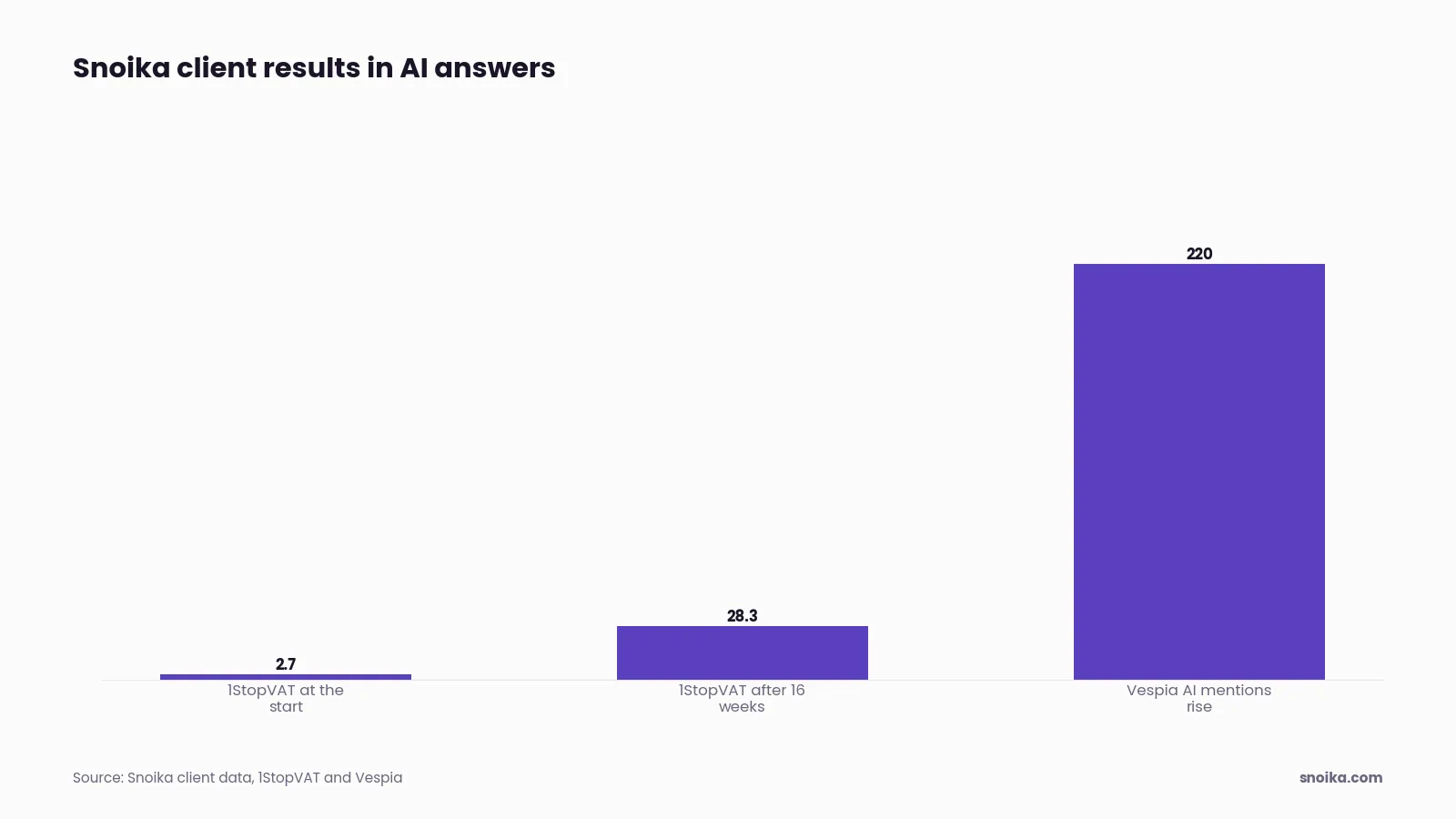
Snoika's founder Anton Vedeshin reported to Startup Reporter 1StopVAT's move from 2.7% to 28.3% ChatGPT visibility in 16 weeks. Vespia, a fintech SaaS company, recorded a 220% increase in AI brand mentions. Re-run the same prompt set every week so you know which change moved the number.
What to do next
This week, pick 20 buying prompts and run each one 10 times in ChatGPT. Log who gets named. Do it before you change a single page. Without a baseline, you can't tell later whether a new comparison page or a press mention moved your AI brand mentions, or whether the answers just shifted on their own.
We start every engagement this way, with a free AI visibility report that shows where assistants name your competitors and which sources they cite. Check your AI visibility free with the brand visibility checker.
FAQ
Run the same buying prompts in each assistant and record cited domains separately for each platform. Repeat each prompt at least 10 times in fresh sessions. Compare the source lists to find where competitors receive coverage that doesn't include your brand.
A consistent category description and specific, checkable facts help assistants identify your product. Use the same description on your website and review profiles. Third-party coverage provides outside evidence, while comparison pages connect your product to the alternatives buyers ask about.
Test 20 to 50 buyer prompts at least 10 times each in fresh sessions, recording named brands and cited URLs. Identify third-party sources that name competitors but omit you. Add a direct question about your brand to check whether the assistant recognizes what you sell.
A first spreadsheet-based audit can take about a day. The time needed depends on how many prompts and assistants you test. Covering additional languages expands the work because each market needs its own tests.
Changing a prompt starts a new data series, so its results shouldn't be treated as a continuation of the old one. To track ai brand mentions over time, keep prompt wording fixed and compare mention rates across repeated weekly runs.


