
How to optimize content for LLMs
How to optimize content for LLMs starts with knowing what a large language model (LLM) does with your page. When it answers a question, it pulls short passages from the pages it retrieves and cites the ones it can quote safely. So you build each section to answer one question in its first sentences. You back every claim with a number or a named source. Keep the page current and test real prompts to see whether it works.
 Jevgenia PogadajevaCFO, Snoika · 13 min read

























Why LLMs cite some content
LLMs cite content that answers a question in a passage short enough to quote and specific enough to trust. An answer engine writes one reply and lists a few sources under it, so it needs a statement it can lift without rewriting the meaning. A paragraph that buries its point three sentences down is hard to extract. A paragraph that leans on the one before it ("as mentioned above") falls apart once it's taken out of context.
Being cited matters more than it did a year ago, because the click below the answer is shrinking. Ahrefs re-ran its click study on December 2025 data and found that an AI Overview now correlates with a 58% lower click-through rate for the top-ranking page, up from 34.5% in April 2025. A Brandlight analysis cited by the PR firm 5W found that the overlap between top Google results and AI-cited sources fell from 70% to under 20%. A page can hold position one and still be missing from the answer.
The structure that gets cited is a page made of self-contained sections. Under a heading phrased the way a buyer asks the question, each section opens with the answer and puts evidence right after it. Comparisons go in tables and sequences go in numbered steps. Answer engine optimization (AEO) is the name for this way of building pages, and the sections below cover each part of it.
Google AI Overviews lean hard on pages that already rank, while ChatGPT gives more weight to recent pages. To test a section for either engine, copy its first two sentences into a blank document. If they don't answer the heading on their own, rewrite them before you touch anything else.
How LLMs select sources
Most AI search engines pick sources through retrieval-augmented generation (RAG). The model searches an index for candidate pages and uses LLM chunking to break them into passages. It grounds its answer in the passages that best match the question. Your page has to clear each stage in turn, and different things trip it up at each one.
Retrieval starts with a search
An LLM can only cite a page that its search step finds. A Nectiv study of more than 8,500 queries, reported by Search Engine Land, found that 31% of prompts triggered a web search, with 2.17 searches per prompt on average. Those searches run against conventional indexes, so classic SEO is still the entry ticket. Google says a page needs to be indexed and eligible for a snippet to appear as a link in AI Overviews or AI Mode, and that there are "no additional technical requirements".
In Kevin Indig's analysis of ChatGPT citations, 43.2% of first-ranked pages were cited by ChatGPT, 3.5 times the rate for pages ranked beyond position 20. Indig is a growth advisor who publishes the Growth Memo newsletter. Agrello, an e-signature company that works with Snoika, recorded "+125.6% organic search sessions YoY" and "51.8K impressions from Snoika-created pages."
Query fan-out widens the pool
Your page can be retrieved for a question the user never typed. Google's Search Central documentation explains that AI Overviews and AI Mode use a "query fan-out" technique to build a response through "issuing multiple related searches across subtopics and data sources". In Google's own example, someone who asks how to fix a weedy lawn triggers hidden searches for herbicides and for prevention.
Cover the sub-questions a buyer would ask next on the same page, each in its own section. A guide that answers the main question and its four obvious follow-ups gets five chances to be retrieved, compared with one for a thin page.
Passage extraction decides the citation
Retrieval gets your page into the pool, and extraction decides whether it gets quoted. The system uses content chunking to split pages and scores each chunk against the question. The model then cites the chunks it actually used. A chunk scores well when its claim names the subject and carries its own evidence, while an opener like "This is why it matters" gives the model nothing to match.
Check your pages for orphaned pronouns at the start of sections and paragraphs. Replace "it" and "this" with the noun they stand for, even if it feels repetitive to a human editor.
Answer-first structure wins
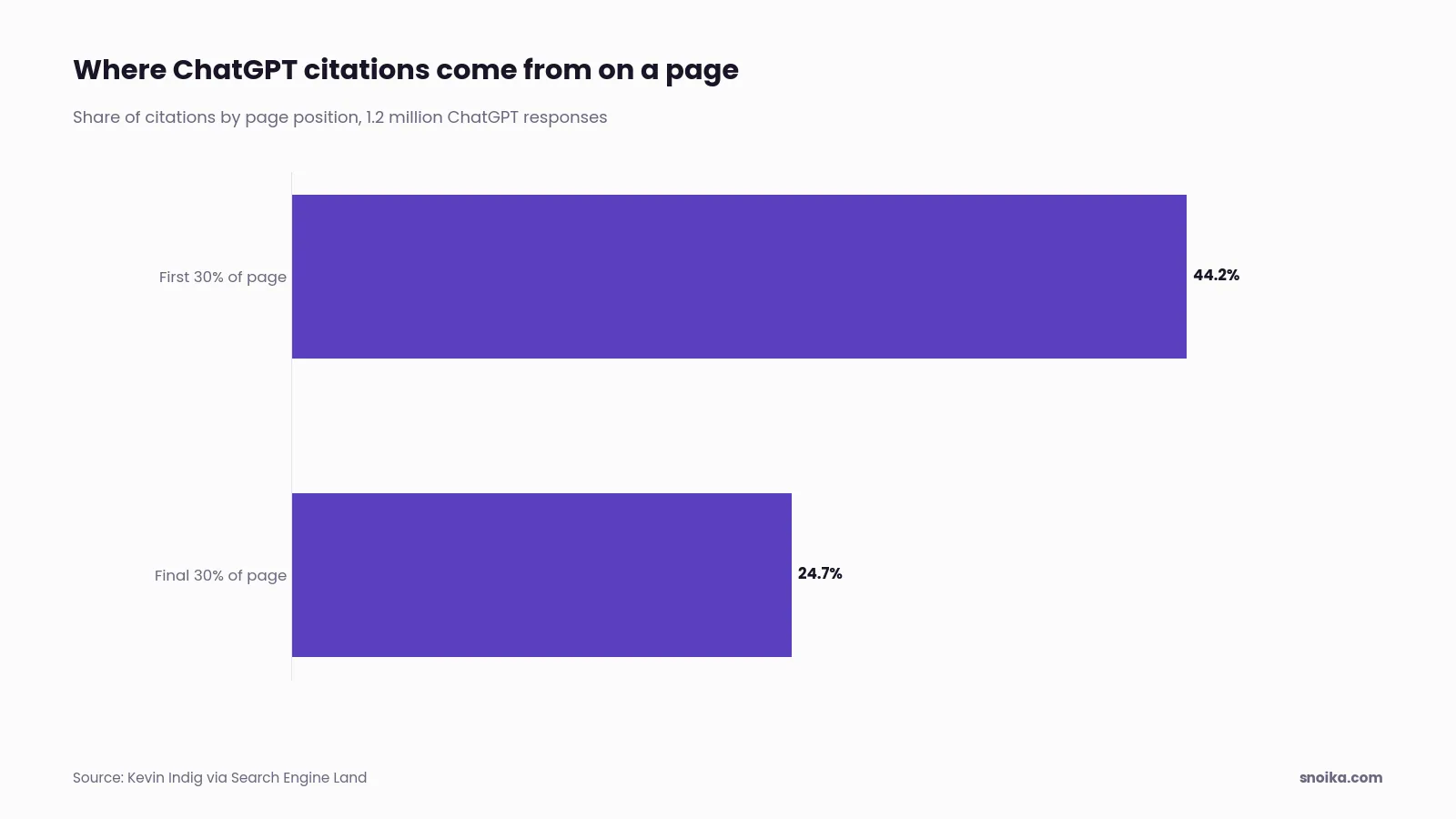
Answer-first content puts the answer to the heading in the section's first one or two sentences, then adds the evidence and the detail. LLMs pull from the top. Indig's study of 1.2 million ChatGPT responses found that 44.2% of citations come from the first 30% of a page, against 24.7% from the final 30%. Indig also found that cited passages used definitive language 36.2% of the time, against 20.2% for passages that weren't cited.
You can rewrite a section answer-first in five steps:
- Phrase the heading as the reader's question or topic. Use the words a buyer would type.
- Answer in the first sentence. Put the subject first and the verb right after it, and give the answer in 15 to 35 words. "A retained search fee is a third of first-year pay" beats "There are a number of ways fees are calculated."
- Use definitive verbs. Write directly with "X is" and "X costs."
- Put the proof second. Follow the answer with a number or a named source. An example or an explanation of the mechanism also provides support.
- Move caveats to the end. Exceptions and edge cases come after the answer, in their own sentence, so they don't blur the claim.
What the first sentence looks like depends on the query. For a definition query, open with "X is Y." In a how-to answer, give the first step or state the number of steps and what they achieve. Use a figure or a range to answer a cost query. Match the opening to what the reader asked for.
The warm-up intro that restates the question ("Many businesses wonder whether...") and the story opener that saves the answer for paragraph four are the two habits that most often break answer-first pages. Both push the useful sentence out of the zone models read most closely. On your top 10 pages, read only the first sentence under each H2. If those sentences, read alone, don't answer the page's question, the page isn't answer-first yet.
FAQ chunks boost retrieval
Question-and-answer chunks help retrieval because each pair has the same shape as a prompt. The question is the heading, and the paragraph under it is the answer. Indig's ChatGPT study found that cited content was twice as likely to contain a question mark, and that 78.4% of citations tied to questions came from headings.
The best questions come from your own buyers. Pull them from sales call notes and support tickets, then check Google Search Console for long, question-shaped queries that already reach your site. Give each question two to four sentences of answer that make sense without the rest of the page. Name the product or place in the answer itself, and state any relevant condition so the chunk makes sense when quoted alone.
For a product page, use five tight questions to cover pricing and setup, with room for questions about limits. A deep guide like this one works better with question-shaped H2s, so the whole page is effectively a set of answer chunks. FAQPage structured data labels the pairs for machines, but the answers still have to sit in visible text on the page.
FAQ blocks go wrong when they're padding. "Why choose us?" isn't a question anyone types into ChatGPT. An answer that says "see our pricing page" gives the model nothing to cite. It also hurts when the same answers are copied across 30 pages, because the engine then has no reason to prefer any one of them. Good AEO content answers each question once, on the page where it belongs.
Data signals authority
An LLM reads authority from 2 places, the specific evidence on your page and how often the rest of the web mentions you. Specific evidence means numbers and named sources, with roles stated for anyone you quote. Researchers at Princeton and Georgia Tech worked with researchers at IIT Delhi to test this in their 2024 Generative Engine Optimization (GEO) paper. Adding statistics lifted visibility in AI answers by up to 41%. Citing external sources in the text lifted it by as much as 115% for a page ranked fifth.
In an Ahrefs study of 75,000 brands, branded web mentions correlated with AI Overview visibility at 0.664, against 0.218 for backlinks. A model that keeps seeing your name next to a topic on other sites treats you as part of that topic. 3DPrinterOS, a Snoika client, reported an "87% increase in LLM brand mentions."
These on-page signals carry the most weight:
- Original numbers. Original research or product data you own, with the sample size and date stated, give a model a fact it can't get anywhere else.
- Sources linked at the claim. Name the study or publication in the sentence and link the figure itself, so the model can see where the number came from.
- Quotes from identified people. Give each person's role or relation to the topic, because an anonymous "expert" adds nothing.
- Consistent facts everywhere. Your prices and product names should match across your site and your third-party profiles. Keep your founding date consistent there too. Conflicting figures give a model a reason to cite someone else.
- Depth on one subject. A cluster of pages that answer related questions on one topic builds a clearer link between your brand and that topic than scattered posts do.
Pages published on your own domain build citations and mentions for that domain. A subdomain or a third-party platform splits that credit. Snoika's GEO services publish client pages this way, through a DNS connection with no site migration.
Check your five most important pages for unsourced figures, and for claims like "industry-leading" that no one could verify. Replace each one with a number and a link, or cut it.
Freshness raises citation odds
AI assistants cite newer pages than Google's organic results do, so a recent and visible update improves your odds. Ryan Law, Director of Content Marketing at Ahrefs, analyzed 17 million citations and found that AI assistants cite content that is 25.7% fresher than organic search results. The average cited URL was 1,064 days old, against 1,432 days for organic results. The time since the last update also averaged 909 days for cited pages, against 1,047 for organic results.
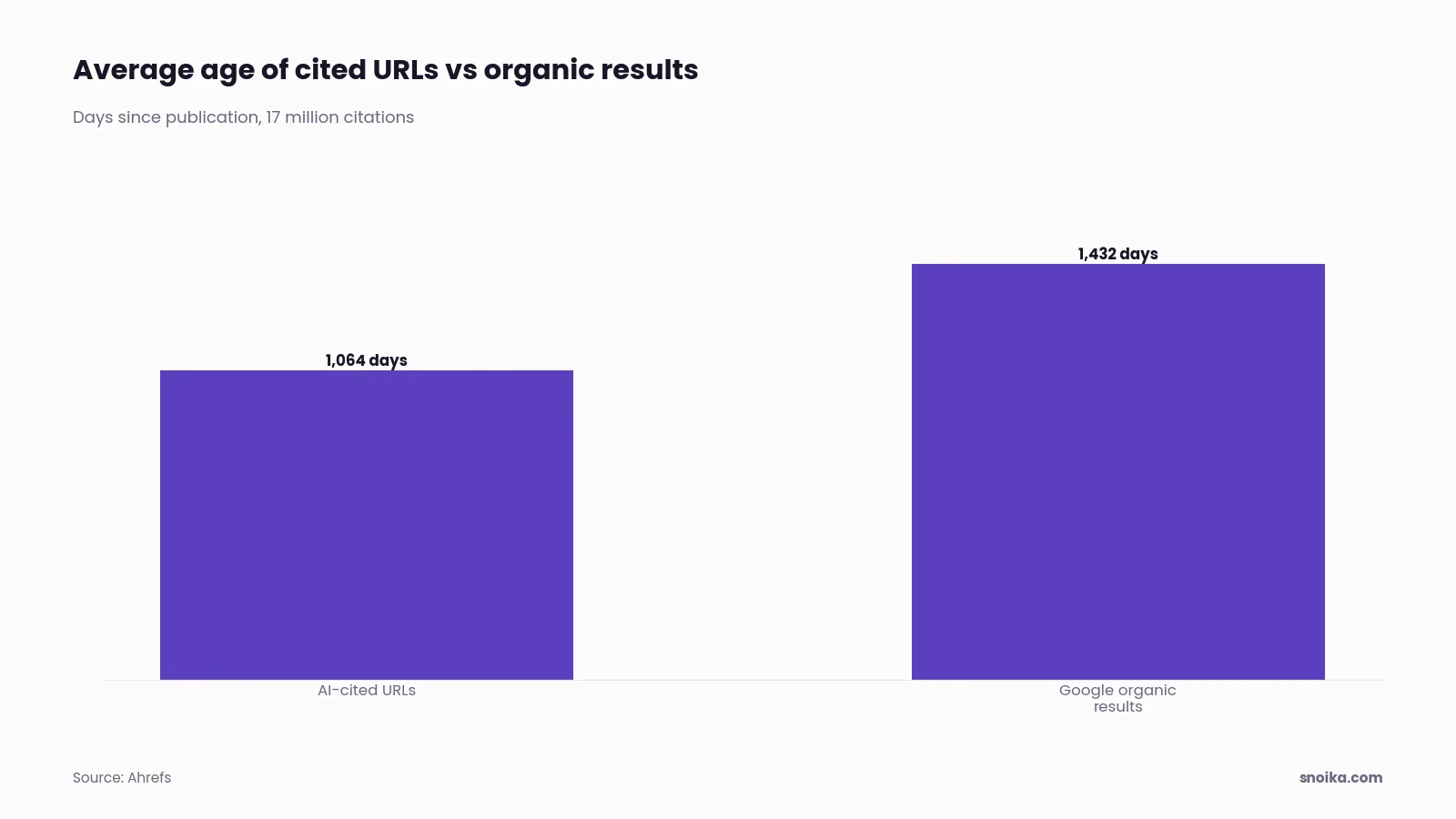
The same Ahrefs study found ChatGPT had the strongest preference for fresh content, while Google AI Overviews leaned toward older pages, in line with organic rankings. If ChatGPT is the engine your buyers use, your update schedule matters more.
An update that counts changes what the page says. Replace old statistics with the latest figures, and add a section on a sub-question that has come up since. Rewrite a recommendation that no longer holds. A date-only change leaves the page's usefulness unchanged and risks the trust of readers who notice. Once you've made a real update, show the "last updated" date on the page and set the dateModified field in your structured data to match.
Review pages with prices or tools every quarter, and use the same schedule for pages with yearly statistics. A yearly review is enough for a definition page because the topic changes more slowly. Start with the pages that already earn citations or rank on page one. Flag any with figures older than 12 months, and update those first.
Comparison pages capture intent
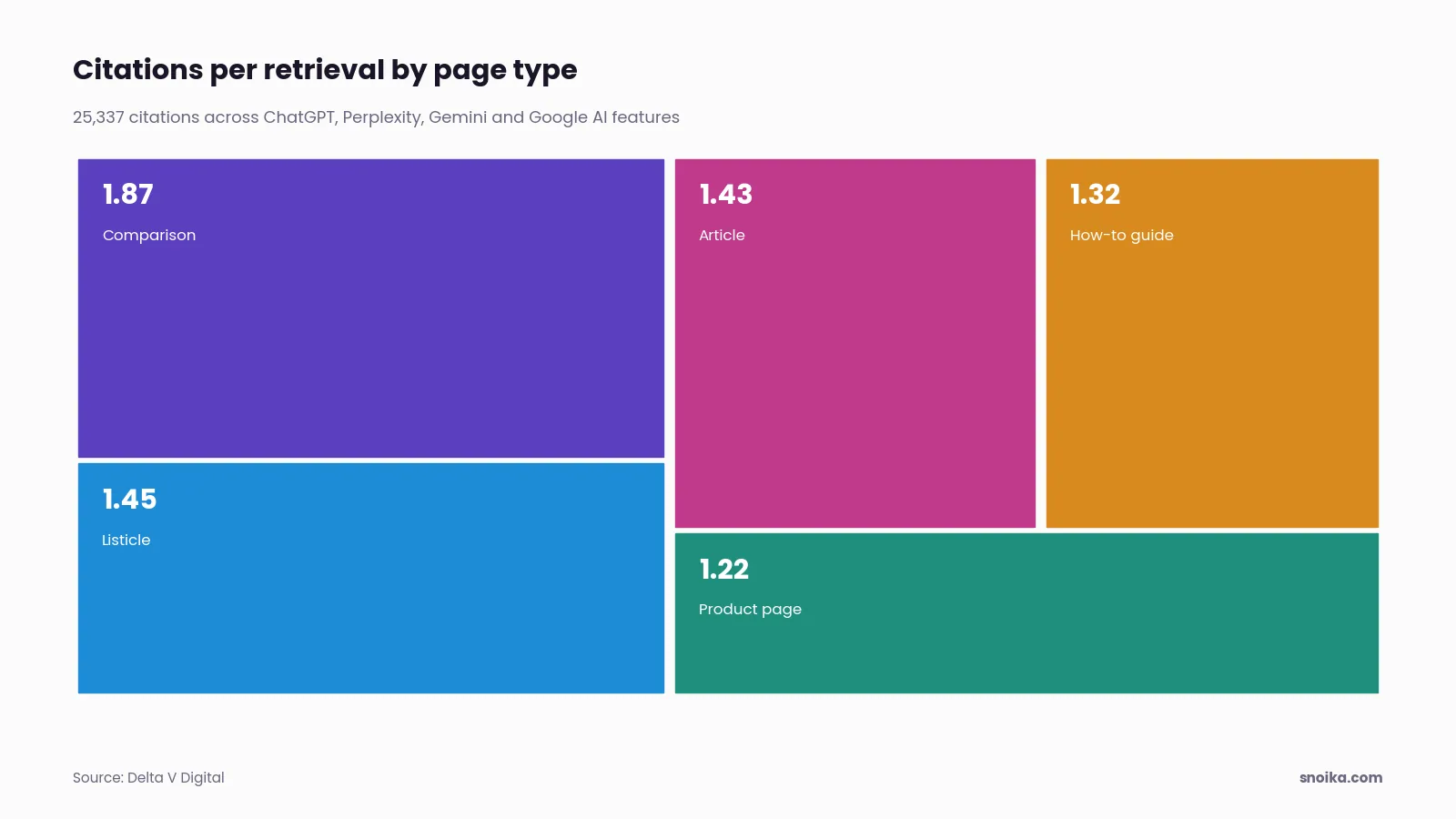
Comparison pages earn citations at a higher rate than any other page type, because they answer the "which one should I pick" questions buyers ask AI assistants. Delta V Digital studied 25,337 citations across ChatGPT and Perplexity, along with Google's Gemini, AI Overviews and AI Mode. It found that comparison pages earned 1.87 citations per retrieval, 45% above the average of 1.29. They still made up only 4.1% of all citations, because few sites publish them.
| Page type | Share of citations | Citations per retrieval |
|---|---|---|
| Article | 23.7% | 1.43 |
| Listicle | 19.6% | 1.45 |
| Product page | 16.3% | 1.22 |
| How-to guide | 4.5% | 1.32 |
| Comparison | 4.1% | 1.87 |
Article
- Share of citations
- 23.7%
- Citations per retrieval
- 1.43
Listicle
- Share of citations
- 19.6%
- Citations per retrieval
- 1.45
Product page
- Share of citations
- 16.3%
- Citations per retrieval
- 1.22
How-to guide
- Share of citations
- 4.5%
- Citations per retrieval
- 1.32
Comparison
- Share of citations
- 4.1%
- Citations per retrieval
- 1.87
The gap between share and rate is the opportunity. An engine cites a comparison page when it retrieves one, but the supply of these pages is small. Delta V found listicles took 61% of citations in B2B technology services and none in healthcare, where articles took 54%. Look at which page types get cited for your own category before you decide what to build.
A comparison page gets cited when it's useful even to someone who chooses an alternative. Put the options in a table with the same criteria for each, such as price and setup time. Add the team size each one suits. Then say plainly who each option is right for, even when an alternative is the answer. You can compare against generic alternatives, like an agency or an in-house team, when naming rivals isn't practical. Indig's study found that cited passages also leaned toward a balanced tone. A page that wins every row reads like an ad and gives the model nothing balanced to quote.
Conversational tone matches queries
Content written the way people talk matches the way they now ask, which makes your passages easier to retrieve for real prompts. AI queries in conversational search are longer and more specific than search keywords. The Nectiv study found ChatGPT's searches averaged 5.48 words, with 77% running five words or longer. Typical Google searches are shorter. The prompts that come before those searches are fuller still, with details about the reader's situation such as "for a 12-person team" or "in Germany". A condition like "without a developer" adds another constraint.
Write in the buyer's words and include their conditions. If prospects ask "how long does onboarding take for a small team", a section headed "Onboarding timeline for teams under 20" will match that prompt better than "Implementation methodology." Use second person where it fits. Contractions and plain verbs help the text sound natural. Keep the definitive voice from the answer-first section, though. Sound like a person talking while keeping the answer ahead of chatty openers or jokes.
Buyers prompt in their own language, and an engine answering a question in German or Portuguese looks for passages in that language first. Snoika creates SEO content in 135+ languages and regional variants for this reason. Check your Search Console queries by country. If your demand comes from places where English isn't the first language and every page is in English, you're asking the model to translate you before it can cite you.
Measuring LLM visibility
You measure LLM visibility by running a fixed set of real buyer prompts in each AI engine on a schedule. Each time, you record whether your brand is mentioned and whether your pages are cited, then compare your share with competitors. One check proves little, because answers change from run to run. SparkToro found less than a 1 in 100 chance that ChatGPT or Google's AI returns the same list of brands twice for the same prompt. As the report put it, "If you ask an AI tool for brand/product recommendations a hundred times nearly every response will be unique." Rand Fishkin, SparkToro's co-founder, ran the research.
So track percentages over many runs, never one position on one day. Ahrefs measured a 70% chance that an AI Overview changes between observations, with 45.5% of cited sources new each time.
| Metric | What it tells you | How to check it |
|---|---|---|
| Mentions | How often answers name your brand | Run your prompt set and count the answers that include you |
| Citations | Which of your pages engines link as sources | Record the cited URLs for each prompt and engine |
| Share of voice | Your mentions against competitors' for the same prompts | Divide your mentions by all brand mentions in the set |
| Sentiment | Whether answers describe you accurately and favorably | Read the passages that name you, and flag errors or negative framing |
| AI referral traffic | Visits that arrive from AI assistants | Filter Google Analytics 4 (GA4) referrals for chatgpt.com and similar sources |
| Search impressions | Exposure in Google, including AI features | Google Search Console Performance report |
Mentions
- What it tells you
- How often answers name your brand
- How to check it
- Run your prompt set and count the answers that include you
Citations
- What it tells you
- Which of your pages engines link as sources
- How to check it
- Record the cited URLs for each prompt and engine
Share of voice
- What it tells you
- Your mentions against competitors' for the same prompts
- How to check it
- Divide your mentions by all brand mentions in the set
Sentiment
- What it tells you
- Whether answers describe you accurately and favorably
- How to check it
- Read the passages that name you, and flag errors or negative framing
AI referral traffic
- What it tells you
- Visits that arrive from AI assistants
- How to check it
- Filter Google Analytics 4 (GA4) referrals for chatgpt.com and similar sources
Search impressions
- What it tells you
- Exposure in Google, including AI features
- How to check it
- Google Search Console Performance report
Build the prompt set from the questions your buyers actually ask, written the way they'd type them into a chat window. Run at least 10 prompts per topic weekly, with the wording fixed so the trend means something. Google reports clicks from AI features in the same Search Console report as the rest of your organic traffic, so don't expect a separate AI filter there.
Snoika starts client onboarding with access to GA4 and Google Search Console, then adds Google Tag Manager access. Weekly prompt sets track mentions and share of voice in ChatGPT and Google AI Overviews. The same sets also track sentiment and citations. Tracked over months, the numbers show whether the content changes worked. Snoika's founder Anton Vedeshin reported to Startup Reporter 1StopVAT's move from 2.7% to 28.3% ChatGPT visibility in 16 weeks.
What to do next
Choose one page that already ranks for a question your buyers ask, and record a baseline before you change anything. Run 10 prompts on that topic in ChatGPT and Google for two weeks and note mentions and citations. Then rewrite the page answer-first and add sourced figures. Without that baseline, you won't be able to tell whether your edits or the engines' normal swings moved the numbers. One page measured this way will teach you more about how to optimize content for LLMs than a site-wide rewrite you can't trace.
Our team audits sites and tracks brand visibility in Google and AI assistants, with a human review layer on top of automated workflows. A free AI visibility report is the usual first step. Book a call to get yours.
FAQ
Use self-contained sections with question-shaped headings, each opening with a direct answer. Put comparisons in tables and instructions in numbered steps. Check that each section names its subject and makes sense when read separately from the page.
Answer the heading in the first sentence, then support the claim with a number or named source. Copy the opening two sentences into a blank document to check whether they stand alone. Replace unclear pronouns with the subject's name.
Specific evidence on your page and relevant mentions elsewhere on the web help establish authority. Give original figures a sample size and date, and identify sources beside their claims. Check that facts on your site match those on third-party profiles.
Run at least 10 fixed buyer prompts per topic weekly in each engine and record which answers cite your pages. Compare citation percentages across repeated runs. Track mentions separately, since being named in an answer doesn't mean your page was cited.
Prepare a baseline before testing how to optimize content for llms on a page that already ranks. Run 10 fixed prompts on that topic for two weeks and record mentions and citations. Keep those results for comparison after the edits.
Keep reading
All articles

