
Amazon SEO for AI shopping assistants
Amazon SEO for AI shopping assistants means preparing product listings so Rufus (now Alexa for Shopping) and Walmart's Sparky can understand them and name them in a conversational answer. Keyword rank still matters. But an assistant recommends products it can explain, so it favors listings with complete attributes and clear use cases. It also looks for reviews that confirm the claims. This guide covers both marketplaces, in the order you'd do the work.
 Denys SuliatytskyiHead of Growth, Snoika · 9 min read

























Optimize listings for Rufus
To get Rufus to recommend a product, build the listing so it answers a shopper's question on its own. Name the product type and main use early in the title. Give each bullet one buying criterion and back each claim with a fact that reviews can confirm. Fill every backend attribute as well. Amazon renamed Rufus Alexa for Shopping on May 13, 2026, and the listing work stays the same. Amazon reported that 300 million+ customers used Rufus in 2025, which helped deliver nearly $12 billion in incremental annualized sales.
Work through priority products in this order:
- Pick 6 to 10 products that matter to revenue. Ask the assistant a fixed set of natural shopping questions about each one and save the answers with dates.
- Build one verified fact sheet per product before you edit any field (the section on fact sheets covers this).
- Rewrite the title in plain words around the product type and main use. Add the main material or spec.
- Turn each bullet into the answer to one real question, with the number first and the condition after it.
- Fill every required and optional attribute in Seller Central. Assistants filter on structured data before they read your prose.
- Use A+ content for a comparison chart across your own range, because shoppers ask an assistant which version to buy.
- Ask your baseline questions again once Amazon has indexed the changes, and record what moved.
Check your work by reading the listing as the assistant would. A finished listing gives someone enough information to answer a shopper's question, such as whether the product fits a small kitchen, from the page alone.
How Rufus ranks products
Rufus picks products by fetching information that matches the shopper's question and then writing an answer from it. Keyword position decides much less than it used to. Amazon's launch post, by Rajiv Mehta (Vice President, Conversational Shopping) and Trishul Chilimbi (Vice President and Distinguished Scientist, Stores Foundational AI), describes Rufus as "trained on Amazon's extensive product catalog, customer reviews, community Q&As, and information from across the web." Rufus draws on your listing and what buyers say about it. It also uses what the open web says about your brand.
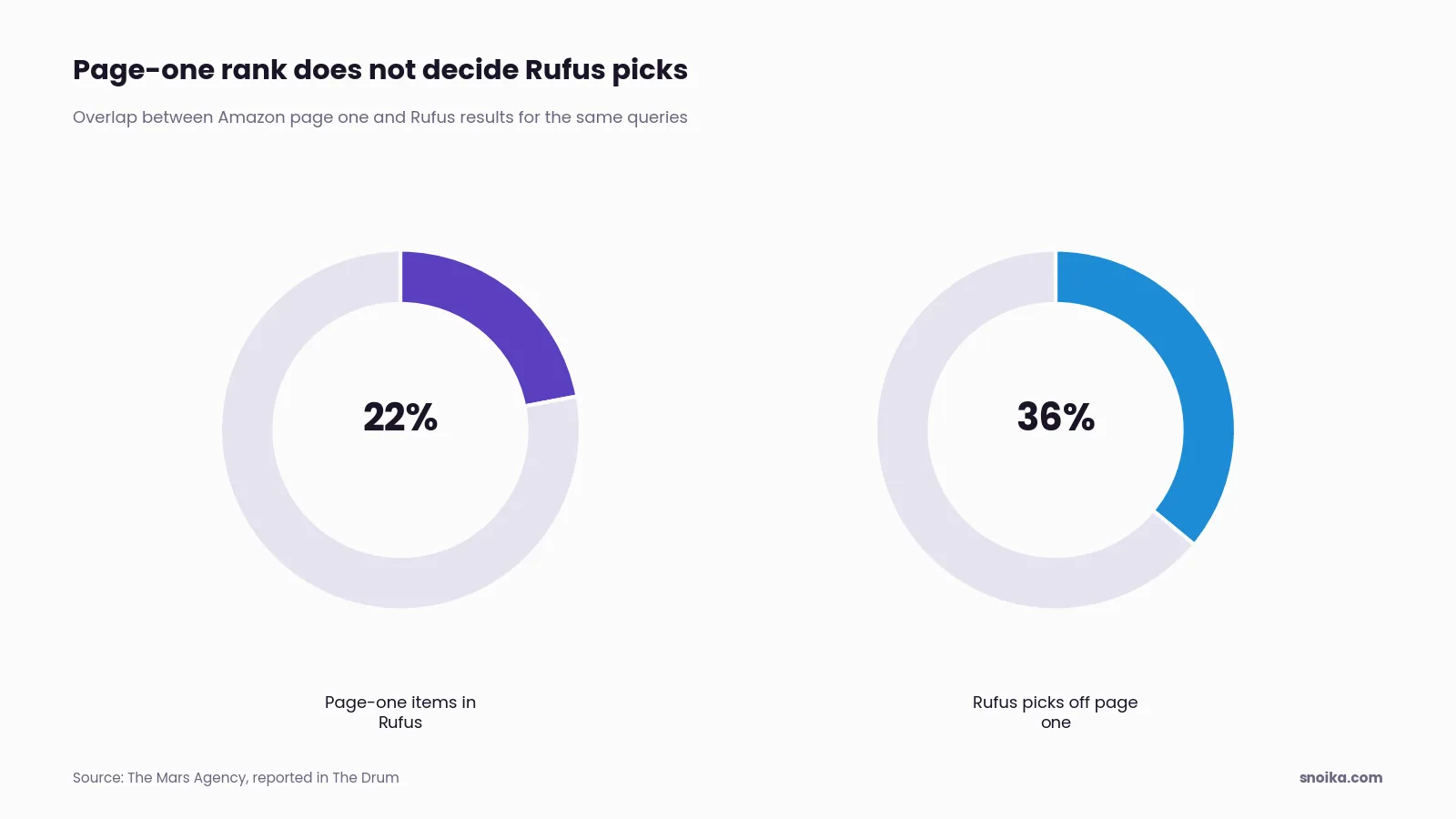
That mix explains why the assistant's picks differ from the results page. Research by the Mars Agency, reported in The Drum, found that only 22% of page-one products also showed up in Rufus results for the same queries. And 36% of Rufus picks weren't on page one at all. Search rank alone doesn't secure inclusion in Rufus answers.
Rufus answers inside a conversation, so a follow-up such as "which one is quieter?" narrows the set to products whose pages state noise levels. Sponsored Prompts are enabled automatically on campaigns and reached general availability in the US on March 25, 2026. Check your organic inclusion separately from your paid inclusion, or the two will blur together in your reporting.
The COSMO algorithm explained
COSMO is Amazon's commonsense knowledge graph. It links products to the reasons people buy them through content signals about function and audience. It also reads signals about the occasion and place of use, along with information on products bought alongside them. Amazon Science describes how the graph is built from query-purchase pairs and co-purchase pairs. A large language model then names the relationship behind each pair with canonical relations such as used_for_function. It also uses used_for_event and used_for_audience. Amazon's own example links slip-resistant shoes to pregnant women.
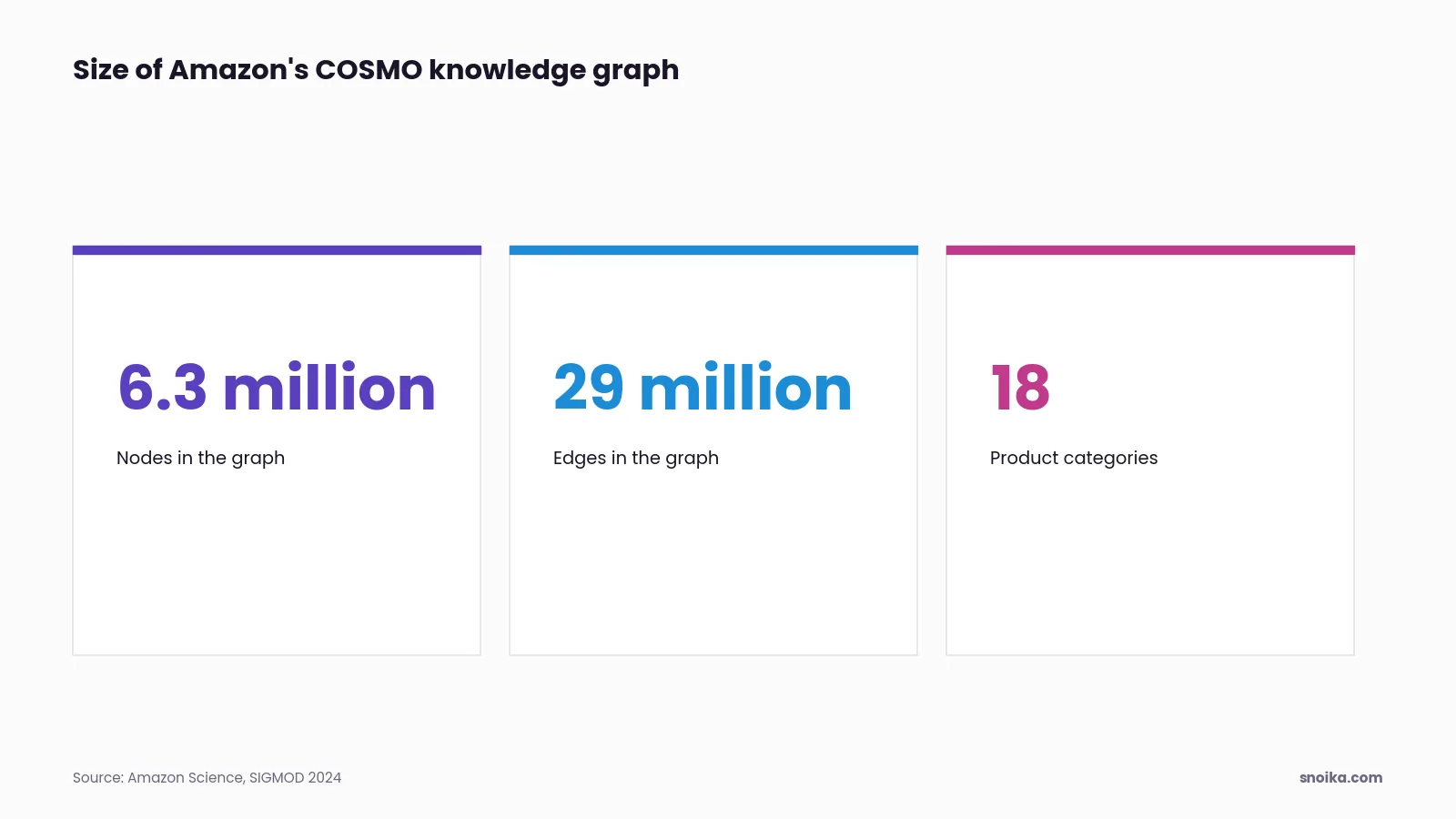
Its SIGMOD 2024 paper describes a graph of 6.3 million nodes and 29 million edges across 18 product categories. Address the signals the amazon cosmo algorithm encodes in your listing:
- Function: what the product does, in the words buyers use ("keeps coffee hot for 12 hours").
- Audience: who it's for ("for beginners" or "for renters").
- Occasion: when people use it (camping trips or holiday hosting).
- Location: where it's used (small kitchens or carry-on luggage).
- Pairing: what people buy with it, which you can mention as compatibility.
- Category: what it is, stated without clever names.
COSMO learns from what shoppers do. Copy can make a relationship that buyers confirm with their purchases explicit, so the graph and the assistant connect your product to it faster.
Question-led content structure
Write question-led copy by starting from the questions shoppers ask and answering each one in the first words of a bullet or paragraph. Amazon's own examples show the style of question Rufus handles on a product page: "is this jacket machine washable?" or "is this cordless drill easy to hold?" Answer each directly with a yes or a number, with a condition where needed.
Compare two versions of a bullet for a cutting board. "Crafted for the modern kitchen" makes a vague claim of premium quality. "This 12 mm high-density polyethylene board is tested to 80 °C and won't warp in the dishwasher" answers a shopper's question. The second answers a real objection with a spec that the assistant can quote.
Put the answer before its proof, with the qualifier next to the claim. Cover the objections your reviews raise as well. If buyers say a pan is heavy, state the weight and who it suits, because the assistant will surface that complaint anyway. Then check every bullet. Rewrite any bullet for which you can't name the shopper question it answers.
From fact sheet to copy
Turn the fact sheet into copy by mapping each verified fact to one listing field per marketplace, so every channel says the same thing. The fact sheet is one document with one owner per product. It records materials and finish alongside exact dimensions in inches and centimeters. Care instructions sit with certifications, while compatibility details accompany the main use cases. If the Amazon listing says bamboo and the Walmart listing says acacia, an assistant that compares sources will distrust both.
| Fact sheet field | Amazon placement | Walmart placement | What to check |
|---|---|---|---|
| Product type and main use | Title, item type keyword | Product name, category | Same wording on both |
| Dimensions and weight | Bullets, item dimensions attributes | Key features, attribute fields | Units and rounded values match |
| Materials and care | Bullets, material attribute | Key features, material attribute | No conflicting material names |
| Audience and occasion | Bullets, A+ modules, target audience attribute | Description, attributes | Matches what reviewers describe |
| Certifications | Bullets, compliance fields | Attributes, description | Certificate is current and named |
Product type and main use
- Amazon placement
- Title, item type keyword
- Walmart placement
- Product name, category
- What to check
- Same wording on both
Dimensions and weight
- Amazon placement
- Bullets, item dimensions attributes
- Walmart placement
- Key features, attribute fields
- What to check
- Units and rounded values match
Materials and care
- Amazon placement
- Bullets, material attribute
- Walmart placement
- Key features, material attribute
- What to check
- No conflicting material names
Audience and occasion
- Amazon placement
- Bullets, A+ modules, target audience attribute
- Walmart placement
- Description, attributes
- What to check
- Matches what reviewers describe
Certifications
- Amazon placement
- Bullets, compliance fields
- Walmart placement
- Attributes, description
- What to check
- Certificate is current and named
Use the sheet as your sole source for the copy. When the product changes, update the sheet first and push the edit to every field in the table on the same day.
Walmart AI search
To optimize a Walmart listing for AI shopping, fill item attributes in Seller Center completely and write the description around the questions Sparky shoppers ask. Work to raise the Listing Quality score as well. Walmart CEO John Furner told analysts on the fourth-quarter call that "the customers who use Sparky have an average order value that's about 35% higher than non-Sparky customers." David Guggina, CEO of Walmart U.S. said about half of Walmart app users use the tool and called it a move "from traditional search to intent-driven commerce."
The Listing Quality dashboard is the clearest signal Walmart gives sellers. It scores each listing out of 100 on four listing factors. Content and discoverability is one factor, and offer is another. Ratings and reviews sits alongside post-purchase quality in the score. Attributes carry the content score, and they're what an assistant filters on when a shopper asks for a size or a material.
Sparky went live inside ChatGPT and Gemini in March 2026, so your item data now answers questions on surfaces Walmart doesn't own. The differences from Amazon come down to fields and tools. Walmart has no A+ equivalent for every seller, so the description and key features do more of the work. Check the dashboard's missing-attribute list first, since those gaps cost visibility in search and in Sparky.
Signals AI assistants read
Assistants read structured product data before the language in reviews and Q&A. They then read what the wider web says about the brand. Each layer answers a different part of the shopper's question.
Structured attributes and specs
When a shopper asks for "a carry-on under 7 pounds," the assistant filters by weight and can only shortlist products whose weight sits in a field it can read. Empty optional fields are the most common gap our audits find on marketplace catalogs, and they're also the cheapest to fix. Use the units the marketplace expects, and keep the values in your product feed identical to your fact sheet.
Reviews and community answers
If the copy says "quiet" and 40 reviews say "loud," the assistant will report the reviews. Read the last 100 reviews for each priority product and note the words buyers use for benefits and complaints. Fix the product or the copy where they disagree. Answer open community questions with the same facts as the listing.
Pages off the marketplace
Rufus draws on information from across the web, so generative engine optimization of brand pages that explain use cases and comparisons gives assistants more to work with. Snoika's GEO services publish those pages on the client's own domain through a DNS connection that requires no migration. The client retains control and approves each page in a dashboard before it goes live.
Measuring AI-driven discovery
Measure AI-driven discovery by asking your baseline questions again on a fixed schedule and comparing the answers with the first log. Record which products appeared and what wording the assistant used to justify each pick. Note the objections it raised as well. A change in that justification wording is the first sign that an edit worked, before sales move.
Pair the log with Search Query Performance in Brand Analytics, which shows your share at each step of each query's funnel. It tracks impressions and clicks before cart-adds and purchases. Longer, conversational queries that start showing up there point to assistant-driven traffic. If you run ads, Sponsored Prompts report results for each prompt, which tells you which questions convert.
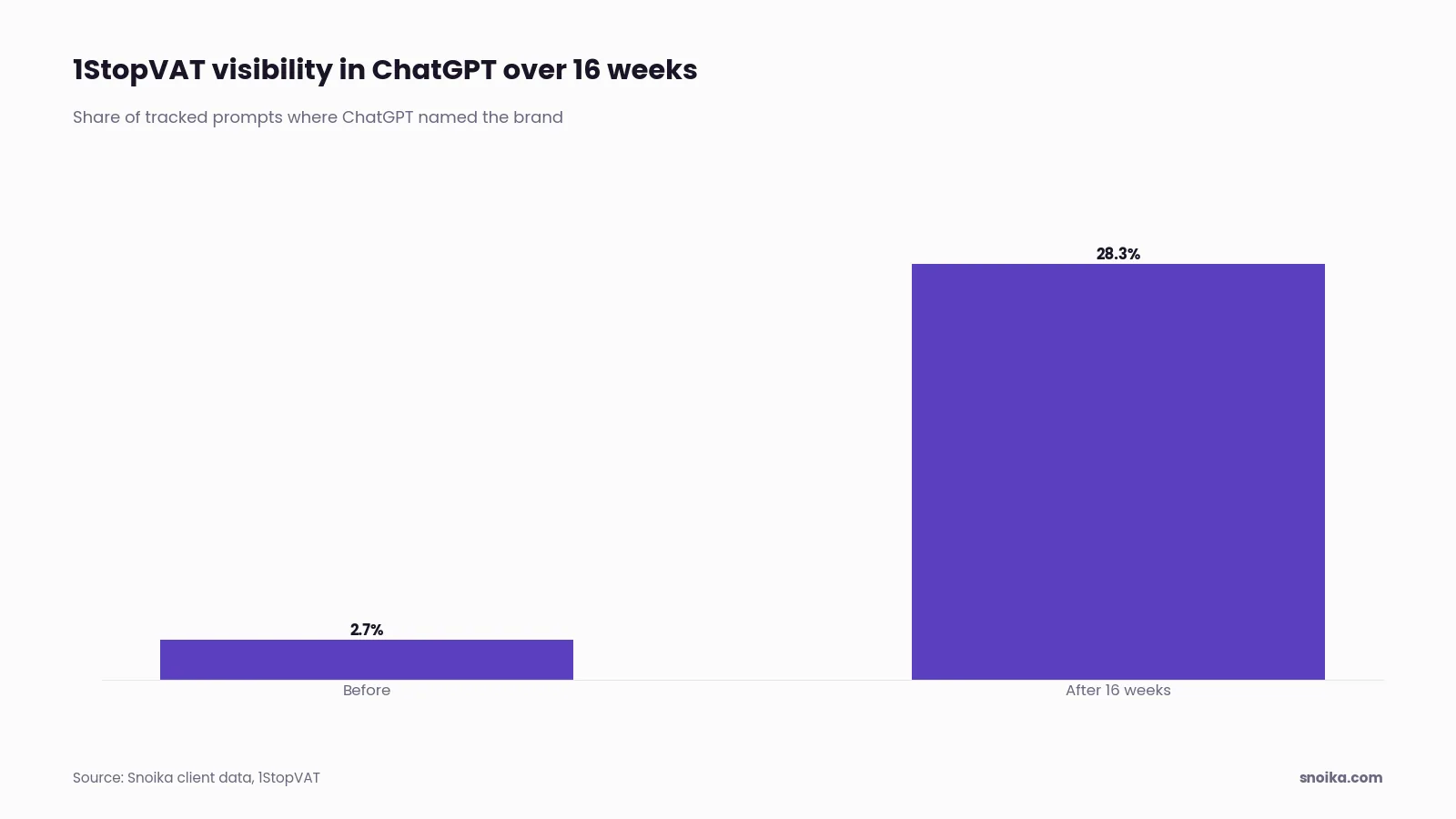
Snoika's weekly prompt sets measure mentions and share of voice in ChatGPT and Google AI Overviews to track discovery outside the marketplace. The tracking also measures sentiment and citations. Snoika's founder Anton Vedeshin reported to Startup Reporter 1StopVAT's move from 2.7% to 28.3% ChatGPT visibility in 16 weeks. Whatever tool you use, change one variable per product between checks. Otherwise you can't tell which edit caused the result.
Keyword research for AI queries
Keyword research for AI queries collects the full questions shoppers ask and maps them to the reasons they buy. Single head terms tell you much less. The method below works on both marketplaces:
- Write down the suggested questions the assistant offers on your product pages and your competitors' pages. They show what the system expects shoppers to ask.
- Pull the benefit and complaint phrases from your reviews and from the top three competitors' reviews.
- Export Search Query Performance and sort for queries of five or more words.
- Tag each question with the COSMO relation it expresses. Use function or audience for questions about what a product does or who it's for. Occasion and location cover when and where it's used. Use pairing for questions about products bought alongside it.
- Find the tags your listing doesn't answer yet, and add those answers to the fact sheet before they reach the copy.
Volume figures for conversational queries are thin, so rank questions by how often they show up across these sources. For sales in more than one country, research how questions differ by market and language because a translated English bullet misses the local phrasing. Snoika creates content in 135+ languages and regional variants, though the research step comes first whoever writes the copy.
Choosing who does the work
Choose the owner according to where the gap sits in your listings or off-marketplace work. Gaps in measurement also affect that choice. Most brands need more than one of these.
| Option | Covers Amazon and Walmart listings | Covers ChatGPT and Google AI Overviews | Cost (2026) | Suits |
|---|---|---|---|---|
| In-house marketplace team | Yes, with direct account access | Rarely | Staff time | Brands with a catalog manager already in place |
| Marketplace agency | Yes | Sometimes, as an add-on | Quoted per project or retainer | Brands that need listing rewrites at scale |
| Monitoring-only tool | No edits, reporting only | Often | Subscription | Teams that can act on data themselves |
| Snoika | No direct Seller Central edits | Yes, tracking and publishing on your domain | Plans on the pricing page | Brands whose AI visibility gap sits outside the marketplace |
In-house marketplace team
- Covers Amazon and Walmart listings
- Yes, with direct account access
- Covers ChatGPT and Google AI Overviews
- Rarely
- Cost (2026)
- Staff time
- Suits
- Brands with a catalog manager already in place
Marketplace agency
- Covers Amazon and Walmart listings
- Yes
- Covers ChatGPT and Google AI Overviews
- Sometimes, as an add-on
- Cost (2026)
- Quoted per project or retainer
- Suits
- Brands that need listing rewrites at scale
Monitoring-only tool
- Covers Amazon and Walmart listings
- No edits, reporting only
- Covers ChatGPT and Google AI Overviews
- Often
- Cost (2026)
- Subscription
- Suits
- Teams that can act on data themselves
Snoika
- Covers Amazon and Walmart listings
- No direct Seller Central edits
- Covers ChatGPT and Google AI Overviews
- Yes, tracking and publishing on your domain
- Cost (2026)
- Plans on the pricing page
- Suits
- Brands whose AI visibility gap sits outside the marketplace
Listing edits belong to whoever holds the Seller Central and Seller Center accounts. Snoika fits the off-marketplace layer that assistants also read, and it measures how ChatGPT and AI Overviews describe your brand.
What to do next
Choose your 6 to 10 priority products this week and log the baseline answers before anyone edits a field. Without that record, you can't show that the work moved anything, and budget for the next round gets hard to defend. Schedule the fact sheets for the products where the assistant raised an objection your listing doesn't answer, because those fixes pay off first. Snoika tracks how ChatGPT and Google AI Overviews mention your brand, and we publish researched pages on your own domain as part of Amazon SEO work that extends beyond the catalog. To plan that work alongside your marketplace listings, talk to an AI search expert.
FAQ
Put the product type and main use early in the title, then make each bullet answer one buying question. Complete required and optional attributes using verified facts. This gives Rufus information it can cite, though search rank alone doesn't secure a recommendation.
COSMO connects products to their function and intended audience. It also considers occasions and places of use. State the product category and relevant compatibility details to clarify relationships reflected in shopper purchases, using claims your product facts support.
Start each bullet with a direct answer to a shopper's question, using a yes or a number where appropriate. Keep any condition beside the claim. If reviews raise an objection, such as weight, give the verified measurement rather than replacing it with a vague benefit.
Start with the Listing Quality dashboard's missing-attribute list and fill those gaps using your product fact sheet. Write descriptions and key features that answer shopper questions. Check that measurements and material names match the facts published on other marketplaces.
Measure amazon seo changes by repeating your recorded shopping questions after the edited listings are indexed. Compare product inclusion and the assistant's explanations with your baseline. Keep paid inclusion separate from organic results, and change one variable per product between checks.
Keep reading
All articles

