
Fintech SEO agency for AI search
When a finance lead asks ChatGPT which VAT compliance tool to trust, the answer names two or three brands and leaves out the rest. We're Snoika, a fintech SEO agency and platform, and our job is to get your product into those answers with content your compliance team approves before it goes live. Weekly tracking measures the increase in mentions and citations in ChatGPT and Google AI Overviews. The first step is a free AI visibility report, which shows where your brand appears today and where competitors appear instead.
AI visibility for regulated fintech
For a regulated fintech, AI visibility means an assistant names and accurately describes your product, with links to your pages, when a buyer asks about your category. Snoika is an all-in-one platform for AI SEO that also covers generative engine optimization (GEO) and answer engine optimization (AEO). The same team runs the software and the SEO solutions, and a human review layer sits on top of every automated workflow, which matters in finance, where a model that repeats a wrong fee or license status does real damage. TechCrunch put Snoika on its 2026 Startup Battlefield 200.
To get a regulated product into AI answers, the assistant needs consistent facts about your company across the web and a page on your own site that answers the buyer's exact question in terms it can check. If either one is weak, the model quotes a competitor or a review site instead. We start by asking ChatGPT the five questions your sales team hears most and recording which brands it names.
For a regulated fintech, AI visibility means an assistant names and accurately describes your product, with links to your pages, when a buyer asks about your category.
Why AI search changes fintech
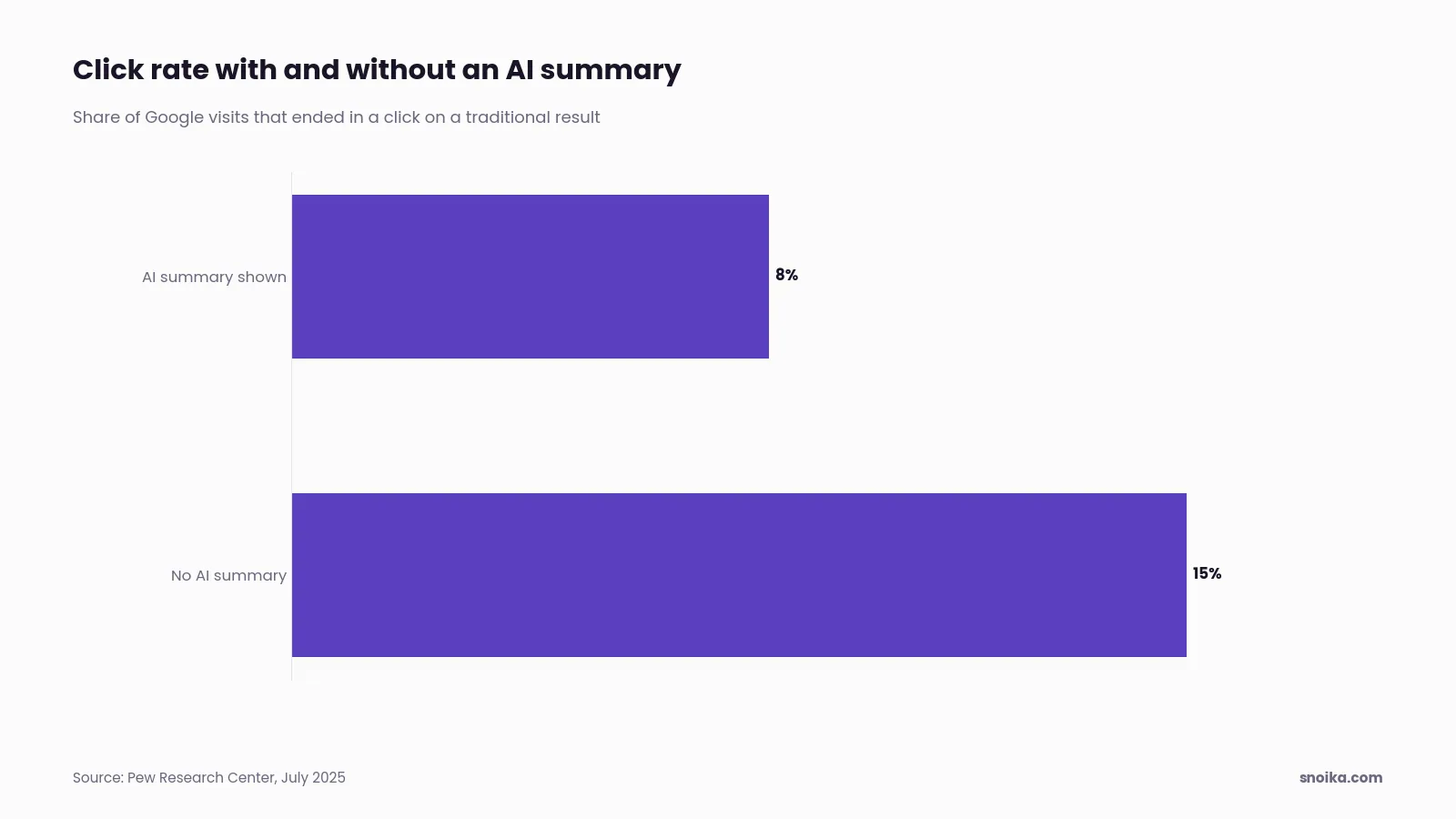
AI search changes fintech because buyers now build their shortlist inside an assistant, before they visit any vendor's site. A July 2025 J.D. Power report of 4,000 respondents, cited by the Financial Planning Association, found that more than 50% of consumers had used AI for financial advice, and 13% used it daily. Pew Research Center tracked the Google searches of 900 US adults and found that people clicked a traditional result in 8% of visits when an AI summary appeared. Without a summary, the figure was 15%.
For a payments API or a consumer lending app, a page that ranks third goes unread while a brand the summary names makes the shortlist. That's why our weekly prompt sets measure mentions, share of voice, sentiment and citations in ChatGPT and Google AI Overviews, where most AI search traffic happens. In Google Search Console, we look for impressions rising while clicks fall, a sign that AI Overviews are answering your queries for you.
Compliance shapes content strategy
Compliance decides what a fintech page is allowed to say, so it has to shape the content plan before anyone writes a word. In the UK, the Financial Conduct Authority (FCA) requires promotions to be "fair, clear and not misleading," and its March 2024 guidance extended that test to social media. Lucy Castledine, the FCA's Director of Consumer Investments, put it bluntly: "Promotions aren't just about the likes, they're about the law."
Our content map separates educational pages from pages that count as promotions, and the rest of the work follows from that split:
Promotional pages
They carry risk warnings and sourced claims.
Local disclosures
Rules vary by market, and because we write in 135+ languages and regional variants, each version follows its local rules instead of a straight translation.
Your approval
No page goes live until you approve it in the dashboard.
At the start, we confirm who in your company signs off on pages and how many days that review takes.
Entity data models trust
Entity data helps a fintech brand get recommended because AI models recommend brands they can describe with confidence, from facts that agree across the web. Your entity is defined by your legal name, license type and place of registration, along with your products and founders. A study of 75,000 brands found that branded web mentions had a 0.664 correlation with AI Overview visibility, while backlinks scored 0.218.
Our work starts on your own site with Organization schema that records your legal name and registration details and links to your official profiles. Those facts need to match on regulator registers, LinkedIn and the directories your buyers read. Entity data drifts in three common ways:
Old product names
A retired name hangs on.
Shared brands
Two legal entities share one brand.
Wrong license labels
A press release calls you a bank when you hold an e-money license.
We ask ChatGPT to describe your company and compare its answer with your regulator's register entry.
Regtech citations done right
Regtech companies show up in ChatGPT when they publish the specific, sourced answer a compliance officer would otherwise get from a lawyer, and when other sites cite that answer. Each page we write answers one regulatory question, names the primary rule it relies on and shows the date it was last checked. Comparison pages and filing checklists get quoted because a model can lift a precise answer from them, while generic thought leadership almost never does.
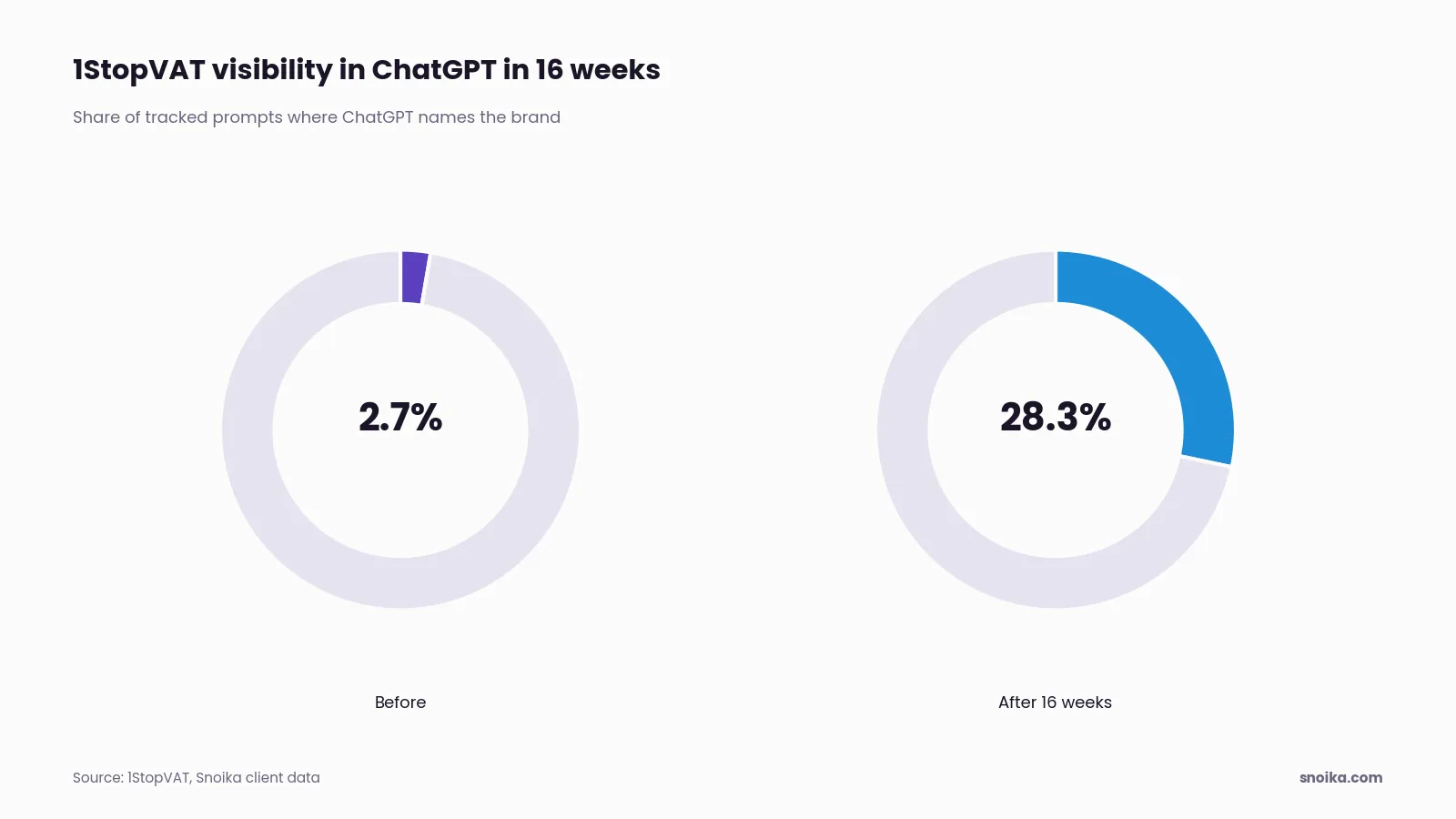
Trade publications and partner pages that quote your explanation give the model a second source that agrees with the first. Snoika's founder Anton Vedeshin reported to Startup Reporter 1StopVAT's move from 2.7% to 28.3% ChatGPT visibility in 16 weeks. When a rule changes, we update the page on the day it changes, because an outdated threshold is the fastest way to lose a citation you've earned.
Technical signals for YMYL
Google classes finance as YMYL ("Your Money or Your Life"), which covers topics that carry a high risk of harm because they "could significantly impact the health, financial stability, or safety of people." Pages on these topics face a stricter quality bar, and AI systems that draw on search results inherit it.
What AI crawlers need
AI crawlers need to reach your content and read it in plain HTML. If key facts load only through JavaScript, or your robots.txt blocks AI search bots, your pages drop out of the pool an assistant can cite. We check your server logs to see which bots actually visit. The pages we create go live on your own domain through a DNS connection, with no migration and no change of CMS, so any authority they earn stays with your domain.
AI crawlers need to reach your content and read it in plain HTML.
How pages prove authorship
Each page we publish names its author and reviewer with their credentials and shows a visible last-updated date. Your license number and registered entity belong in the footer, and claims link to primary sources. Raters and models both look for these signals, and without them a page reads as anonymous financial advice.
Each page we publish names its author and reviewer with their credentials and shows a visible last-updated date.
What fintech clients gain
Fintech clients gain more brand mentions in AI answers and more organic sessions, and when the content matches what buyers ask, more inbound leads. Vespia, a fintech SaaS, recorded a 220% increase in AI brand mentions.
Industry-specific SEO results depend on where you start and how crowded your category is. A brand with clean entity data and an approved content backlog moves faster than one fixing its basics. No one can guarantee placement in a model's answer, and we don't promise it.
Fintech clients gain more brand mentions in AI answers and more organic sessions, and when the content matches what buyers ask, more inbound leads.
How Snoika works with you
We work with you in the same order on every engagement, and your team stays in the approval loop at each stage.
Onboarding
We learn about your category, buyers and goals, and connect Google Analytics 4 (GA4), Google Search Console and Google Tag Manager.
Audit
We review your site and your entity data.
Tracking
We set up AI search visibility tracking in ChatGPT and Google AI Overviews on prompts from the stage where buyers compare vendors, such as "best e-money API for marketplaces," because that's where a mention turns into a lead.
Content map
We build a researched content map, ordered by which gaps cost you the most citations.
Content
We write the content and publish it on your domain once you approve it.
Off-site work
We run off-site strategies that earn mentions from sources models trust.
Reporting
You get reports with lead tracking, so you can link visibility to pipeline.
For integrations through an MCP server or our API, you'll see your visibility data inside your own tools. Access is arranged on a call with our team. Our team sets up access to both on request.
Trusted by

























FAQ
We report weekly, prompt-level citation data from ChatGPT and Google AI Overviews, and lead tracking connects visibility changes to pipeline. Every page passes your compliance approval before it is published.
We start with consistent company facts and pages that answer specific buyer questions using verifiable sources. Before publishing, we confirm whether each page counts as a promotion and get your compliance approval. We also check that AI search bots can access the approved content.
Focused answers to regulatory questions, supported by primary rules and a visible review date. We use comparison pages or filing checklists where they answer a buyer's question, and update affected pages when rules change so cited thresholds stay accurate.
Consistent company details help AI systems describe your product accurately. We compare your site's legal name and license information with regulator records, then correct conflicting descriptions on external profiles. This removes conflicting facts, but it doesn't guarantee a recommendation.
Timing depends on your starting position and how crowded your category is. Clean company data and an approved content backlog help the work move faster, and compliance review time is part of the plan. We compare weekly citation reports against your initial baseline.