
SaaS SEO agency for AI search
Your buyers now ask ChatGPT and Google AI Overviews which software belongs on their shortlist. The products those answers name are the ones that get demo requests. We're Snoika, a SaaS SEO agency and platform that works to get your product cited in those answers, then tracks the leads that come from them. The first step is a free AI visibility report, which shows the prompts where your product already appears and the ones where a competitor is named instead.
SaaS SEO built for AI
For SaaS, our AI-search-first, industry-specific SEO strategy starts with the questions buyers ask assistants, then makes your pages and your mentions on other sites the sources those assistants quote. Rankings still count, because answer engines pull from search indexes. A July 2025 study found that 76% of AI Overview citations came from pages ranking in Google's top 10. The targets shift from keywords to prompts and from clicks to mentions.
Our strategy has four parts:
Prompt map
We map the prompts a buyer asks at each stage, such as "what is X" and "X vs Y".
Answer pages
We publish pages that answer each prompt in their first lines.
Outside mentions
We earn mentions on the third-party sites assistants trust.
Weekly counts
We count how often each assistant names you, every week.
A new product in a crowded category needs outside mentions before its own pages get cited, while an established brand has the mentions but lacks pages written as answers. That's why our SEO solutions list prompts as well as keywords.
How Snoika gets SaaS cited
We get SaaS products cited through a single workflow on an AI search visibility tool our own team operates, with audits and reporting built in. The people who build the software also deliver the service, and a person reviews the output of every automated step. TechCrunch put Snoika on its 2026 Startup Battlefield 200.
Onboarding
We learn about your category, your buyers and your goals, and connect Google Analytics 4 (GA4), Google Search Console, Google Tag Manager and, when we publish pages, your content management system (CMS).
Audit
The audit finds what stops search engines and assistants from reading your site, because pages crawlers can't read never reach the answer layer.
Tracking
We track your visibility in ChatGPT and Google AI Overviews, starting from 20 prompts your buyers actually ask.
Content map
A researched content map built around the prompts where you're missing sets the order of everything we write.
Content
We write content in 135+ languages and regional variants and publish it on your domain.
Off-site work
Off-site strategies go after the mentions your own site can't earn.
Reporting
Reporting with lead tracking ties the work to pipeline.
Owning category answers
The content that wins category answers in Google AI Overviews is a category page that defines the space in its first two sentences, backed by use-case and integration pages that link to it. A Pew Research Center study found that 88% of AI summaries cited three or more sources, so a challenger can get named next to the leader.
The usual mistake is a definition written as homepage copy, full of claims an engine can't quote. We write a definition that a summary can lift word for word, then say who the category serves and how the options differ. How long this takes depends on how settled your category name is, so if buyers search under 3 different names, we test all 3 before we commit to one.
The content that wins category answers in Google AI Overviews is a category page that defines the space in its first two sentences, backed by use-case and integration pages that link to it.
Winning alternatives pages
Alternatives pages win citations when they name the competitor plainly, compare features and pricing in a table, and say who should pick which product. This page type gets quoted more than any other. In Radyant's study of 20,160 AI chats about software, comparison and alternatives pages made up 36.4% of review-platform citations.
Honesty is what earns the citation. When the page admits where the rival is stronger, an assistant can use it to answer a fair question, while a page that hides every weakness reads as an ad and engines skip it. Before we publish, we check each claim about a competitor against its current pricing page, because stale numbers get noticed fast.
Alternatives pages win citations when they name the competitor plainly, compare features and pricing in a table, and say who should pick which product.
Capturing best-software lists
To get your SaaS into AI "best software" answers, you need to appear on the lists and review pages those answers already draw from. Mentions count for more than links here. A study of 75,000 brands found that branded web mentions correlate with AI Overview visibility at 0.664, against 0.218 for backlinks. Our off-site work follows four steps:
Source check
We run your "best [category] software" prompts and record which sources each assistant cites.
Review profiles
We complete your profiles on the review platforms that show up in those citations.
Editor pitches
We pitch the editors of the cited listicles, with facts about your product they can check.
Fair list page
We publish your own list page that ranks the options fairly, your product included.
Content on your domain
Your SaaS content marketing should live on your own domain, because that's where citations and authority build up. The pages we create go live on your own domain through a DNS connection, with no migration and on any CMS. You review and approve each page in the dashboard before it goes live, and because the URLs are yours, the authority stays with you if the contract ends.
Agrello, in e-signature, recorded +125.6% organic search sessions year over year and generated 51.8K impressions from Snoika-created pages.
Your SaaS content marketing should live on your own domain, because that's where citations and authority build up.
Why AI-first SEO differs
AI-first SEO differs because assistants write a new answer every time instead of returning a fixed list of links. Sam Altman, CEO of OpenAI, said ChatGPT reached 800 million weekly users in October 2025. Alan Antin, Vice President Analyst at Gartner, said, "Generative AI (GenAI) solutions are becoming substitute answer engines."
AI-first SEO differs because assistants write a new answer every time instead of returning a fixed list of links.
Measuring pipeline over rankings
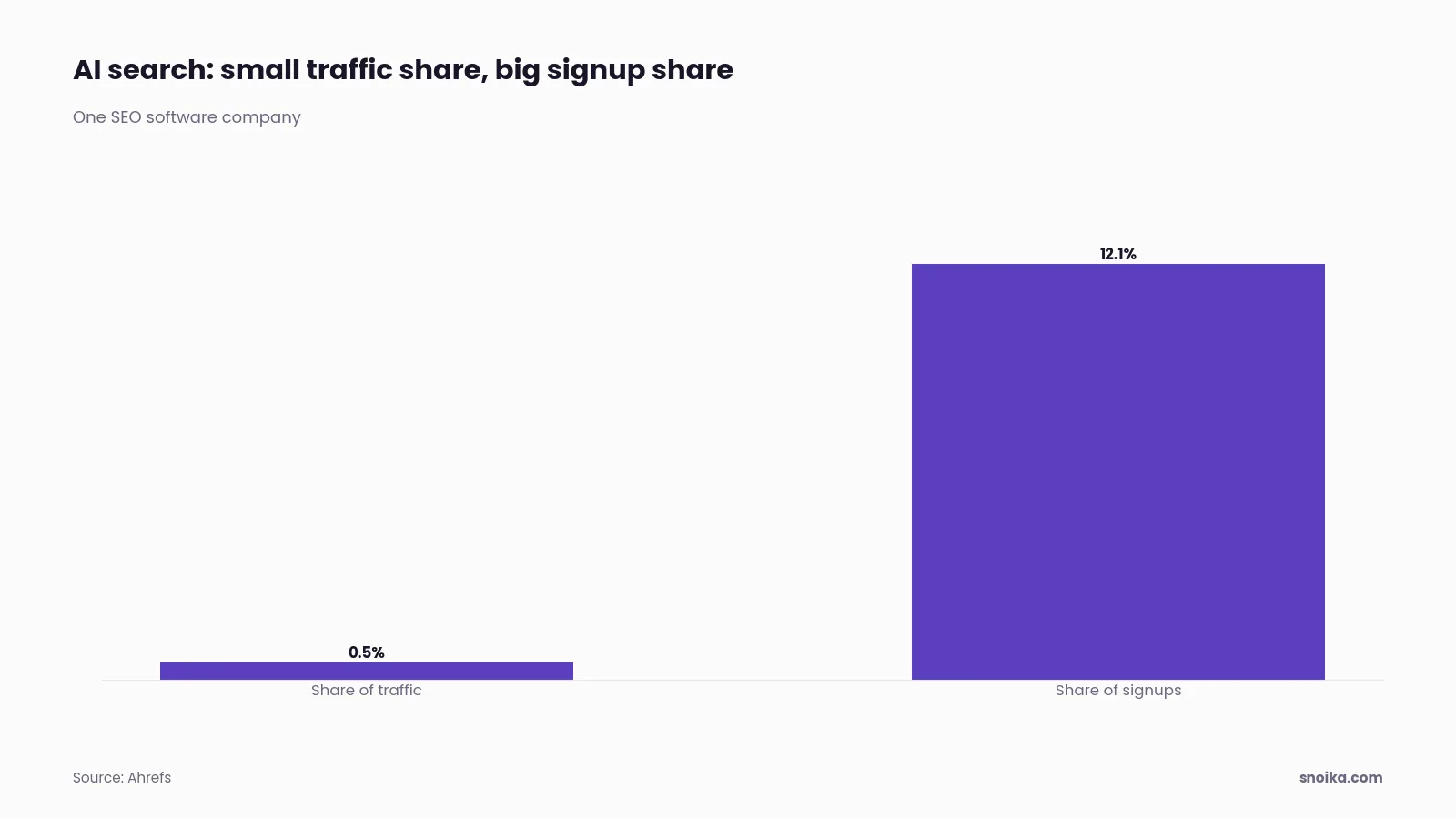
We measure SaaS lead generation first and use visibility as the early signal, because traffic alone misleads. Pew found users clicked a result in 8% of visits when an AI summary appeared, against 15% without one. Yet the visitors who do click are ready to buy: one SEO software company found that 0.5% of its traffic from AI search drove 12.1% of its signups.
A single "AI ranking" can't be trusted, since SparkToro found under a 1 in 100 chance that ChatGPT gives the same brand list twice. So we track mentions and share of voice across weekly prompt sets in ChatGPT and Google AI Overviews, where most AI search traffic happens, along with sentiment and citations. Snoika's founder Anton Vedeshin reported to Startup Reporter 1StopVAT's move from 2.7% to 28.3% ChatGPT visibility in 16 weeks.
On the pipeline side, 3DPrinterOS achieved #1 visibility in ChatGPT for industry-specific queries and now receives a steady 3–4 qualified inbound leads/day through AI search.
Trusted by

























FAQ
Look for prompt-level reporting, lead tracking and content that stays on your domain, which is how Snoika works. We measure your current visibility on the buyer questions that matter before any work starts, so every later report has a baseline.
We prioritize buyer questions where your product is missing from AI answers. A new product may need third-party mentions first, while an established product may need pages that answer those questions directly, and technical SEO stays in scope because assistants also draw from search indexes.
We target the review platforms and software lists that assistants already cite for your category. We run the relevant buyer questions to find those sources, complete your profiles, and give list editors verifiable product facts.
A category page with a factual definition in its first two sentences, supported by linked use-case and integration pages. If buyers use different category names, we test those names before choosing the page's focus, then explain who the category serves and how the options differ.