
Deep tech marketing for AI search
Your next buyer or investor will probably ask ChatGPT about your category before they open your website. That answer decides who makes the shortlist. Our deep tech marketing for AI search gets your technology named and cited there, with pages engineers trust and language models can quote, published on your own domain and tracked in ChatGPT and Google AI Overviews. The first step is a free AI visibility report that shows where you stand today.
AI-ready content for deep tech
The deep tech companies that get cited by AI publish owned pages full of verifiable specifics and earn mentions on sites they don't control. The specifics matter because models prefer content they can check. In the KDD 2024 study that defined generative engine optimization (GEO), Princeton and IIT Delhi researchers tested content with added statistics and quotations. With cited sources also added, they found that visibility in AI answers rose by up to 40%.
A study of 75,000 brands found that branded web mentions correlated with AI Overview visibility at 0.664 versus 0.218 for backlinks. What changes from company to company is which prompts your buyers actually type, so our AI SEO work tests the prompts your buyers use. Weekly prompt sets measure mentions, share of voice, sentiment and citations in ChatGPT and Google AI Overviews.
The deep tech companies that get cited by AI publish owned pages full of verifiable specifics and earn mentions on sites they don't control.
Why deep tech messaging differs
Deep tech messaging is harder because one page has to satisfy two readers. An engineer checks tolerances, while a buyer or investor can't read a datasheet. While a SaaS product can be explained by what it does on screen, a new battery chemistry or a novel actuator needs a reason to care before it needs specs.
“A pitch is very different from a thesis presentation and needs to excite even an uneducated audience,” says a Boston Consulting Group and Hello Tomorrow report on deep tech investment. Climate tech marketing shows the split clearly: the plant engineer wants efficiency curves, while the CFO wants payback in years. Before we publish a page, we check that both readers would find their answer on it.
Deep tech messaging is harder because one page has to satisfy two readers.
Translating specs for buyers
A robotics startup writes content investors understand when it leads with the problem and the measurable outcome, then gives the spec that makes the outcome possible. "VC is fundamentally a pattern matching machine. I think deep tech founders often just don't fit the pattern," said Adam Hammer, CEO of the deep tech fund Roadrunner, on the Fun Raising podcast. We give investors a recognizable pattern on every page:
Customer
Name the customer and the job that costs them money today.
Result
State the result in their units, such as hours saved, defects avoided or cost per part.
Spec
Give the one spec that produces that result, with its test conditions.
Datasheet
Link to the full datasheet for the engineers who will verify it.
A repeatability figure of ±0.02 mm means little to a fund partner until the page explains that it lets a line skip a manual inspection step.
Formats AI assistants cite
AI assistants mostly cite tables and direct answers they can lift whole. They also cite specs written in plain HTML. Each format suits a different kind of query.
Specification tables
Tables answer "which" and "how much" questions. We write the units into the column headers and add the test conditions. Each row covers one product or method, so a model can quote a single row and stay accurate.
Tables answer "which" and "how much" questions.
Answer-first sections
We open each section with one sentence that answers its heading, then explain. Models pull that first sentence word for word, so we write it to make sense on its own.
We open each section with one sentence that answers its heading, then explain.
Datasheets as web pages
Engineers rate content with specific technical detail, such as datasheets and CAD drawings, as the most valuable content type, according to GlobalSpec's 2023 State of Marketing to Engineers report. Too many hardware firms lock that detail inside PDFs. We publish the key figures as HTML text and keep the PDF as the download.
Engineers rate content with specific technical detail, such as datasheets and CAD drawings, as the most valuable content type, according to GlobalSpec's 2023 State of Marketing to Engineers report.
SEO for hardware companies
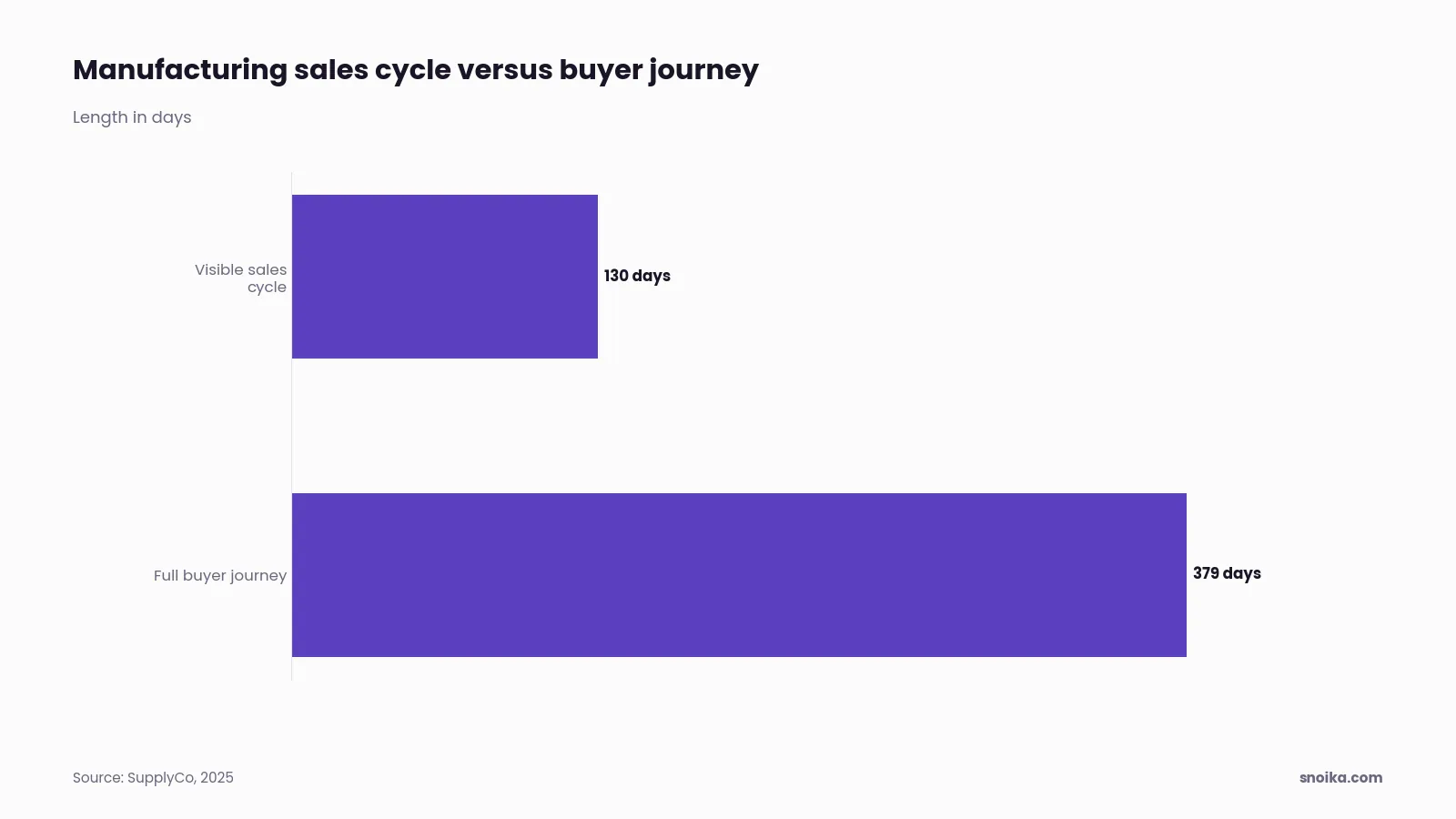
With long sales cycles, the industry-specific SEO tactic that works is a page for every question buyers ask during months of anonymous research. SupplyCo's 2025 analysis puts the visible manufacturing sales cycle at about 130 days, with the full buyer journey at roughly 379 days. The 6sense 2025 Buyer Experience Report found the winning vendor is already on the Day One shortlist 95% of the time.
Hardware marketing therefore needs pages for problem research, method comparison, integration and total cost, live long before a buyer fills in a form. The pages we create go live on your own domain through a DNS connection, with no migration and on any CMS, and you approve every page in the dashboard first. With this approach to 3D printing marketing, 3DPrinterOS achieved #1 visibility in ChatGPT for industry-specific queries and turned AI search into a steady source of 3–4 qualified inbound leads/day.
SEO for robotics companies
Robotics SEO works best when it targets the application. Buyers search for the task and the setting, like palletizing in cold storage or machine tending for small CNC shops. Very few type a model number.
We build one page per application, and each page states the payload, cycle time, floor space and integration route it covers. System integrators influence the purchase, so we write pages that help them specify your robot. To answer safety questions early, the pages explain how your cells meet ISO 10218, the international safety standard for industrial robots, and say what the customer still has to assess.
Robotics SEO works best when it targets the application.
Credibility with industrial buyers
Industrial buyers and AI models trust what other people say about you more than what you say about yourself. Muck Rack's "What Is AI Reading?" study of over 25 million cited links found that earned media makes up 84% of AI citations.
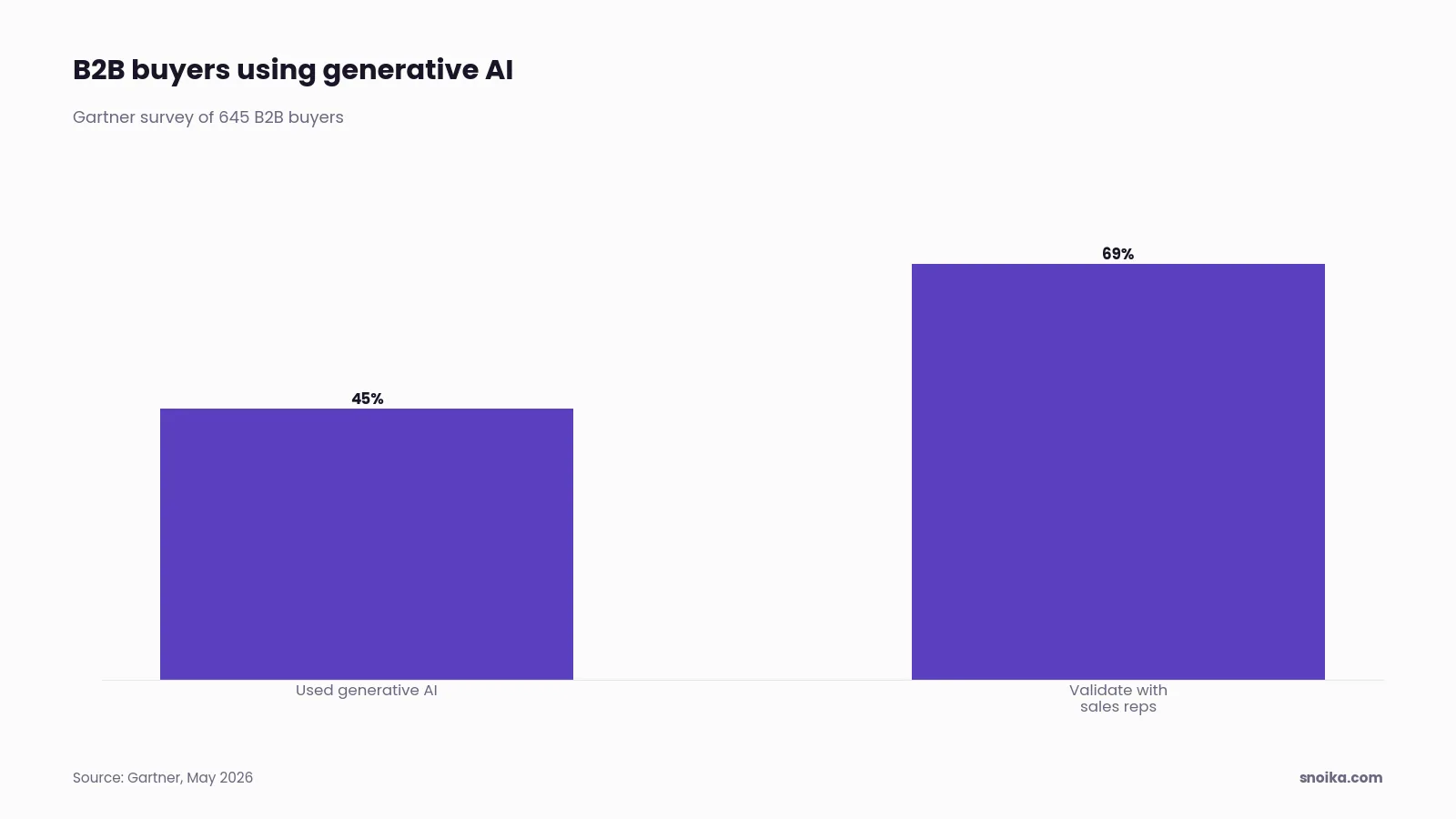
That puts trade press, standards bodies, distributor listings and conference proceedings at the center of our off-site work. Gartner's survey of 645 B2B buyers found 45% used generative AI, mainly to gather information on vendors, and 69% turn to sales reps to validate those insights. We check that the claims on your site match your listings, and that what your reps say on calls agrees with both.
Proof before case studies
Deep tech founders build credibility before they have case studies by publishing evidence that someone else can verify. On proof pages, we publish:
Pilot data
Results with stated test conditions and honest limits.
Lab results
Findings from third-party labs.
Grant awards
Public records of who funded the work.
Certifications
Standards certifications the product holds.
Research partners
Named partners and peer-reviewed papers.
A pilot report with real numbers and honest limits persuades engineers more than a polished testimonial does. Before we publish a proof page, we check that every number on it links to a document available to a skeptical engineer on request. TechCrunch's selection of Snoika for its 2026 Startup Battlefield 200 gave us a third-party reference of the same kind, one that holds up without any client story behind it.
How Snoika works
Our SEO solutions for deep tech run in a fixed order, starting from a measured baseline. They suit deep tech firms without an SEO team.
Onboarding
We learn about your category and its buyers in relation to your goals.
Baseline
We find which buyer prompts mention you and which name a competitor instead, which tells us which pages to build first.
Audit
We run an audit and set up AI visibility tracking in ChatGPT and Google AI Overviews.
Content map
A researched content map orders the pages by the gaps they close.
Content
We write content in 135+ languages and publish it on your domain after your approval.
Off-site strategies
We earn the third-party mentions that models trust.
Reporting
Reports include lead tracking, so the baseline becomes a number to judge results against.
Thought leadership for founders
Founder thought leadership works when it takes a position on a technical question and backs it with data only your team has. We help founders write about why a common approach fails at scale, what their test runs showed or where a standard falls short. Models cite these pieces because the claims appear nowhere else.
Founder thought leadership works when it takes a position on a technical question and backs it with data only your team has.
Trusted by

























FAQ
We start with pages that answer buyer prompts using verifiable evidence. We identify gaps in existing AI answers, publish direct answers or comparison tables with cited sources, and support those pages with accurate third-party mentions.
Lead with the customer's problem and a measurable business outcome, such as hours saved or cost per part, then explain the specification behind it. We include test conditions and link to a datasheet so engineers can check the claim.
We build pages around the questions buyers research before they speak to sales: problem research, method comparisons, integration and total cost. For robotics, we organize pages by application rather than model number, so the content matches how buyers search.
We publish evidence readers can verify, such as pilot data or third-party lab results, with test conditions and limits stated next to each result. We also check that the claims on your site agree with external listings and what your sales team says.