
What is a topical map in SEO site planning
A topical map is a plan that lists every question a website must answer to cover one subject in full.
It sorts those questions into pillar pages and cluster pages, then joins them with internal links. A topical map is a site plan built around subjects, while keyword lists are built around single search terms.























Topical map defined for SEO
In SEO, a topical map is the document a team writes before it publishes, so that each page has one job inside a larger subject. It starts from the questions people ask about that subject and groups them by intent. The map builds topical authority because search engines find a site that answers related questions together, with each page linked to its neighbors. Over time, they treat that site as a dependable source on the subject.
Not a topographic map
A topical map has nothing to do with the contour maps hikers carry. The two words sound alike, so people new to SEO sometimes type one when they mean the other. In content planning, "topical" just means "about a topic." What the map charts is subjects and how they relate, and nobody draws it with elevation lines.
Pillars with cluster pages
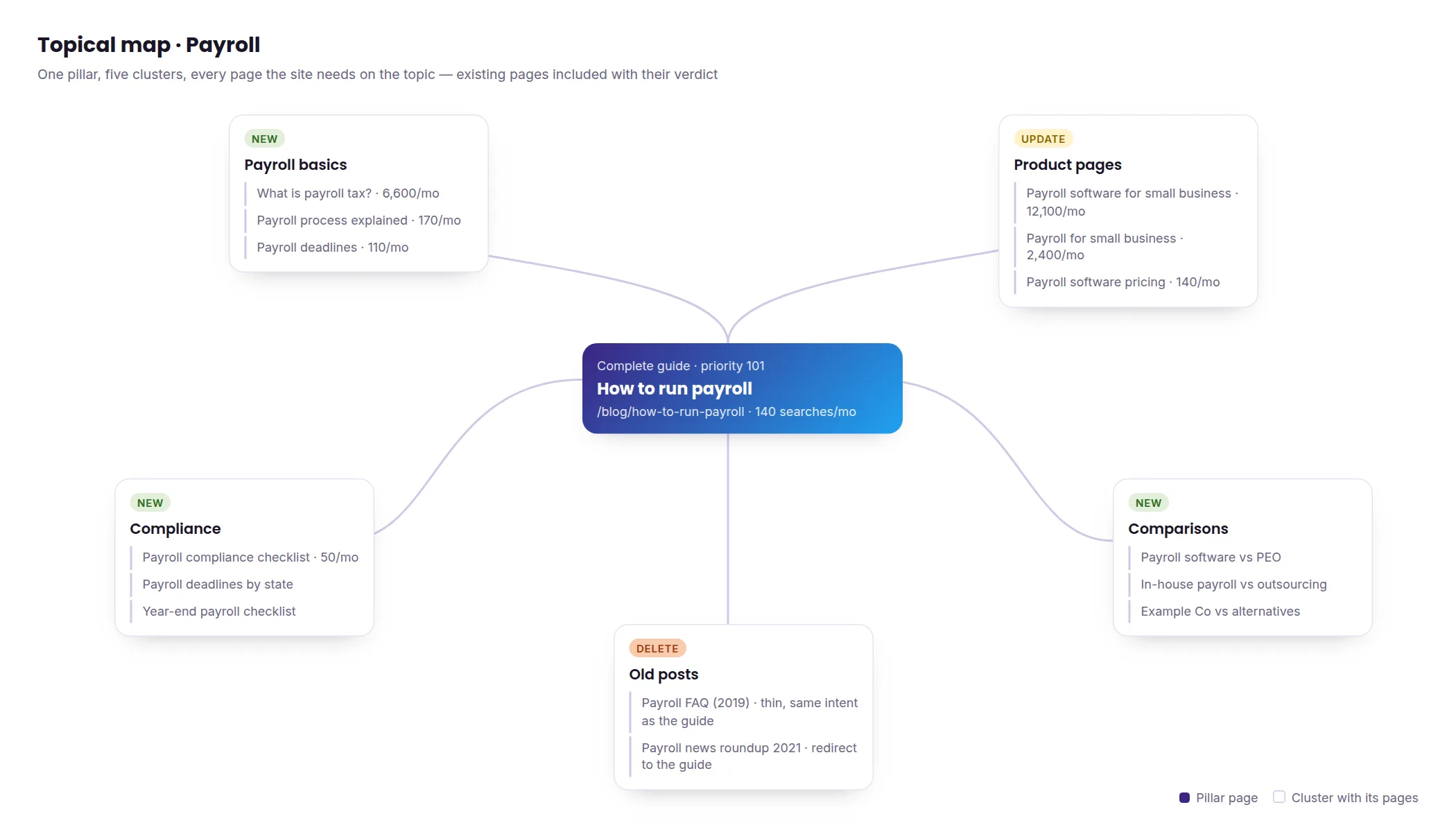
The two layers of a topical map are pillar pages that cover a broad subject and cluster pages that each answer one narrower question under it. The pillar gives the overview and links down to every cluster, while each cluster goes deep on its own question. A narrow subject needs only a handful of clusters, but a broad one needs dozens. Check that no two clusters answer the same question, because duplicate pages compete with each other in search.
How internal links connect it
Internal links turn a list of pages into a map. Every cluster links up to its pillar, and the pillar links down to each cluster. Clusters that share part of an answer also link sideways to each other. When you audit a map, look for orphan pages that have no links pointing to them. Those pages sit outside the structure, which reduces how frequently crawlers reach them.
Topical map vs content map
In SEO, a topical map and a content map are two names for the same kind of plan. When people distinguish the terms by scope, a topical map starts from one subject, while a content map covers a whole website. Snoika uses the content map name for that reason. In its content map, every existing page gets a verdict and every new page gets its place in a pillar and a cluster. Each page also carries the questions it must answer in AI assistants.
Why AI assistants reward coverage
AI assistants build answers from passages that address a specific question, so a site that covers a subject in full gives them more to work with. If you have a page for each related question, the assistant has more passages to match and cite. Gaps in coverage leave room for a competitor's page to fill. We test coverage by asking an assistant the questions on your map and noting which sources it names.
A short topical map example
Take a baking supply store that plans a pillar called "Sourdough baking guide." The store groups these cluster pages under the guide.
Each cluster links back to the guide. The page on rising problems also links to the hydration page, because the two answers overlap.
Related terms worth knowing
You'll meet these terms next to topical mapping. Each one sits close to it but describes something different.
Topical authority
Topical authority is the trust a site earns on a subject when it covers that subject in depth. The map is the plan, and authority is what search engines infer once the plan is published. You earn authority through the pages you publish.
Content cluster
A content cluster is one pillar together with its cluster pages. A topical map holds several clusters. So the cluster is one part of the map, and the map is the whole.
Keyword map
A keyword map assigns target search terms to specific pages. It works at the level of phrases, while a topical map works at the level of subjects and questions. Teams build the keyword map once the topical map is settled.
Semantic SEO
Semantic SEO means writing for meaning and related concepts. A topical map is one of its main planning tools. Once you know what a topical map is, start with one subject on your site and list every question a reader asks about it. Then sort those questions into a pillar and its clusters.