

What is GEO
GEO stands for Generative Engine Optimization and it is the practice of preparing your website pages for AI assistants like ChatGPT, Claude, Perplexity and Google AI Overviews. GEO is important today as never before because AI models read content online and treat it as sources to answer questions of your potential clients.
In early 2026, 68% of Google searches ended without a single click, and when Google shows an AI summary, people click a regular result on only 8% of visits. The answer itself became the battleground. Your page either gets quoted inside it or stays invisible.
Classic SEO no longer guarantees this. Ahrefs says that only 38% of pages cited in AI Overviews also rank in the top 10 for the same query. GEO is a separate discipline with its own rules. Research from Princeton confirms that applying those rules can lift a page's AI visibility by up to 40%.
What is GEO checker
The GEO checker is a free tool that measures how ready one page is to be cited by AI engines. You paste a URL and get a report in a few seconds. No signup, no email gate. The tool reads your page the way AI systems do, then runs 52 individual signals across 7 categories: content structure, machine-readable markup, evidence quality, AI crawler access, content humanness, linguistical patterns, and freshness.
Each signal returns numbers you can work with. Short comments explaining what each finding means are provided at the end of each run.
How to read GEO scores
The total score runs from 0 to 100 and maps to six grades. 90 or above earns an A+, meaning the page is genuinely well prepared for AI citation. 80 to 89 is an A, strong with minor gaps. 70 to 79 is a B, solid but with clear room to improve. 55 to 69 is a C, meaning AI engines can read the page but better-prepared competitors will usually be picked first. 40 to 54 is a D, and anything below 40 is an F, largely invisible to AI search.
Treat the score as a readiness measure and never as guarantee that the page will be cited by AI. No tool can promise you that because AI engines weigh many factors including your overall domain authority. What the score tells you reliably is whether your page helps or hurts your chances, and exactly where.
What each category shows
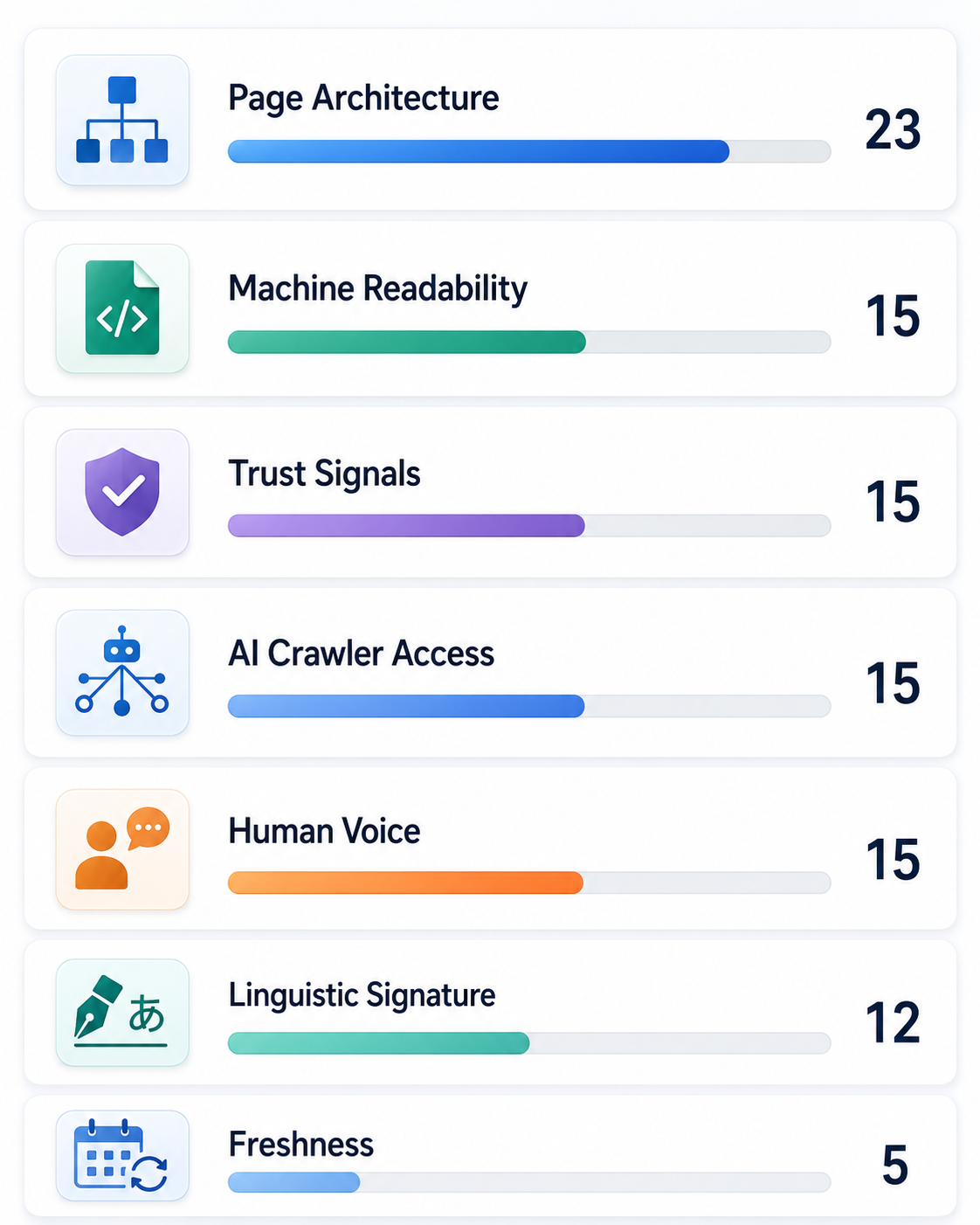
The 100 points are split across seven categories, which are as follows:
- Page Architecture (23 points) checks whether your content is structured so AI can lift answers from it: headings, question-phrased subheadings, short sections, lists and FAQ blocks.
- Machine Readability (15 points) inspects your structured data markup and image descriptions.
- Trust Signals (15 points) counts statistics, source citations, expert quotes and author identity which are all very important to AI models.
- AI Crawler Access (15 points) tests whether the 11 major AI crawlers are allowed in, whether your text is readable without JavaScript, and whether an llms.txt file exists.
- Human Voice (15 points) runs 15 detectors for typical AI-writing patterns that make content sound generic.
- Linguistic Signature (12 points) measures sentence variety, vocabulary breadth and paragraph sizing.
- Freshness (5 points) checks visible and structured update dates.
How GEO score is calculated
Every one of the 52 signals is a concrete measurement taken from your live page: counts, rates, presence checks. Each signal earns points inside its category, category points add up to the total, and thresholds are fixed in code. No AI model judges your content, which is why results are consistent and reliable.
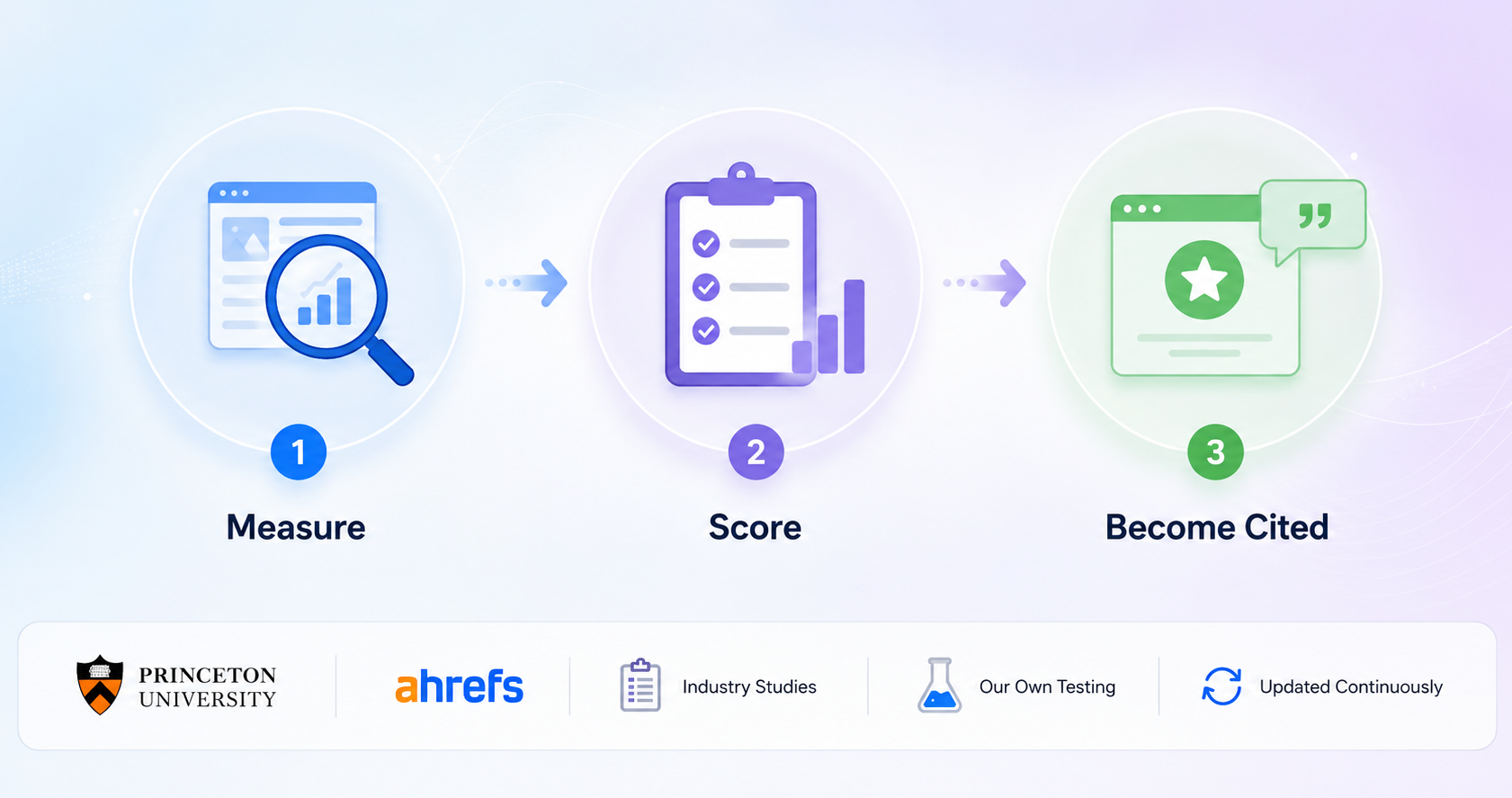
The category weights follow published evidence. Statistics, quotations and source citations each lifted AI visibility by 30 to 40% in the Princeton GEO benchmark, so Trust Signals carries heavy weight. AI assistants cite content that is 25.7% more recent than organic results on average, so freshness earns dedicated points.
AI engines do not publish their algorithms so nobody knows exactly the scoring criteria. Our weights reflect the best available research (Princeton, Ahrefs, etc.) plus our own testing, and we update them as new studies come out.
Who can use GEO checker
Anyone with a page to check because no technical skills are required.
- Content writers can use it before publishing to catch structural gaps and AI-sounding wording while edits are still cheap.
- SEO and marketing teams can audit existing articles to decide which ones to update first.
- Founders and small business owners can check whether their key pages appear at all in the new AI search landscape.
- Agencies can scan client pages and competitor pages side by side, because the score makes the gap concrete and easy to explain.
It also works as a writing quality check: the Human Voice and Linguistic Signature categories flag patterns that make text read like unedited AI output, which matters for readers and rankings alike. Google's March 2024 update cut low-quality content in results by 45%, so sounding human is now a measurable advantage.
What Snoika's GEO checker shows that other GEO checkers don't
Other free GEO tools check structure, markup and crawler access. We check those too but we go a few layers deeper. Two full categories analyze the writing itself.
- Human Voice runs 15 detectors for recognizable AI-writing patterns: filler signposting, vague attributions, repeated arguments and more, each measured per 1,000 words against defined thresholds.
- Linguistic Signature adds 10 statistical measures of style, including sentence variety and vocabulary breadth, based on peer-reviewed research comparing human and machine text.
You also get depth elsewhere: the crawler check covers 11 AI bots individually, the markup check looks for eight schema types, and freshness is verified in both visible text and structured data. Every one of the 52 signals shows your actual numbers with a plain-language comment, so the report doubles as a to-do list.

Common questions
What does the GEO checker actually measure?
It measures how ready one specific page is to be found and quoted by AI engines like ChatGPT, Perplexity and Google AI Overviews. The score combines 52 measurable signals across 7 categories, from content structure to crawler access to how human the writing sounds.
How is it different from the SEO checker?
The goal is different. An SEO checker measures how well a page can rank in a list of links, so it looks at keywords, meta tags, backlinks and technical health. GEO checker measures how well a page can be quoted inside an AI answer. AI engines lift short passages, and they favor direct answers, verified facts with named sources, machine-readable structure, and writing that sounds human. Most of those signals never appear in a classic SEO audit.
Is the tool really free?
Yes. No signup, no email, no trial. To keep the tool fast for everyone, each visitor can run up to 30 scans per hour and 100 per day.
How long does a scan take?
Usually 2 to 5 seconds.
Which URL should I test?
Test a real content page: a blog post, a guide, a product explainer. That is what AI engines cite. Homepages usually score lower because they are navigation hubs with little liftable content, and that is expected.
Can a high score guarantee that AI will cite my page?
No, and be careful with any tool that promises this. AI engines also weigh factors outside a single page, such as your domain's overall authority and how often your brand appears in their training data. What the score shows reliably is whether your page helps or blocks your chances, and which specific fixes would improve them.
My page ranks well in Google. Why is my GEO score low?
Because the two systems reward different things. Ahrefs says that only 38% of pages cited in Google's AI Overviews also rank in the organic top 10. A page can rank through backlinks and domain strength while still lacking the structure, evidence density and crawler access that AI citation requires.
Why did my score change since last week?
The checks are deterministic, so the same page content always scores the same. If the score moved, something changed: the page itself, its robots.txt, its structured data, or its update dates. Freshness checks also shift naturally as content ages.
What are the Human Voice and Linguistic Signature categories?
They analyze how the page is written. Human Voice runs 15 detectors for patterns typical of unedited AI text, like filler phrases, unsourced claims and hype vocabulary. Linguistic Signature measures the statistical shape of your prose: sentence variety, vocabulary breadth, paragraph sizing. Content that sounds human earns reader trust, and 62% of consumers say they engage less with content they know is AI-made.
Does using AI to write content hurt my score?
Not by itself. The tool does not detect whether AI was involved. It detects whether the text shows the patterns of unedited machine writing. Well-edited AI-assisted content passes these checks. Mass-produced, generic content does not, and Google's own policies treat that kind of content as spam.
What is llms.txt and do I need it?
llms.txt is an emerging standard: a plain-text file on your site that gives AI systems a curated map of your best content. Adoption is early and no major AI vendor has confirmed using it yet, so it carries only 2 points in our scoring. It is cheap to add and positions you well if adoption grows.
My site is behind bot protection. Can you still check it?
Often yes. The tool has a fallback for pages that block simple automated visits, and the report will tell you honestly when parts of the page could not be verified. If nothing can be read at all, you get a clear message instead of an inaccurate score. That result is itself useful because if we cannot read your page, many AI crawlers cannot either. And this can hurt your AI visibility.
Does it work for pages in other languages?
Partly, and the report is honest about it. The technical categories, like structure, markup, crawler access and freshness, are scored for any language. The two writing categories, Human Voice and Linguistic Signature, currently work for English content only, so for non-English pages they are shown as not scored and the total score is calculated from the remaining checks. Pages in scripts without spaces between words, like Chinese or Japanese, usually cannot be scored yet.
Do you store my page or my results?
No. Each scan is processed on the fly and the result is shown only to you. We do not publish your results or share them with third parties.
How often should I re-check a page?
After every meaningful edit, and otherwise about once a month. AI search is moving fast, freshness decays on its own, and we update the checks as new research appears, so periodic re-scans keep your picture current.
My score is low. What should I fix first?
Open the categories with the most missed points and start there. Crawler access issues come first, because if AI bots cannot read the page, nothing else matters. Structure and evidence fixes usually move the score most after that. If you would like this done for you, that is exactly the work Snoika does, from single-page fixes to a full AI visibility strategy.