Semrush AI toolkit review: how Snoika compares
This Semrush AI toolkit review comes from Snoika, so it sticks to published facts on both sides. Semrush offers teams already in its SEO suite an AI visibility tracking add-on. Snoika combines tracking with content that we write and publish on your own domain after review. The Semrush toolkit measures your AI visibility, but your team still has to do the work of raising it.

























Semrush AI toolkit reviewed
The Semrush AI Visibility Toolkit is an add-on that shows how AI assistants talk about your brand. It sits alongside Semrush's keyword, backlink and site audit tools. Semrush's documentation lists Visibility Overview, Competitor Research, Prompt Research among its reports, along with Brand Performance, Prompt Tracking and an AI Search Site Audit. It's available on its own or as part of Semrush One, which bundles the SEO and AI toolkits into one subscription.
On November 19, 2025, Adobe agreed to acquire Semrush for $1.9 billion, and the companies expected the deal to close in the first half of 2026. Before signing a long contract, we'd ask how Semrush will bundle the product with Adobe Experience Cloud.
What the toolkit tracks
The toolkit tracks how often AI answers mention your brand, what tone those answers take and which pages they cite. Coverage includes ChatGPT, Google AI, Gemini and Perplexity, and the base toolkit refreshes rankings daily for 25 custom prompts. The Brand Performance reports compare your share of voice and sentiment with competitors. Semrush explains that "AI platforms don't rank pages" because they give narratives and summaries.
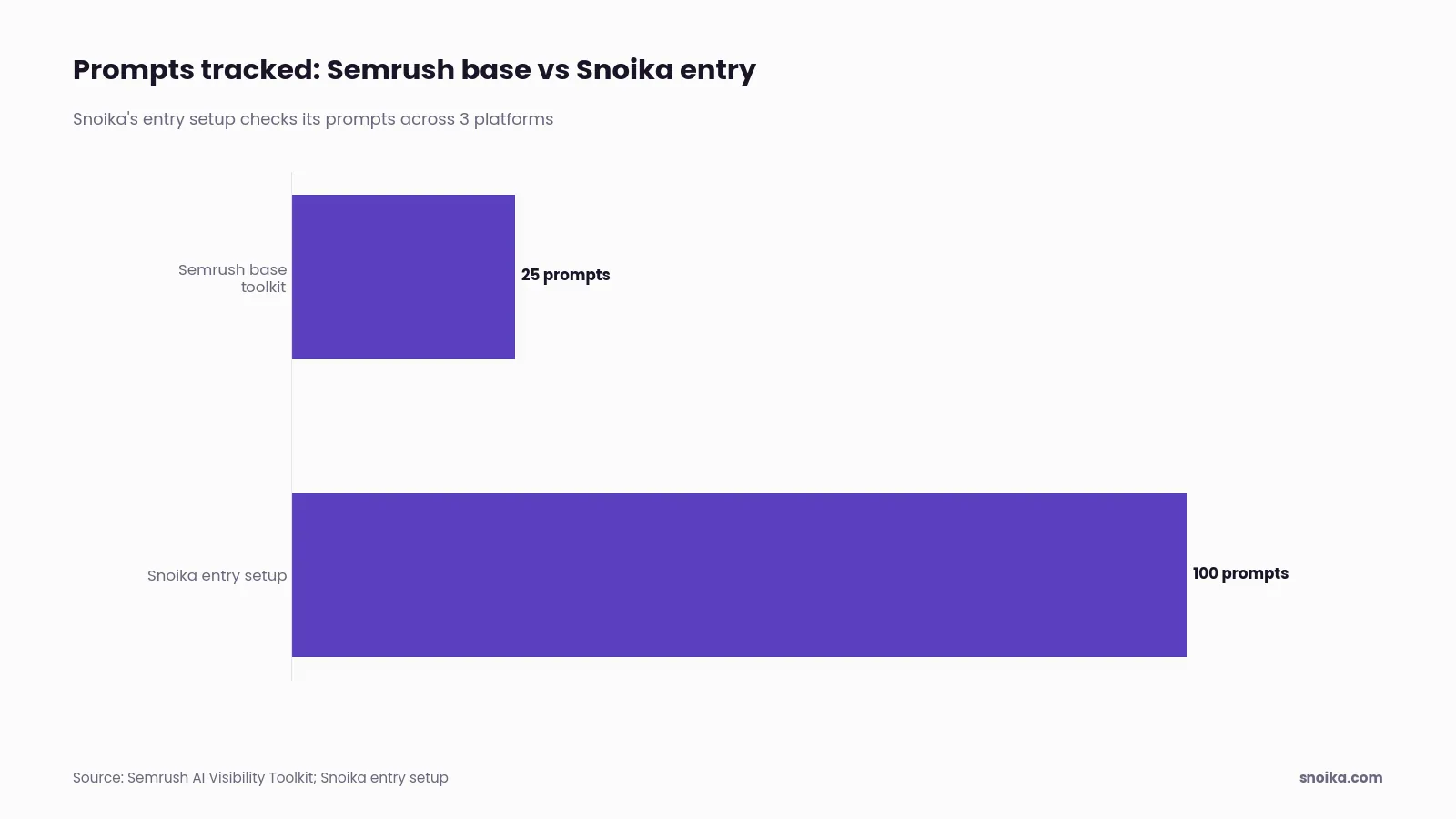
Snoika measures mentions, share of voice, sentiment and citations in ChatGPT and Google AI Overviews, where most AI search traffic happens, and runs prompt sets weekly. Semrush checks a wider range of engines at a higher frequency, while our entry setup checks 100 prompts across 3 platforms, 4 times the prompt volume of the base Semrush toolkit. When comparing AI SEO tools, we start from the engines your buyers actually use, because a daily score on an engine they never open won't tell you much.
The content production gap
The Semrush AI Visibility Toolkit monitors visibility and gives you recommendations. Once the reports show a prompt where competitors appear and you don't, someone on your side has to write the page and get it live. Semrush's Guru tier adds content marketing tools, but writing and publishing are still separate steps your team takes. Snoika closes that gap itself:
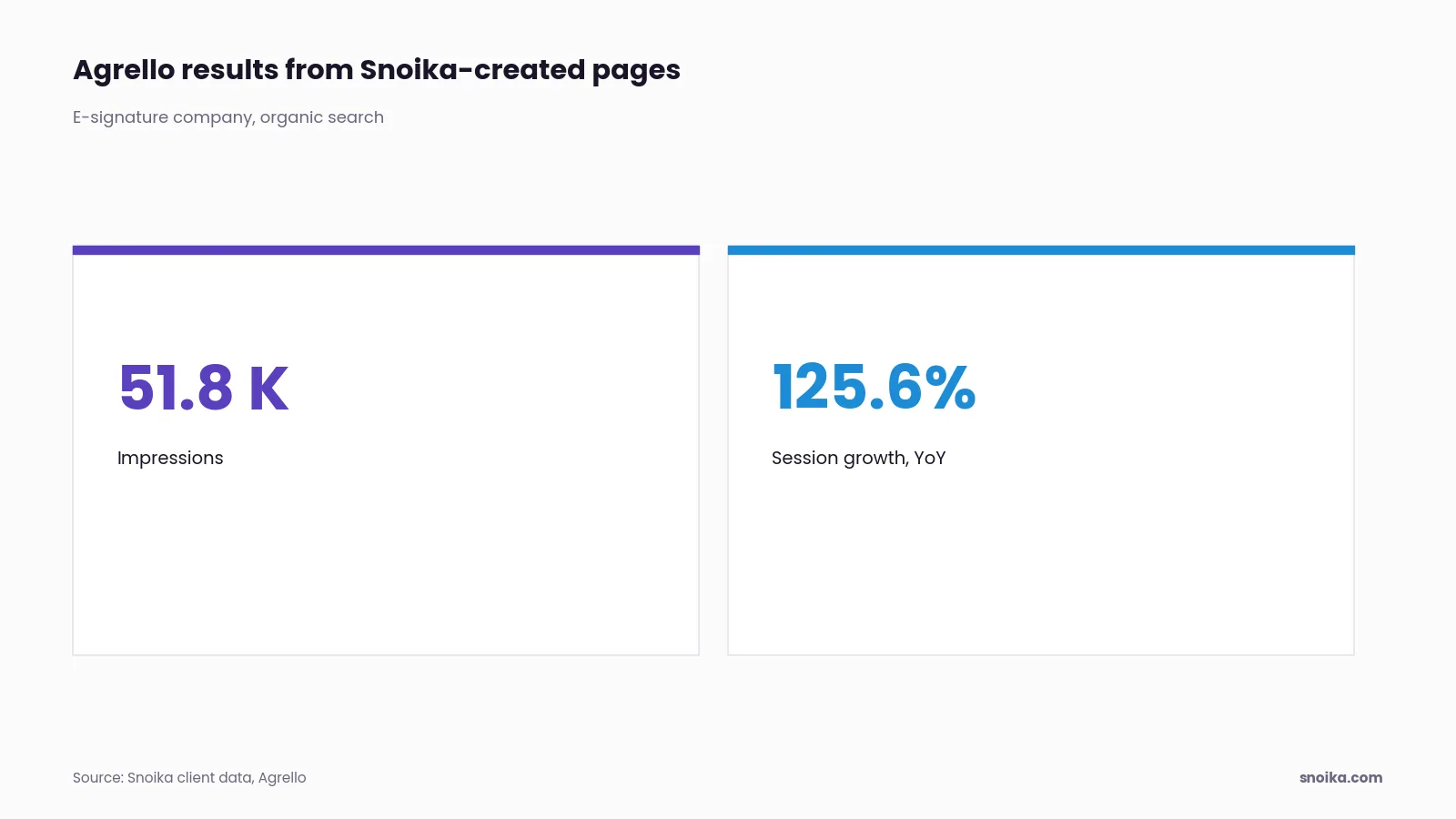
Agrello, an e-signature company, generated 51.8K impressions from Snoika-created pages and saw organic search sessions grow 125.6% year over year. The question for your team is who will turn the next visibility report into published pages, and how fast.
Which team fits Snoika
Snoika fits teams that want AI visibility to grow and don't have the writing capacity to make that happen themselves, such as a lean marketing team or a founder-led company that sells in more than one language. We create content in 135+ languages and regional variants, and our SEO packages cover both the platform and the work. Plans are on the pricing page.
1StopVAT, in tax and fintech, saw 10x growth in ChatGPT visibility in 7 weeks. Work like that starts with onboarding on your category, your buyers and your goals, plus access to Google Analytics 4 (GA4), Google Search Console, Google Tag Manager and, when we publish pages, your CMS. If your security team takes weeks to approve that kind of access, allow time for it.
Which team fits Semrush
Semrush fits SEO teams and agencies that already use its suite and have writers who can act on what it finds. If your daily Semrush work combines rank tracking with site audits and backlink research, AI visibility shows up in the same login. Semrush's own review says the platform "can feel like more than you need if you're simply looking for a lightweight AI mention tracker," and it pays off most when AI visibility is part of a broader SEO workflow.
A team that needs a few prompts tracked on a single domain can start small. We'd check whether your writers have time to act on new gaps every week, because the toolkit only pays off when someone does.
Toolkit limitations
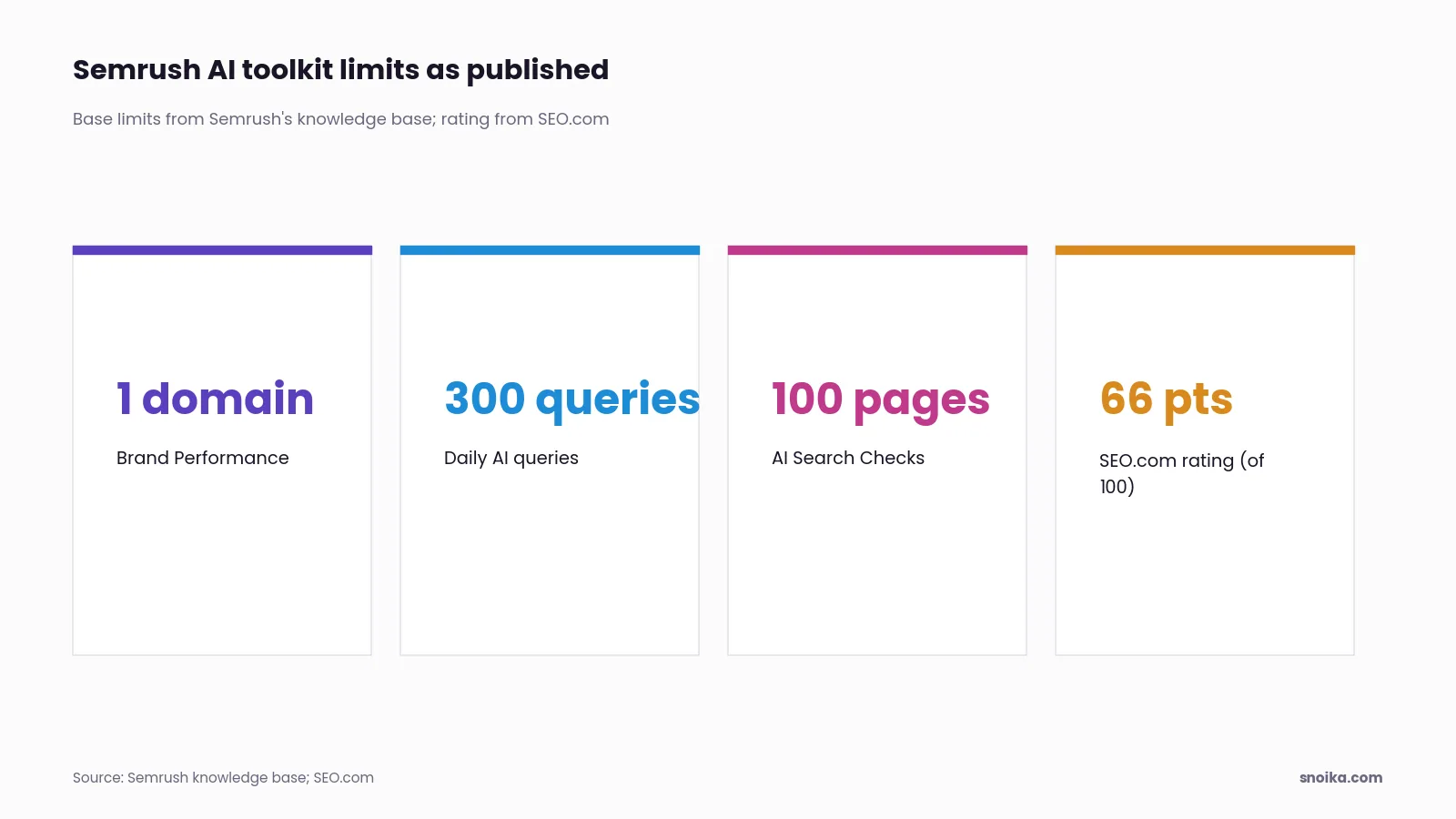
The toolkit has limits on tracking and scale, and your team has to do the work it recommends. SEO.com rated it 66 out of 100, listing the single plan, the 25-prompt cap and the lack of a free trial among its shortfalls.
How far do 25 prompts go?
Not far, for a brand with several products or markets. Each product line needs its own set of buyer questions in more than one language. Semrush's knowledge base sets the base limits at 1 domain for Brand Performance and 300 daily AI Analysis queries, and AI Search Checks cover up to 100 pages. Semrush One raises the prompt limits.
What about extra seats?
Each extra teammate who needs the toolkit requires a separate license per subuser, and each extra domain or location for Brand Performance is added separately. Ten client brands means ten domains to add.
Who acts on the data?
You do. The toolkit diagnoses problems and recommends fixes, and your writers or developers have to carry out each one.
Enterprise AIO versus Snoika
Semrush Enterprise AIO is a separate product for large brands. Adobe's product page describes a database of 261M+ real user prompts with monitoring in dozens of languages. It adds deep content audits, live content scoring, log file analysis that checks whether AI bots can reach your site, and a connection to Adobe Analytics traffic data.
Snoika Enterprise offers unlimited prompts on every AI platform, multi-brand management, executive reporting and a 99.9% SLA, plus custom integrations and API access that we set up on a call. Enterprise AIO gives a large in-house team more data and sharper recommendations, while Snoika supplies a team to write and publish the pages.
Making the right call
Semrush fits teams that need a full SEO suite with AI tracking included, while a specialist platform like Snoika, one of the Semrush alternatives, fits those whose main goal is to grow AI visibility and who lack the people to act on the data. We'd work through these checks in order:
- 011EnginesList the AI engines your buyers use, and confirm that each tool covers them.
- 022PromptsCount the prompts you need across every product and language.
- 033HoursEstimate the monthly hours your team needs to write and publish the fixes.
- 044ProofAsk each vendor for results from a company like yours.
Every Semrush AI toolkit review comes back to one question: is your visibility actually changing? You can only answer it if you recorded your starting position, which is why we measure a baseline before any new page goes live.
FAQ
The Semrush AI Visibility Toolkit shows how AI assistants mention your brand and which pages they cite. It includes competitor comparisons and recommendations, helping you identify visibility gaps that your team can address through content or site changes.
No, the AI Visibility Toolkit monitors your brand and recommends improvements, but it doesn't write and publish pages for you. Snoika does that work: we write, review and publish the pages on your own domain after your approval.
Semrush fits teams that already use its SEO suite and have writers available. Snoika fits teams short on writing capacity, since we write and publish the pages that close visibility gaps.
We record your starting mentions and share of voice before making changes, then compare later results on the same prompts and AI platforms. That way, differences in tracking don't get mistaken for changes in visibility.
Other comparisons