
Perplexity vs ChatGPT for brand visibility
For most B2B brands, ChatGPT matters more. Far more buyers use it, and it decides which names they remember. Perplexity is the easier place to earn your first citation, because each answer lists more sources and shows all of them. If you sell to a broad business audience, start with ChatGPT when you weigh Perplexity vs ChatGPT. Add Perplexity once you see that your buyers check evidence before they build a shortlist.
 Jevgenia PogadajevaCFO, Snoika · 8 min read

























Two platforms buyers use differently
Buyers go to ChatGPT for advice and to Perplexity to check that advice. In ChatGPT the conversation comes first, and sources show up only when it decides to search. Perplexity searches every time and puts the evidence on screen. That one design choice changes what "visible" means on each platform. Visibility means your name is in the answer on ChatGPT, while on Perplexity it means your page is one of the numbered sources under the answer.
| Attribute | ChatGPT | Perplexity |
|---|---|---|
| Reach | 800 million weekly users (October 2025) | 780 million queries in May 2025 |
| Sources per answer | 3.7 sources on average | 8.6 sources on average |
| When sources appear | Only when it runs a web search | On every answer, numbered |
| Where live results come from | Mostly Bing's index | Perplexity's own live web retrieval |
| What visibility looks like | Your brand named in the text | Your page listed as a source |
Reach
- ChatGPT
- 800 million weekly users (October 2025)
- Perplexity
- 780 million queries in May 2025
Sources per answer
- ChatGPT
- 3.7 sources on average
- Perplexity
- 8.6 sources on average
When sources appear
- ChatGPT
- Only when it runs a web search
- Perplexity
- On every answer, numbered
Where live results come from
- ChatGPT
- Mostly Bing's index
- Perplexity
- Perplexity's own live web retrieval
What visibility looks like
- ChatGPT
- Your brand named in the text
- Perplexity
- Your page listed as a source
Look at the reach row and you'll see the two figures measure different things. ChatGPT counts people per week, and Perplexity counts queries per month. Even so, the gap is wide. Perplexity's CEO, Aravind Srinivas, said in mid-2025 that the platform handled about 30 million queries a day.
How Perplexity sources answers
Perplexity runs a live web search for each question. It writes the answer from the pages it retrieved and links each claim to a numbered source. According to Perplexity's own help center, "Every answer includes citations linking to the original sources." Because the answer depends on what the search returns at that moment, a page published last week can appear tomorrow. Perplexity can use new content before its model is retrained.
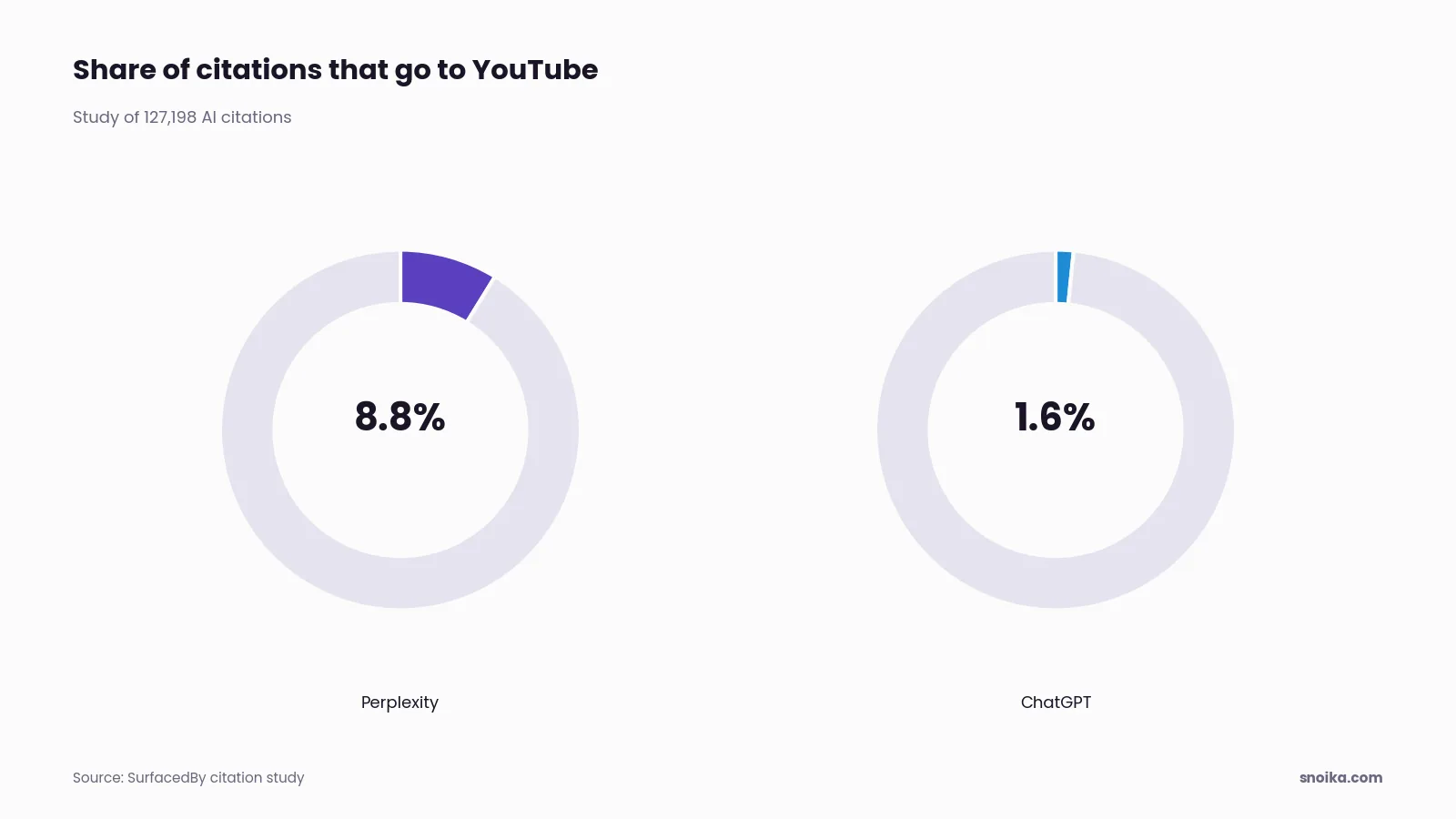
The source list is also long, and that changes who gets in. SurfacedBy's study of 127,198 citations found Perplexity sends 8.8% of its citations to YouTube, while ChatGPT sends just 1.6%. With 8 or so slots per answer, a mid-sized vendor can sit beside the category leaders. A page that ranks eighth has a real chance of being cited here, and it barely registers in a three-source answer.
The catch is that Perplexity can cite your page without ever naming you. A Semrush study with Kevin Indig, a growth advisor who writes the Growth Memo newsletter, found that 62% of AI citations are "ghost citations." In those, the page is linked as a source but the brand never appears in the answer text. Check whether you're both cited and named in your Perplexity results.
How ChatGPT builds brand recall
ChatGPT names brands from two places. It draws on what the large language model absorbed in training and the pages it pulls from a live search when it decides to run one. The training side favors brands with frequent, consistent discussion across the web. Ahrefs studied 75,000 brands and found that branded web mentions correlate with AI visibility at 0.66 to 0.71 across ChatGPT and Google's AI products. The same study found ChatGPT has weaker links to classic authority metrics such as Domain Rating.
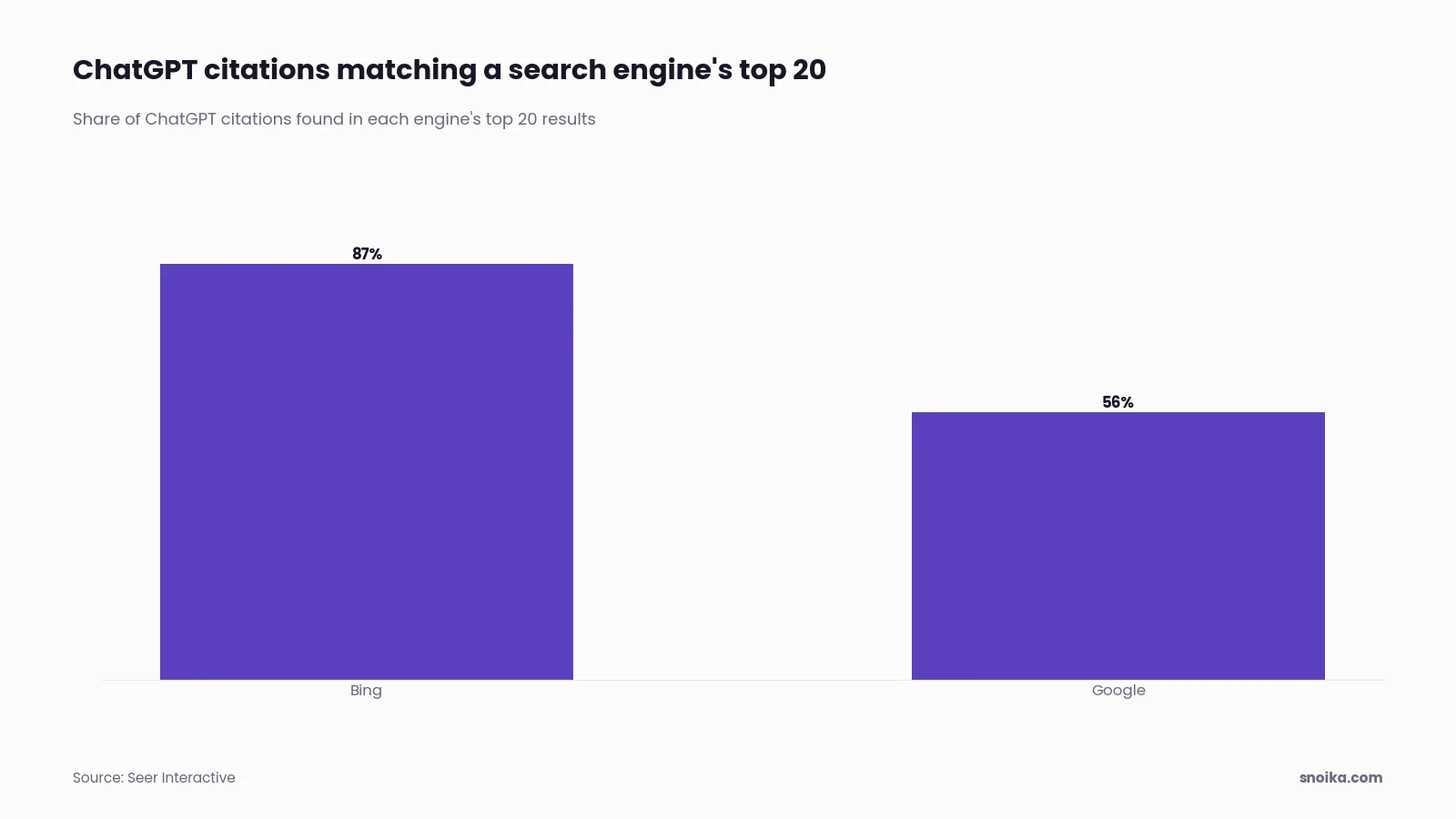
The live search side runs mostly through Bing. Seer Interactive compared ChatGPT citations with search results and found that 87% of citations matched Bing's top 20 results, compared with 56% for Google. If you're strong in Google and weak in Bing, ChatGPT will miss your best page.
Brands with a strong public identity get named even when nobody cites them. In the Semrush data, Google showed up in answer text almost three times as often as it appeared as a source link. That's what recall looks like. Test your brand by asking ChatGPT a category question with search off, then asking again with search on. Compare what the model remembers about you in the first answer with what Bing can surface in the second.
Audience overlap is not equal
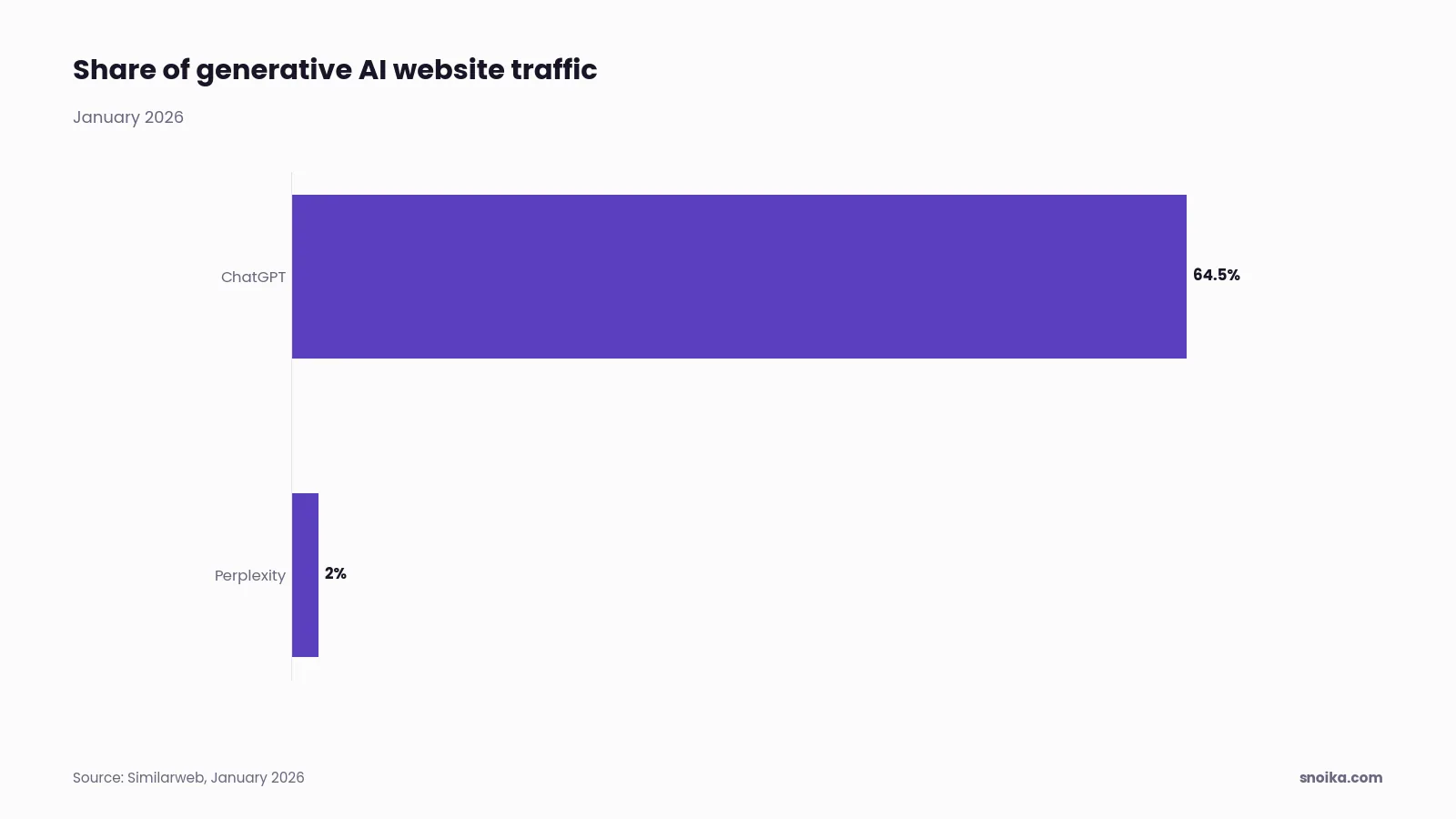
ChatGPT's audience includes most of Perplexity's, but the reverse isn't true. Perplexity's smaller group also behaves differently. Similarweb's January 2026 tracker put Perplexity at 2.0% of traffic to generative AI websites, against 64.5% for ChatGPT. ChatGPT is the clear choice on reach alone.
Goodie's GA4 analysis of a panel of business-facing sites found Perplexity sent 7.3% of AI referrals in March and April 2026, while ChatGPT sent 62.6%. With roughly 2% of visits, Perplexity produced more than 3 times that share of clicks to B2B sites. Its users click through to check sources, and those visits land on your pages.
Overlap is also weak at the source level. In the SurfacedBy data, 69.6% of cited domains appeared in only one of the five engines studied. If you're cited in Perplexity, that tells you almost nothing about how ChatGPT treats you. Audit each platform separately before you assume a win on one carries over to the other.
Where B2B buyers actually search
For B2B tools, ChatGPT is the main assistant for recommendations because that's where most buyers ask. G2 surveyed more than 1,000 software decision makers and found that half of buyers now start their research in an AI chatbot instead of Google. ChatGPT was the favorite for 47% of them, nearly 3 times any other model.
AI search now shapes the shortlist itself. In G2's 2026 Buyer Behavior Report, the top influences on shortlist decisions were review sites at 38%, with AI chatbots close behind at 37%. Buyers use the assistant to narrow the field, then check peer reviews before they commit. A brand that's missing from ChatGPT's answer misses the shortlist that reviewers later confirm.
3DPrinterOS achieved #1 visibility in ChatGPT for industry-specific queries and turned AI search into a steady inbound lead source, with 3–4 qualified inbound leads a day. Before you choose your own focus, ask your sales team what new prospects say when asked how they found you. Some will name a specific assistant.
Optimising for Perplexity citations
You get cited in Perplexity by publishing pages that answer one specific question with facts it can check, and by showing up on the third-party sites it already trusts. Perplexity retrieves pages live, so the work is mostly retrieval and extraction. It has to find your page and be able to lift a clear sentence from it.
- Run your 20 to 50 most important buyer prompts in Perplexity and record every cited domain. That list shows the sources you're competing against.
- Build a page for each prompt that has no strong answer. Put the direct answer in the first two sentences, then add figures and dates a reader can verify.
- Name your brand inside the evidence itself. Semrush suggests clearer brand references and comparison sections featuring specific tools to turn a ghost citation into a mention.
- Show a visible "last updated" date and refresh the figures every quarter. A live retriever can see when a competitor's page is newer than yours.
- Get covered on the channels Perplexity draws from, such as YouTube explainers and review sites. Your own domain is only part of the source pool.
Host these pages on your main domain. The citation credits whichever domain holds the page. We publish client pages through a DNS connection so every citation builds the brand's own domain. This works on any CMS without a migration.
Optimising for ChatGPT mentions
ChatGPT mentions come from how often and how consistently the web describes your brand in your category, plus how well your pages rank in Bing when it searches. The two levers work on different timelines. Bing rankings can change within weeks. Training data only catches up with the next model update.
First, check that your key pages are indexed in Bing Webmaster Tools and that your titles match the exact phrases buyers use. Use the same words to describe your category and use cases on your site and your review profiles. Carry that description through to your partner pages. A model that reads "VAT compliance platform" in one place and "tax tool" in another links your name to neither phrase. Comparison pages help as well, because buyers ask ChatGPT "X vs Y" questions and the model rewards pages that answer them fairly.
A fintech brand that wants to appear in both assistants needs a single content base that serves both mechanisms. Write answer-first pages on regulatory questions, with thresholds and dates Perplexity can cite. Back them with steady third-party coverage that teaches ChatGPT your category. Fintech buyers ask about rules that differ by country, so local-language versions matter, and we produce content in 135+ languages and regional variants for that reason. Vespia, a fintech SaaS, recorded a 220% increase in AI brand mentions with this kind of mix.
Which platform to prioritise first
Prioritise ChatGPT before Perplexity. It reaches the buyers who build shortlists, and the authority you build for it also helps on other engines. Perplexity earns its own budget under specific conditions you can test. Your category decides the priority, so run your own prompts on both platforms before you move money.
When ChatGPT should come first
Put ChatGPT first if your buyers are broad business users and not specialists, or if competitors already appear in its answers and you don't. A gap in ChatGPT costs you shortlist places every week it stays open. 1StopVAT, in tax and fintech, saw 10x growth in ChatGPT visibility in 7 weeks. Snoika's founder Anton Vedeshin discussed the result with Startup Reporter.
When Perplexity earns its own budget
Give Perplexity its own budget when your buyers are analysts or engineers who check sources before they trust a claim. The same applies to finance teams with that habit. It also deserves focus when your Perplexity referrals in GA4 grow faster than your ChatGPT referrals. Another signal is when Perplexity cites different domains from ChatGPT for the same prompts. Then neither platform's results predict the other's, and the long source list gives you a cheaper first foothold.
Measuring your AI brand visibility
Measure AI visibility with a fixed set of prompts that you run every week, and count mentions and citations for each platform separately. Measure share of voice and sentiment for each platform as well. A single test proves little, because AI answers change from run to run. SparkToro research based on 2,961 prompts found there's less than a 1 in 100 chance that ChatGPT or Google's AI returns the same list of recommendations twice. Compare trends across weekly runs.
| Metric | What it tells you | Platform where it weighs most |
|---|---|---|
| Mentions | Whether your brand is named in the answer text | ChatGPT |
| Citations | Whether your page is used as a source | Perplexity |
| Share of voice | Your mentions against competitors for the same prompts | Both |
| Sentiment | Whether the answer describes you favorably | Both |
| AI referral sessions | Whether visibility turns into visits | Both, read in GA4 |
Mentions
- What it tells you
- Whether your brand is named in the answer text
- Platform where it weighs most
- ChatGPT
Citations
- What it tells you
- Whether your page is used as a source
- Platform where it weighs most
- Perplexity
Share of voice
- What it tells you
- Your mentions against competitors for the same prompts
- Platform where it weighs most
- Both
Sentiment
- What it tells you
- Whether the answer describes you favorably
- Platform where it weighs most
- Both
AI referral sessions
- What it tells you
- Whether visibility turns into visits
- Platform where it weighs most
- Both, read in GA4
Our own tracking uses weekly prompt sets to measure mentions and citations in ChatGPT and Google AI Overviews, where most AI search traffic happens. We also measure share of voice and sentiment in those results. Every LLM SEO engagement starts with access to GA4 and Google Search Console. Access to Google Tag Manager is also required at the start so answer-level data can be matched against real sessions and conversions.
When you read the numbers, look out for ghost citations. A tracker that counts only brand mentions will report you as absent from Perplexity even when your page carries the answer. Keep citations and mentions in separate columns. And segment AI referrals in GA4 by source, because a combined "AI traffic" figure hides which platform is working.
Our verdict
For this week's baseline, run 30 prompts your buyers ask in both assistants and record where you're named or cited. Note which competitors appear in your place as well. That one exercise settles the Perplexity vs ChatGPT question for your category better than any general rule. Repeat it monthly with the same prompts, because AI answers change from run to run and only trends mean anything. Track your Bing rankings alongside it. When your ChatGPT visibility stalls, the cause is a page that ranks in Google but that Bing has never indexed.
FAQ
ChatGPT is the main assistant B2B buyers use for recommendations. In G2's survey of more than 1,000 software decision makers, 47% preferred ChatGPT. That supports prioritizing its audience, but doesn't establish how often either assistant recommends a tool per answer.
For Perplexity, publish focused answers with verifiable facts and dates. For ChatGPT's search answers, check that those pages are indexed and visible in Bing. Track source links separately from brand mentions, since a citation doesn't mean your name appears in the answer.
ChatGPT should usually come first when weighing perplexity vs chatgpt for B2B visibility. Give Perplexity a separate budget when your buyers routinely check sources or its referral traffic grows faster. Compare the same buyer questions on both before shifting spending.
Publish answer-first regulatory pages with country-specific thresholds and dates that Perplexity can cite. Support those pages with third-party coverage that consistently describes your category, helping ChatGPT associate your brand with it. Use local-language versions where buyers research rules in their own language.
Perplexity can use new pages through live retrieval without waiting for model retraining, but citation timing isn't guaranteed. Bing rankings can change within weeks, affecting ChatGPT's search answers. Changes to ChatGPT's training-based recall depend on a future model update.


