
Copilot vs ChatGPT: how each assistant sources the answers it gives
For brand visibility, ChatGPT matters more to most B2B marketers. It has the larger audience and sends far more referral traffic to websites. Copilot matters when your buyers work inside Microsoft 365, and it's the easier of the two to measure. In the copilot vs chatgpt decision, both assistants depend heavily on Bing results. So make ChatGPT your main target, and treat Copilot as a smaller gain that much of the same work also wins.
 Artem LozinskyOperations and product, Snoika · 8 min read






















Citations drive B2B visibility
A citation is the link an AI assistant shows next to its answer. For a B2B brand, it now does the job a first-page ranking used to do. Forrester's Buyers' Journey Survey, 2024 found that 89% of B2B buyers used generative AI in at least one area of their purchasing process. A buyer who asks for a vendor shortlist reads the answer and its sources before visiting any vendor site. If your page isn't one of those sources, the buyer hears about your brand from a competitor's page or a review site, or doesn't hear about it at all.
The share of buyers using AI is still rising. Forrester's State of Business Buying, 2024 report says almost 95% of buyers expect to use generative AI to support a purchase in the next 12 months. That's why the sourcing question matters more than which assistant writes better prose. Each tool picks its sources in its own way, so a page can be cited by one and missed by the other. Start with a list of the questions your buyers ask before they talk to sales. Then check whether either assistant cites you when it answers them.
How each tool retrieves sources
Copilot picks its sources by turning your prompt into a short Bing query. Inside Microsoft 365, it can blend those web results with the user's company files. ChatGPT rewrites the prompt into one or more targeted queries for outside search providers. After it reads what comes back, it can search again before it answers. Both tools write the final answer themselves. What differs is where the candidate pages come from and how much control a site owner has.
| Attribute | Microsoft Copilot | ChatGPT |
|---|---|---|
| Where web results come from | Bing search service | Third-party search providers plus OpenAI's OAI-SearchBot crawler |
| How queries are built | A short query from key terms in the prompt | One or more rewritten queries, then follow-up searches |
| Private data in answers | Microsoft 365 work data with a paid licence | Files the user uploads or connects |
| Site owner control | Bing indexing and IndexNow | robots.txt rule for OAI-SearchBot |
| Citation reporting for site owners | AI Performance report in Bing Webmaster Tools | Referral visits in your own analytics |
| Main limit | Smaller audience | Source choice is harder to predict |
| Best fit | Brands that sell into Microsoft 365 companies | Brands that need the widest reach |
Where web results come from
- Microsoft Copilot
- Bing search service
- ChatGPT
- Third-party search providers plus OpenAI's OAI-SearchBot crawler
How queries are built
- Microsoft Copilot
- A short query from key terms in the prompt
- ChatGPT
- One or more rewritten queries, then follow-up searches
Private data in answers
- Microsoft Copilot
- Microsoft 365 work data with a paid licence
- ChatGPT
- Files the user uploads or connects
Site owner control
- Microsoft Copilot
- Bing indexing and IndexNow
- ChatGPT
- robots.txt rule for OAI-SearchBot
Citation reporting for site owners
- Microsoft Copilot
- AI Performance report in Bing Webmaster Tools
- ChatGPT
- Referral visits in your own analytics
Main limit
- Microsoft Copilot
- Smaller audience
- ChatGPT
- Source choice is harder to predict
Best fit
- Microsoft Copilot
- Brands that sell into Microsoft 365 companies
- ChatGPT
- Brands that need the widest reach
In a company tenant, Microsoft lets admins manage public web access for Copilot, so some employees never see web citations at all. ChatGPT only searches when it decides the question needs current information. Otherwise it answers from its training data and cites nothing. Before you judge either tool, find out whether web search was on for the answers you're looking at.
Copilot search grounding explained
Copilot search grounding works by sending a short, generated query to Bing and using the results to write a cited answer. In Microsoft's documentation, Copilot Chat ["parse[s] the user's prompt and identifies terms"](https://learn.microsoft.com/en-us/microsoft-365/copilot/manage-public-web-access) where web information would improve the response, then builds a search query from those terms. The query reaches Bing with user and tenant identifiers removed. Microsoft says these queries aren't used for advertising or for training foundation models.
The query is much shorter than the question. A Microsoft answer on its Tech Community forum puts it plainly: "Web search queries might not contain all the words from a user's prompt." They're based on a few terms. A buyer types a 40-word question about compliance software for a German subsidiary, and Bing still receives only 3 or 4 words. Your page competes for that short query.
Microsoft's own example of the licensed version shows Copilot looking up a user's manager in Microsoft 365 data and then searching Bing for that name. For a vendor, this means a buyer's internal notes and past emails can sit next to your public page in the same answer. Check how your key pages rank in Bing for the 2- to 4-word version of each buyer question. That's the query Copilot sends.
ChatGPT web search explained
ChatGPT web search rewrites your question into targeted queries for search partners. It writes an answer from the pages it reads in the results. OpenAI's help centre says ChatGPT search "typically rewrites your query into one or more targeted queries" for those providers. In OpenAI's own example, a researcher's question about drugs that target CCR8 first becomes "CCR8 immunotherapy drug development 2025". After it reads those results, ChatGPT sends a narrower follow-up such as "CHS-114 conference 2025".
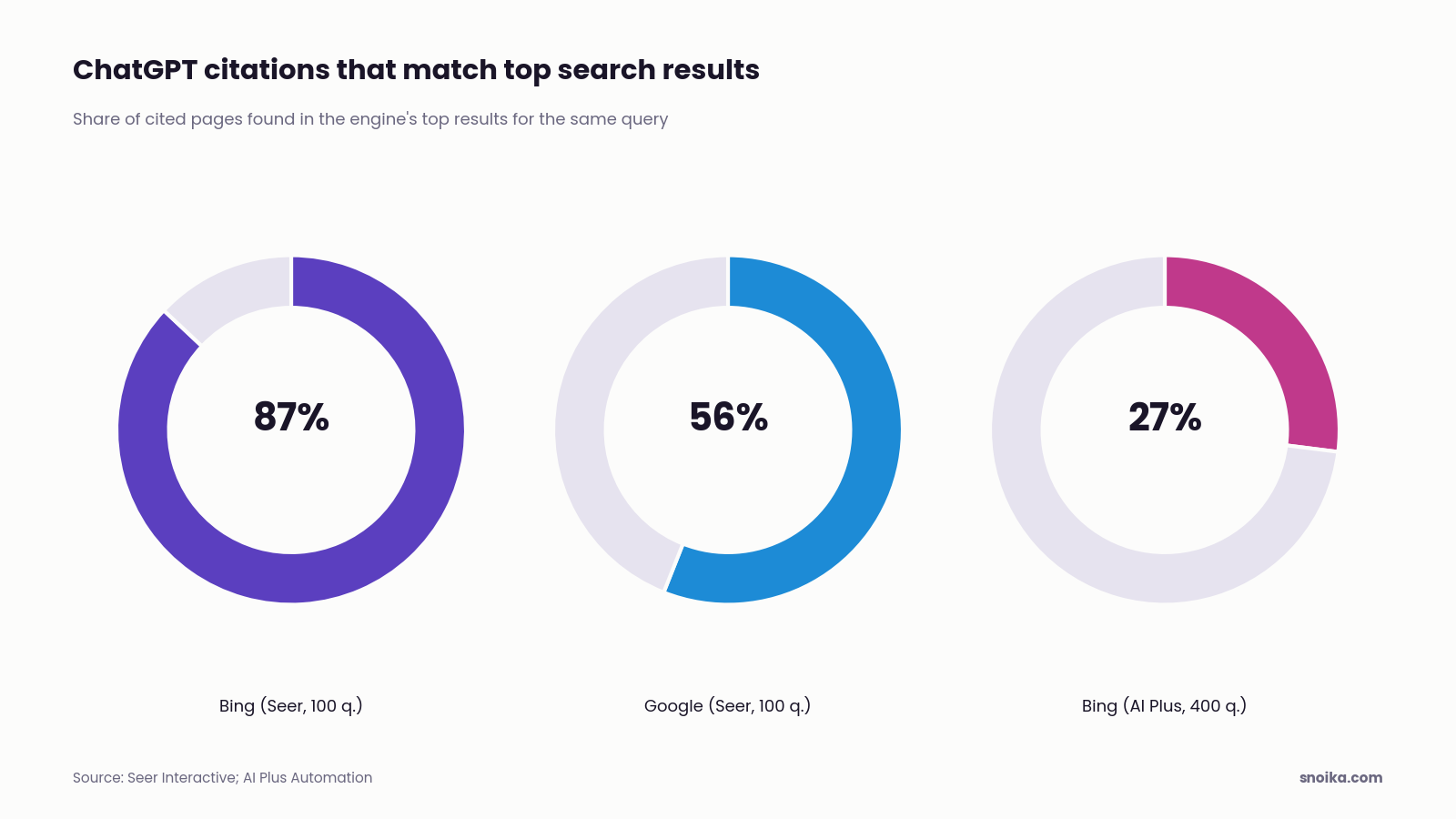
OpenAI doesn't name every provider, but the evidence points to Bing. Seer Interactive compared 500+ ChatGPT citations with search results for the same 100 queries. It found that 87% of citations matched Bing's top results, against 56% for Google. A later 400-question test by AI Plus Automation found a match rate of 27%. Read the Bing link as strong but loose. ChatGPT also pulls from OpenAI's own crawler and from content partners.
OpenAI's crawler documentation says "Sites that are opted out of OAI-SearchBot will not be shown in ChatGPT search answers", though they can still appear as navigational links. GPTBot, the training crawler, is a separate setting. You can block training and still allow search. Open your robots.txt file and check the rules for each bot by name.
Which earns more B2B citations
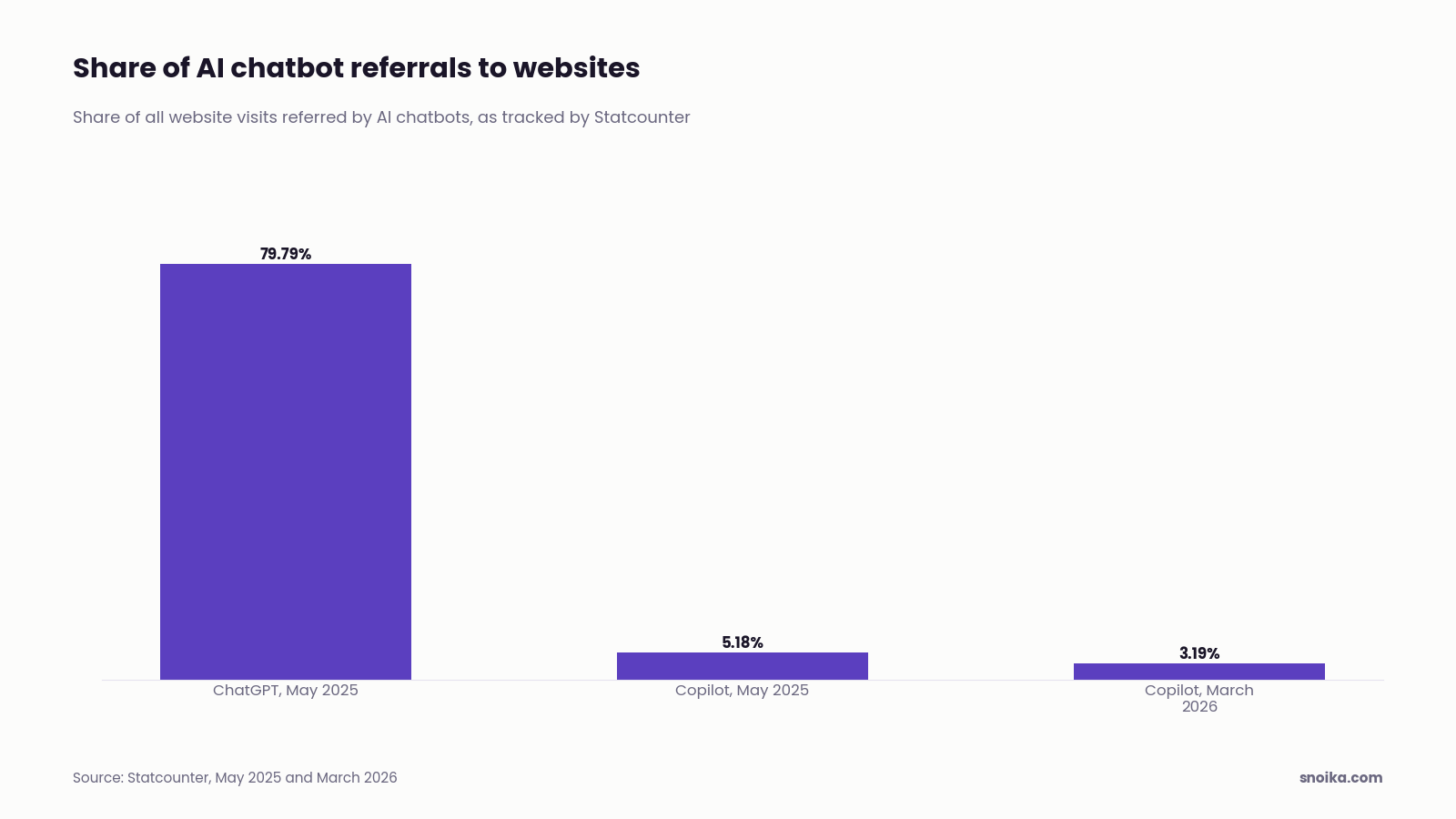
ChatGPT brings in more citations that turn into visits, which makes it the better choice for brand visibility for most B2B brands. Statcounter's referral data for May 2025 gave ChatGPT 79.79% of AI chatbot referrals to websites, against 5.18% for Microsoft Copilot. By March 2026, Copilot's share had fallen to 3.19%. Audience size explains part of the gap. OpenAI CEO Sam Altman told developers in October 2025 that "More than 800 million people use ChatGPT every week".
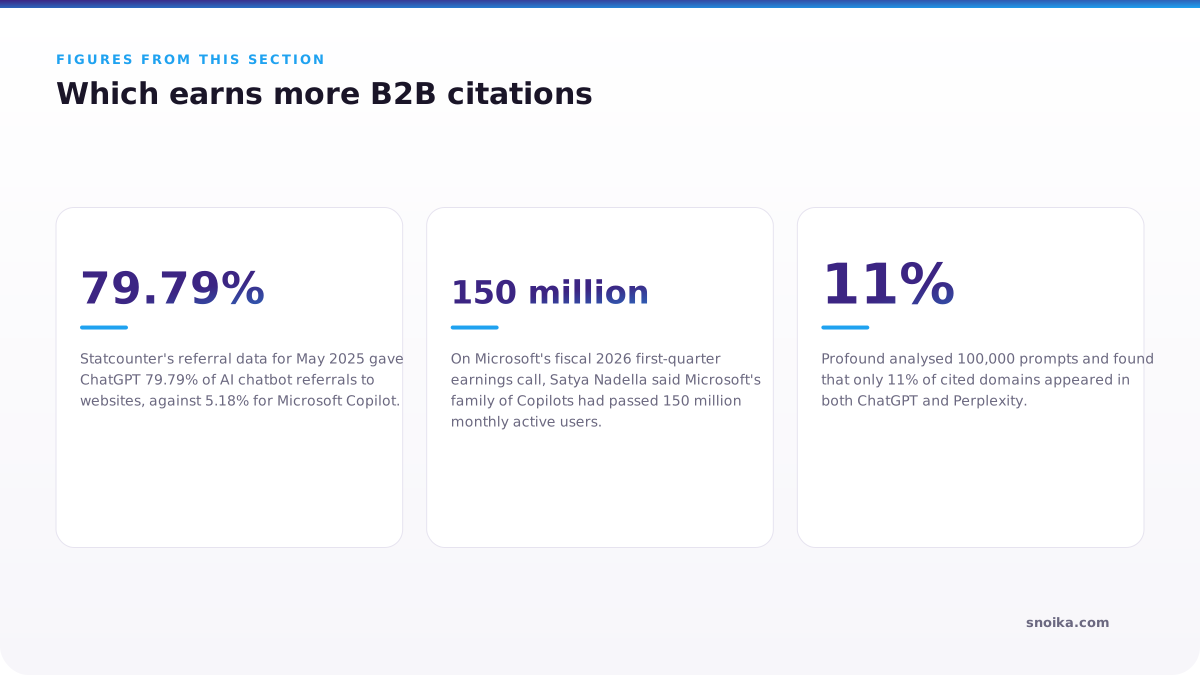
Copilot's case is about who its users are. On Microsoft's fiscal 2026 first-quarter earnings call, Satya Nadella said Microsoft's family of Copilots had passed 150 million monthly active users. In the same quarter, he wrote that 90% of the Fortune 500 use Microsoft 365 Copilot. If you sell to large enterprises, your buyer asks Copilot from inside Teams or Outlook and never opens ChatGPT.
Don't assume that a citation in one assistant brings a citation in the other. Profound analysed 100,000 prompts and found that only 11% of cited domains appeared in both ChatGPT and Perplexity. No study we found measures the ChatGPT vs Copilot overlap directly. So test both assistants with your own buyer questions and record each one's citations separately.
Cost versus value
Both assistants are free to try, and paid seats cost between $8 and $30 per user a month. For a brand chasing citations, the real cost is the content and technical work. The table shows list prices in USD, checked in 2026. Prices change, so confirm them on each vendor's page before you buy.
| Plan | Price per month | Who it's for |
|---|---|---|
| ChatGPT Free | $0 | Individuals testing the tool |
| ChatGPT Go | $8 | Light individual use |
| ChatGPT Plus | $20 | Individual power users |
| ChatGPT Pro | $100 or $200 | Heavy individual use |
| ChatGPT Business | $20 per seat annual, $25 monthly | Teams of 2 or more |
| Microsoft Copilot (consumer) | $0 | Individuals |
| Microsoft 365 Premium | $19.99 | Individuals who want Copilot in Office apps |
| Microsoft 365 Copilot Business | $18 promotional, $21 standard | Firms under 300 users |
| Microsoft 365 Copilot (enterprise) | $30 per user | Large organisations |
ChatGPT Free
- Price per month
- $0
- Who it's for
- Individuals testing the tool
ChatGPT Go
- Price per month
- $8
- Who it's for
- Light individual use
ChatGPT Plus
- Price per month
- $20
- Who it's for
- Individual power users
ChatGPT Pro
- Price per month
- $100 or $200
- Who it's for
- Heavy individual use
ChatGPT Business
- Price per month
- $20 per seat annual, $25 monthly
- Who it's for
- Teams of 2 or more
Microsoft Copilot (consumer)
- Price per month
- $0
- Who it's for
- Individuals
Microsoft 365 Premium
- Price per month
- $19.99
- Who it's for
- Individuals who want Copilot in Office apps
Microsoft 365 Copilot Business
- Price per month
- $18 promotional, $21 standard
- Who it's for
- Firms under 300 users
Microsoft 365 Copilot (enterprise)
- Price per month
- $30 per user
- Who it's for
- Large organisations
Sources: ChatGPT Plus at $20 and the other ChatGPT tiers from CloudZero. Microsoft 365 Copilot at $30 and the other Copilot tiers from Copilot Experts.
Microsoft's business plans sit on top of a required Microsoft 365 base licence, so the true per-seat cost is higher than the add-on price. For visibility work, the plan your buyer pays for matters more than the plan you pay for. A buyer with a paid Microsoft 365 Copilot licence gets answers that mix your public page with their own company files. To test both tools, one paid seat of each is enough. Run the same 20 buyer questions every month.
Get cited by both
Pages that Bing indexes quickly and OAI-SearchBot can read meet the technical entry conditions for both assistants. The Bing link covers Copilot directly and ChatGPT in large part. The crawler rule covers ChatGPT alone. Neither guarantees a citation. Both are entry conditions you can confirm in an afternoon.
Make your pages findable in Bing
Verify your site in Bing Webmaster Tools and submit a sitemap. Check how your priority pages rank for short queries. Bing has also told site owners to push updates the moment they publish. Fabrice Canel, Principal Product Manager at Microsoft Bing, said at SMX Munich in March 2025: "Gen AIs value fresh content in particular, partly as a reference check of their LLM training data. Use the API at indexnow to push that information as it's published or updated." In the same talk, Canel confirmed that schema markup helps Microsoft's LLMs understand content. Set up IndexNow through your content management system if it supports it.
Let OAI-SearchBot read your pages
Allow OAI-SearchBot in robots.txt and allow OpenAI's published IP ranges at your firewall or content delivery network. Security tools block unknown bots by default, and a block at the firewall overrides a permissive robots.txt. If your legal team wants to opt out of model training, disallow GPTBot on its own line. Then test a page with a recent ChatGPT search and confirm it can still be cited.
Optimising content for AI search
Content earns citations when an assistant can lift a precise, sourced answer from it. So write each page to answer the short query each tool sends. Both assistants read the pages they retrieve in chunks and cite the chunk that answers the query. A page that hides its answer under three paragraphs of context loses to a thinner page that states it in the first line.
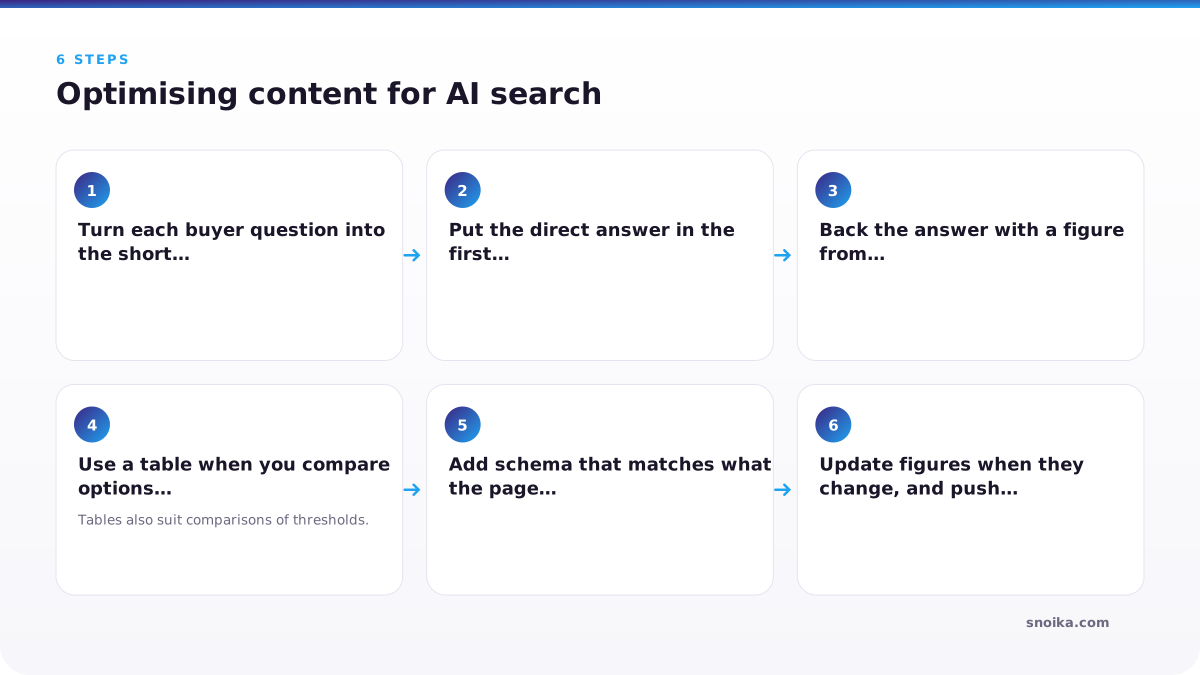
- Turn each buyer question into the short query an assistant sends, such as "payroll software cost mid-size SaaS".
- Put the direct answer in the first sentence under the matching heading.
- Back the answer with a figure from a named source and specify the year.
- Use a table when you compare options or plans. Tables also suit comparisons of thresholds.
- Add schema that matches what the page shows, and keep it in sync with the visible text.
- Update figures when they change, and push the updated URL through IndexNow.
Most failures come from pages organised around keywords at the expense of specific questions. A guide's rank for a broad term does not guarantee an answer to the narrow follow-up query ChatGPT sends after its first search. Read your top 10 pages with that follow-up in mind. Does each one answer a precise question in its first sentence?
Implications for SEO leads
Add Bing to your rank reports and report AI citations as their own line, separate from organic traffic. In February 2026, Microsoft launched AI Performance in Bing Webmaster Tools as a public preview. It shows citation counts across Copilot and Bing's AI summaries, along with the grounding queries that pulled your pages in. It's the first first-party view of what Copilot actually searched for.
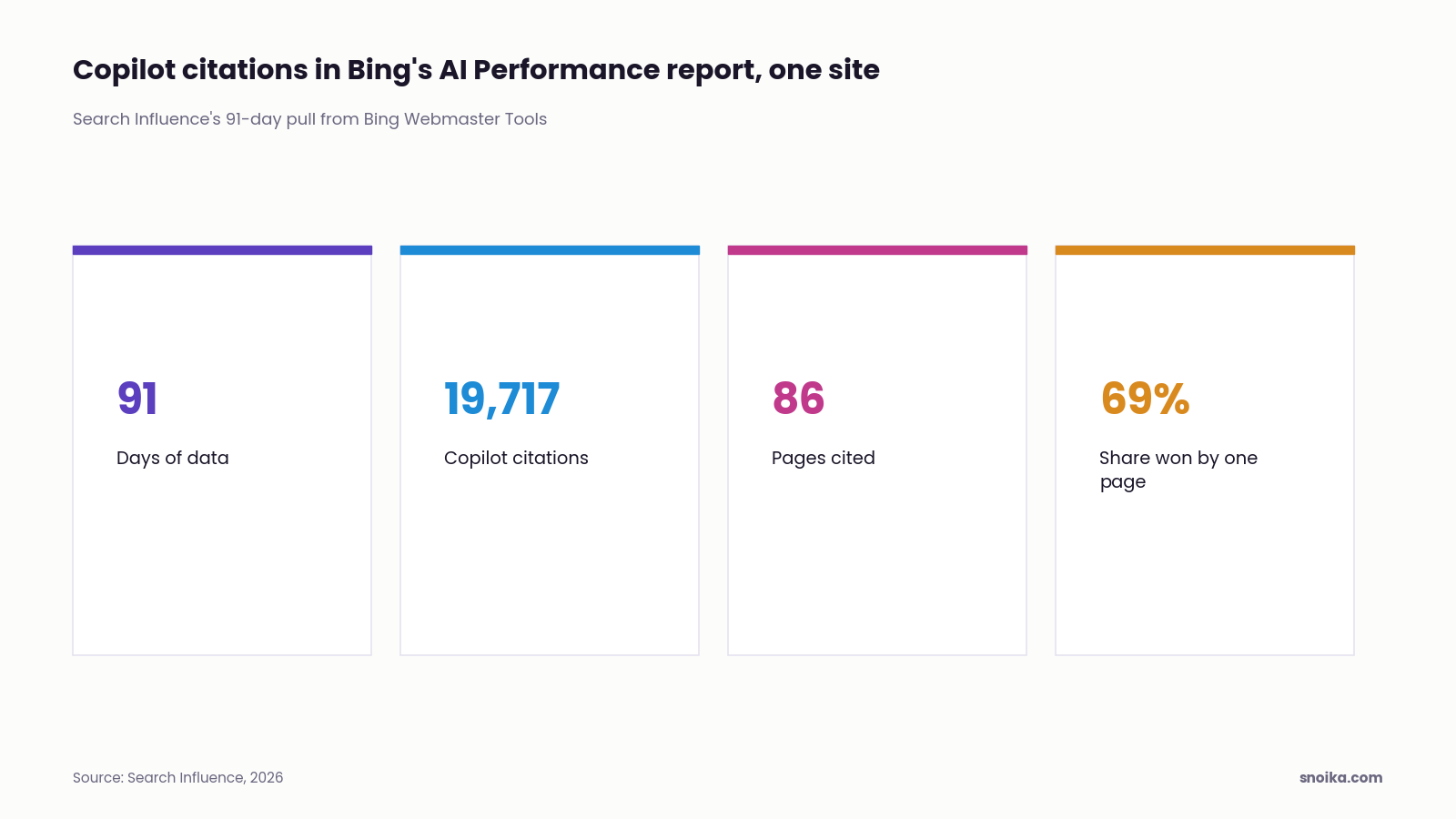
Will Scott of the agency Search Influence pulled 91 days of data and found 19,717 citations across 86 pages; one page earned 69% of them. Protect the pages you identify as citation earners and copy their structure on the pages that earn none.
ChatGPT gives you no equivalent dashboard, so you measure it with referral visits in analytics and repeated prompt tests. Platforms such as Snoika track brand visibility across Google and AI assistants in one place. Whatever tool you use, report the two assistants separately. A citation gain in Copilot tells you little about ChatGPT.
Which one to choose
Choose ChatGPT as your main target. Its referral share and weekly audience are both many times larger than Copilot's. Give Copilot dedicated effort only if your buyers sit inside Microsoft 365 enterprises. This week, confirm that OAI-SearchBot is allowed through both robots.txt and your firewall, and that your priority pages are indexed in Bing. Those two fixes cover most of the ground in the copilot vs chatgpt decision. Copilot is the assistant you can measure today. Use its grounding queries to learn which short queries your buyers trigger. Then write answers for those queries, which ChatGPT also uses when it searches.
For the mechanics behind both assistants, from tokens to retrieval, read how LLMs work.
FAQ
ChatGPT is the stronger choice for most B2B marketers in the copilot vs chatgpt comparison because it has a larger audience and sends more referral traffic. Copilot deserves attention when your buyers work inside Microsoft 365.
Copilot retrieves web sources through a short Bing query, while ChatGPT can run several rewritten queries and follow-up searches through outside providers. Test the same buyer questions in both assistants, since visibility in one doesn't establish visibility in the other.
Copilot turns key terms from your prompt into a short Bing query, then uses the results to write a cited answer. Microsoft removes user and tenant identifiers before sending the query. Company administrators can disable public web access.
ChatGPT rewrites your question into targeted searches and reads the returned pages to build an answer. It may run narrower follow-up searches. It doesn't search for every question, so check whether an answer used web search before assessing your site's visibility.
Yes, you can block GPTBot while allowing OAI-SearchBot because training and search use separate crawler controls. Check each bot's robots.txt rules and ensure your firewall allows OAI-SearchBot. Allowing access makes pages eligible for search answers but doesn't guarantee citations.
Keep reading
All articles

