
Discover What's Holding Back Your AI Visibility
Get a personalized AI Visibility Audit that reveals your biggest growth opportunities and shows exactly what to improve over the next 90 days
Trusted by SMEs and Enterprises
Supported by leaders in AI innovation
We're proud to be supported by NVIDIA Inception and OpenAI, accelerating our mission to build trustworthy and impactful AI solutions

Recognized by NVIDIA Inception as a company shaping the future of AI-driven brand visibility

Powered by OpenAI to simulate real user queries and surface how AI engines perceive your brand
What's Included in Your Snoika AI Visibility Audit
See how your business performs across today's leading AI platforms and receive a prioritized 90-day action plan
What Our Clients Say
Trusted by SMEs and enterprises worldwide
Very good articles! I like the style of writing. The AI visibility reports are exactly what we needed. All good, great job!

I like the AI visibility insights very much. The platform shows exactly where our brand stands in AI search results. Good pieces!

Snoika's team has been professional in their service and keeps contact with us. They are passionate about the AI visibility service they provide.

I have already recommended a few people to have a chat with Snoika. Overall the experience is good and we are happy with the AI visibility platform and level of support.


Anton Vedeshin, Ph.D.
Founder at Snoika
Anton Vedeshin, Ph.D. is a serial entrepreneur, TEDx speaker, and investor. He holds a Ph.D. in cloud computing and cybersecurity and has authored scientific papers and patents across NLP, blockchain, and data protection (IEEE, ACM, Springer).
Today Anton is focused on Snoika — an AI marketing engine built for a new reality: AI is the first place people discover products. Snoika builds brand context for LLMs and makes companies show up in answers across ChatGPT, Gemini, Claude, Perplexity, and Google AI. Unlike generic AI writers, Snoika produces expert-structured, human-sounding content designed to be cited, trusted, and ranked — reinforced through structured signals and continuous testing.
Anton has worked with teams including NASA, Google, Microsoft, Bosch, BMW, Cisco, and 15% of Global 2000 companies. That same systems thinking now powers how Snoika engineers visibility in AI search.
Personalized Audit Session with Anton Vedešin
"Get a prioritized 90-day marketing action plan. I'll audit your current marketing engine, identify the biggest growth constraints, and show you exactly which initiatives to launch, improve, pause, or eliminate."
What You Get During the 30-Minute Call
Precise quick-wins for immediate execution, and a clear strategic roadmap tailored to your team's bandwidth
Book a Call
Anton Vedeshin, Ph.D.
Founder of Snoika, serial entrepreneur, TEDx speaker, investor, Ph.D.
Seven-area strategic audit
A strategic marketing audit covers seven areas of your marketing setup. Each area answers one question about why buyers do or don't reach you. Each one also produces its own fixes for the roadmap.
| Area | What we check | The question it answers |
|---|---|---|
| AI visibility | Mentions and citations across AI platforms | Do assistants recommend you? |
| Content strategy | Whether pages show your expertise in a form models can read | Does your content explain what you do? |
| Brand authority | Trust signals, reputation and authority online | Do search engines and models trust you? |
| Competitive analysis | Your visibility benchmarked against named rivals | Where are competitors winning instead of you? |
| Website experience | Technical issues, usability and conversion barriers | Does the site lose visitors it already earned? |
| Account-based outreach | Personalized outbound to priority enterprise and mid-market accounts | Are you reaching the accounts you want most? |
| Channel prioritization | Return by channel | Where should your time and budget go? |
AI visibility
- What we check
- Mentions and citations across AI platforms
- The question it answers
- Do assistants recommend you?
Content strategy
- What we check
- Whether pages show your expertise in a form models can read
- The question it answers
- Does your content explain what you do?
Brand authority
- What we check
- Trust signals, reputation and authority online
- The question it answers
- Do search engines and models trust you?
Competitive analysis
- What we check
- Your visibility benchmarked against named rivals
- The question it answers
- Where are competitors winning instead of you?
Website experience
- What we check
- Technical issues, usability and conversion barriers
- The question it answers
- Does the site lose visitors it already earned?
Account-based outreach
- What we check
- Personalized outbound to priority enterprise and mid-market accounts
- The question it answers
- Are you reaching the accounts you want most?
Channel prioritization
- What we check
- Return by channel
- The question it answers
- Where should your time and budget go?
Four of the seven areas sit outside SEO. Outreach, channel return, conversion barriers and brand reputation decide whether traffic turns into pipeline. A marketing strategy audit that stops at rankings misses those leaks, so ours scores all seven areas.
What the 90-day roadmap covers
A 90-day roadmap assigns every fix from the audit an owner and a start week. It also names the metric that proves each fix worked. We sort fixes by expected return against effort, so the cheap fixes that unblock visibility come before the slow ones that build authority. The roadmap follows three 30-day blocks.
Days 1 to 30: remove what blocks visibility
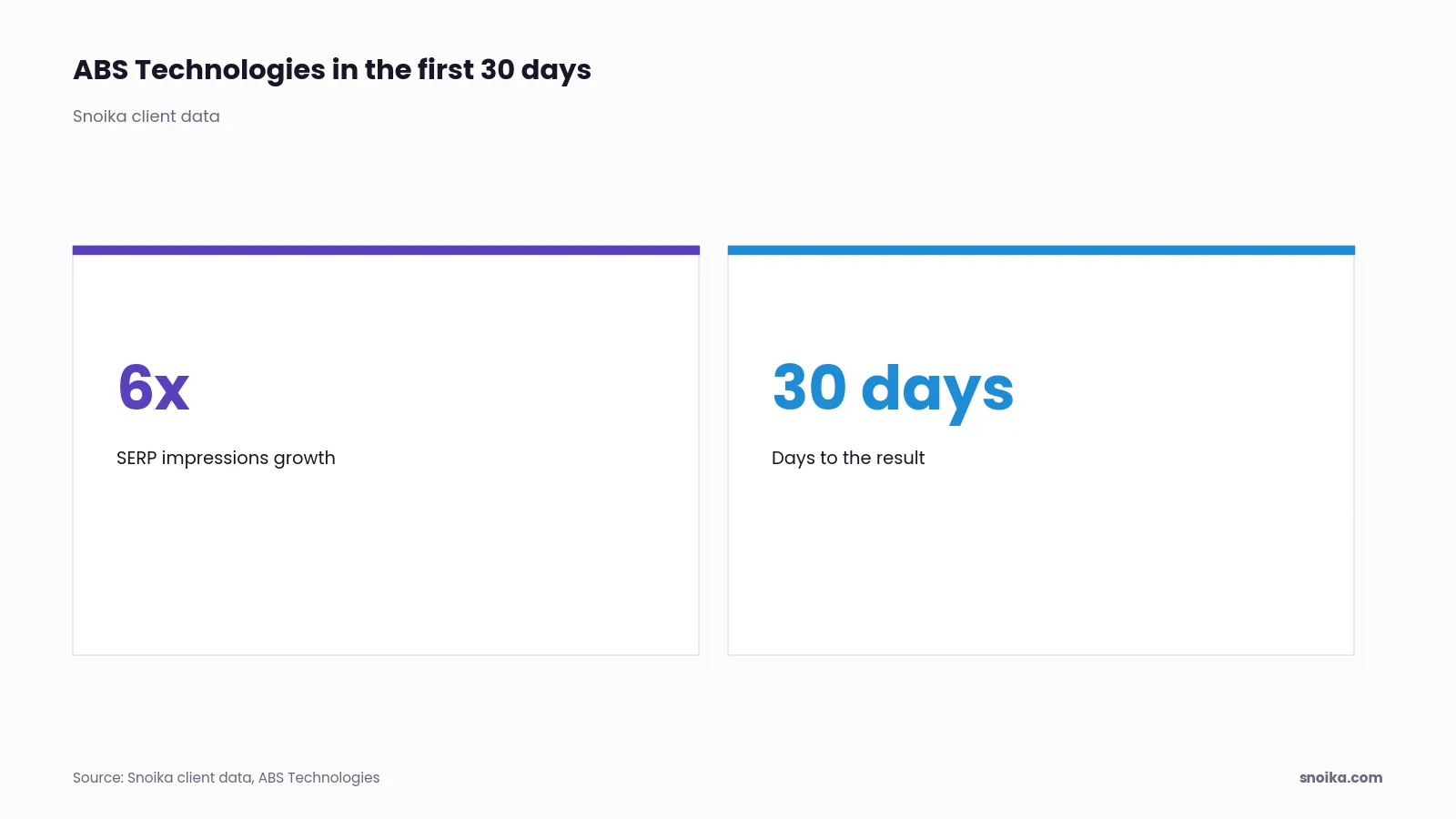
The first month covers technical and indexing fixes, along with pages that answer buyer prompts poorly. These changes show results quickly. ABS Technologies got 6x SERP impressions, and it "improved keyword indexability and significantly increased search visibility within the first 30 days." We name every first-month fix in concrete terms, because a vague fix means the real blocker hasn't been found.
Days 31 to 60: build authority
Month two goes to the content map and to the third-party sources that models cite. You review and approve each page in the dashboard before it's published. Pages go live on your own domain through a DNS connection, with no migration and on any CMS.
Days 61 to 90: reallocate budget
The last block compares results with the baseline the audit set. Budget then moves toward the channels that paid back. Our 90 day marketing plan ends with a decision, and it names the metric that triggers each change.
AI visibility audit explained
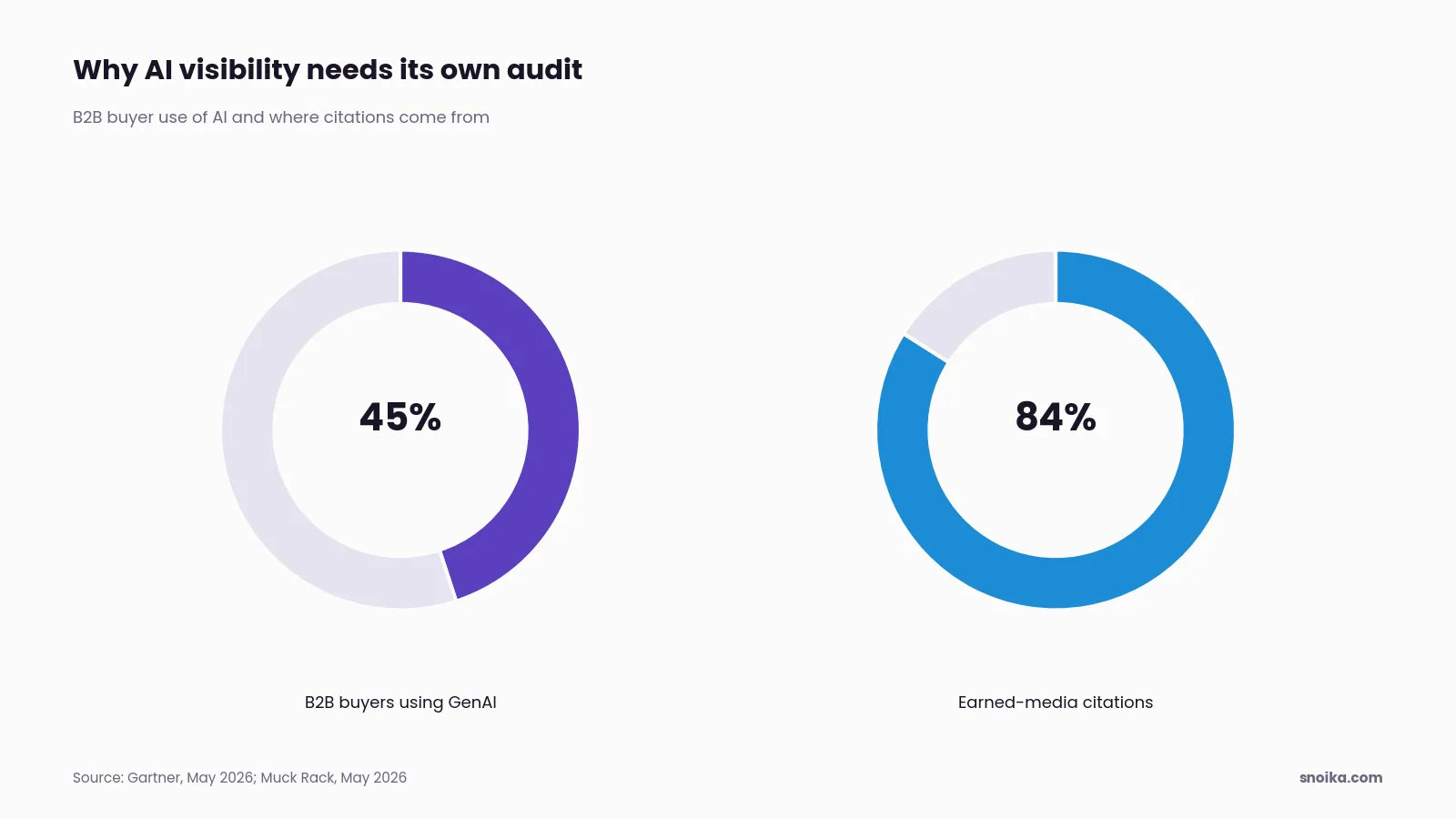
An AI visibility audit tests the prompts your buyers type into AI assistants and records whether your brand appears, how it is described and which sources get cited. It matters because buyers now research there: a Gartner survey found that 45% of B2B buyers used generative AI in a recent purchase, mostly to gather information on vendors.
What we test each week
We run weekly prompt sets in ChatGPT and Google AI Overviews, where most AI search traffic happens, and measure mentions, share of voice, sentiment and citations. A single snapshot can't separate a trend from noise, so the same prompts run every week. Snoika's founder Anton Vedeshin reported to Startup Reporter 1StopVAT's move from 2.7% to 28.3% ChatGPT visibility in 16 weeks.
Why ChatGPT skips a brand
When ChatGPT doesn't recommend your company, the usual reason is that the sources it reads rarely mention you. Muck Rack's May 2026 study of more than 25 million cited links found that earned media accounts for 84% of AI citations. Your own site describes you well and still loses to a competitor that trade press and review sites cover. We also check that your pages state plainly who you serve and what you do, since vague positioning prevents a model from matching you to a buyer's prompt.
How brand authority is assessed
We assess brand authority by measuring the trust signals AI platforms and search engines use to judge you. Those signals include reviews, press coverage, expert mentions and how consistently third parties describe your company. We map which sites cite you, then compare that map with the sites that cite your competitors. The gap between the two maps becomes the authority work in the roadmap.
Authority varies more by category than by company size. In fintech or tax, models favor regulated sources and established publications, while a software tool earns citations through review platforms and community threads. Our assessment names the actual domains to win, because a single abstract score gives you nothing to act on.
Channel prioritisation explained
Channel prioritization finds the channels that underperform and moves time and budget to the 2 to 3 that bring the highest return. Most teams run more channels than they can feed well, and spreading effort thin means none of them reach the volume where results compound. We use your GA4 data to compare each channel's pipeline against its cost and effort, then recommend what to cut.
AI SEO has to be part of that comparison now. Alan Antin, Vice President Analyst at Gartner, predicted that search volume will drop 25% by 2026 and said: "This will force companies to rethink their marketing channels strategy." Our audit treats AI assistants as a channel with its own numbers, because folding them into SEO hides what they're worth.
What competitors reveal about gaps
Competitors reveal three kinds of gaps through the prompts where assistants name them and leave you out, and through sources that cite them but never mention you. Their coverage also exposes topics your site skips. We benchmark your share of voice against named rivals on the same weekly prompts, so each gap comes with a number.
AI assistants sometimes recommend a smaller specialist or a directory over the market leader, and that's the rival you're really losing prompts to. We list the competitors that AI platforms actually recommend in your category, beyond the ones you gave us.
How the session works
The session runs in three steps, and you have a roadmap at the end.
- 011Onboarding callWe learn about your category and buyers so the prompt sets match what your buyers actually ask. We also learn your goals, including the single metric that should move by day 90.
- 022AccessYou grant access to GA4 and Google Search Console. You also grant access to Google Tag Manager, plus your CMS if we'll publish pages. That lets the audit work from your real traffic and conversions.
- 033RoadmapWe present the seven-area findings and the prioritized 90-day plan, and you choose what to run in-house and what to hand to us.
The same team runs the platform and the SEO solutions, and people review every automated workflow. If your markets span languages, we create content in 135+ languages and regional variants.
Audit with follow-through
Our audit comes with the follow-through: our team carries out the fixes with your approval, and we measure AI visibility every week. As an AI marketing agency with its own platform, we cover all seven areas, not only SEO. Ongoing plans are on the pricing page. If you have staff to run parts of the roadmap, you keep those in-house and hand the rest to us.
FAQ
Our strategic marketing audit assesses how buyers find your business and where your marketing loses them. The seven-area review connects search and AI visibility with your wider setup, including website experience and outreach. We turn the findings into fixes ranked by expected return and effort.
Each fix gets an owner, a start week and a metric for checking results. We rank the work by expected return against effort. The plan begins with visibility fixes, moves to content and authority, then compares results with the baseline to guide budget changes.
Beyond SEO, we examine website conversion barriers and brand reputation. We also review outreach to priority accounts and the return of each channel. That shows whether your traffic turns into pipeline and where budget should move.
Usually because the sources AI assistants cite rarely mention your company. Vague website descriptions also make it hard for a model to match you to a buyer's question. Our audit maps competitor citations and checks that your pages state plainly who you serve.