
AI search optimization services
Your buyers now ask ChatGPT and Google AI Overviews which vendor to choose, and the answer names a handful of brands. Our AI search optimization services get your brand into those answers and track week by week whether it stays there. A free AI visibility report shows which buyer prompts mention you today and which ones name your competitors. It also identifies the pages the engines cite.
Trusted by

























Ranking in AI search answers
Ranking in AI search means how often an assistant names your brand when a buyer asks for a recommendation. There's no fixed position to hold. SparkToro, the audience research company led by Rand Fishkin, ran 12 recommendation prompts 60 to 100 times each. It found a less than 1 in 100 chance that ChatGPT or Google's AI returns the same brand list twice.
That's why a single screenshot of a chat tells you almost nothing. We find where your brand ranks by running the prompts your buyers actually type every week and counting the share of answers that mention you. That share is what affects revenue. Pew Research Center found that Google users clicked a traditional result in 8% of visits when an AI summary appeared, compared with 15% when none did.
How AI engines choose recommendations
AI engines recommend brands they've seen described repeatedly and consistently, and they cite accessible pages that answer the prompt directly. As an AEO agency, we work on both the model's training sources and the live pages an engine retrieves, because each influences recommendations differently.
What the model learned before the question
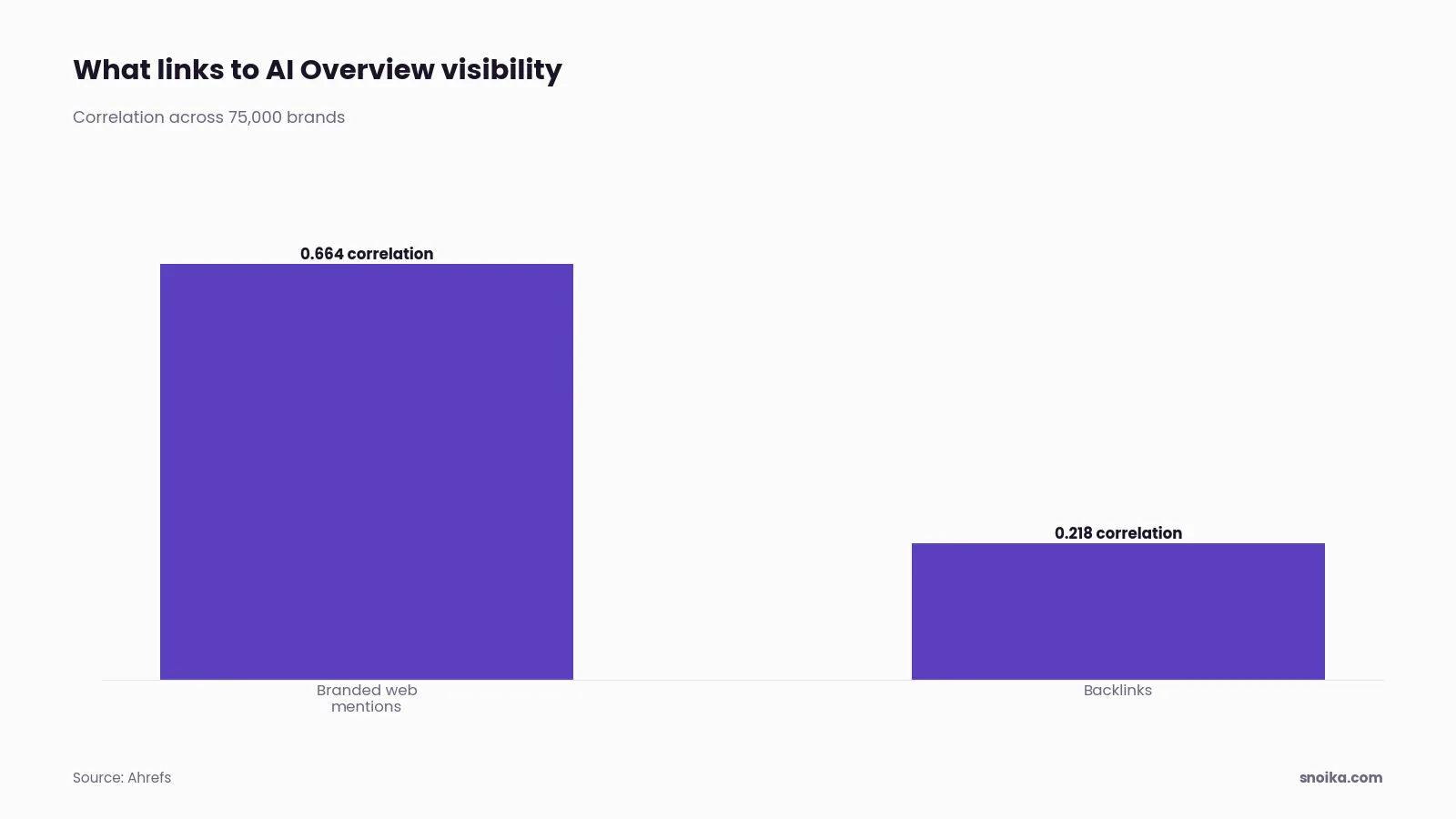
A language model forms its view of your category from the text it was trained on. Repeated appearances in reviews, comparisons and trade press increase how often a brand gets named. One study of 75,000 brands found that branded web mentions correlated with AI Overview visibility at 0.664, against 0.218 for backlinks. So we treat off-site mentions as core work, not a side project.
What the engine retrieves at answer time
ChatGPT search and Google AI Overviews also fetch live pages while they write an answer, and they cite the pages they used. In Pew's data, 88% of AI summaries cited three or more sources. A page gets picked when it answers a buyer's question in the first lines, names your product plainly and can be reached by crawlers. Our GEO checker shows whether your best pages are written as answers or as brochures.
Which buyer prompts we target
We target the conversational search prompts buyers type when they're close to a decision. A prompt that contains your brand name tells you little, because the engine will mention you anyway. We get the prompts from our content map research, which shows how your buyers phrase their questions in your category:
- Best-for questions — Buyers ask which tool is best for their situation.
- Vendor comparisons — Buyers compare named vendors side by side.
- Alternatives — Buyers ask for alternatives to a product they know.
- Price or fit — Buyers ask whether an option suits their budget or team.
You then add custom prompts for the competitors and positioning you care about most. We build the prompt set for your market and region, because a tax software buyer in Germany asks different questions from a 3D printing buyer in the US. Every prompt passes one test: a real buyer would type those words.
Where citations are missing
Citations go missing wherever a buyer prompt has no page on your site that answers it, or where the sources an engine trusts describe your category without mentioning you. We find these gaps by comparing the pages engines cite for your competitors with the pages you already have. The result is a list of prompts where the citation goes to a competitor's comparison page, an industry glossary or a review site instead of your site. On almost every site we also find the same technical gaps:
Each of these gaps needs its own fix, which is why the audit comes before any writing.
Our optimization methodology
Our GEO services improve how often AI recommends your brand by publishing pages that answer buyer prompts, and by making your brand easier for engines to find and trust. Every engagement starts with onboarding, where we learn about your category, buyers and goals and connect Google Analytics 4 (GA4), Google Search Console and Google Tag Manager. Then the work runs in this order:
- 1AuditWe check your site for crawl and indexing problems, along with structural issues that keep engines from reading or citing it.
- 2Content mapWe research the buyer questions in your category and map each one to a page you have or a page you need.
- 3Content creationWe write the pages for search and AI platforms in any of 135+ languages and regional variants. Our team reviews every automated draft before it moves on.
- 4PublishingThe pages we create go live on your own domain through a DNS connection, with no migration and on any CMS. You approve each page in the dashboard first.
- 5Visibility strategiesWe work on the off-site signals and page structure that affect whether engines pick your brand.
- 6ReportingYou see weekly changes in mentions and citations, so we can adjust the next batch of pages.
The same team runs the platform and the services, so the people reading your tracking data are also the people planning your content. For 3DPrinterOS, that work led to #1 visibility in ChatGPT for industry-specific queries and 3–4 qualified inbound leads a day.
Measuring citation share over time
Success in an AI search optimization engagement is measured by how much more often engines mention and cite your brand for your target prompts, compared with a baseline taken before work begins. We track ChatGPT and Google AI Overviews, where most AI search traffic happens. Your prompts are generated in the app from your content map, or you add them yourself. Each week we record:
- Mentions. How often your brand appears across the prompt set.
- Citations. Which of your pages the engines cite.
- Share of voice. Your share of answers against named competitors.
- Sentiment. The tone of the text around your brand.
- Competitor positions. Where rivals appear in the same answers.
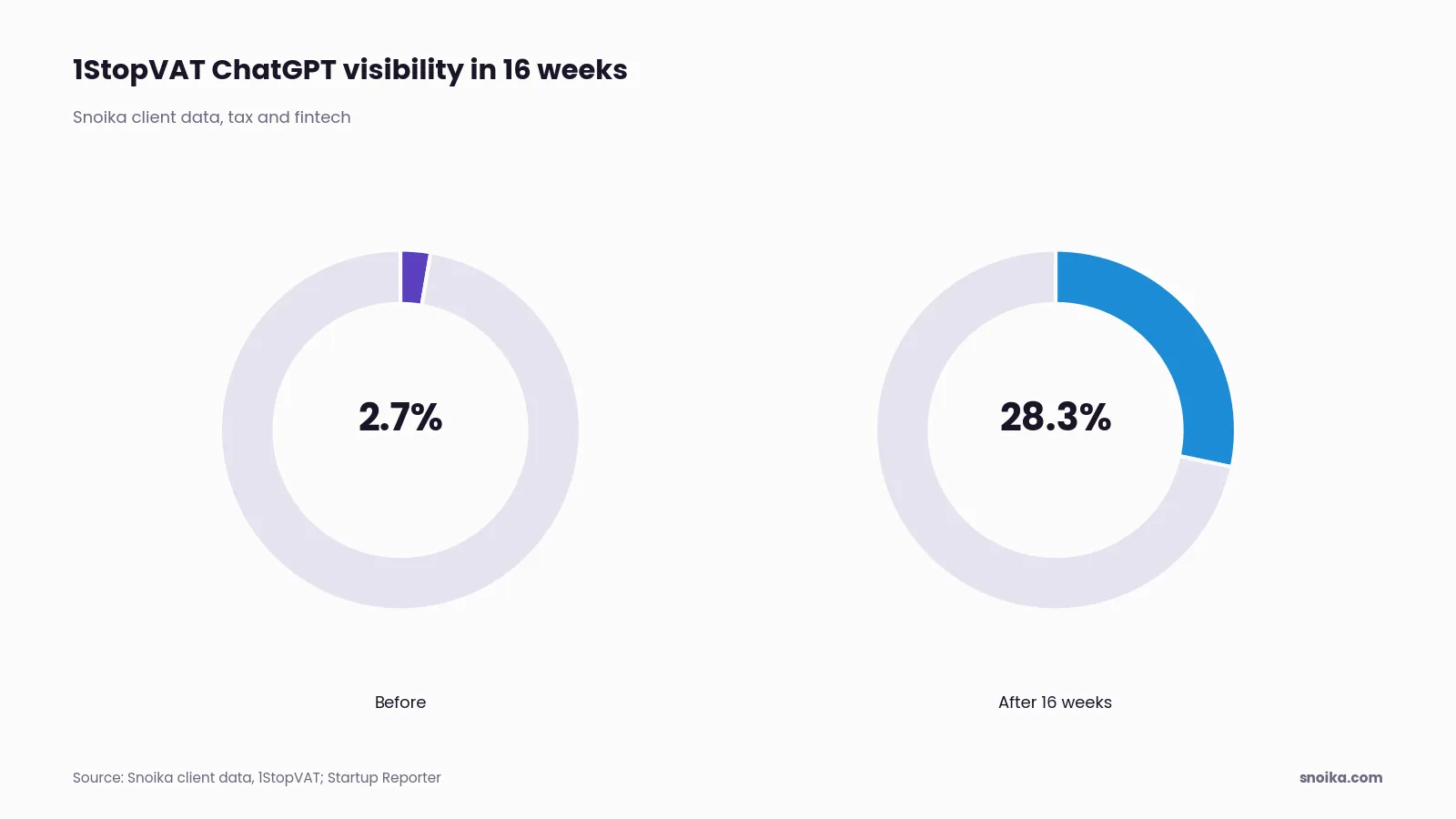
Weekly data evens out the randomness SparkToro measured, because a trend across hundreds of runs is reliable in a way one answer isn't. We show you the baseline and the prompt list before work starts, because without both an "increase" can't be checked. Snoika's founder Anton Vedeshin reported to Startup Reporter 1StopVAT's move from 2.7% to 28.3% ChatGPT visibility in 16 weeks. Results depend on the category, the starting point and how fast pages go live.
Why traditional SEO falls short
Traditional SEO aims for a position in a list of links, and AI search gives an answer that names brands without a click. Gartner analyst Alan Antin put it this way when the firm forecast that traditional search engine volume would drop 25% by 2026: "Generative AI (GenAI) solutions are becoming substitute answer engines."
SEO still matters for generative engine optimization, because engines fetch pages from the indexes that SEO work builds. A classic SEO retainer reports on keyword positions, gives direct-answer pages little attention and leaves off-site mentions to link building. That is why rankings can rise while buyers still hear competitor names from ChatGPT, and why our reporting starts from AI answers.
What sets our service apart
Our service sets itself apart by tracking AI answers every week and creating the pages that change them, with one team responsible for both. A free AI visibility report on your own buyer prompts is the baseline every engagement starts from.
Snoika suits teams that want tracking and content in one place. Plans are on the pricing page.
FAQ
The best fit measures change against your own buyer-prompt baseline and does the content work as well. Snoika reports weekly brand mentions and the exact pages cited, and the same team writes and publishes the pages that close the gaps.
We improve the pages engines can access and the sources that describe your brand. That means fixing blocked crawlers, publishing direct answers to buyer questions and working on missing mentions in relevant reviews and comparisons.
Your brand doesn't hold a fixed position in AI answers. We run your buyers' recommendation prompts every week and calculate the share of answers that mention you, compared with your competitors' share.
We measure success as a higher share of target answers mentioning or citing your brand, compared with the baseline taken before work begins. You see the same buyer prompts tracked every week, with competitors' share as context.
There's no fixed timeline. Progress depends on your starting visibility and how quickly pages go live, and our weekly tracking shows whether mentions and citations rise against your baseline.