
Manufacturing SEO for AI search
Manufacturing SEO has to rank your pages in Google and get your company named when an engineer asks ChatGPT for a supplier. We build both as industry-specific SEO for manufacturers, so the buyer who never clicks a search result still finds your plant on the shortlist. Our work starts by finding the procurement prompts that mention your competitors and leave you out. The rest of this page follows from that gap.
AI-first SEO for manufacturers
AI-first SEO for manufacturers means we write and structure your site so answer engines can quote it, then check every week whether they do. Forrester's Buyers' Journey Survey found that 94% of business buyers used AI in their buying process in 2025, up from 89% a year earlier. When Google shows an AI summary, Pew Research Center measured clicks on a traditional result in 8% of visits, against 15% without one. Your rankings still count, but the citation inside the answer is where the buyer sees you.
Our manufacturing work starts from your engineering data. A query like "5-axis machining of titanium brackets" barely registers in keyword tools, yet the person typing it is close to sending an RFQ. We write technical pages that put tolerances, certifications, lot sizes and lead times where a crawler and a procurement manager can both find them. A job shop with a short list of target accounts needs precision more than traffic, while a distributor with thousands of SKUs (stock keeping units) needs scale, so we agree which prompts to track before we decide what to publish.
AI-first SEO for manufacturers means we write and structure your site so answer engines can quote it, then check every week whether they do.
Why engineers search differently
Engineers search with specifications, and they check an answer before they act on it. The 2026 State of Marketing to Engineers research from TREW Marketing and GlobalSpec found that technical buyers complete 62% of the buying journey before they contact a vendor, and 69% use generative AI during the purchase. Yet they rate their trust in AI answers at 4.7 out of 10, so they use the assistant to build a list, then go to supplier sites to confirm it.
Three findings shape how we write for them:
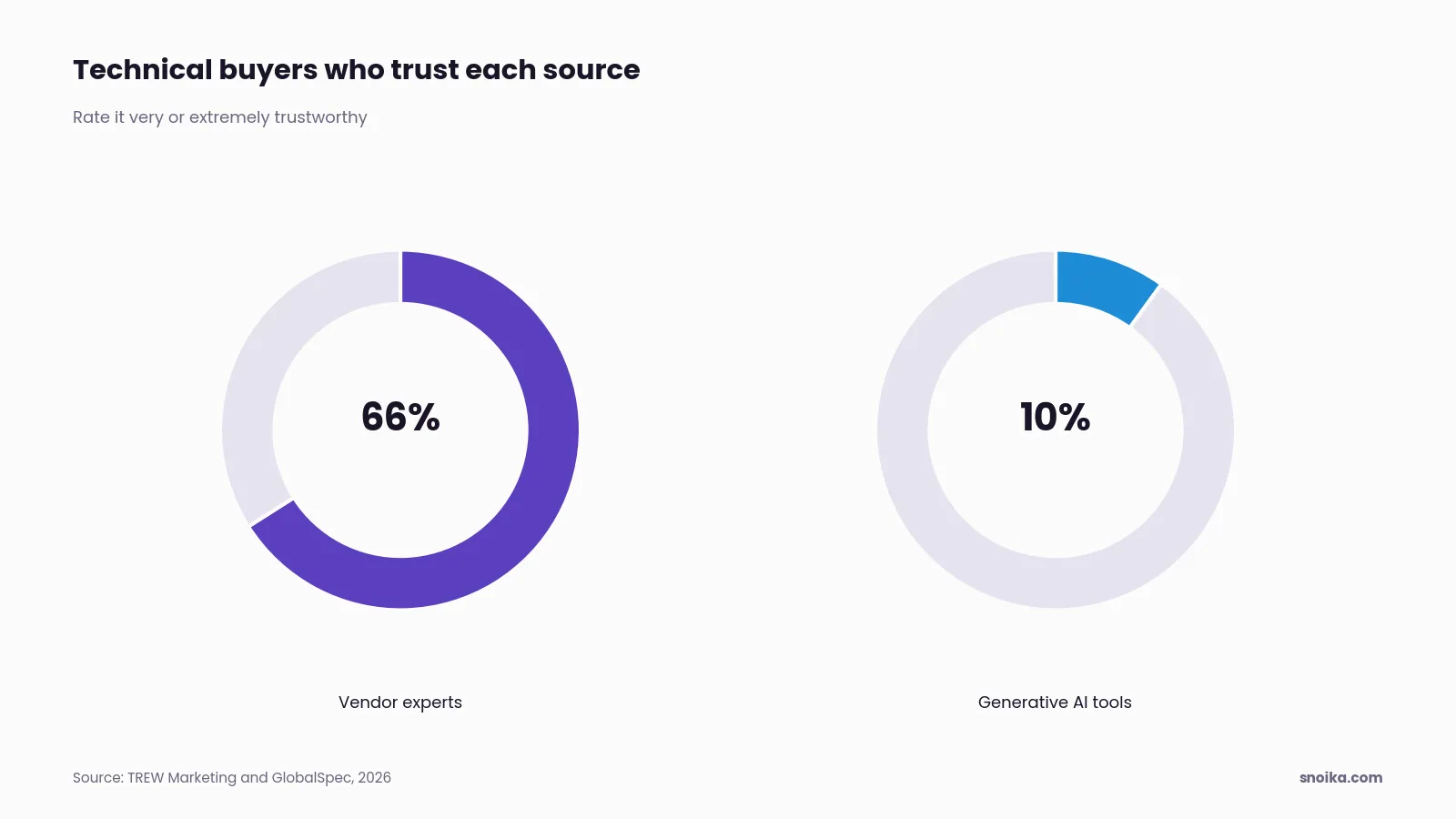
- Experts beat AI. In GlobalSpec's breakdown of the same survey, 66% of technical buyers rate engineering experts at vendor companies very or extremely trustworthy, while generative AI tools get 10%.
- Long queries trigger summaries. Pew found that searches of 10 words or more produced an AI summary 53% of the time, against 8% for one- or two-word searches.
- Speed decides. If finding your tightest tolerance takes longer than 10 seconds, an engineer will leave and an assistant will skip you.
How assistants source suppliers
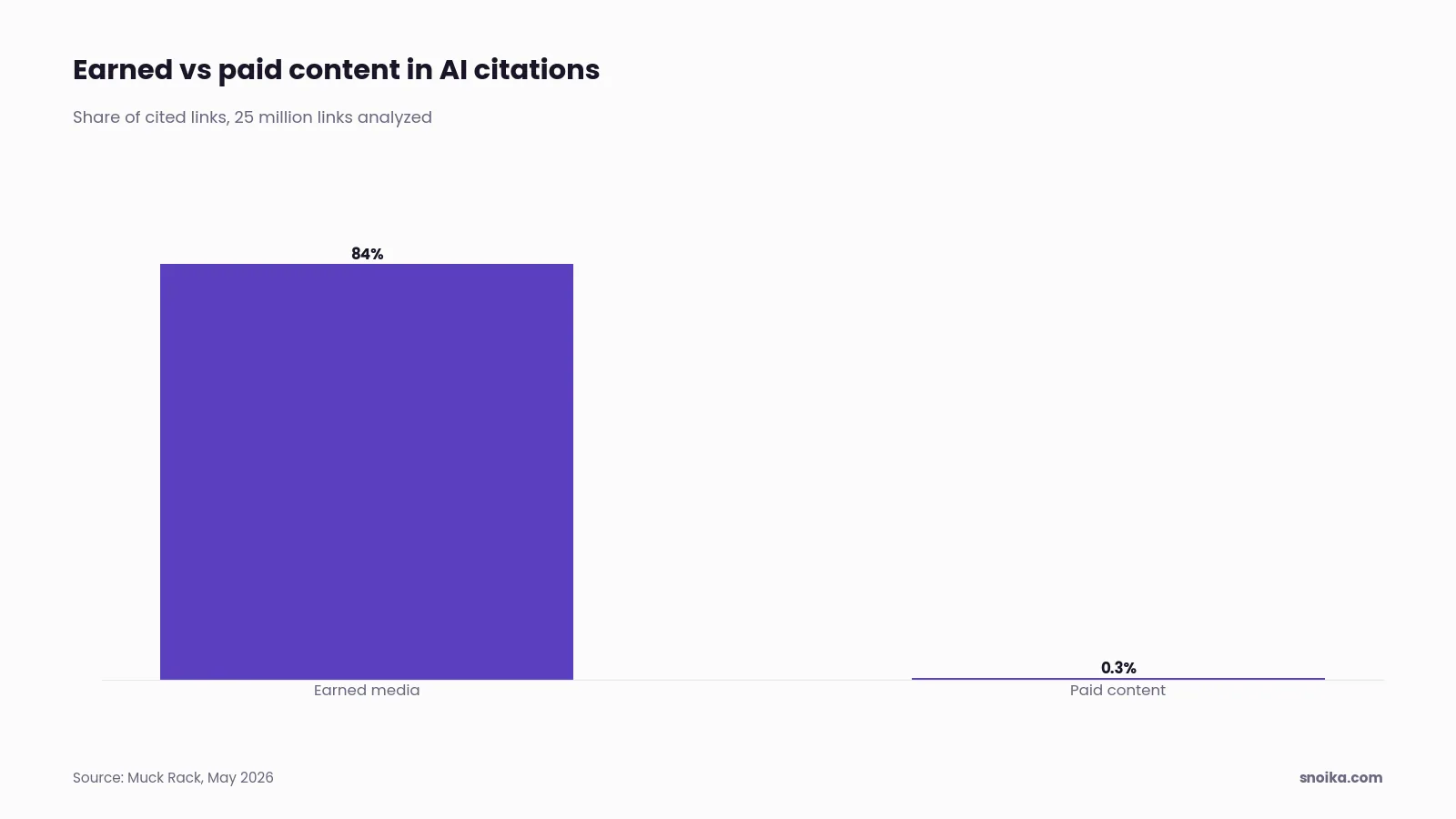
Assistants recommend manufacturers whose capabilities they can confirm through both your own spec-rich pages and independent sources that repeat the same facts. Muck Rack's May 2026 What Is AI Reading? report analyzed more than 25 million links and found that earned media makes up 84% of AI citations, while paid content accounted for 0.3%. Your website gives the assistant the facts, and trade press and directories tell it those facts hold up.
This is how we help assistants verify and recommend your company:
Stacker's summary of the Muck Rack data says ChatGPT includes citations in 96% of its responses, at about 5 sources each, while Claude cites less frequently but draws on more sources when it does. That's why we test each assistant separately.
- Numbers in plain sentences. Each capability gets a plain sentence that carries a number, such as "We hold ±0.005 mm on parts up to 600 mm."
- Consistent listings. Your certifications and equipment read the same across directories and distributor listings.
- Trade coverage. Our off-site work targets trade publications and association member pages.
- Buyer wording. Application pages use the wording buyers put in their prompts.
- Weekly re-tests. We re-test the same prompts every week to see which change moved the answer.
Capability pages that get cited
A capability page gets cited when it answers one buyer question in its first sentence and backs it with numbers a machine can lift. Most manufacturing sites fail here because one "Capabilities" page lists every process the shop has ever run, and an assistant can't match a specific prompt to a page that says everything at once.
What each capability page states
We give each process its own page. It opens with the material range, part envelope, tolerance and typical batch size, then lists the equipment by make and model. Each certification appears with its issuing body and scope, because "ISO certified" on its own tells a buyer nothing they can check. The page closes with the industries you serve and a link to a matching case or application page.
We give each process its own page.
How we structure it
A short spec table near the top holds one attribute per row. Headings are the questions a buyer asks, such as "Maximum part size for wire EDM," with the answer directly underneath. We use the units your buyers use, metric and imperial where you sell to both, and keep the facts in HTML text. Before a page goes live, we check that a stranger could quote any single paragraph without the rest of the page and still be accurate.
A short spec table near the top holds one attribute per row.
Material specification content
Material specification pages answer engineers' questions about grades and standards before they pick a supplier, and they establish whether you can supply and work the material. A page we write comparing 316L with 304 stainless, for example, gives the governing standard (ASTM A240 for plate) and the property differences that matter in service. It also explains how each grade machines and what you keep in stock, which an engineer can't get from a generic materials site and which gives an assistant a reason to name you.
These pages need the site's highest level of accuracy, because engineers will hold your figures up against the datasheet. We cite the standard and revision, and someone on your team who works with the material signs off. A German buyer searches for 1.4404 where a US buyer types 316L, and since we create content in 135+ languages and regional variants, each market's page uses the designation its engineers actually type.
Material specification pages answer engineers' questions about grades and standards before they pick a supplier, and they establish whether you can supply and work the material.
Application pages for procurement
Application pages win procurement leads because they describe the buyer's problem in the buyer's words, then show the process that solves it. "Sterilizable polymer housings for surgical devices" matches a real prompt more closely than "Injection molding." Procurement teams use the volumes you handle and your lead times to decide whether you qualify, along with the compliance documents you ship with each lot and the quality checks you run.
We build one page for each industry and use case you want to win, with the quote path on the page itself. Buyers can upload a STEP file and see an email response time, since GlobalSpec found that 59% of technical buyers prefer email for first contact with a vendor. This approach worked for 3DOS, which reached top visibility in ChatGPT for targeted industry queries and doubled registered users.
Application pages win procurement leads because they describe the buyer's problem in the buyer's words, then show the process that solves it.
Lead generation through search
Manufacturing lead generation through search works when the pages assistants cite live on your own domain and lead straight to an RFQ. The pages we create go live on your own domain through a DNS connection, with no migration and on whatever CMS your site already runs. Your team approves every page in the dashboard before it goes live, and the authority those pages build stays with your domain.
The leads that come in are further along than form fills from paid ads. 3DPrinterOS reached #1 visibility in ChatGPT for industry-specific queries and gained a steady 3–4 qualified inbound leads/day through AI search. Buyers still want a person to confirm what the assistant told them: a 2025 Gartner survey found that 69% of B2B buyers prefer to check AI-generated insights with sales reps. Your sales team should know what the pages claim before the calls start.
Manufacturing lead generation through search works when the pages assistants cite live on your own domain and lead straight to an RFQ.
Measuring AI-driven pipeline
You measure AI-driven pipeline by connecting how often assistants name you with which of those buyers later reach your RFQ form. We use weekly prompt sets to track brand mentions and share of voice in ChatGPT and Google AI Overviews, where most AI search traffic happens. We also track sentiment and citations in those answers.
During onboarding we connect Google Analytics 4 (GA4), Google Search Console and Google Tag Manager, plus your CMS when we publish pages. That lets us tag RFQ forms and separate referrals from AI assistants from organic search. Attribution gaps arise when an engineer reads your page in ChatGPT and types your URL in directly a week later, so we compare a "How did you find us?" field on the form with the tracked figures every month.
You measure AI-driven pipeline by connecting how often assistants name you with which of those buyers later reach your RFQ form.
Our manufacturing service
Our manufacturing service combines AI visibility tracking with an audit, technical content and off-site work, as one of our SEO solutions. It runs in this order:
Prompt audit
We test 20 prompts taken from real RFQs and sales calls in ChatGPT and Google AI Overviews and note who gets named. That list becomes the baseline for every later report, and a free AI visibility report shows it before any work starts.
Content map
A researched content map shows which capability and application pages to build first.
Technical pages
We write the pages with human review and publish them on your domain once you approve them.
Off-site work
We pursue the trade press and directory mentions that confirm your facts.
Tracking
Weekly tracking and reporting with lead tracking show which pages move answers and RFQs.
We make the most sense when you need the tracking and the pages together and don't have the staff to write them.
Trusted by

























FAQ
We publish specific capability facts on your site and keep them consistent across independent listings. We start with buyer questions from real quote inquiries, check which suppliers AI answers name, and repeat the same searches weekly to track changes.
We give each process its own page, opening with material range and maximum part size. A specification table sits near the top, buyer questions are answered directly under headings, and specifications stay in HTML text so each answer can be quoted accurately on its own.
Snoika starts with engineering data and specific supplier searches rather than traffic volume alone. Our technical content helps buyers verify production limits and certifications, and we report on the procurement questions we track and the qualified inquiries they bring.
We build each application page around a specific buyer problem and the process that solves it. Production volumes and lead times let procurement assess fit, and a quote form with file upload sits on the page next to the expected email response time.