
Link building services
Our link building services put your brand on pages that already rank in Google and already get quoted by AI assistants. Each link should bring in readers and raise the odds that ChatGPT or Google AI Overviews name you in an answer. We choose the pages, you approve each one, and we track what every placement changes. Our initial proposal lists the target pages, the link type for each and the metrics we expect each placement to move.
Trusted by

























Placements on pages that rank
To get your brand cited in AI answers, we place links on pages Google already ranks and AI assistants already quote. AI answers draw on the open web, and they lean on pages that search engines trust. In a March 2026 study of 863,000 keywords, 38% of cited pages also ranked in Google's top 10 for the same query, down from 76% when the study ran in July 2025. So a top-10 page still gives you the best odds, but it no longer guarantees a citation.
Most of the web carries no weight at all: 96.55% of pages get zero traffic from Google. A link on one of those pages has no readers, and AI systems rarely retrieve it. That's why we check whether every candidate page ranks and already shows up in AI answers for the questions your buyers ask.
Why backlink quality beats volume
A single link from a relevant page with real traffic does more for you than dozens from sites built to sell links. Three things shape how we judge quality.
Paid link risk
Cheap links carry risk. Google's spam policies list "buying or selling links for ranking purposes" as link spam, and they allow paid links only when they're marked `rel="sponsored"` or `rel="nofollow"`. Bulk packages of high DA backlinks break that rule, and a manual action can undo years of work.
Brand mentions count
AI visibility tilts the math in off-page SEO even further toward quality. A study of 75,000 brands found that brand web mentions correlate with AI Overview visibility at 0.664, against 0.218 for backlinks. How often trusted pages name your brand in a relevant context predicts citations.
Domain scores come second
Domain Authority (DA) and Domain Rating (DR) are scores from third-party tools. Google doesn't use them, and a site can push them up without earning any readers. So we check the page's traffic trend and its topic match before we look at DA.
How we select placement pages
Our off-page SEO service tests whether AI assistants actually retrieve a page before it places anything there. That's the first filter we apply. A page that passes it then has to meet every criterion below:
Rankings
It ranks for queries your buyers search, and its traffic is stable or rising.
AI citations
ChatGPT or Google AI Overviews cite it for prompts in your tracked set.
Topic match
Its topic matches your product, so readers expect your brand there.
Clean outbound links
Its outbound links point to real companies.
Market fit
It's published in the language and market where you sell.
The pages we turn down are just as telling. We reject sites whose traffic spiked and collapsed, which means an algorithm update caught them. We also reject pages that list "write for us" pricing next to dozens of unrelated outbound links, and when a page fails on topic, a high DR score doesn't rescue it.
Link types we build
We choose the link type for each page based on what it already ranks for and how its editors work.
Contextual mentions in ranking articles
This is a mention of your brand, with a link, added to an article that already ranks and already gets cited. It works fastest because the page's authority and AI retrieval history already exist. The trade-off is that editors control the wording and decide whether the mention is one sentence long.
Guest articles on industry publications
This is a full article on a trade or industry site, written for that site's readers, with a link back to a relevant page of yours. It takes longer to place. In return you get room to explain what your product does, and AI systems can quote that passage.
Digital PR coverage
This is original data or expert commentary that journalists pick up and cite. It's the slowest type to land. It also earns the brand mentions that the correlation data above rewards, across several publications from one story.
Our link building process
Our process starts with onboarding and runs as a tracked visibility strategy. The same team runs both the platform and the service, and people review every automated step. Plans are on the pricing page, and the proposal covers placement costs, because those depend on the pages we pick.
Onboarding
We learn about your category, buyers and goals. We ask for access to GA4 and Google Search Console, plus Google Tag Manager and CMS access if we'll be publishing pages.
Audit
We check your current backlinks and internal links and record your AI visibility baseline.
Page selection
We shortlist placement pages against the criteria above.
Approval
You sign off on pages and copy.
Placement
Links go live, and any pages they point to get published on your domain.
Tracking
We schedule the work as a visibility strategy in the Snoika app, so every placement is linked to the metrics it's intended to move.
Placement approval process
You approve each target page and the placement copy before anything goes live. Nothing appears under your brand without your sign-off. The steps run in this order:
Shortlist
We send a shortlist of target pages, each with its traffic, rankings and the AI prompts it's cited for.
Your decision
You approve or reject each page, and rejected pages drop off without further discussion.
Copy
We draft the placement copy and the anchor text, and you approve them.
Go-live
The placement goes live, and we log it in your tracking with its publication date.
Sometimes links point to pages that don't exist yet, such as a comparison page or a data study. We create those pages, and they go live on your own domain through a DNS connection, with no migration and any CMS. You review and approve them in the dashboard before they go live, too.
What results you can measure
We record a baseline before the first placement, then use backlink monitoring to track referring domains and the rankings of your linked pages against it. AI citations are compared with the same baseline. Without one, nobody can separate the growth links caused from growth that would have happened anyway.
| Metric | Where it's measured | What it tells you |
|---|---|---|
| Referring domains gained and lost | Snoika app | Whether new links stick or quietly disappear |
| Orphan pages, broken links, links to redirects | Snoika app | Whether link value reaches the pages that need it |
| Organic sessions and impressions | Google Analytics 4 (GA4), Google Search Console | Whether linked pages gain traffic in Google |
| Mentions, share of voice, sentiment, citations | ChatGPT and Google AI Overviews, weekly prompt sets | Whether AI assistants name your brand more often |
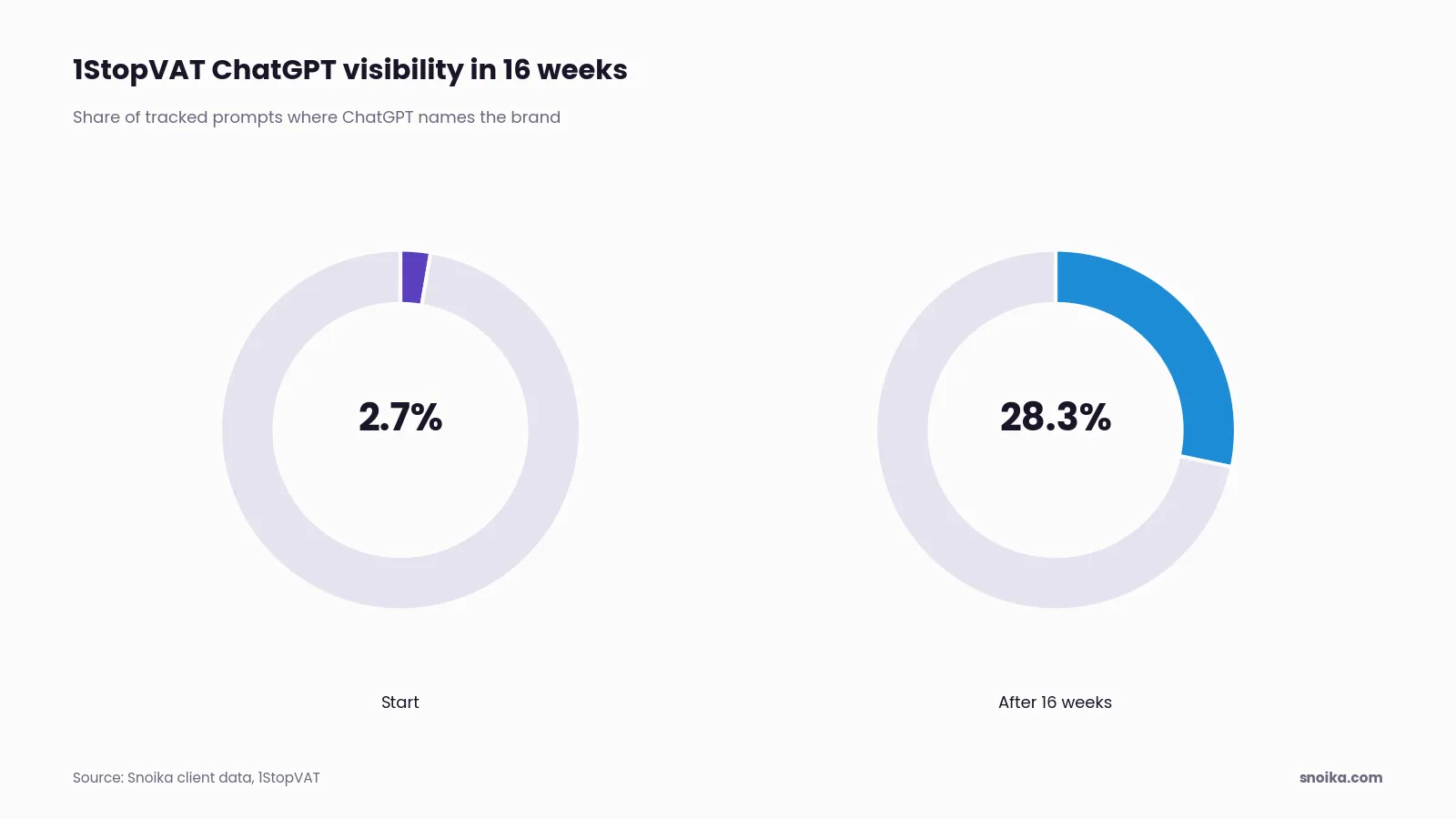
We track AI visibility in ChatGPT and Google AI Overviews because that's where most AI search traffic happens. Snoika's founder Anton Vedeshin reported to Startup Reporter 1StopVAT's move from 2.7% to 28.3% ChatGPT visibility in 16 weeks. That result came from a full engagement, not from links alone.
SaaS link building considerations
For software-as-a-service (SaaS) companies, our link building service targets the comparison and "best tools" pages that buyers and AI assistants read when they're shortlisting software. Those pages decide which products make the list in an AI answer, and a link from a general business blog rarely does the same work. In SaaS link building, we point links beyond your homepage to pages that convert, such as feature, integration or comparison pages.
SaaS buyers ask AI tools in their own language, so we work in your markets, with content in 135+ languages and regional variants. Vespia, a fintech SaaS, recorded a 220% increase in AI brand mentions. For a SaaS team, that metric belongs next to sign-ups.
FAQ
Snoika places relevant brand mentions on pages that already rank and already appear in AI answers. Existing citations show that AI systems retrieve those pages, though they don't guarantee your brand will be cited.
Snoika tests AI retrieval before it selects any placement. Every proposed page comes with its traffic, rankings and the AI prompts it's cited for, because domain scores alone don't show retrieval.
We record rankings and AI citations before the first placement, then compare later results against that baseline. The same set of AI prompts runs every week, and each placement is logged with its publication date.
For SaaS companies, we target software comparison and "best tools" pages in your buyers' markets. Links point to pages that convert, such as feature, integration or comparison pages, not only your homepage.