
AI search visibility for CMOs
Your buyers now ask ChatGPT and Google AI Overviews for a shortlist before they visit any vendor site. If you can't see those answers, you can't defend the budget behind them. Most of the work of AI for CMOs is to measure how often AI answers name your brand and use that number to build a case your board will fund.
Trusted by

























Snoika tracks brand visibility in ChatGPT and Google AI Overviews and builds content that gets cited. You can see the problem for yourself this week: run 20 questions your buyers really ask through ChatGPT and write down which brands come back.
Measure AI share of voice
Snoika measures your AI share of voice by running a fixed set of buyer prompts through each AI assistant every week, then counting how often your brand appears compared with your competitors. The process takes five steps:
- 1Write prompts in buyer wordsWe pull them from sales call notes and Google Search Console queries, and mix category questions ("best VAT software for ecommerce") with problem questions.
- 2Pick the platformsChatGPT and Google AI Overviews carry most AI search traffic, so we cover both before adding others.
- 3Run every prompt weeklyAnswers change from one run to the next, so a single test proves little.
- 4Record each answerWe note whether you're mentioned, where you appear, the tone and which URL gets cited.
- 5Calculate the shareYour mentions are divided by all brand mentions across the prompt set.
Our AI visibility tool keeps the prompt set the same from quarter to quarter, because changed questions break the trend line. Four weeks of weekly results on two platforms give you a baseline before you approve any spend.
AI share of voice explained
AI share of voice is your brand's percentage of all brand mentions in AI answers to your category prompts. Classic share of voice counts ad spend or ranking positions, but an AI answer has no page of ten links. It names a handful of brands, or none at all. In a 2025 Pew Research Center study, Google users clicked a regular result in 8% of visits when an AI summary appeared, compared with 15% when no summary appeared.
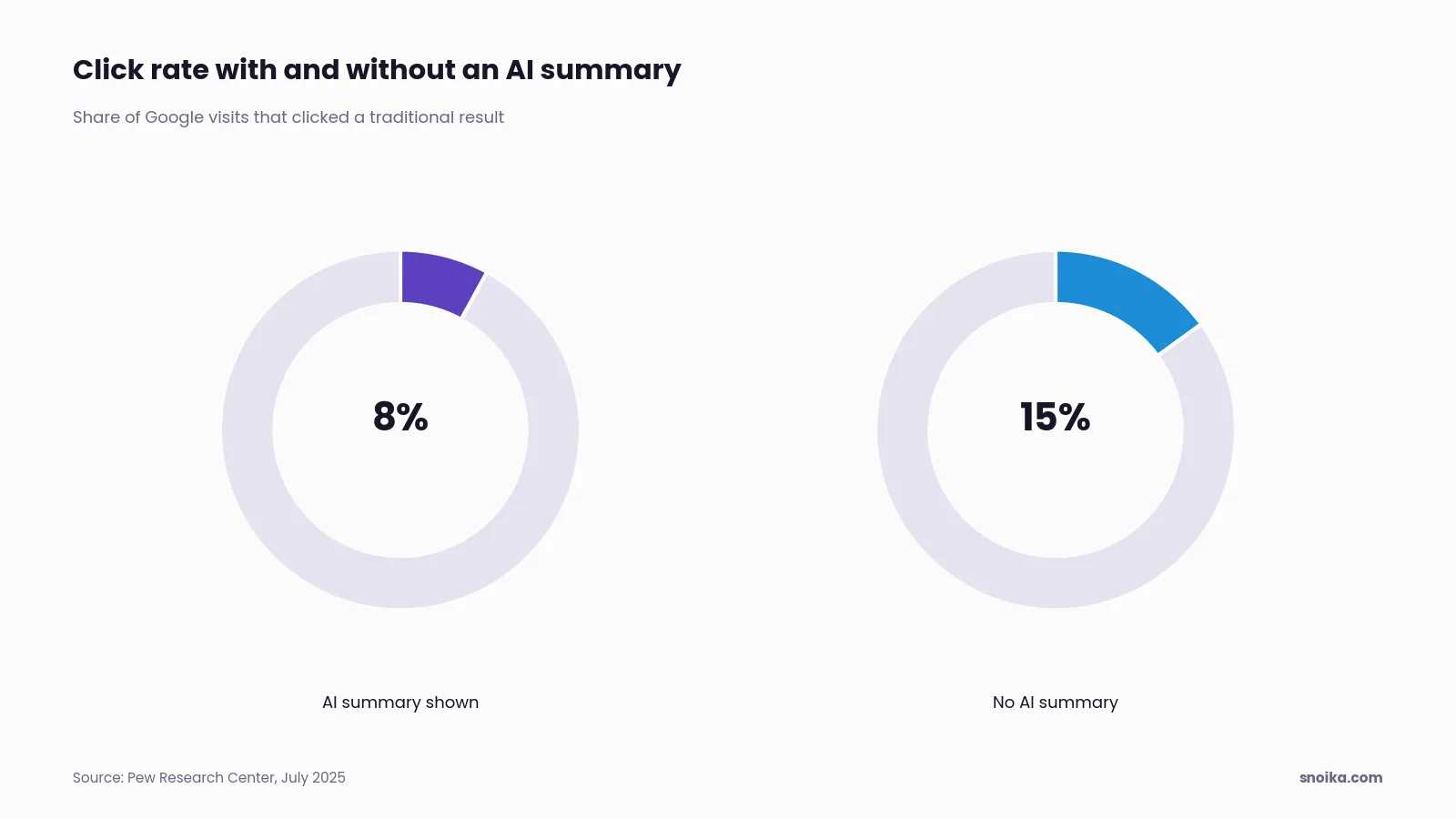
So being named inside the answer now matters more than ranking below it. Snoika tracks mentions of your name in the answer text separately from citations that link to your page as a source. We also read the tone, because a brand that's mentioned often but described wrongly has a problem the percentage won't show.
How CMOs report AI visibility
A CMO should report five metrics to the board, and Snoika's weekly tracking supplies the first three. Each metric comes from a different source and moves at a different pace:
| Metric | What it shows | Cadence |
|---|---|---|
| AI share of voice | Your slice of brand mentions across the prompt set | Monthly trend, quarterly to board |
| Citations | How often AI assistants cite your pages | Monthly |
| Sentiment | Whether answers describe you accurately | Quarterly |
| AI-referred sessions | Visits from chatgpt.com and other assistants, via GA4 | Monthly |
| AI pipeline | Leads and deals from those sessions, via CRM | Quarterly |
AI share of voice
- What it shows
- Your slice of brand mentions across the prompt set
- Cadence
- Monthly trend, quarterly to board
Citations
- What it shows
- How often AI assistants cite your pages
- Cadence
- Monthly
Sentiment
- What it shows
- Whether answers describe you accurately
- Cadence
- Quarterly
AI-referred sessions
- What it shows
- Visits from chatgpt.com and other assistants, via GA4
- Cadence
- Monthly
AI pipeline
- What it shows
- Leads and deals from those sessions, via CRM
- Cadence
- Quarterly
Give the board two lines: your share of voice trend against your top competitors, and your pipeline. The weekly detail stays with your team. Treat the GA4 figure as a minimum, because part of AI-driven traffic arrives without a referrer and gets counted as direct.
Put one person in charge of the number. In our experience, AI programs stall when share of voice belongs to everyone, so it should sit with one owner who reports it next to pipeline.
The board-ready case
Build your business case for AI search visibility around the gap between your share of voice and your top competitor's, and the value of an AI-referred visitor. In February 2024, Gartner predicted that search engine volume would drop 25% by 2026. Alan Antin, Vice President Analyst at Gartner, said GenAI tools "are becoming substitute answer engines, replacing user queries that previously may have been executed in traditional search engines."
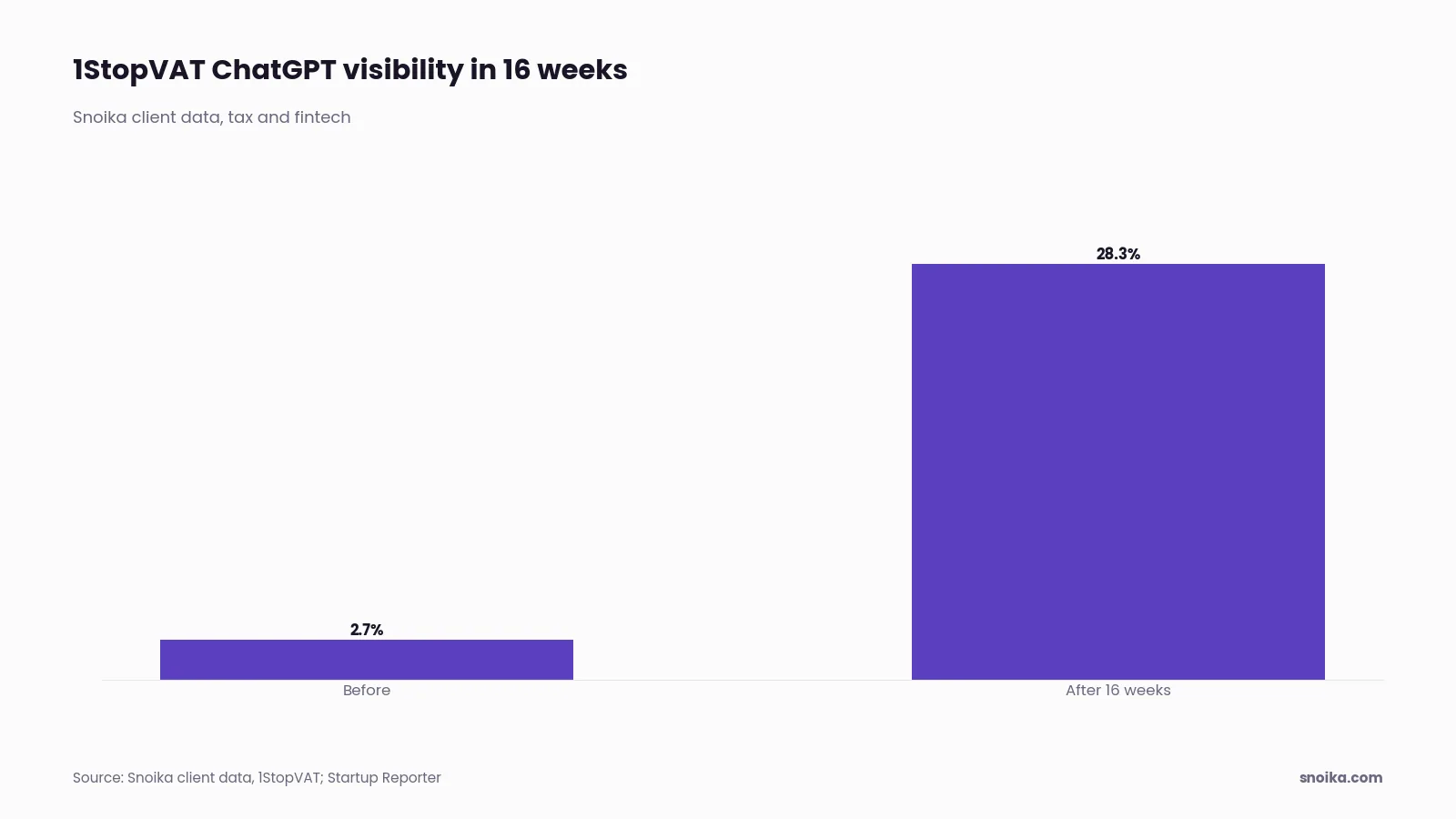
A June 2025 study of 500+ topics found that AI search visitors convert at 4.4 times the rate of traditional organic visitors. Snoika's tracking gives you the baseline for one slide; add a realistic target, the cost and a review date. Snoika's founder Anton Vedeshin reported to Startup Reporter 1StopVAT's move from 2.7% to 28.3% ChatGPT visibility in 16 weeks. Present that as a single case, not a promise.
Content that earns AI citations
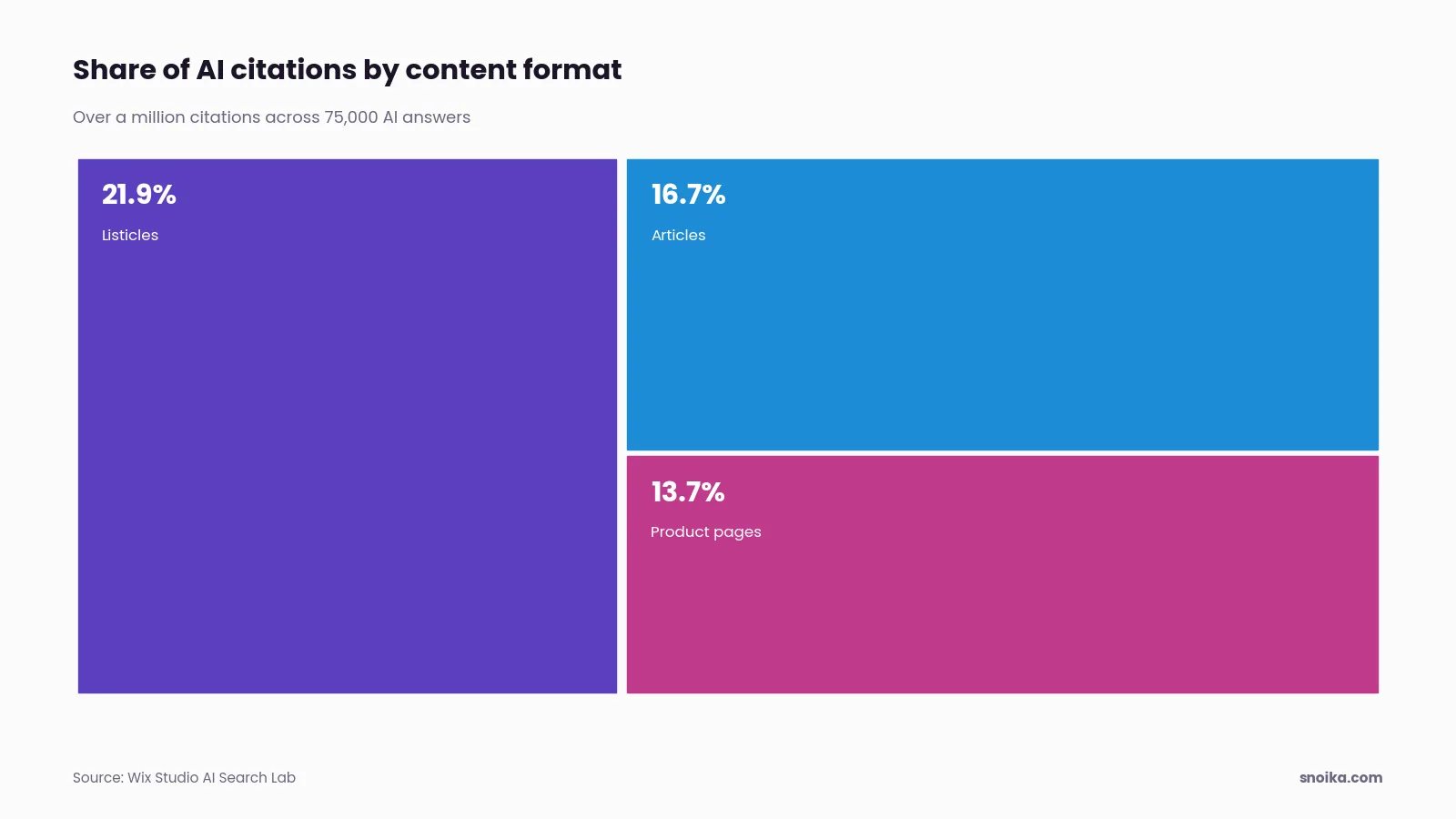
Listicles, articles and product pages are the formats that earn the most AI citations, so Snoika plans each page's format around the query it targets. Wix Studio's AI Search Lab analyzed over a million citations across 75,000 AI answers. It found listicles at 21.9% of citations, articles at 16.7% and product pages at 13.7%. The same study found that query intent predicts the cited format better than industry or model does.
Listicles for commercial queries
Listicles took 40% of citations on commercial-intent queries, close to double any other type. A "best tools for X" page works when it states its criteria and treats rivals fairly. AI assistants can tell when a list exists only to rank its own publisher first.
Articles for informational questions
On informational queries, articles were cited 2.7 times more often than other formats. Our articles put the answer in the first two sentences, then explain how it works. Assistants pull short, self-contained passages, so the definition shouldn't be buried under background.
Comparison pages
HubSpot's research found that comparison content has the highest single-citation rate on ChatGPT. Product pages get cited once a buyer is close to buying. They need specs and plain pricing that an assistant can quote word for word.
Tying AI visibility to revenue
Tie AI visibility to revenue by connecting a GA4 segment for AI referrers with a source field in your CRM. Link those records to responses from a "how did you hear about us" question on forms that lists ChatGPT as an option. Self-reported answers pick up buyers who read an AI answer and then typed your URL directly.
The link holds up when leads arrive steadily. 3DPrinterOS achieved #1 visibility in ChatGPT for industry-specific queries and turned AI search into a steady source of 3–4 qualified inbound leads/day. Your sales cycle determines how long revenue takes to appear; a B2B deal can close two quarters after the first AI mention. Also check whether branded search grew at the same time, and don't credit AI with all of that growth.
Funding a sustainable programme
Fund AI visibility as an ongoing budget line, because answers change weekly and competitors keep publishing. The budget covers tracking and SEO content production, plus your team's review time. Plans are on the pricing page.
Part of the money can come from your SEO budget, because in our AI SEO work the same pages serve both channels. Run a 90-day pilot on one product line, then compare its share of voice and pipeline with the baseline before you scale.
Snoika for marketing leaders
Snoika is an all-in-one platform for SEO and GEO that also supports AEO. It audits websites and tracks brand visibility in Google and AI assistants, and its researched content maps guide the content it creates and publishes:
- Your own domain — Pages go live on your own domain through a DNS connection, with no migration and on any CMS.
- Your approval — Nothing publishes until you approve it in the dashboard.
- Several markets — Content comes in 135+ languages and regional variants.
- Connected reporting — Onboarding includes access to GA4, Google Search Console and Google Tag Manager, the data the reporting above relies on.
The same team runs the platform and the SEO solutions, and people review the output of every automated workflow.
FAQ
Divide your brand mentions by all brand mentions across a fixed set of buyer questions, then multiply by 100. Snoika runs those questions every week on ChatGPT and Google AI Overviews and tracks linked citations separately. We keep the questions unchanged between quarters so the trend stays comparable.
Report AI share of voice against competitors and pipeline from AI referrals, plus citation counts and whether answers describe your brand accurately. Add AI-referred sessions as a minimum, because some visits appear as direct traffic. Snoika's weekly tracking detail stays with your team.
In the Wix Studio study, listicles took 21.9% of citations, articles 16.7% and product pages 13.7%. Snoika picks the format by the buyer's question: listicles for commercial queries, articles for informational ones.
Base the case on your visibility gap against competitors and the value of AI-referred visitors. Snoika's tracking gives you the baseline to show beside a realistic target, the cost and a review date. Treat published results as individual cases, not promised outcomes.
Evaluate a focused pilot after 90 days by comparing share of voice and pipeline with a baseline set from four weeks of weekly tracking. Revenue may take longer, because a B2B deal can close two quarters after the first AI mention.