
Law firm SEO for AI search
Law firm SEO now targets both the Google results page and the answer ChatGPT or Google writes before a prospect clicks anything. Your goal is to be the firm that answer names when someone in your city describes the problem you handle. We start by measuring where your firm shows up today on a fixed set of client-style prompts, and that baseline shows which of the fixes below to make first and whether they're working. The firms named in AI answers often turn out to be a different set from your Google rivals.
Law firm SEO for AI
Law firm SEO for AI applies ordinary search work to getting the firm cited inside AI-generated answers as well as ranked under them. Client behavior drives this shift, as Clio's 2025 Legal Trends Report found that 57% of consumers have used AI to answer legal questions or would. In 28% of cases, the AI told them to contact a lawyer. The assistant decides which lawyer.
An analysis of 146 million results pages, cited by 5WPR, found AI Overviews on 23.6% of legal queries and 57.9% of question-style searches. Snoika combines SEO with GEO (generative engine optimization) in one platform that also handles AEO (answer engine optimization). A human review layer checks the output of our automated workflows, because legal content requires closer review than most content.
Law firm SEO for AI applies ordinary search work to getting the firm cited inside AI-generated answers as well as ranked under them.
How assistants pick legal answers
Assistants pick legal answers from pages they can crawl and trust, and they lean toward firms whose facts match across independent sources. For Google, a page only has to be indexed and eligible for a snippet, and Google says there are no other technical requirements. Its guide on generative features states that "The best practices for SEO continue to be relevant because our generative AI features on Google Search are rooted in our core Search ranking and quality systems."
We work on the law firm SEO signals for AI citations in this order of priority:
Crawlable answers
A crawlable page that answers the client's question in its first lines.
Matching facts
Firm and attorney facts that match on your site and on every outside profile.
Local mentions
Mentions in local news, bar association pages and "best of" lists.
Recent reviews
Reviews that are recent and describe real matters.
The second and third signals come from Whitespark's 2026 ranking factors study, which added an AI search visibility category. In that category, consistency across sources and unlinked citations gained weight. ChatGPT and Google AI Overviews don't draw on identical sources, so we check both before calling your AI SEO problem solved.
Practice pages that win citations
Practice pages win citations when each page gives a plain-language answer to one legal question within a single jurisdiction. An assistant needs more detail than the eight claim types listed on a page called "Personal Injury" to quote a specific answer, such as how long someone has to file a slip-and-fall claim in Ohio.
What a practice page opens with
We open each practice page with a two or three sentence answer to the question a client would actually type, then give the reasoning. The deadline, fee structure or first step sits near the top, in a sentence that still makes sense if it's lifted out of the page.
Headings match the follow-up questions, such as what the claim is worth or whether the client needs a lawyer at all. The full explanation sits lower down, where a reader who clicked through will find it.
We open each practice page with a two or three sentence answer to the question a client would actually type, then give the reasoning.
Where jurisdiction shapes the copy
Jurisdiction decides whether an answer is correct, so each page names the state, cites the statute and carries a date. Assistants that are trying to avoid giving wrong legal advice favor content that limits its own scope.
Firms serving immigrant communities face a second limit when their pages are in English alone, because those pages miss clients who search in Spanish or Vietnamese. Snoika writes content in 135+ languages and regional variants, so a firm can publish the same answer for each client community it serves.
Jurisdiction decides whether an answer is correct, so each page names the state, cites the statute and carries a date.
Attorney credentials as signals
Attorney credentials work as signals when verifiable bar admissions with numbers, court admissions and named certifications sit on each attorney's own profile page, where they can be checked. The markup we add helps AI assistants surface your firm:
Person
A schema.org `Person` for each lawyer, linked to the firm by `worksFor`.
Credentials
`hasCredential` for bar admission and board certification.
Bar listing
`sameAs` links to the state bar listing.
Schema.org defines hasCredential as "a credential" awarded to a person or organization. Under ABA Model Rule 7.2, a lawyer can claim to be a certified specialist only if an approved body issued the certification and the communication names that body. We put the certifying organization's name in the bio text and in the markup, so the claim stays compliant wherever an assistant repeats it.
Local signals assistants trust
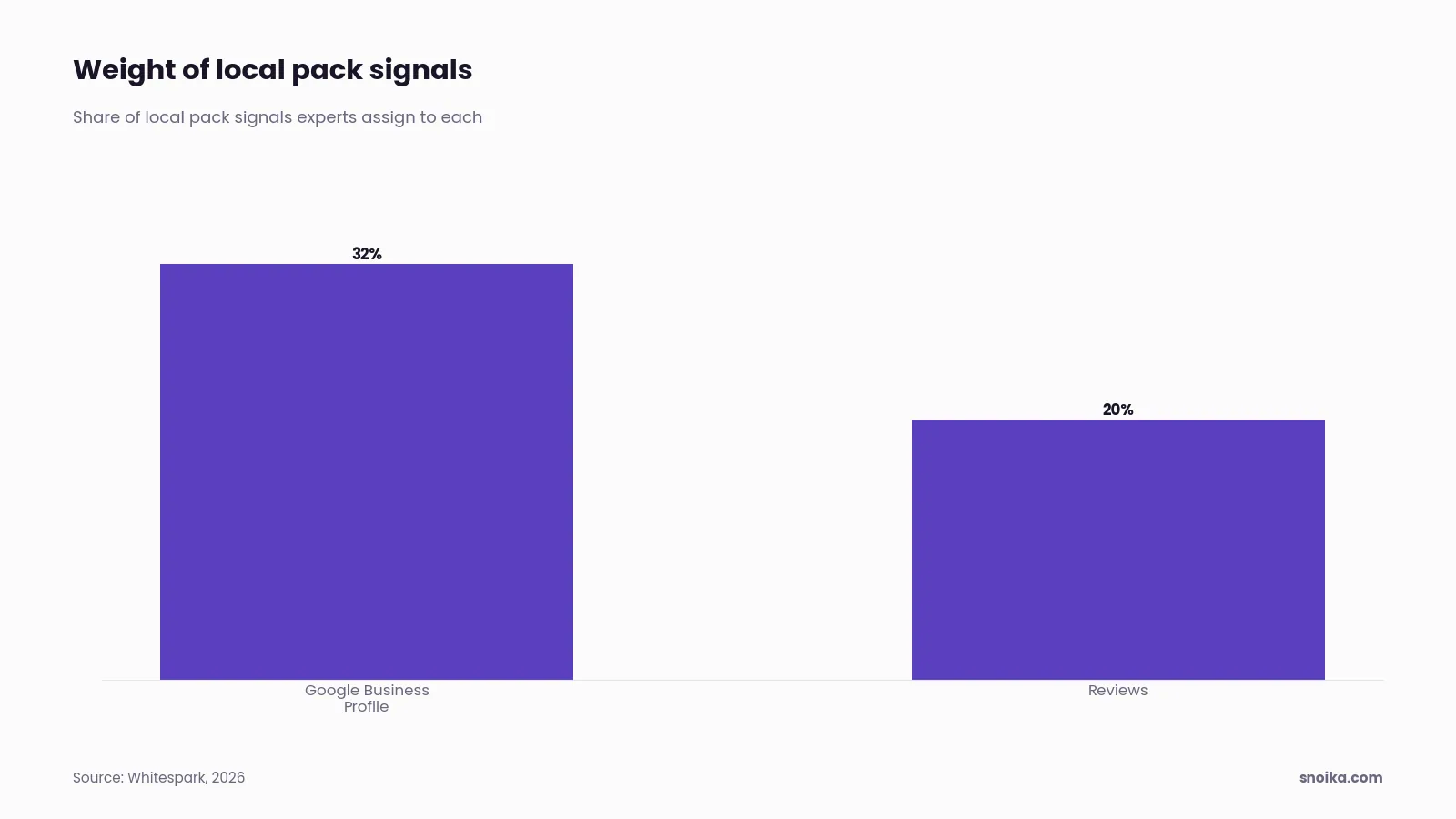
Assistants trust local signals that agree with each other, and the Google Business Profile carries the most weight. In Whitespark's 2026 survey, experts put 32% of local pack signals on the profile and 20% on reviews. We prioritize profile accuracy before reviews and outside mentions when we structure local SEO for AI suggestions.
Profile category
Pick the primary profile category that matches your main practice, such as "Personal injury attorney."
Matching details
Make the firm's name, address and phone number match exactly between the website, the profile and every bar or legal directory listing.
Office pages
Build one page per office with its address, the attorneys based there and the courts they appear in.
Reviews
Ask for reviews after a matter closes, and reply to each one without disclosing anything about the client.
Local mentions
Earn mentions from local outlets and associations, which assistants read as independent confirmation.
Multi-office firms break step 2 first. An old suite number on a directory listing is enough to make an assistant unsure which address is right, so we fix entity consistency before writing new pages: content can't overcome conflicting addresses.
Structured data for legal pages
Structured data for legal pages labels the firm, its offices and its people so machines read them consistently. It makes pages eligible for rich results, though according to Google it isn't required for generative AI search. We start by replacing old markup, because Schema.org now marks the `Attorney` type deprecated in favor of LegalService, and some legal site themes still output it.
| Schema type | Where it goes | Properties worth filling |
|---|---|---|
| `LegalService` | Homepage and office pages | name, address, telephone, areaServed, openingHours |
| `Person` | Each attorney bio | jobTitle, worksFor, hasCredential, sameAs, knowsAbout |
| `Service` | Each practice page | serviceType, provider, areaServed |
| `BreadcrumbList` | Every page | itemListElement in site order |
We validate every template after a site update, because plugins sometimes overwrite custom markup without warning.
Measuring AI-driven referrals
We measure AI-driven referrals through both clicks that reach your site and mentions that never produce a click. For clicks, ChatGPT adds `utm_source=chatgpt.com` to its links, and GA4 then records the visit as chatgpt.com / referral. Free ChatGPT users don't send referrer data, so part of that traffic shows up as Direct. Google counts AI Overview clicks inside the Search Console Performance report under the Web search type, without separating them out.
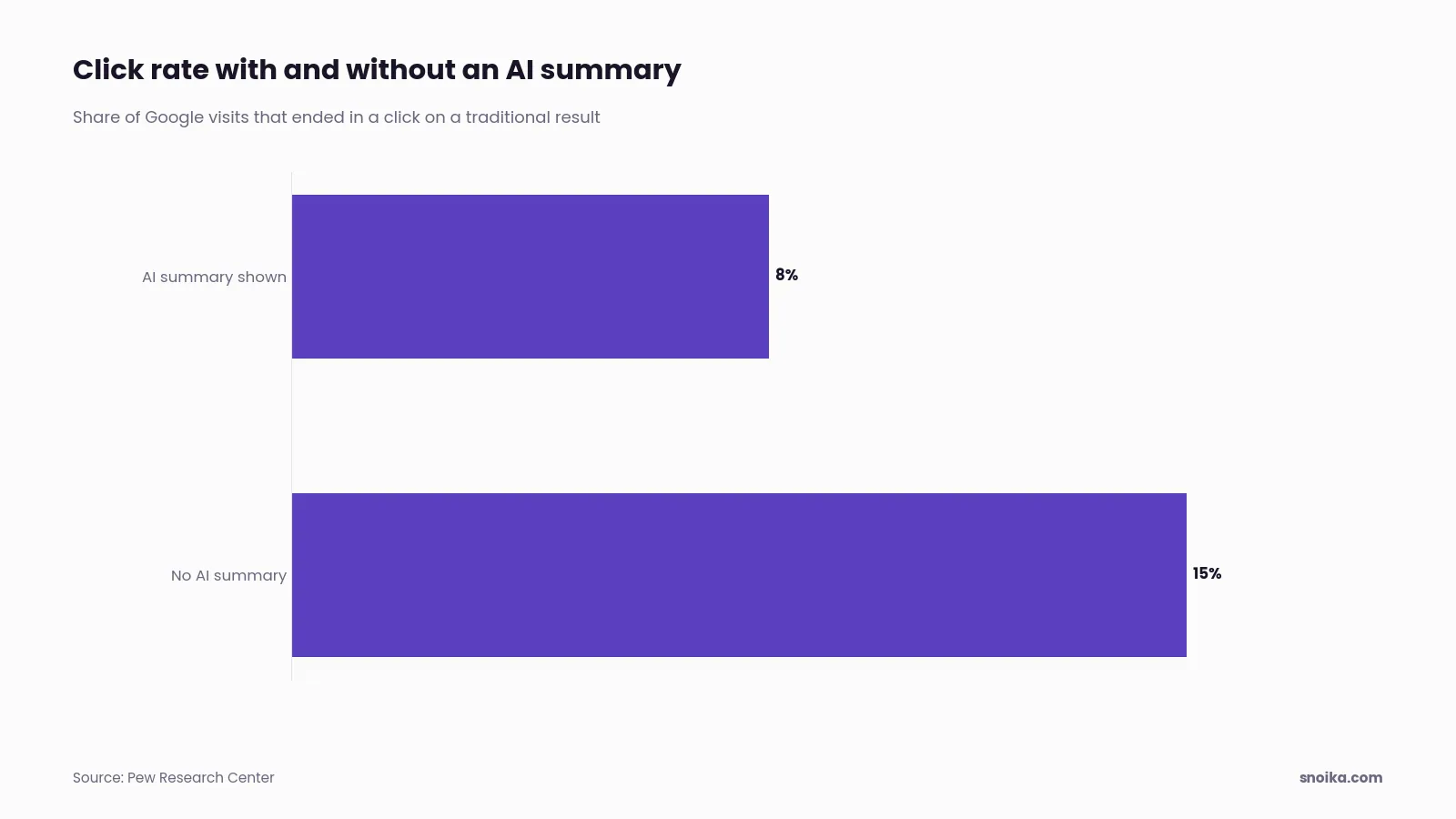
The mention layer matters more for law firms, because Pew Research found users clicked a result 8% of the time when an AI Overview appeared, against 15% without one. Snoika uses weekly prompt sets to track brand mentions and share of voice in ChatGPT and Google AI Overviews, along with sentiment and citations. With GA4, Google Search Console and Google Tag Manager connected, we match tracked mentions to sessions and then to leads.
What Snoika delivers
Snoika delivers AI citation tracking and published content from one team, with a person reviewing legal content before it goes live. Like any industry-specific SEO engagement, the work starts from the firm's own prompt baseline:
Audit
We review the site and how AI assistants describe the firm today.
Tracking
Weekly AI visibility tracking runs in ChatGPT and Google AI Overviews.
Content map
A researched content map sets which practice pages come first.
Content
We write pages in 135+ languages, and the firm approves each one in the dashboard before publication.
Publishing
Pages go live on the firm's own domain through a DNS connection, with no migration and on any CMS.
Off-site work
Our SEO solutions also include off-site strategies and reporting with lead tracking.
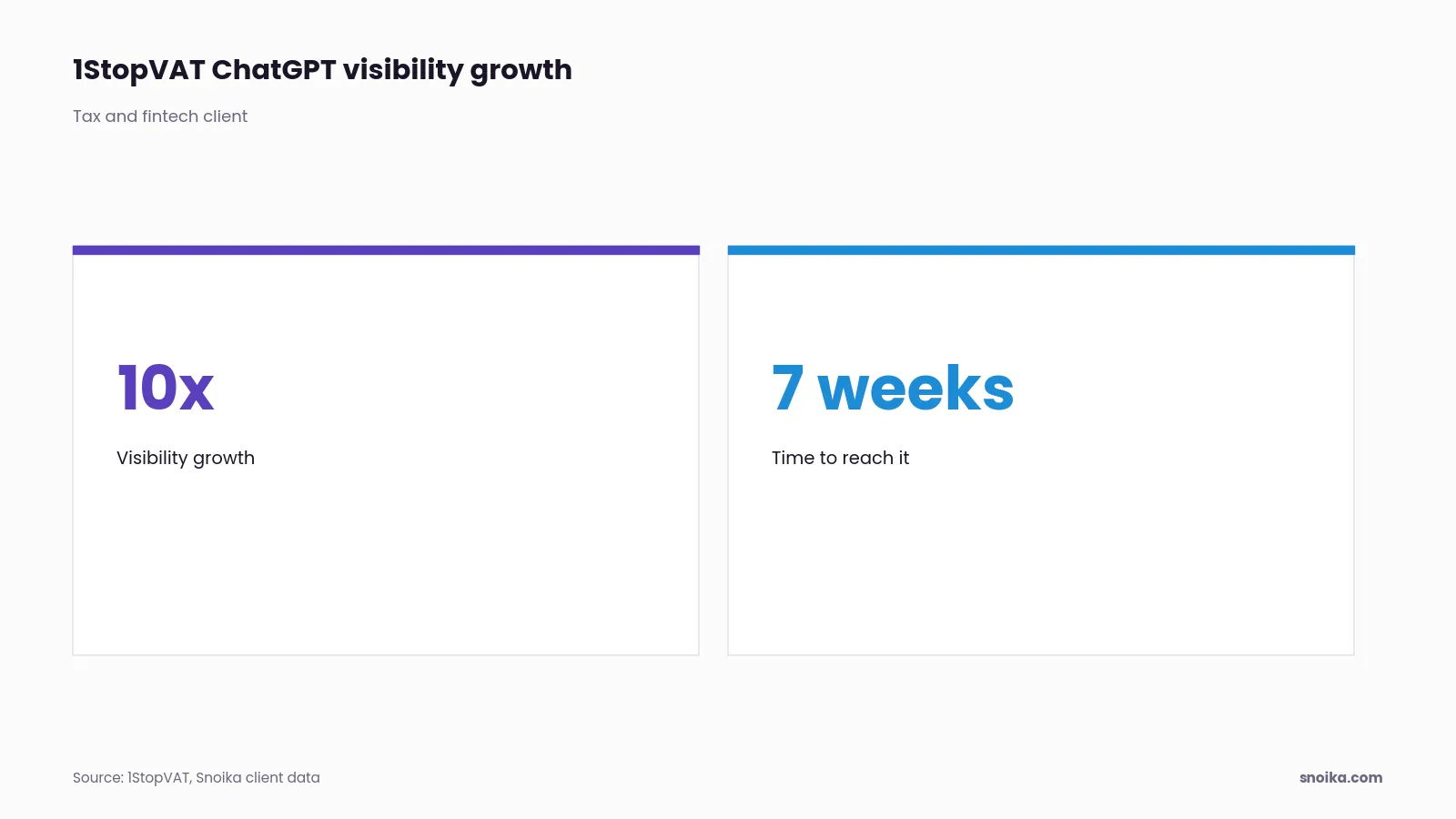
A multi-office or multilingual firm gets the most from tracking and publishing under one roof. The same method is behind our published client results. 1StopVAT, in tax and fintech, saw 10x growth in ChatGPT visibility in 7 weeks.
Trusted by

























FAQ
We prioritize crawlable pages that answer client questions immediately, followed by consistent firm and attorney facts across sources. Once those foundations are correct, we work on independent mentions and recent reviews that describe real matters.
We open each page with a two- or three-sentence answer to one legal question in a specific jurisdiction, with the relevant deadline or fee structure near the top. Each page names the state and cites the statute, so the answer keeps its legal context when quoted.
We add Person markup to each attorney biography, with worksFor linking the lawyer to the firm, hasCredential for verifiable qualifications and sameAs for the state bar listing. For specialist certification claims, we name the approved certifying body in both the biography and the markup.
We start with an accurate Google Business Profile and matching office details across directories, and give each office its own page listing the attorneys based there. We resolve conflicting addresses before expanding content, then work on reviews and local mentions.
No, website traffic alone can't show how often an AI answer names a firm without generating a click. We track mentions on the same client-style prompts each week alongside referral visits, and check ChatGPT and Google AI Overviews separately because their sources differ.