
Ecommerce SEO services for AI search
Ecommerce SEO services rank your category and product pages in Google and get your store named when a shopper asks ChatGPT or Google AI Overviews what to buy. Snoika does both for online stores, from product data and buying guides to the review and marketplace sources assistants check. We start by measuring where your store appears in AI answers today, because every choice below depends on that baseline.
SEO for AI shopping answers
SEO for AI shopping answers helps an AI assistant find products it trusts enough to name when a shopper asks for a recommendation. Adobe Analytics found that generative AI tools drove a 693.4% increase in traffic to US retail sites over the 2025 holiday season. That figure covers more than 1 trillion visits.
No one can honestly promise that ChatGPT will cite your store, and we don't. What we do is measure the result every week and work on two fronts: product data on your site that machines can read, and the off-site reviews and listings that assistants check before they name a store. Our weekly prompt sets track mentions, share of voice, sentiment and citations in ChatGPT and Google AI Overviews.
SEO for AI shopping answers helps an AI assistant find products it trusts enough to name when a shopper asks for a recommendation.
How AI Overviews pick stores
AI Overviews pick from pages Google has already indexed, so an indexed page is the entry ticket. Google Search Central says a page must be indexed and eligible to show with a snippet, with "no additional technical requirements" beyond that. Google also says Merchant Center feeds can help products show up in AI responses.
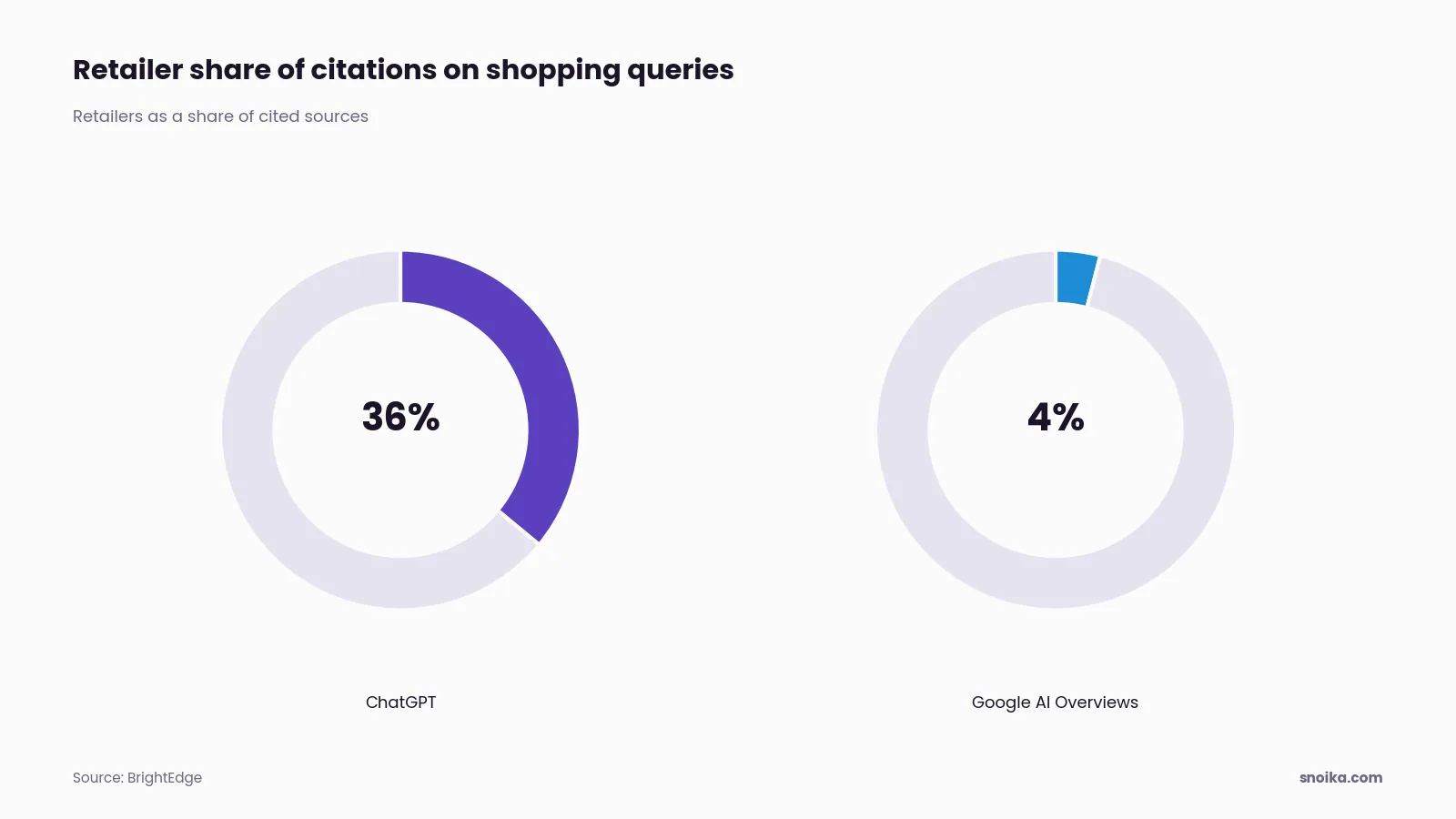
To get your product pages recommended, we make each one indexable with a full snippet, back it with a clean Merchant Center feed and build presence on the sources Google trusts for shopping research. BrightEdge found that AI Overviews cite retailers only about 4% of the time on ecommerce queries, with YouTube, Reddit and Quora among the leaders instead. How often an Overview appears at all depends on the category: Bartosz Góralewicz, founder of Onely, found AI Overviews on 16% of ecommerce searches in a set of 25,000 queries. That's why we check your own top 50 queries by hand before we plan around them.
AI Overviews pick from pages Google has already indexed, so an indexed page is the entry ticket.
Category page optimisation
Category pages win the "best X for Y" queries that AI answers summarize, and only when the page says who each product suits. A grid of thumbnails with no text gives a model nothing to quote. We write a short introduction that explains who the range is for, what separates the price tiers and which attributes matter most.
We let a filter page be indexed when people search for it (say, "waterproof trail shoes for women") and canonicalize the rest, so faceted navigation doesn't flood the index with thin duplicates. When we audit a category template, we check three things:
Concrete attributes
The copy names them.
Canonical filters
Filter URLs resolve to one canonical page.
Crawlable listings
A crawler can reach page two of the listing.
Product page content signals
Assistants pick products by matching what the shopper asked for against facts they can check on your page and in your feed. OpenAI's ChatGPT release notes say inventory and price are factors in its merchant rankings, and quality and primary seller status also affect them. Every one of those comes from data you control.
Structured product data
Product schema and a merchant feed carry the price and stock data a model needs. They also supply identifiers such as the Global Trade Item Number (GTIN). OpenAI now takes merchant feeds directly, and a guide from Alhena notes merchants can refresh them every 15 minutes. We keep feed and page in sync, because a feed that shows a product in stock while the page says sold out undercuts the trust you're building.
Product schema and a merchant feed carry the price and stock data a model needs.
Descriptions that answer questions
Shoppers ask assistants things like "quiet enough for an apartment" or "fits a 15-inch laptop." We answer those questions in your descriptions with measurements and plain claims, which copy-pasted manufacturer text can't do. Each description covers materials, use cases, what's in the box and what the product doesn't do. That last point builds trust, because models favor pages that sound like an honest spec sheet.
Shoppers ask assistants things like "quiet enough for an apartment" or "fits a 15-inch laptop." We answer those questions in your descriptions with measurements and plain claims, which copy-pasted manufacturer text can't do.
Buying guide strategy
Buying guides capture the research questions that come before a purchase, which is where AI Overviews mostly appear. Most desktop AI Overview triggers, 88.1% in March 2025, come from informational keywords. A guide that answers "how to choose a road bike" gets you into the answer before the shopper has picked a brand.
We write one guide per real decision and link it to the category page that settles that decision, not a guide for every keyword variant. If you sell abroad, each market needs wording that matches how its buyers phrase the question, and we create content in 135+ languages and regional variants to provide it. Before we write a guide, we check that the decision it covers maps to a category you stock.
Buying guides capture the research questions that come before a purchase, which is where AI Overviews mostly appear.
Review source authority
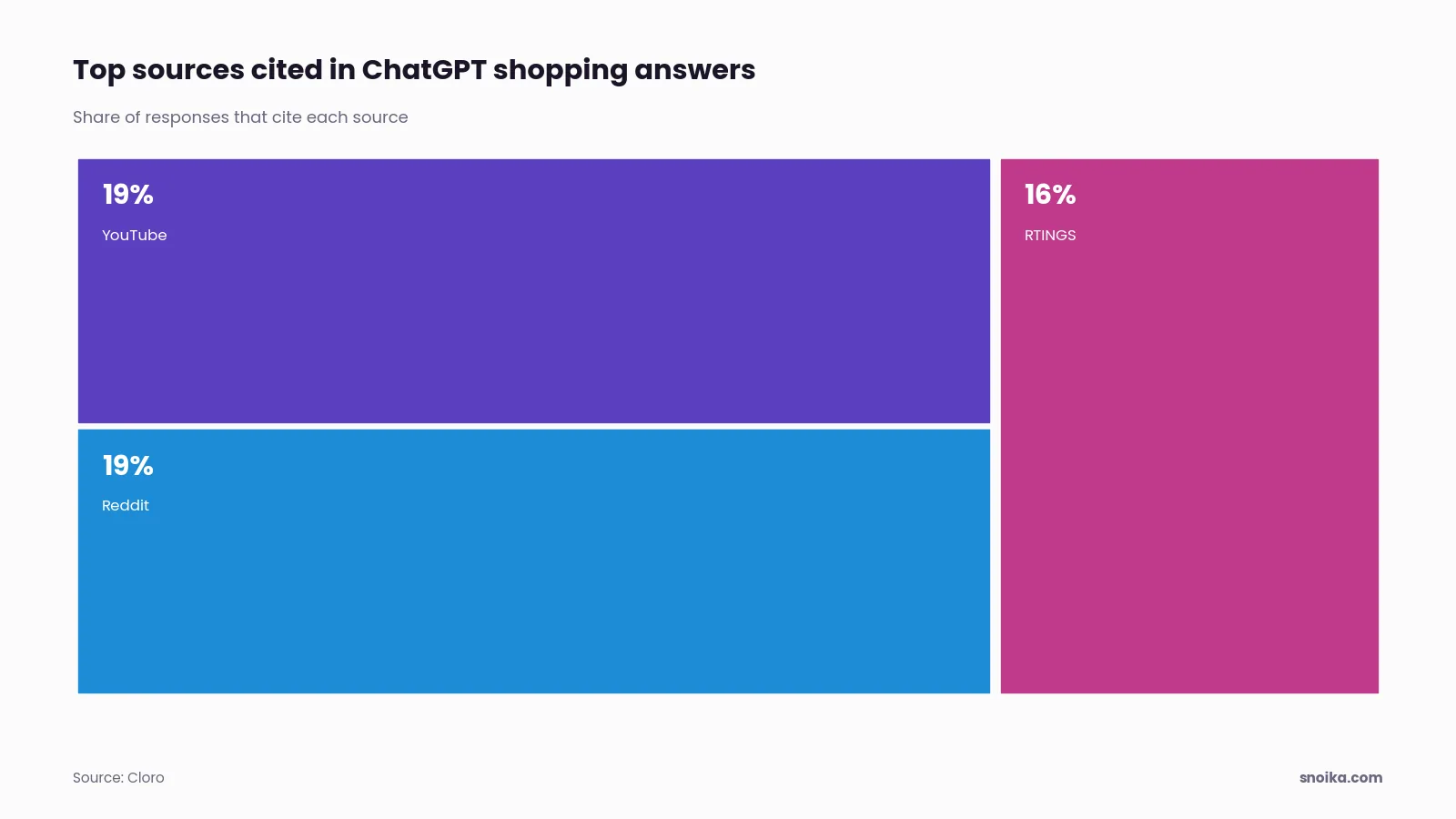
Review sources decide which store an assistant recommends, because the model trusts what others say about a product more than what the brand says. Cloro's study of ChatGPT shopping answers found YouTube cited in 19% of responses. Reddit matched that share, and RTINGS followed at 16%, while brand-owned domains barely registered.
Our off-site work targets the places where models read reviews:
We earn reviews without shortcuts, which carry legal risk: the US Federal Trade Commission (FTC) rule on fake reviews allows civil penalties of $51,744 per violation.
- Independent review sites. Your products need coverage where models look first.
- Editorial roundups. Category roundups name the stores assistants repeat.
- Community threads. Real buyers compare options there.
- On-site reviews. They still count when they're marked up and kept current.
Marketplace citation coverage
Marketplace listings are where ChatGPT looks first for a lot of shopping queries, so your products need to be listed there accurately. BrightEdge found that retailers make up about 36% of ChatGPT citations on shopping queries, with Amazon, Target and Walmart among the leaders.
Differences in a product's title or price between Amazon and your own site can cause a model to treat it as two different products and split your citations. A mismatched GTIN can have the same effect. We audit your top 20 sellers across every marketplace you list on and fix mismatches before you spend on new content.
How Snoika runs the engagement
Snoika runs the engagement as a fixed sequence, and the same team handles both the platform and the SEO solutions:
Onboarding
We learn your category, buyers and goals, and connect Google Analytics 4 (GA4), Google Search Console and Google Tag Manager.
Audit
We check your site's technical health and how visible it is in AI answers today.
Tracking
AI search visibility tracking in ChatGPT and Google AI Overviews sets the baseline on 20 prompts a real shopper in your category would type, recording which stores the assistants name.
Content map
A researched content map ties each guide and category page to a buyer question.
Content
We write for each market, with a human review layer on top of the automated workflows.
Publishing
Pages go live on your own domain through a DNS connection, with no migration and on any CMS, after you approve each one in the dashboard.
Off-site strategies
We go after the review and marketplace sources assistants cite.
Reporting
Reports include lead tracking, so visibility gains connect to revenue.
What results to expect
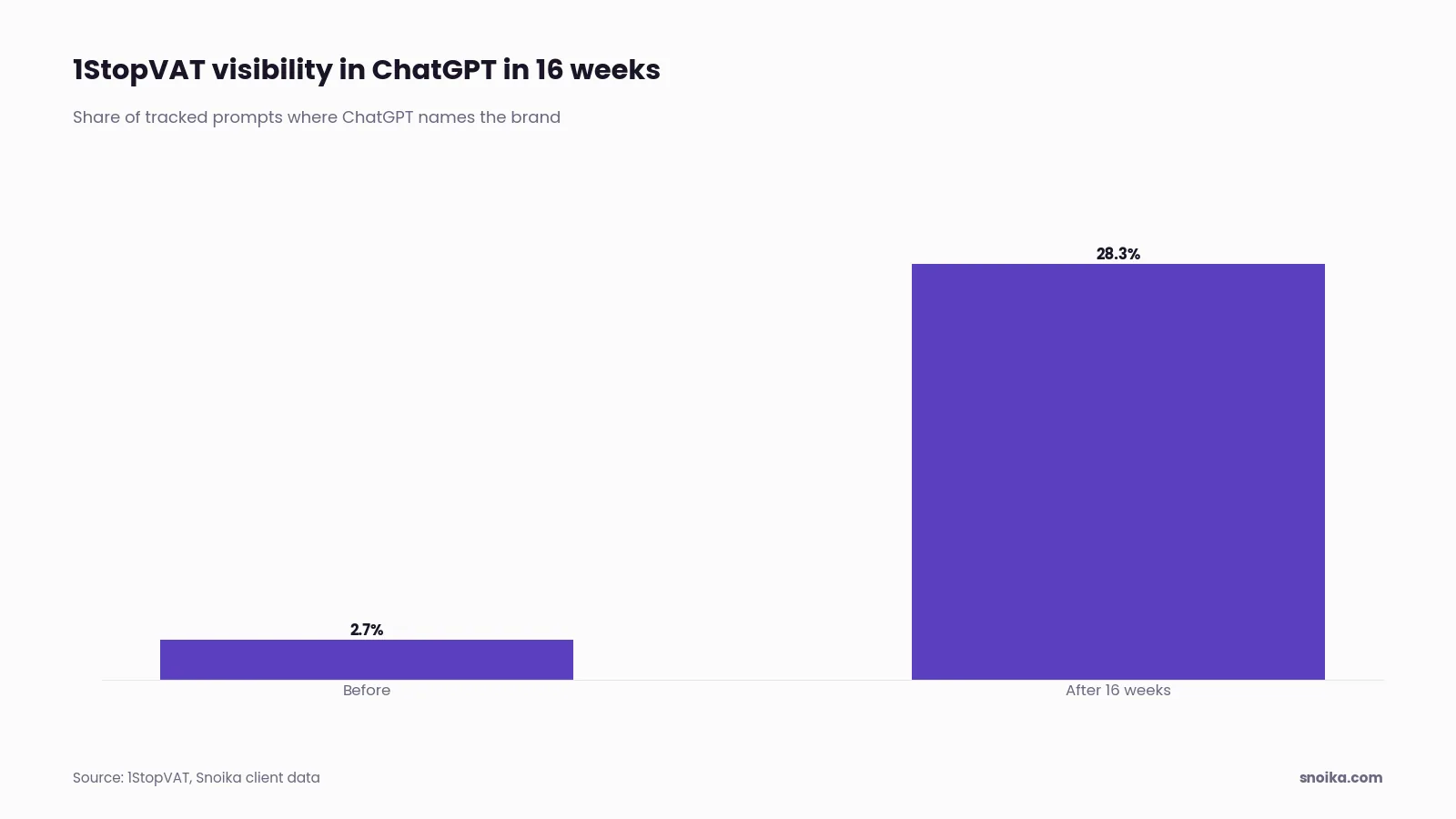
Expect measurable movement in AI visibility within two to four months, and more traffic after that. Our published results come from software and fintech clients, so read them as proof of the method. Snoika's founder Anton Vedeshin reported to Startup Reporter 1StopVAT's move from 2.7% to 28.3% ChatGPT visibility in 16 weeks.
As with any industry-specific plan, your own timeline depends on catalog size and on how much review coverage you already have.
Trusted by

























FAQ
We run weekly prompt sets in ChatGPT and Google AI Overviews and report mentions, share of voice, sentiment and citations against your starting baseline. We work on product data and off-site review coverage together. No one can guarantee that ChatGPT will cite your store, and we don't.
We start with pages Google has indexed and can display with a snippet, backed by an accurate Merchant Center feed. Google specifies no extra technical requirements for AI Overviews. Eligibility doesn't guarantee a recommendation, so we check whether Overviews appear for your target shopping queries.
Product facts that answer shopper questions, with measurements that explain who a product suits, help most. We keep price and stock information consistent across your pages and feeds, so assistants don't encounter conflicting details.
Independent reviews give assistants evidence beyond a store's own claims. Our off-site work builds coverage on review sites and in buyer discussions, and we keep on-site reviews current. We never use fake reviews, which carry legal risk.
No, results from software or fintech clients don't establish an ecommerce forecast. Treat them as evidence of the method; we measure your store against its own starting visibility. Your timeline depends on catalog size and existing review coverage.