
Wikidata SEO for brands
Wikidata SEO gives your company one verified record that Google and AI assistants can read, so they describe you with the right name and category. A well-kept Wikidata entry also lets them link you to the right founders and website. Most brands that show up wrong in AI answers have one of two problems: either no entity exists, or a half-finished one conflicts with what their own website says. We start by checking what Wikidata says about your company today, or whether there's an item at all.
Trusted by

























Verified brand entity via Wikidata
A verified brand entity is a Wikidata item for your company, with its own Q-number, where every statement is backed by a reference a stranger can check. Wikidata currently holds 123,487,977 items, and your Q-number tells a machine which one is your company, even when a dozen businesses share your name. Search engines and AI systems match that ID against your website and your profiles elsewhere. When the facts agree, the model treats them as one entity and answers about you with more confidence.
Wikidata's notability rules accept an item that is described using serious and publicly available references, which is a lower bar than Wikipedia's. But the community polices company items closely. Wikidata's guideline on self-promotion states that "creating an item about yourself is almost always a bad idea" because of conflict of interest.
Existing items
Whether an item already exists, and whether there are duplicates.
Press coverage
Which coverage backs each statement.
Registries
What support registries or databases provide.
If those references don't exist yet, we focus on earning coverage first, because an item without them gets deleted.
Why AI models cite Wikidata
AI models reuse Wikidata because it's free to copy and structured for machines, and because every fact can carry a source. All structured data on Wikidata is released under Creative Commons Zero, so model builders can put it into training sets and retrieval systems without licensing deals. That alone puts it in front of more AI pipelines than most commercial databases.
Wikimedia Deutschland launched the Wikidata Embedding Project on October 1, 2025, a vector database that makes Wikidata usable for generative AI applications. Lydia Pintscher, Portfolio Lead at Wikimedia Deutschland, said the goal is "an infrastructure that enables everyone to develop generative AI applications based on verifiable, free and open data." ChatGPT repeats the facts it absorbed from Wikidata and the sources that copied it, so our job is to make sure those facts are correct before a model learns them.
How search reuses Wikidata facts
Google builds its Knowledge Graph from sources across the web, and Wikidata is one of the open databases it reads. The link goes back to 2014, when Google said it would move Freebase data to Wikidata and close its own open knowledge base. According to Google, the Knowledge Graph now holds 500 billion facts about five billion entities, with web pages and open databases among its sources. It also draws on licensed sources.
To have Google recognize your company as an entity in the Knowledge Graph, we work in this order:
Company facts
Publish clear company facts on your own site's About page and homepage.
Organization schema
Add Organization structured data to the homepage, with `sameAs` links to your profiles and your Wikidata item.
Wikidata item
Create or correct the item, if the company meets notability, with references for each statement.
Independent coverage
Earn independent off-page SEO coverage that repeats the same facts, then claim the knowledge panel once it appears.
We follow this order because Google compares sources. When your Wikidata item disagrees with your homepage, Google gets two conflicting answers and picks neither.
What a Wikidata entry contains
A Wikidata entry is a set of labeled facts about one thing, stored in a fixed format that any program can read. It has four parts, and each one does a different job for a machine.
Labels
The label is the name, and the description is a short phrase that separates your company from namesakes, such as "Estonian software company". Aliases catch abbreviations and former names people use, and the legal name also belongs among them. Each language gets its own label and description, so a brand that sells in France and Germany needs both filled in.
Statements
Statements are the facts, written as property and value pairs: "founded by" a named person, "headquarters location" a named city. Qualifiers add context, such as a start date for a chief executive. Values that point to other items create the links that turn your entity into part of the Wikidata knowledge graph.
References
Each statement can carry a reference to a publication or URL with a retrieval date. Editors remove unreferenced company statements first, and machines trust those statements least.
Identifiers
External identifiers, such as a Legal Entity Identifier or a LinkedIn company ID, connect the item to registries and profiles. Where Wikipedia articles exist, sitelinks connect the item to each language version.
Wikidata properties that matter
The properties that help AI cite a brand are the ones that state what the company is, and the ones that tie it to identifiers other systems already trust. A model that knows your type and your official website can tell you apart from a namesake. Founders and a parent company give it context, and identifiers let it confirm everything against a second source.
| Property | ID | What it tells machines |
|---|---|---|
| instance of | P31 | The entity type, such as business or software company |
| official website | P856 | The domain that speaks for the brand |
| inception | P571 | The founding date |
| industry | P452 | The sector the company competes in |
| headquarters location | P159 | The city, as a linked place item |
Identity properties
Connection properties
We start with P31 and P856, because every other match depends on them. Then we check that each value is something an outside source states. Self-described traits like "leading provider" have no property, and editors delete them when they're added as descriptions.
Wikidata vs Wikipedia for brands
A Wikidata entry is a structured record of facts, and a Wikipedia page is an article written in prose. They have different entry bars and serve different readers. Wikipedia asks for significant coverage in multiple independent reliable sources, and most young companies can't meet that yet. Wikidata asks for serious, public references, so far more companies qualify.
| Aspect | Wikidata entry | Wikipedia page |
|---|---|---|
| Format | Property and value statements | Written article |
| Entry bar | Serious, public references | Significant independent coverage |
| Main reader | Machines and databases | People |
| Data license | CC0, no attribution needed | CC BY-SA, attribution needed |
| Edits by the company | Discouraged on creation, references required | Discouraged, changes go through talk pages |
For most brands, we start with Wikidata and follow with a Wikipedia article once press coverage exists.
How we build your entity
We build your Wikidata entity as one part of a visibility plan set up in the Snoika app. That way the Wikidata facts match your website and your schema markup from the start. Our team runs the platform and the off-page SEO services, and a person reviews every statement before it's published. The work runs in this order:
Audit
We look at how your brand shows up on Wikidata and in search, then compare it with your site and authoritative sources. We note gaps and duplicates, and check for conflicting facts.
Research
We check whether a suitable item exists and find related founder and product items it should link to. We identify location items for it to link to as well.
Map facts
We list each statement you can verify and pair it with an independent source. Claims that have no source are dropped.
Structure
We create or improve the item with the right properties in accordance with Wikidata's rules for editors with a conflict of interest.
Align
We match the same facts on your site and in your Organization schema. Labels go in each language where you sell. We create content in 135+ languages and regional variants, so the local pages use the same names.
Signals that reinforce brand trust
A Wikidata item is believed when other sources say the same thing. Machines weigh agreement between sources more than any single record, so we check these signals:
Organization schema
Google documents multiple `sameAs` URLs in Organization structured data to link your site to profiles elsewhere.
Consistent facts
One spelling of the company name and one founding date, used on every profile.
Registry identifiers
IDs such as a business registration code that third parties can verify.
Independent coverage
Articles and Reddit threads that describe the company in their own words.
Your own pages
Thought leadership pages on your own domain, where your facts live in full.
The pages Snoika creates go live on your own domain through a DNS connection, with no migration and on any CMS. You approve each page in the dashboard before it goes live, so the facts in your articles stay under your control and match your Wikidata item.
Results brands can expect
A correct Wikidata entity gives you accuracy first, and visibility gains come later from the wider program around it. Wikidata edits go live within seconds. Google's Knowledge Graph and AI models update on their own schedules, and those can take weeks or longer. We measure mentions, share of voice, sentiment and citations in ChatGPT and Google AI Overviews with weekly prompt sets.
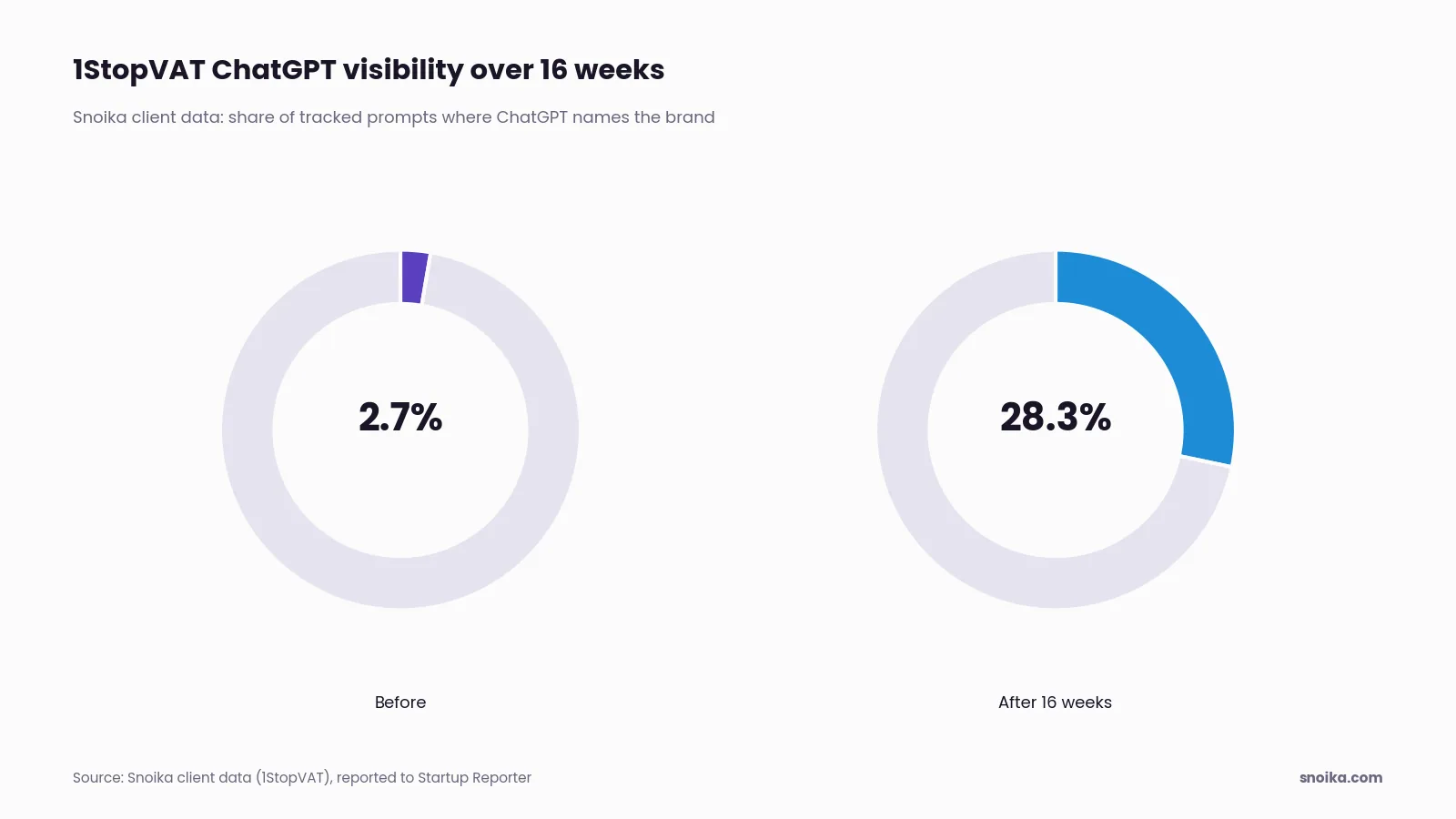
The results below come from full programs that included entity work, not from a Wikidata item alone. Snoika's founder Anton Vedeshin reported to Startup Reporter 1StopVAT's move from 2.7% to 28.3% ChatGPT visibility in 16 weeks. Vespia, a fintech SaaS, recorded a 220% increase in AI brand mentions.
FAQ
We start by publishing consistent company facts on your website and adding Organization structured data with sameAs links. Then we create or correct an eligible Wikidata item with references for each statement, backed by independent coverage. A Google knowledge panel can be claimed once it appears.
We start with instance of (P31) and official website (P856). They identify your company's type and domain, helping distinguish it from namesakes. Each value gets a reference that an outside reader can check.
A referenced Wikidata item gives machines a Q-number that distinguishes your company from namesakes. In wikidata seo, matching that record to your website helps systems connect facts to the right company. Visibility gains depend on the wider program.
A Wikidata entry stores structured facts for machines, while a Wikipedia page presents an article for people. Wikidata accepts serious, publicly available references. Wikipedia requires significant coverage in multiple independent reliable sources, so eligibility for Wikidata doesn't establish eligibility for Wikipedia.
We review the existing item before creating another one. We compare its facts with your website and authoritative sources, note conflicts or missing references, and check for duplicates, so the work improves the existing record rather than adding a competing entry.