
Reputation management with Trustpilot reviews
When a buyer asks ChatGPT which supplier to trust, the answer quotes a TrustScore and sums up what reviewers said. Reputation management for business now addresses both the people reading your reviews and the AI systems that summarize them. We start by measuring what AI assistants say about your brand today, then build the review program around that gap.
Trusted by

























Trustpilot-powered reputation management
Trustpilot-powered reputation management is a program that collects verified reviews on Trustpilot and answers them in public. It also tracks how those reviews change what search engines and AI assistants say about you. Trustpilot is one of the off-page SEO strategies we set up inside the Snoika app, next to content and site work, as one part of a wider search and AI visibility program. The same team runs the platform and the off-page SEO services, and a person reviews what the automated workflows produce.
A plain review tool shows you stars and counts, but it can't tell you whether ChatGPT named you when a buyer asked for the best option in your category. So we connect the review work to measurement inside the AI answers themselves, and you see AI answers about your brand from before the work started and from after it. Plans are on the pricing page.
Reviews shape AI answers
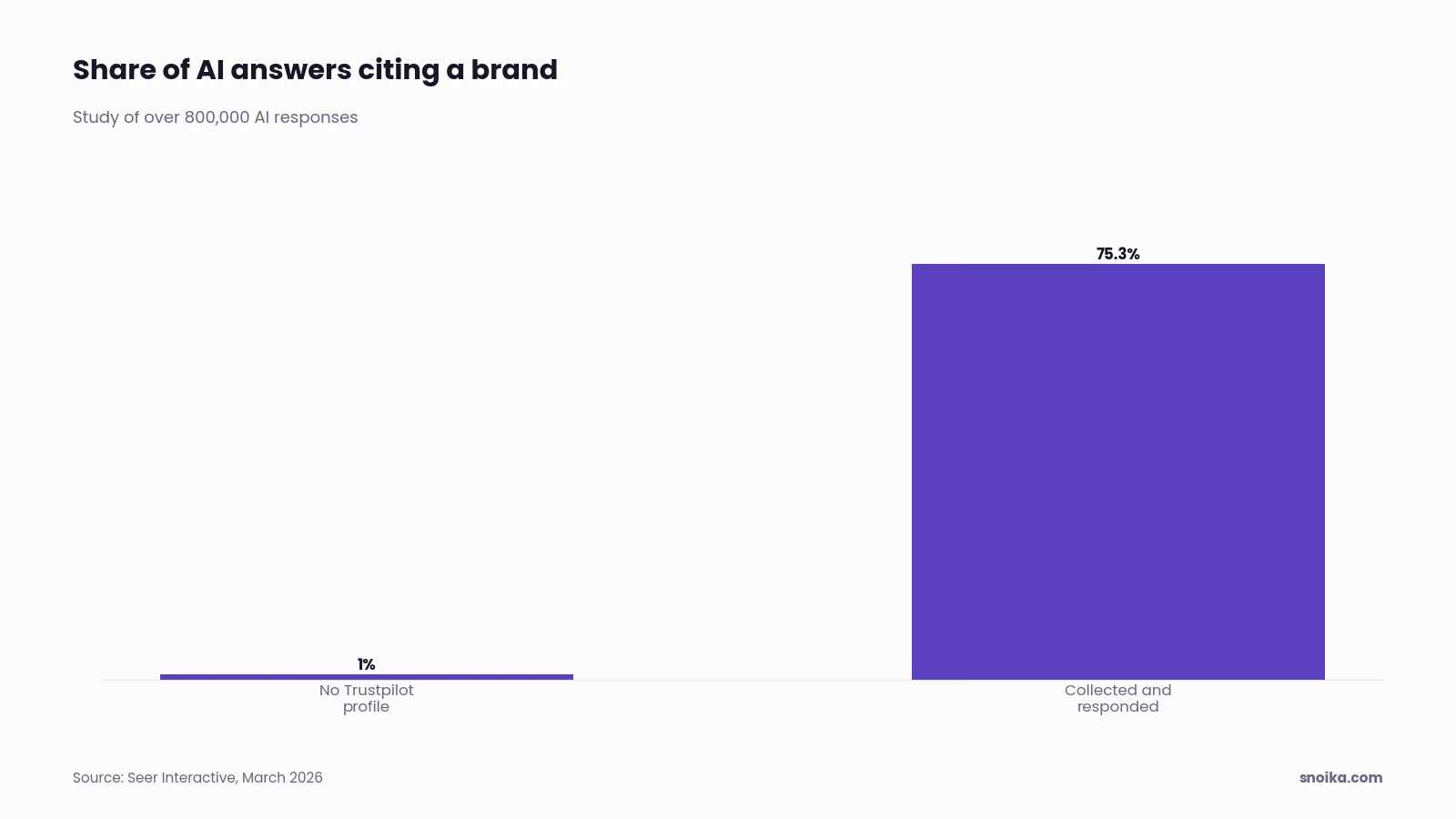
Trustpilot reviews get a brand cited by AI because AI assistants treat review platforms as independent evidence and pull those pages into their answers. In March 2026, Seer Interactive studied over 800,000 AI responses for Trustpilot. It found that only 1% of answers cited a brand with no Trustpilot profile, while brands that collected and responded to feedback were cited 75.3% of the time. The same study ranked review and trust sites as the second-largest citation source, at 14% of all citations.
Consumer brands and online services feel the impact first because buyers ask AI tools to compare them, and B2B brands feel it a little later. Vespia, a fintech SaaS company we work with, recorded a 220% increase in AI brand mentions. Before any review work, we ask the assistants about your category and look at which sources they cite.
How profile setup drives visibility
A claimed and verified Trustpilot profile drives visibility when it's complete enough for search engines to rank it and for AI systems to match it to your brand. An unclaimed profile still exists, because anyone can review any business, but you can't reply to reviews or send invitations from it. We set it up in this order:
Claim the profile
We claim it through Trustpilot Business and verify your domain, so the profile is tied to your website.
Pick the category
AI answers group brands by category, and a vague category puts you next to the wrong competitors.
Match the description
It uses the same words your website uses, which helps AI systems recognize the profile as yours.
Automate invitations
Invitations connect to your order or CRM (customer relationship management) system, so every customer gets one.
Add the widget
The TrustScore widget goes on the pages of your own site where buyers decide.
The profile works best alongside pages on your own domain that explain your offer in detail. We create those pages, and they go live on your own domain through a DNS connection, with no migration and on any CMS. You approve each page in the dashboard before it goes live.
Review acquisition that scales
Review collection scales when it runs on a fixed, automatic trigger that invites every customer, whether their experience was good or bad. Trustpilot's business guidelines require businesses to invite everyone the same way and at the same point in the customer journey. Inviting only happy customers breaks that rule, and so does offering any incentive for a review. In the US, the Federal Trade Commission's (FTC) review rule adds penalties of up to $51,744 per violation for fake reviews and for suppressing negative ones.
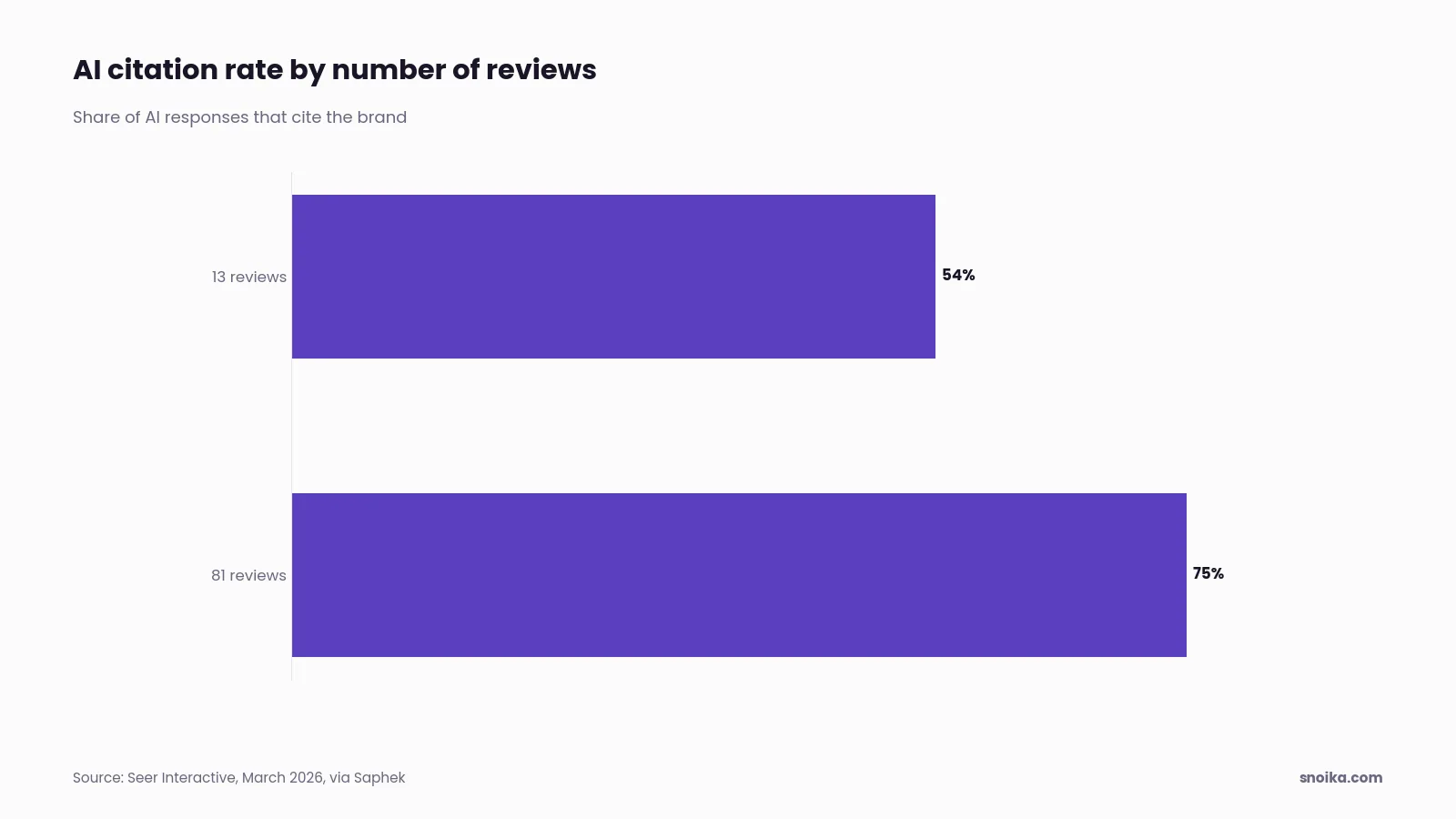
Volume matters more than a perfect score. A summary of the Seer data puts the AI citation rate at 54% with 13 reviews and 75% at 81 reviews. We ask for reviews days after delivery or weeks into a subscription, once the customer has had time to use the product, and we check that your Trustpilot invitation cap covers your monthly order count.
Response management that builds trust
Responses build trust when they arrive quickly, stay factual and answer the specific complaint without arguing. Buyers notice how fast you reply. Figures from Thrive Agency and BrightLocal show that 53% of consumers expect a reply to a negative review within a week, and 11% expect one the same day.
Write for the next buyer
Trustpilot allows one public reply per review, so each reply speaks to future buyers as well as the reviewer.
Name the problem
We say what you changed, then move any private details into a direct message.
No refunds for edits
A refund in exchange for an edited review counts as an incentive under Trustpilot's rules.
A complaint you've answered well can help you more than a page of unanswered five-star reviews. Readers see the reply, and AI summaries mention how a company handles complaints.
What AI reads in reviews
AI assistants first read the score in your reviews, then the themes that keep coming up in the text. Seer's research describes both levels, and each one needs its own kind of work.
Star ratings
In ChatGPT responses that cited Trustpilot, 59% used TrustScore or star ratings in the answer. The number reaches the buyer in one line before they read anything else about you. Because the rating counts recent reviews more heavily, a steady flow of new reviews moves it faster than a one-off campaign does.
Recurring themes in review text
AI models then condense the review text into themes such as delivery speed, support quality or pricing. If 30 reviews mention slow refunds, the assistant will say so, whatever your star rating is. Fixing the cause of a theme is a product or operations job, and new reviews will eventually reflect the fix.
You won't know which themes stick until you measure them. We track mentions and share of voice with weekly prompt sets that also measure sentiment and citations. Snoika's founder Anton Vedeshin reported to Startup Reporter 1StopVAT's move from 2.7% to 28.3% ChatGPT visibility in 16 weeks.
Choosing the right review platform
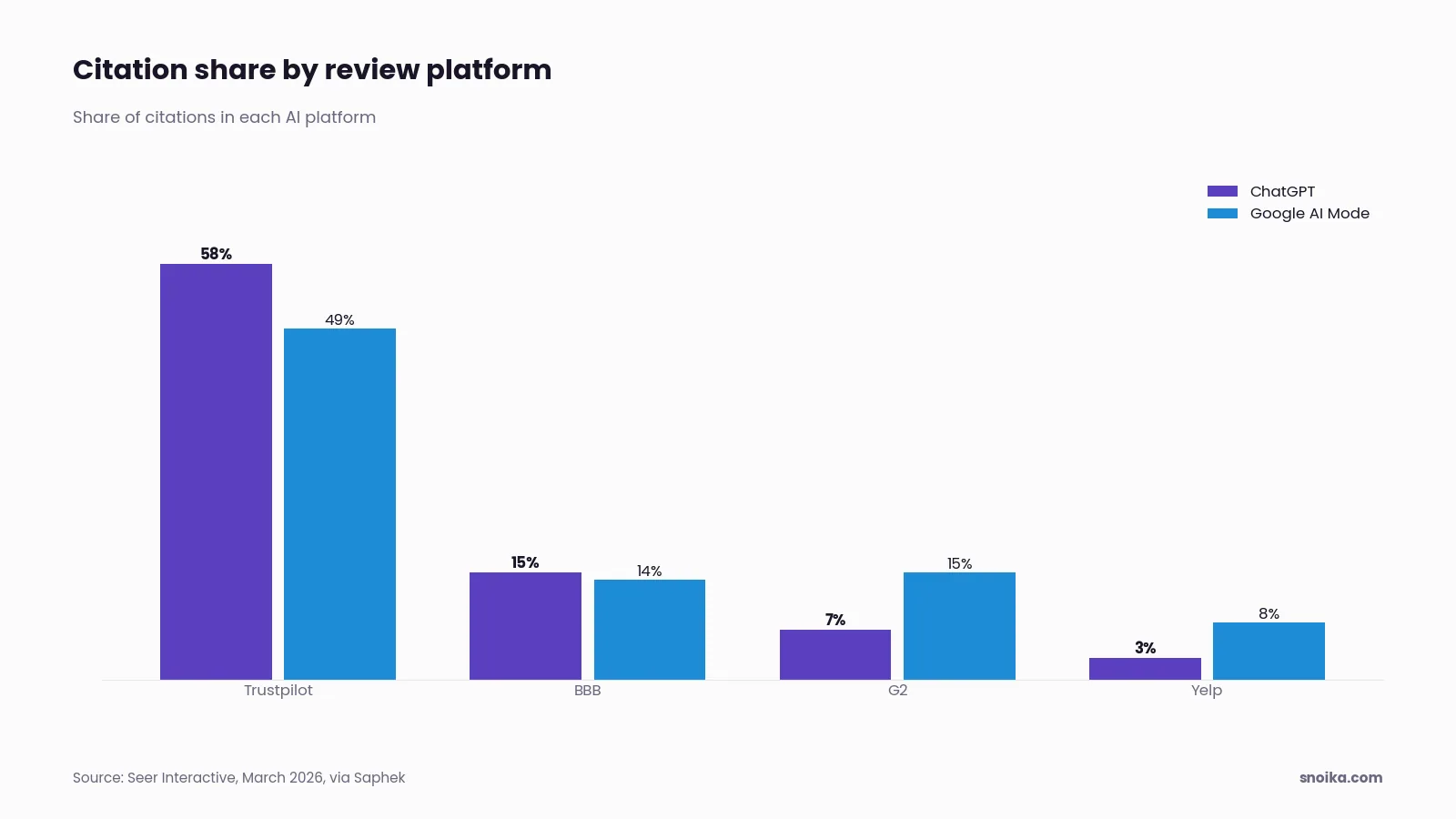
Trustpilot is the right review platform when AI visibility is the goal, because AI assistants cite it more than any other review site. Buyers rarely rely on one site: BrightLocal's 2026 survey found that 74% of consumers check at least 2 review sites before they decide. The shares below come from Seer's study of citations by review platform.
Trustpilot
58% in ChatGPT, 49% in Google AI Mode, 21% in Gemini, 52% in Perplexity. Suits consumer brands, online services and fintech.
BBB
15% in ChatGPT, 14% in Google AI Mode, 15% in Gemini, 10% in Perplexity. Suits US service businesses.
G2
7% in ChatGPT, 15% in Google AI Mode, 4% in Gemini, 15% in Perplexity. Suits B2B software.
Yelp
3% in ChatGPT, 8% in Google AI Mode, 5% in Gemini, 9% in Perplexity. Suits restaurants and local trades.
Google reviews still matter most for local businesses, and G2 matters most for software. For software sellers, we recommend Trustpilot alongside G2, while businesses with a storefront should also keep their Google profile active. For brands selling across countries, the content we create runs in 135+ languages and regional variants.
Reviews in AI Overviews
Reviews reach Google AI Overviews through the organic results, because Overviews build their summaries from pages that already rank. Seer found that 99.5% of Trustpilot citations happen because Trustpilot pages appear organically in search results. A profile that ranks for "[your brand] reviews" feeds the summary.
Alphabet CEO Sundar Pichai said in July 2025 that AI Overviews had 2 billion monthly users. We track sentiment in ChatGPT and Google AI Overviews answers, so a shift in tone shows up in the weekly data before it reaches your sales numbers. We also read what the Overview says when someone searches your brand name with "reviews" or "vs" a competitor.
FAQ
Trustpilot reviews give AI assistants independent evidence to cite when comparing businesses, and assistants use both the TrustScore and recurring review themes in their answers. We track which customer experiences appear in AI summaries, not just whether you are cited.
We claim your profile and verify your domain, choose the most specific category and match the description to your website's wording. Then we connect review invitations to your order system so every customer receives one at the same stage.
Snoika connects review collection with weekly AI-answer tracking, so you can see whether the review work changes recommendations. You get before-and-after AI answers to your buyers' questions rather than star ratings alone.