
Brand audit for AI search visibility
A brand audit for AI search visibility checks how Google and AI assistants such as ChatGPT describe and cite your brand when buyers ask about your category. It compares those answers with what your site and the wider web say about you. Then it lists the gaps that keep you out of the answer. You run a fixed set of prompts on a schedule and score the results against the same signals each time.
 Jevgenia PogadajevaCFO, Snoika · 12 min read
























Brand audits for AI search
A brand audit for AI search measures whether your brand appears inside generated answers, while a classic audit measures where your pages rank on a results page. That difference changes what you record and how often you record it. The old audit looked at branded rankings and review sites. It also checked off-brand pages on page one, while the new audit examines the answer itself because that is now where a buyer stops reading.
Pew Research Center tracked the browsing of 900 U.S. adults and found that people who saw a Google AI summary clicked a traditional result in 8% of visits, against 15% when no summary appeared. Only 1% of visits included a click on a link inside the summary. So if the summary leaves your brand out, the buyer never sees your site at all, even when it ranks.
OpenAI's own count put ChatGPT at 900 million weekly active users in February 2026, up from 400 million a year earlier. Those users ask full questions such as "which VAT software handles EU one-stop-shop filing", and they get a short list of named brands back instead of ten blue links.
The second difference is that AI answers don't hold still. Research by SparkToro found a less than 1 in 100 chance that ChatGPT or Google's AI returns the same list of brands twice for the same prompt. While a ranking audit can end with a screenshot of position 3, an AI audit has to run each prompt more than once and report how often you appear as a percentage.
What a brand audit is
A brand audit is a structured review that compares how your brand wants to be seen with how it's actually seen. Marketing teams have done this for decades with customer surveys and competitor reviews. They also check whether the logo and messaging stay consistent. For search, the audit examines what search results and AI answers tell a stranger about you.
The output is a scorecard with a baseline number for each signal and a ranked list of fixes. Next quarter you'll run the same audit again and compare. A scorecard that can't be repeated with the same prompts and the same scoring rules is a snapshot.
Scope varies with the business. A single-market software company can audit one language and one set of competitors in a few days. A manufacturer selling in 12 countries needs prompts in each language, because AI assistants answer a German buyer from German sources. A regulated business in finance or health also needs to check accuracy closely, as does a legal business, since a wrong claim in an AI answer about fees or licenses does more harm than a missing mention.
Before you start, write down your positioning in 2 or 3 plain sentences about what you sell and who buys it. Explain why those buyers pick you. The audit measures the distance between that statement and what the machines say. Without it, you'll have no way to call an answer right or wrong.
How AI assistants find brands
AI assistants find brands in two ways, through what the model learned during training and through pages it retrieves live from a search index when it answers. The first is memory. It changes only when the model is retrained, and you can't edit it directly. The second is retrieval, and that's where an audit can find fixable problems.
Retrieval depends on crawler access. OpenAI's documentation says sites that block its search crawler, OAI-SearchBot, "will not be shown in ChatGPT search answers", though they can still appear as navigational links. A separate crawler, GPTBot, collects data for training, and you can allow one while you block the other. Plenty of sites blocked every AI bot in 2023 and never revisited the rule. That's a five-minute check in your robots.txt file.
Google works from its own index. Its Search Central documentation explains that "Both AI Overviews and AI Mode may use a 'query fan-out' technique, issuing multiple related searches across subtopics and data sources, to develop a response." In practice, one buyer question becomes 5 or 10 hidden searches, and your page can be pulled in by a sub-question you never targeted.
What varies is which index each assistant reads and how much it leans on memory. ChatGPT answers from training alone when search is switched off and cites pages when search is on. Google's AI features almost always cite. So when you audit, note whether each answer showed sources. A missing brand points to a content or mention gap when the answer cites sources, or to weak presence in the model's training data when it doesn't. That training-data gap takes longer to change.
Key signals Google evaluates
The 2 reasons your brand stays out of Google AI Overviews are page ineligibility and Google's preference for other sources it trusts more. Google sets a straightforward eligibility rule that a page must be indexed and eligible to be shown in Search with a snippet, and adds: "There are no additional technical requirements." So a noindex tag or a nosnippet directive removes a page from AI Overviews completely.
For the harder task of source selection, Google's guidance on helpful content describes experience and expertise. It also covers authoritativeness and trust (E-E-A-T) and says plainly: "Of these aspects, trust is most important." Trust shows in who wrote the page and whether the claims carry sources. It also shows in whether the rest of the web agrees with you.
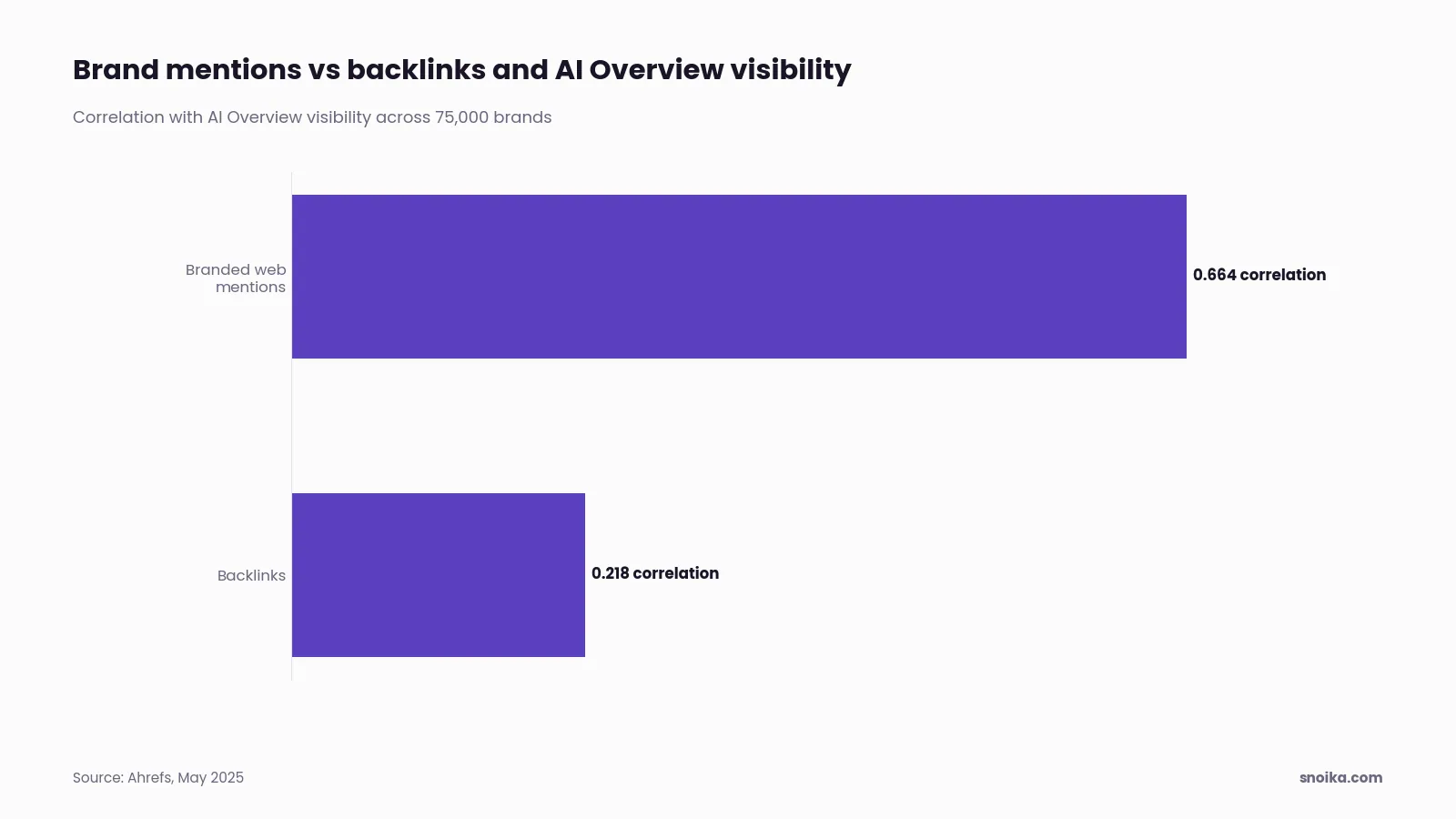
A May 2025 correlation study of 75,000 brands found that branded web mentions correlated with AI Overview visibility at 0.664, against 0.218 for backlinks. Mentions don't need a link to count. A brand that's discussed on industry sites and forums is a brand Google's AI is comfortable naming.
The query also decides whether an AI Overview appears at all. Pew found that just 8% of one- or two-word searches produced an AI summary, while 53% of searches with 10 words or more did. If you only test short head terms, you'll conclude you're absent when there's simply no summary to be absent from.
| Reason you're missing | How to check | First fix |
|---|---|---|
| Page not indexed | URL Inspection in Google Search Console | Remove noindex, fix canonicals, resubmit |
| Snippet blocked | Look for nosnippet or a low max-snippet value | Remove the directive on pages you want cited |
| Few off-site mentions | Search your brand name on industry and review sites | Earn coverage in the places your buyers read |
| Page doesn't answer the sub-question | Compare your page with the sources Google cites | Add a direct answer in the first lines of the section |
| No AI Overview for that query | Test longer question-style versions | Track longer prompts instead |
Page not indexed
- How to check
- URL Inspection in Google Search Console
- First fix
- Remove noindex, fix canonicals, resubmit
Snippet blocked
- How to check
- Look for nosnippet or a low max-snippet value
- First fix
- Remove the directive on pages you want cited
Few off-site mentions
- How to check
- Search your brand name on industry and review sites
- First fix
- Earn coverage in the places your buyers read
Page doesn't answer the sub-question
- How to check
- Compare your page with the sources Google cites
- First fix
- Add a direct answer in the first lines of the section
No AI Overview for that query
- How to check
- Test longer question-style versions
- First fix
- Track longer prompts instead
The brand audit checklist
A brand audit for AI search, or GEO audit, covers 4 areas, beginning with your own site's access and clarity and the facts about your brand as an entity. It also examines what third parties say and what AI answers actually return. The checklist below works top to bottom. Earlier items block later ones, so a fix to crawler access will change the AI answer results, never the other way round.
Owned site and technical access
- Your robots.txt allows OAI-SearchBot and Googlebot on the pages you want cited.
- Key pages are indexed in Google Search Console and carry no nosnippet directive.
- Each product or service page states what it is and who it's for in its first 2 sentences.
- An About page names the company and founders. It also provides the location and registration details.
- Organization schema markup lists your official name and logo. Your social profiles are listed there too.
- Pages that make claims about prices or results link to the source.
Entity facts and consistency
- Your company name is spelled the same way on your site and LinkedIn. That spelling also matches your directories and Google Business Profile.
- Founding year and headquarters match everywhere they appear. Product names are consistent too.
- Old product names and retired prices are gone from pages you control.
- A Wikipedia or Wikidata entry, if you qualify for one, matches your current facts.
Third-party mentions and reviews
- Industry publications that cover your category mention you by name.
- Review platforms in your field list you with recent reviews.
- Forum and community threads about your category include accurate mentions.
- Comparison articles that rank competitors include you, or you know why they don't.
- Partner and customer sites describe your product correctly.
AI answers and sentiment
- Category prompts ("best X for Y") name your brand.
- Branded prompts ("what is [brand]") describe you accurately.
- Comparison prompts ("[brand] vs [competitor]") state your differences correctly.
- You record whether each mention's tone is positive or negative, with neutral as the category for neither.
- Cited sources for each answer are logged, and competitor pages are part of that log.
Running your brand audit
To audit your brand's AI search visibility, build a fixed prompt set and run it repeatedly in each assistant. Record the same fields every time. Then compare the answers with your positioning and your search data. The sequence below takes a small team about a week for one market.
- Write your positioning baseline. Two or three sentences on what you sell, to whom, and why buyers choose you. Add your 3 to 5 main competitors.
- Build the prompt set. Start with about 40 prompts that cover category questions and problem questions. Include comparisons and branded questions in that set. Write them the way buyers type them, in full sentences. Use your sales team's call notes for real wording.
- Run each prompt more than once. Because answers vary from run to run, run each prompt at least 5 times per assistant, in a logged-out or clean session. Test ChatGPT with search on and Google with AI Overviews showing.
- Record every answer. For each run, note whether your brand appears and where it sits in the list. Record which competitors appear and the sentiment. Save every cited URL as well.
- Pull your search data. Export branded query impressions from Google Search Console. In Google Analytics 4 (GA4), look for referral traffic tagged with utm_source=chatgpt.com, which ChatGPT adds automatically to its links.
- Check technical access. Go through the owned site items in the checklist above. One blocked crawler can explain an entire column of zeros.
- Score and rank the gaps. Fill in the template below. Then sort the fixes by how many prompts each one affects.
Teams skip Step 5 even though its search data links AI answers to business results. Snoika therefore asks for GA4 and Google Search Console access during onboarding before audit work starts. It also asks for Google Tag Manager access at that stage. The prompt results tell you what the assistants say, and the analytics tell you whether any of it reaches your site.
What varies is the prompt mix. A business that sells to developers will find comparison prompts matter most, because developers ask "X vs Y". A local service business needs location in every prompt. And if you sell in more than one language, build a separate prompt set per language. Don't just translate the English one, because buyers phrase questions differently.
Brand audit template
A brand audit template is a scorecard with one row per signal and the same columns every time you run it. Copy the table below into a spreadsheet. Add a column per audit date so each run sits next to the last one.
| Signal | What to record | Where to find it | Healthy result |
|---|---|---|---|
| Branded SERP control | Share of page 1 results you own or approve of | Google search for your brand name, clean session | Your pages and accurate profiles fill most of page 1 |
| AI mention rate | Percentage of prompt runs that name your brand | Prompt set results | Rising across audits, highest on category prompts |
| Share of voice | Your mentions divided by all brand mentions in the answers | Prompt set results | Equal to or above your main competitor |
| Citation share | Percentage of cited URLs from your domain | Sources listed in each answer | Your pages cited on prompts about your product |
| Sentiment | Positive, neutral or negative per mention | Prompt set results | No negative mentions based on outdated facts |
| Accuracy | Wrong facts per answer (prices, features, location) | Branded prompts | Zero errors on core facts |
| Entity consistency | Mismatched names or facts across profiles | Directories, social profiles, schema | One version of every fact |
| Off-site mentions | Count of category articles that name you | Web search of industry sites | Present in most comparison articles |
| Technical eligibility | Blocked crawlers, unindexed pages, snippet blocks | robots.txt, Search Console | No blocks on pages you want cited |
| AI referral traffic | Sessions from chatgpt.com and AI features | GA4, Search Console | Growing alongside mention rate |
Branded SERP control
- What to record
- Share of page 1 results you own or approve of
- Where to find it
- Google search for your brand name, clean session
- Healthy result
- Your pages and accurate profiles fill most of page 1
AI mention rate
- What to record
- Percentage of prompt runs that name your brand
- Where to find it
- Prompt set results
- Healthy result
- Rising across audits, highest on category prompts
Share of voice
- What to record
- Your mentions divided by all brand mentions in the answers
- Where to find it
- Prompt set results
- Healthy result
- Equal to or above your main competitor
Citation share
- What to record
- Percentage of cited URLs from your domain
- Where to find it
- Sources listed in each answer
- Healthy result
- Your pages cited on prompts about your product
Sentiment
- What to record
- Positive, neutral or negative per mention
- Where to find it
- Prompt set results
- Healthy result
- No negative mentions based on outdated facts
Accuracy
- What to record
- Wrong facts per answer (prices, features, location)
- Where to find it
- Branded prompts
- Healthy result
- Zero errors on core facts
Entity consistency
- What to record
- Mismatched names or facts across profiles
- Where to find it
- Directories, social profiles, schema
- Healthy result
- One version of every fact
Off-site mentions
- What to record
- Count of category articles that name you
- Where to find it
- Web search of industry sites
- Healthy result
- Present in most comparison articles
Technical eligibility
- What to record
- Blocked crawlers, unindexed pages, snippet blocks
- Where to find it
- robots.txt, Search Console
- Healthy result
- No blocks on pages you want cited
AI referral traffic
- What to record
- Sessions from chatgpt.com and AI features
- Where to find it
- GA4, Search Console
- Healthy result
- Growing alongside mention rate
Keep scoring rules fixed. Decide once whether a brand that appears only in a cited link counts as a mention. Write the rule at the top of the sheet. If you change it halfway through the year, the trend line breaks and you won't know whether you improved or just counted differently.
The healthy results column is relative on purpose. For a new brand in a crowded category that starts at a 2% mention rate, doubling that is real progress. Set targets against your own baseline and your closest competitor.
Fixing gaps AI surfaces
Fix technical access before factual errors, since gaps block each other. Then address missing mentions before tone. A crawler block makes every other fix pointless, while a wrong price in an AI answer costs you deals today. Missing mentions also cost you deals you never knew about. Sentiment improves on its own as the first 3 fixes take hold.
The quick technical fixes are to unblock the right crawlers and remove stray noindex tags. Make sure the pages that answer buyer questions are in the index. Re-run the affected prompts within a few weeks, after Google and OpenAI have had time to recrawl.
Factual errors need a source the assistant can find. Correct the fact on your own site first. Then correct it on the profiles and directories the AI cited when it got it wrong. If an old review article carries the outdated price, ask the publisher for an update. The assistant will repeat whatever the strongest sources say, so you have to change the sources.
Missing mentions are a content problem and a reputation problem at once. On your side, publish pages that answer the exact questions in your prompt set, with the answer in the first sentence and the evidence below it. Snoika publishes these pages on the client's own domain through a DNS connection. This works on any CMS without a migration. The client approves each page in the dashboard before it's published. Off your site, the work is earning mentions in the industry coverage and community threads your audit showed the AI citing.
Multi-market gaps need native content. If ChatGPT names you in English prompts but not in Spanish ones, translated product pages alone rarely fix it. You need pages written for that market's questions, and Snoika creates content in 135+ languages and regional variants for this reason.
Results from this kind of work show up as mention growth first and leads later. Vespia, a fintech SaaS, recorded a 220% increase in AI brand mentions. 3DPrinterOS achieved #1 visibility in ChatGPT for industry-specific queries and turned AI search into a steady source of 3–4 qualified inbound leads/day.
Measuring audit outcomes
You measure audit outcomes by re-running the same prompt set on a fixed schedule to compare mention rate and share of voice against your baseline. Compare sentiment and citations with that baseline too. Weekly runs catch changes after a fix, while monthly runs smooth out the noise of individual answers and are enough for reporting to leadership.
The percentage is what matters. Rand Fishkin, co-founder of SparkToro, summed up his team's findings this way: "If you ask an AI tool for brand/product recommendations a hundred times nearly every response will be unique." The same report found that visibility percentage across queries held steadier than ranking position. So don't panic when one run leaves you out, and don't celebrate when one run puts you first.
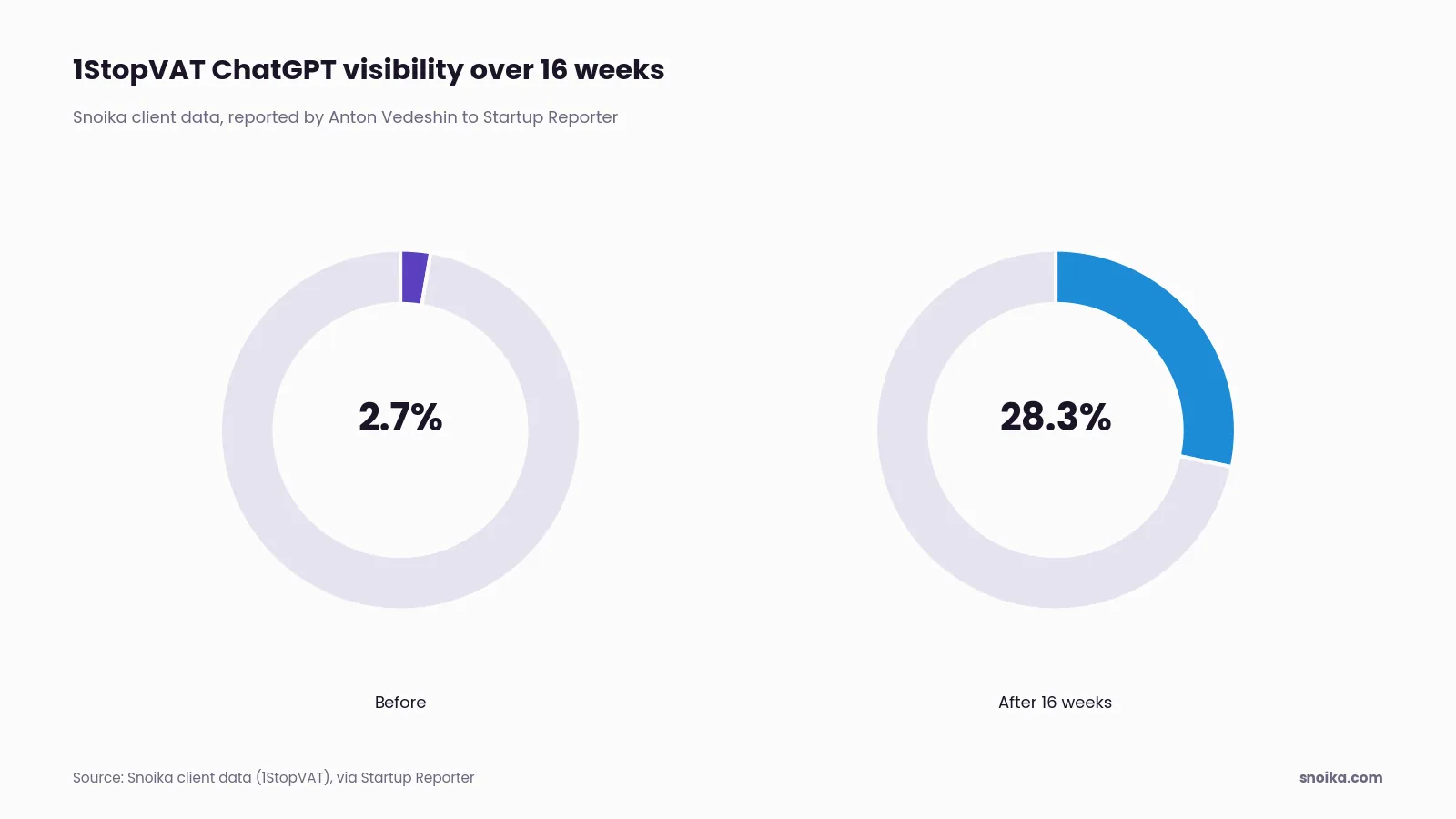
Snoika's tracking follows this approach. It uses weekly prompt sets to measure mentions and share of voice in ChatGPT and Google AI Overviews, where most AI search traffic happens. Those runs also measure sentiment and citations. Mention rate is the clearest headline number. Snoika's founder Anton Vedeshin reported to Startup Reporter 1StopVAT's move from 2.7% to 28.3% ChatGPT visibility in 16 weeks.
Google counts clicks from AI Overviews and AI Mode alongside regular results inside the "Web" search type in the Search Console Performance report. Watch branded impressions and the queries with long, question-style wording, since summaries appear more often for those queries. Pair that with GA4 referrals from chatgpt.com to see whether rising mentions bring visits.
Before you report a win, check whether the prompt set changed, because added prompts can lift or drop your rate on their own. Keep a core set that never changes and report on it, and test new prompts in a separate group.
What to do next
Run your baseline before you fix anything. Write your 40 prompts and run each one 5 times in ChatGPT and Google. Then fill in the template. Without that first set of numbers, you won't know which fix moved your mention rate, and next quarter's brand audit will have nothing to compare against. Save the cited URLs from the first run too. They're the reading list of sources the assistants trust in your category, and they show you where coverage counts most.
Our team audits websites and tracks brand visibility in Google and AI assistants, with a human review layer on top of automated workflows. To see where your brand starts, get a free AI visibility report.
FAQ
Build a fixed set of about 40 buyer questions and run each at least five times per assistant. Record brand mentions and cited sources, then compare answers with your positioning. Save the results as a baseline before making changes.
A brand audit should cover your site's accessibility and the consistency of company facts. It should also assess third-party coverage and what AI answers say about you. Use repeatable scoring rules so later audits show whether the gaps have narrowed.
Your pages may be ineligible, or Google may select other sources. Check that key pages are indexed and allowed to show snippets, then compare them with cited pages. Confirm the query produces an AI Overview before treating a missing mention as a visibility gap.
An AI search audit measures appearances inside generated answers, while a traditional search audit focuses on rankings. Because AI recommendations vary between runs, track the percentage of answers mentioning your brand rather than relying on one result.
Allow about a week for a small team auditing one market. Work across several languages takes longer because each market needs its own prompt set, and regulated businesses also need closer checks of factual accuracy.