
Best AI SEO tools for rankings in 2026: which ones to use
The best AI SEO tools for 2026 depend on the job you need done. Semrush One suits teams that want Google rankings and AI visibility in a single login. Ahrefs Brand Radar suits teams already on Ahrefs, and Profound suits analysts who work mainly with AI answer data. On a tight budget, start with the free Google and Bing reports, then add Otterly.AI or Peec AI. We build Snoika, which is on this list too, so we flag it wherever it appears.
 Jevgenia PogadajevaCFO, Snoika · 10 min read






















AI visibility plus Google rankings
In 2026, an AI SEO tool has to report where you rank in Google and whether AI assistants name your brand. The second job exists because buyers changed where they ask questions. ChatGPT had 900 million weekly users in February 2026, more than double the 400 million it reported a year earlier. On Alphabet's Q2 2025 earnings call, Sundar Pichai reported that Google's AI Overviews, the written summaries above the blue links, had reached 2 billion monthly users.
Clicks fell as more answers appeared on the results page itself. SparkToro's 2024 clickstream study with Datos found that 58.5% of US searches ended without a click to the open web. Gartner had forecast a 25% drop in search volume by 2026. Alan Antin, a Vice President Analyst at Gartner, said, "Generative AI (GenAI) solutions are becoming substitute answer engines, replacing user queries that previously may have been executed in traditional search engines."
A page-one ranking and an AI mention are now separate results, and you can win one while you lose the other. A competitor can sit below you in Google and still be the brand ChatGPT recommends. Most tools here started on one side of that line and added the other side later. Before you pay, check which side the vendor built first, because the side added later is thinner. We call Snoika an all-in-one search engine optimization platform with support for Generative Engine Optimization (GEO) and Answer Engine Optimization (AEO), two newer disciplines. The suites below now make the same claim, so test it.
How we tested these tools
We evaluated every tool against these buying criteria.
- Engine coverage: which AI assistants it queries, and whether ChatGPT and Google AI Overviews are in the entry plan or locked behind a higher tier.
- Sample size: how many prompts it runs and how often, since one answer from an AI assistant proves little.
- Metrics: whether it reports mentions and citations next to classic rank tracking and audit data, and whether it measures share of voice.
- Action: whether it tells you what to fix, or helps you publish the fix.
- Real cost: the price at your scale after per-domain and per-engine charges. Seat fees count toward that total too.
Prices and plan limits come from vendor pricing as independent reviewers reported it in mid-2026, and every figure links to its source. We didn't score interface taste, because that's personal and changes with every redesign. We also left out tools that only write articles, since they don't measure anything.
How much each question weighs depends on your situation. A single-brand software company needs ChatGPT coverage and enough prompts to trust the trend. An agency cares more about the per-domain price than anything else, because that line gets multiplied by every client. Decide which two questions matter most to you before you read the verdicts.
Top picks for enterprise teams
For enterprise teams, Semrush and Ahrefs are the broadest options. Profound goes deepest on AI answers. Snoika fits teams that want tracking and content work run by a single team. The right pick depends on where your data already lives and who will act on it.
Semrush One for SEO and AI in one login
Semrush sells its AI Visibility Toolkit from $99 per domain a month, and Semrush One, which bundles it with the classic SEO toolkit, starts at $199. The toolkit's base plan tracks 25 custom prompts across ChatGPT and Google AI. It also covers Perplexity and Gemini. Teams already running keyword research and audits in Semrush get AI data on the same screen. The drawback is the per-domain price, which climbs fast once you track more than a handful of brands.
Ahrefs Brand Radar for teams already on Ahrefs
Brand Radar is an add-on, priced at $199 per AI index or $699 a month for all of them, on top of a base Ahrefs plan. Appscribed put the realistic entry at about $328 a month once you include the cheapest base plan. Its strength is the large prompt index sitting next to Ahrefs' backlink data. But it only monitors, and Meev's review notes that chatbot indexes refresh only once a month unless you buy custom prompt checks.
Profound for dedicated AI search analysts
Profound is built only for AI visibility. Its Starter plan costs $99 a month billed annually for 50 prompts on ChatGPT only. Growth moves to $399 for three answer engines, and the widest coverage sits in the custom Enterprise tier. It suits a team with a dedicated AI search analyst better than one led by a generalist SEO lead.
Snoika for tracking and publishing under one team
We built Snoika so that the same team runs both the platform and the services, with a person reviewing what the automated workflows produce. Our Enterprise plan has a custom price for unlimited prompts across all AI platforms and executive dashboards. It also includes a 99.9% SLA guarantee. Custom integrations and the API let your own reporting stack pull visibility data directly, and access is arranged by booking a call. This is the right pick if you want someone accountable for acting on the data, beyond just reporting it.
Best free AI SEO tools
The best free AI SEO tools for data about your own site are the reports from Google and Bing. Ahrefs' free tier is the best free option for audits. These tools cost nothing and provide real first-party data unmatched by paid trackers, though their coverage excludes ChatGPT.
Google Search Console's generative AI report
On 3 June 2026, Google added a generative AI features report to Search Console, with impressions from AI Overviews and AI Mode in a view of their own. Before that, the AI data was folded into ordinary web search totals. CrawlRaven points out that the new report carries impressions only, without click or query data. It also combines AI Mode and AI Overviews in a single view.
Bing Webmaster Tools AI Performance
Microsoft launched AI Performance on 10 February 2026, in public preview inside Bing Webmaster Tools. It shows which of your pages Copilot cites and the grounding queries behind those citations. The Microsoft product managers who announced it called it "an early step toward Generative Engine Optimization (GEO) tooling". It covers Microsoft surfaces only and excludes ChatGPT citations, even though ChatGPT has a partnership with Microsoft.
Ahrefs Free for audits and backlinks
Ahrefs' free plan for verified sites includes Site Audit, which scans for 170+ technical issues as well as on-page problems. Site Explorer adds keyword and backlink data for your own domain. Technical health still decides whether AI crawlers can read your pages at all, so this audit is a sensible first step. You get no AI mention data from it.
Paid trackers have free entry points too, and they ask for the same data sources. When we onboard a site, we ask for Google Analytics 4 (GA4) and Search Console access. We also ask for Google Tag Manager, and for CMS access when pages will be published. If you connect those free Google tools now, any paid tool you add later starts with history instead of a blank chart.
Tracking brands in AI answers
Semrush and Ahrefs Brand Radar both track brand mentions in ChatGPT answers. Profound offers this tracking too, as does Peec AI. Otterly.AI and Surfer's AI Tracker offer the same capability. It is also part of Snoika. The real differences lie in how often each tool asks and what it counts. Those choices matter because AI answers don't hold still.
To test how much AI answers change, Rand Fishkin's team at SparkToro ran 12 brand-recommendation prompts 60 to 100 times on each platform. They found less than a 1 in 100 chance of getting the same brand list twice. Fishkin called treating these tools as consistent rankings "provably nonsensical." His research also found that visibility percentage, which measures how often a brand appears across repeated runs, is the number that holds up.
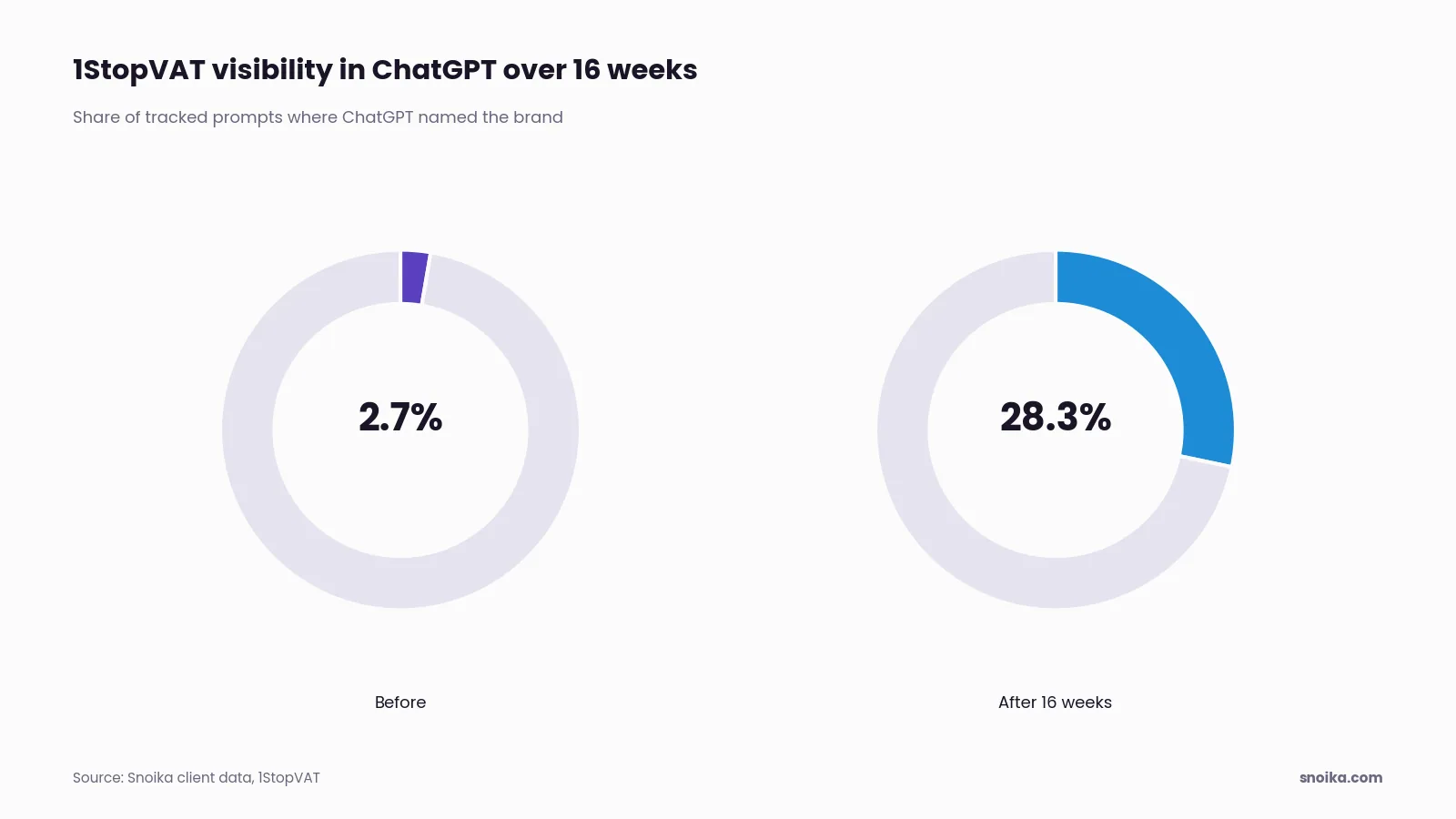
So judge a tracker by its sample. A tool that runs 15 prompts once a week tells you far less than one that runs hundreds. Our tracking measures mentions and share of voice in ChatGPT and Google AI Overviews, where most AI search traffic happens. It also scores sentiment and citations, with prompt sets that rerun every week. Read results as trends over weeks. Snoika's founder Anton Vedeshin reported to Startup Reporter 1StopVAT's move from 2.7% to 28.3% ChatGPT visibility in 16 weeks.
Before you pick a tracker, check whether you write the prompts yourself or the vendor supplies them. Check whether you can export the full answer text and the cited URLs. Then check which country and language it queries from, because answers change by market.
Workflow fit by team size
To compare tools by workflow fit, ask who does the work after the dashboard shows a gap. A tool that suits a team of 40 will bury a solo marketer, and a cheap tracker leaves a big team with no way to act on the data. Team size helps you judge your capacity to act on the gaps a tool finds.
A solo marketer or a two-person team gets the most from a tool that pairs tracking with writing help. Surfer's Standard plan, at $99 a month billed yearly, combines its content editor with 25 AI prompts refreshed weekly. Otterly.AI's Lite plan is cheaper and tracks only. Neither will run your content program for you, and you shouldn't expect it to.
In-house teams of five to 20 people need shared access more than anything else. Peec AI includes unlimited seats on every tier, so writers and product marketers can all read the data without seat charges. Semrush One works here as well, provided your SEO work already runs through Semrush.
Agencies and companies with multiple sites need per-site separation at a sane price. Semrush One's Starter plan monitors 5 websites and 50 prompts, which makes it the strongest option on this list for managing multiple sites on a mid-range budget. Otterly's Standard plan adds unlimited workspaces, and our Enterprise plan includes multi-brand management with reporting kept separate for each brand. Whichever you trial, test it with your three largest sites, since small test sites hide pricing problems.
Where most tools fall short
Most AI SEO tools stop at the dashboard. They show you that a competitor gets cited for a prompt you care about, and then the work of fixing that lands on your team. That's the main gap in the category, and it's why the people who buy AI visibility trackers stop using them.
A page that answers the question directly, with sources a model can cite, fixes an AI visibility gap. Brand Radar and Profound's entry tiers measure without publishing anything. We built publishing into Snoika for that reason. Pages go live through a DNS connection on your own domain. This works on any CMS without a migration. You approve every page in the dashboard before it goes live.
Language coverage leaves a second gap because few trackers help you create content in the languages your buyers search in, even though they query from a list of countries. We create content in 135+ languages and regional variants. If you sell in more than one market, check where the tool tracks and whether it can help you produce the pages.
Attribution is the third gap, and no tool solves it yet. Google's new report shows impressions without clicks, and AI assistants pass little referral data. Treat any vendor that promises exact revenue from AI answers with caution, and judge it by visibility trends next to your own lead data.
Pricing tiers worth knowing
Paid AI visibility tracking starts at about $29 a month, and the usual middle runs from $200 to $400. Rankability's study of more than 30 AI search monitoring tools put the average price at $337 a month. The entry prices below differ mostly in prompt count and engine coverage.
| Tool | Entry price | What the entry tier covers | Best suited to |
|---|---|---|---|
| Otterly.AI Lite | $29 a month | 15 prompts on ChatGPT, AI Overviews, Perplexity and Copilot | Solo marketers testing AI tracking |
| Peec AI Starter | €70 a month, billed annually | 50 prompts on 3 chosen models, unlimited seats | Small in-house teams |
| Profound Starter | $99 a month, billed annually | 50 prompts, ChatGPT only | Teams focused on ChatGPT |
| Semrush AI Visibility Toolkit | $99 per domain a month | 25 prompts across 4 AI platforms | Existing Semrush users |
| Surfer Standard | $99 a month, billed yearly | 25 AI prompts weekly plus the content editor | Content-led small teams |
| Ahrefs Brand Radar | $199 per index a month, plus a base plan | One AI index, $699 for all | Existing Ahrefs users |
| Snoika | Plans on the pricing page | 100 prompts weekly, 3 AI platforms, monthly report | Teams that want tracking plus content work |
Otterly.AI Lite
- Entry price
- $29 a month
- What the entry tier covers
- 15 prompts on ChatGPT, AI Overviews, Perplexity and Copilot
- Best suited to
- Solo marketers testing AI tracking
Peec AI Starter
- Entry price
- €70 a month, billed annually
- What the entry tier covers
- 50 prompts on 3 chosen models, unlimited seats
- Best suited to
- Small in-house teams
Profound Starter
- Entry price
- $99 a month, billed annually
- What the entry tier covers
- 50 prompts, ChatGPT only
- Best suited to
- Teams focused on ChatGPT
Semrush AI Visibility Toolkit
- Entry price
- $99 per domain a month
- What the entry tier covers
- 25 prompts across 4 AI platforms
- Best suited to
- Existing Semrush users
Surfer Standard
- Entry price
- $99 a month, billed yearly
- What the entry tier covers
- 25 AI prompts weekly plus the content editor
- Best suited to
- Content-led small teams
Ahrefs Brand Radar
- Entry price
- $199 per index a month, plus a base plan
- What the entry tier covers
- One AI index, $699 for all
- Best suited to
- Existing Ahrefs users
Snoika
- Entry price
- Plans on the pricing page
- What the entry tier covers
- 100 prompts weekly, 3 AI platforms, monthly report
- Best suited to
- Teams that want tracking plus content work
Our other SEO packages follow the same weekly pattern. To compare a weekly price with monthly plans, multiply it by about 4.3.
Per-domain charges at Semrush and per-AI-index charges at Ahrefs multiply the headline price. The tier you'll actually need can cost far more than Otterly's cheap tier because it charges extra for engines outside its base four. Before you compare, price the plan for your real number of brands and engines. Include the prompt count in that calculation.
Picking from this list
Write down 30 questions your buyers would type into ChatGPT, then pick the two tools from this list that match your team size and budget. Run those same questions through both during their trial periods. Your own prompts show you more than any vendor demo, because they reflect your market and your competitors.
Then give the test four weeks or more. As SparkToro's research showed, single answers swing from run to run, so a tool only proves its worth once its visibility percentage settles into a trend. The AI SEO tools that keep a place in your budget are the ones whose numbers you'd act on.
FAQ
Semrush and Profound both track brand mentions in ChatGPT answers. Compare how many prompts each plan checks and how often it repeats them. Visibility across repeated checks is more useful than a single answer, because recommendations change between runs.
Semrush One is the strongest option on this list for multiple sites on a mid-range budget. Its Starter plan monitors five websites and 50 prompts. Test it with your largest sites, and calculate any per-domain charges before judging the total cost.
Compare ai seo tools by who'll act on their findings. Small teams may need tracking with writing support, while larger teams need shared access. If nobody can turn reports into page updates, a monitoring-only tool leaves that work unresolved.
Look for coverage of the assistants your buyers use and enough repeated prompt checks to assess trends. Check whether you can export full answers with cited URLs. Calculate the price for your actual usage rather than relying on the advertised entry price.
Test for at least four weeks so you can compare visibility trends rather than isolated answers. Use the same buyer questions in both tools. If an entry plan can't accommodate your test set, account for the higher tier in your comparison.
Keep reading
All articles

