
SEO content writing framework
SEO content writing means planning and drafting pages so search engines can match them to a query and AI assistants can quote a passage from them as an answer. A framework that works runs in a fixed order. You map the intent and put the answer in the first sentence under each heading. Every claim gets a named source. Then you track whether Google and ChatGPT cite the page.
 Jevgenia PogadajevaCFO, Snoika · 9 min read

























A writing framework that ranks
The framework that wins both rankings and AI citations has six steps, done in order, because each step depends on the one before it. You can't write an answer-first section until you know the question, and you can't measure citations for a page that never named the prompts it was written for. Here's the sequence, with the part that changes from page to page.
- Pick one query and name its intent. Decide whether the searcher wants information or help with a purchase. For purchase-related queries, distinguish between comparing options and buying. That choice sets the page type before you write a word.
- List the sub-questions. Search the query in Google and ChatGPT. Note the "People also ask" boxes and the follow-up questions the assistant suggests. Each one becomes a heading or a sentence.
- Write the answer first. Put a 40 to 60 word answer under the H1 and under every H2. The explanation comes after it.
- Back each claim with a named source. Numbers and quotes get a link and the name of whoever published them. Dates get the same treatment, which guards against content decay.
- Make the entities consistent. Use a consistent name for the company and for the product everywhere. Keep the author's name consistent too. Structured data has to match the visible text.
- Publish, then track citations weekly. Run the same prompt set every week so the numbers can be compared.
To check a draft, read only the first sentence of each section. If those sentences answer the page's main question on their own, the structure holds. If they read like introductions, rewrite them before you start any other SEO content optimization.
Why SEO writing still matters
SEO writing still matters because AI answers are built from pages that search engines have already crawled and indexed. Google's own guidance on AI features and your website says a page only needs to be indexed and eligible for a snippet to appear in AI Overviews, and that "there are no additional technical requirements." The old fundamentals decide who gets into the pool of pages AI can cite.
Pew Research Center tracked real browsing data and found that Google users clicked a regular result in 8% of visits when an AI summary appeared, against 15% when none did. Longer queries were also more likely to trigger a summary, at 53% for searches of 10 words or more. So a page now has to rank and also be quotable.
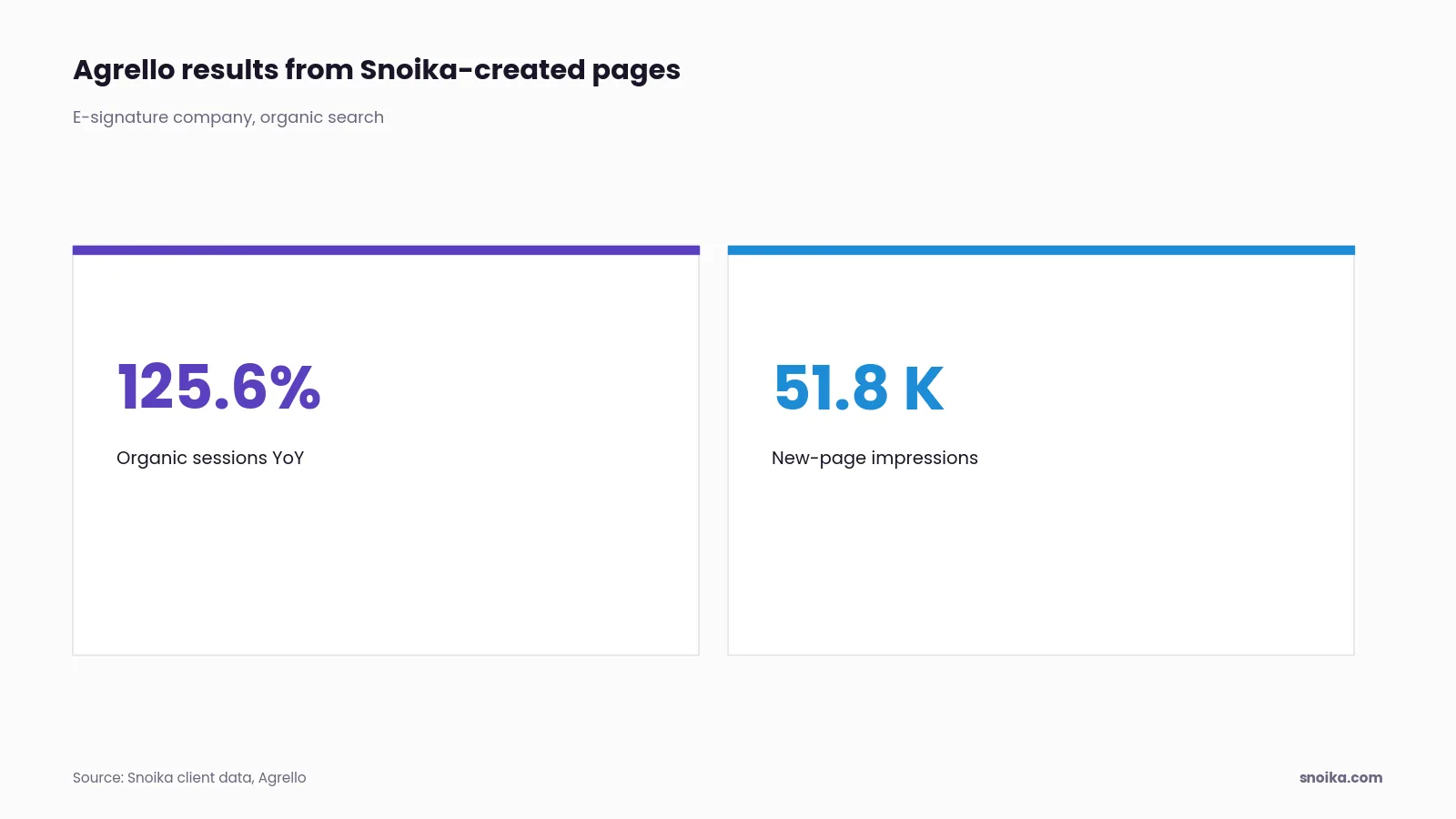
Danny Sullivan, who speaks for Google Search to site owners, put it bluntly in 2025: "Good SEO is good GEO, or AEO, AI SEO, LLM SEO, or LMNOPEO." The organic channel still pays off when the writing is sound. Agrello, in e-signature, saw +125.6% organic search sessions year over year and generated 51.8K impressions from Snoika-created pages.
What AI overviews actually cite
AI Overviews cite pages that Google already ranks for the query or for one of its sub-queries. Within that pool, they favor passages with checkable facts from brands the wider web already discusses. Each signal below works on its own, and a page that has only one of them can still be passed over.
Pages that rank for the query and its fan-out
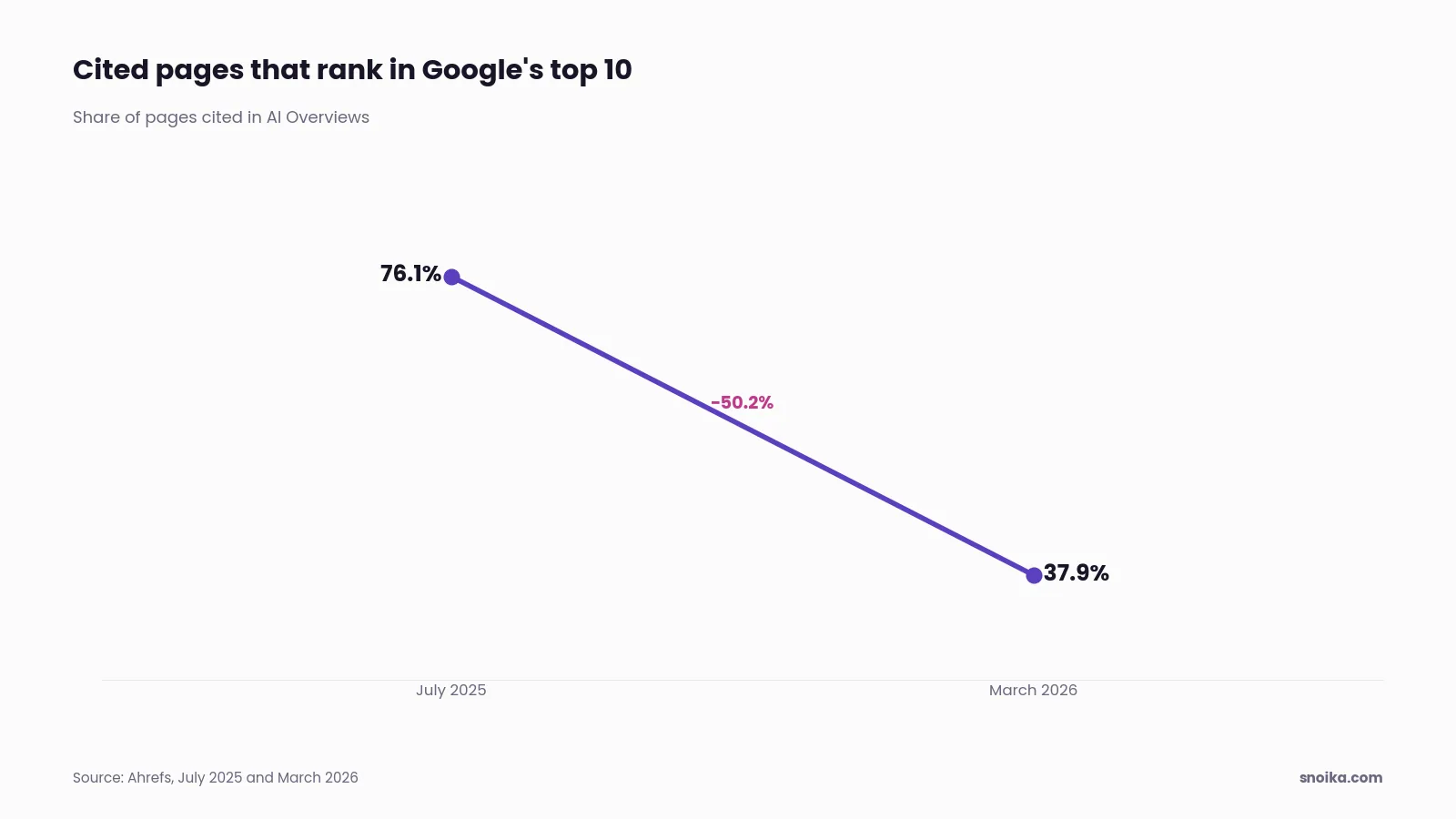
Ranking in the top 10 has shifted from a near guarantee of citation to a less reliable signal. Ahrefs measured 76.1% of cited pages in the top 10 in July 2025 and 37.9% in March 2026, after Google began spreading each query across more sub-queries. If your content marketing strategy covers a full topic cluster, you have more chances to be pulled in than if you rank once for the head term.
Passages with numbers and named sources
Researchers at Princeton and Georgia Tech tested how rewriting affects AI answers. They found that adding source material, citations and quotations, alongside statistics can boost visibility by 40% in generative engine responses. Their paper also found that the effect differs by subject, so a legal page and a recipe page won't respond to the same edits in the same way.
Brands the web already mentions
Off-site presence counts more than links. In a study of 75,000 brands, Ahrefs found that branded web mentions correlated with AI Overview visibility at 0.664, compared with 0.218 for backlinks. Your page is one input, and what other sites say about you is another.
Intent mapping before you write
Intent mapping means deciding what the searcher wants to do next before you draft, because intent sets the page's format and its length. An informational query needs a definition and steps. A commercial query needs a comparison table with criteria and prices with the year, followed by a verdict. A transactional query needs a product page. If you write the wrong type, no amount of polish will rank it.
Read the results page to find the intent. If the top five results are comparison guides, Google has decided the searcher is comparing, and your how-to won't beat them. Then ask ChatGPT the same query and write down the follow-up questions it offers. Those show what the reader asks next, and they match the sub-queries AI Overviews fan out into.
Intent also changes between markets. A query that's informational in one country can be commercial in another, where buyers already know the category. That's why each language version needs its own check, and it matters more when content goes out in 135+ languages and regional variants, as Snoika's does. Before drafting, add one sentence to your content brief template that names the reader and the decision they're trying to make. If you can't write it, the page isn't ready.
Structure that earns featured snippets
A page earns featured snippets when each heading names the question a searcher asks and the first 40 to 60 words below it answer that question in full. Moz analyzed 1.4 million featured snippets and found the best paragraph length was roughly 40 to 50 words, or about 300 characters. Google pulls that block whole, so it has to make sense with nothing around it.
Match the format to the answer. Steps the reader follows in order go in a numbered list, and Google lifts them as a list snippet. Options compared on the same attributes go in a table with a header row. Explanations with a "because" stay in prose, since a bullet can't carry a reason.
The usual mistake is a heading that promises one thing while the paragraph below opens with background. Google skips that section and quotes a competitor whose first sentence does the job. Indexing problems hide good structure too. ABS Technologies got 6x SERP impressions and "improved keyword indexability and significantly increased search visibility within the first 30 days." To test a section, paste its first paragraph into a blank document. If it still answers the heading, it's ready.
Entity signals Google needs
Google needs to understand the company a page describes and how the people behind it are connected to it. Search engines and language models store facts about entities. A page is easier to trust and quote when it names its author and links that author to a company. Consistent product descriptions across pages also help.
Start on your own site. Use one exact name for each product, and don't let marketing rename it from page to page. Give every article a named author with a role that fits the subject. Add Organization and Article structured data, and make sure it matches the visible text, because Google's guidance warns against markup that says something the page doesn't.
The off-site part takes longer. Language models learn about a brand from the places that mention it, such as review sites, trade press and podcasts. Each consistent mention adds to the picture. Vespia, a fintech SaaS, recorded a 220% increase in AI brand mentions. To check your entity signals, ask ChatGPT what your company does. If the answer is vague or describes an old product, the web hasn't caught up with you yet.
Optimizing for LLM recommendations
To get AI assistants to recommend a page, build every section so it answers one question in its opening sentence and still makes sense when lifted out alone. Then name your brand next to the category terms buyers use. An assistant builds its answer from passages. A passage that depends on the paragraph before it ("as mentioned above") loses its meaning once it's extracted.
OpenAI CEO Sam Altman said in October 2025 that ChatGPT had reached 800 million weekly users. When buyers ask it for a recommendation, it reaches for pages that set options against clear criteria and say who each one suits. A page that only praises its own product gives the model nothing to compare.
Recommendations from these tools change each time you ask. Rand Fishkin, CEO of SparkToro, studied repeated prompts and found less than a 1-in-100 chance that ChatGPT or Google's AI would return the same brand list twice. So aim to appear across a large set of related prompts and don't chase one fixed position. 3DPrinterOS achieved #1 visibility in ChatGPT for industry-specific queries and turned AI search into a steady source of 3–4 qualified inbound leads/day.
Measuring citation gains
You measure whether ChatGPT quotes your content by running a fixed set of buyer prompts every week. Record whether your brand is mentioned and your page is cited, then compare that log with referral visits in Google Analytics 4 (GA4). If you keep the prompts the same, a change in the numbers reflects a change in your visibility.
Report visibility as a share of prompts. Fishkin's advice on the random results was direct: "If you don't like an answer, or your brand doesn't show up where you want it to, just ask a few more times." A share measured across 100 prompts every week shows a trend you can act on.
ChatGPT links carry utm_source=chatgpt.com in GA4, so those sessions show up under their own source. Clicks from Google AI Overviews are counted inside Search Console's "Web" performance report, mixed in with regular clicks. Because of that, a citation log is the only way to tell them apart.
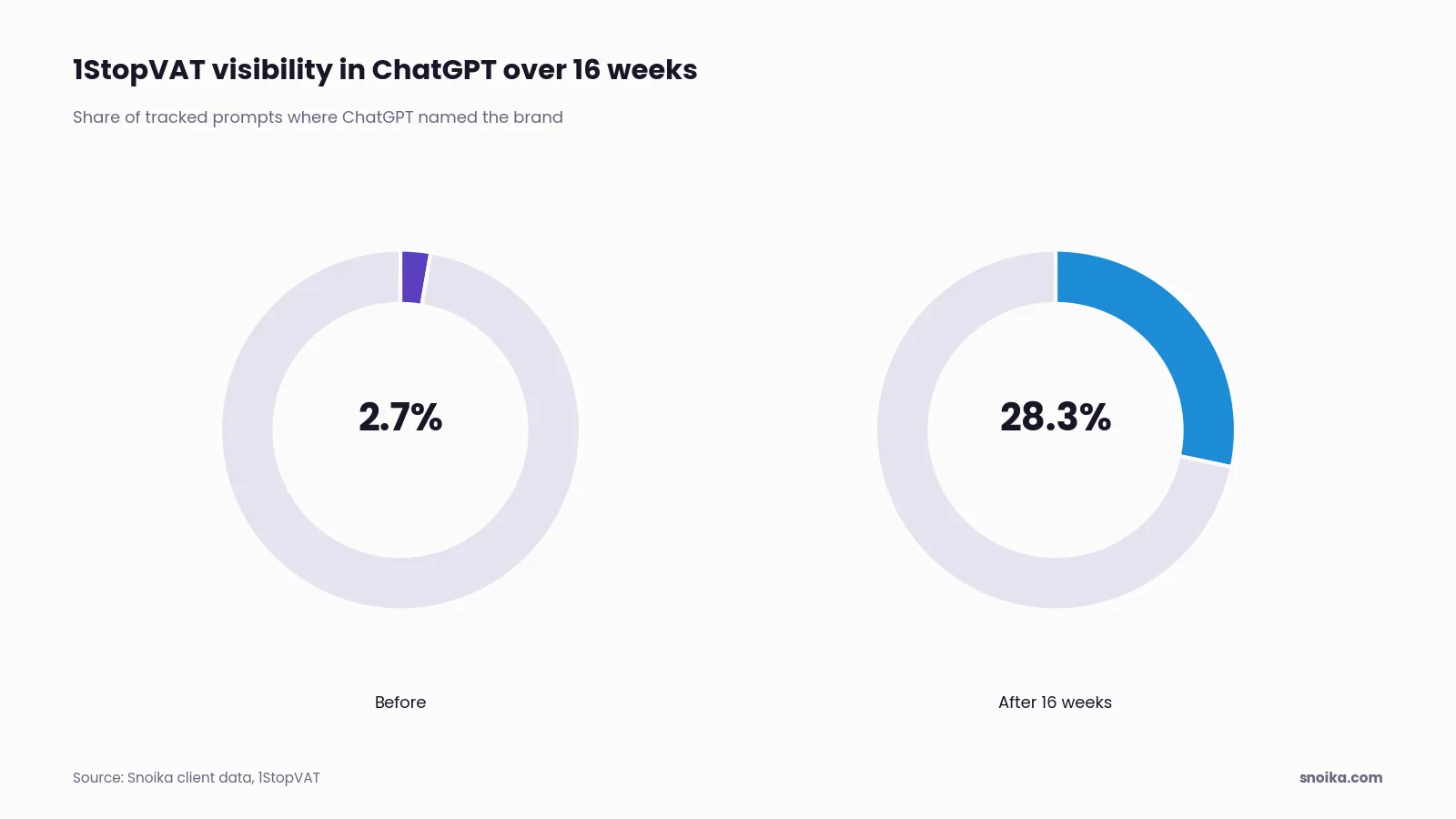
Snoika uses weekly prompt sets to track mentions and share of voice in ChatGPT and Google AI Overviews, where most AI search traffic happens. It also tracks sentiment and citations. Onboarding starts with access to GA4 and Google Search Console. Google Tag Manager access comes next, with CMS access added when pages will be published. Snoika's founder Anton Vedeshin reported to Startup Reporter 1StopVAT's move from 2.7% to 28.3% ChatGPT visibility in 16 weeks.
Who should run the framework
Pick the option based on who writes the pages and who measures the citations, because most setups only cover one of the two. The table compares four common options on the same attributes, with prices as published in 2025 and 2026.
| Option | Who writes | Tracks AI citations | Typical cost | Suits |
|---|---|---|---|---|
| In-house writer | Your staff | Only with added tooling | $76,910 median salary (US, May 2025) | Teams with steady volume and subject experts on hand |
| SEO agency | Agency writers | Depends on the contract | $3,209 average monthly retainer | Companies that want rankings and have their own analytics |
| Monitoring-only tool | You | Yes | Subscription, varies by vendor | Teams that have writers and need data |
| Snoika | Platform plus the same team, with human review | ChatGPT and Google AI Overviews, weekly | Plans on the pricing page | Teams that want writing and tracking in one place |
In-house writer
- Who writes
- Your staff
- Tracks AI citations
- Only with added tooling
- Typical cost
- $76,910 median salary (US, May 2025)
- Suits
- Teams with steady volume and subject experts on hand
SEO agency
- Who writes
- Agency writers
- Tracks AI citations
- Depends on the contract
- Typical cost
- $3,209 average monthly retainer
- Suits
- Companies that want rankings and have their own analytics
Monitoring-only tool
- Who writes
- You
- Tracks AI citations
- Yes
- Typical cost
- Subscription, varies by vendor
- Suits
- Teams that have writers and need data
Snoika
- Who writes
- Platform plus the same team, with human review
- Tracks AI citations
- ChatGPT and Google AI Overviews, weekly
- Typical cost
- Plans on the pricing page
- Suits
- Teams that want writing and tracking in one place
The salary figure comes from the U.S. Bureau of Labor Statistics, which put the writers' median at $76,910 in May 2025. The agency figure comes from Ahrefs' survey of 439 SEO providers, which also found that 63% of businesses spend between $500 and $5,000 a month.
An in-house writer is the best value when you publish every week and your experts can review drafts. Snoika combines content writing services with citation tracking in one place. Pages go live on your own domain through a DNS connection that works with any CMS and requires no migration. You approve each page in the dashboard before it publishes. If you already have strong writers and only lack data, a monitoring-only tool costs less.
What to do next
Measure before you rewrite. Run your 20 most important buyer prompts in ChatGPT and Google this week, and record which competitor gets cited for each one. That baseline tells you which pages to put through an SEO content audit first and gives you the number you'll compare against in 8 weeks. Without it, any gain from SEO content writing is a guess.
Snoika audits your site and tracks your brand in ChatGPT and Google AI Overviews. Our team reviews each page Snoika writes and publishes to close the gaps. To see where your brand stands today, get a free AI visibility report.
FAQ
Make each section answer one question and make sense on its own. In seo content writing, put the answer in the opening sentence and remove references such as “as mentioned above.” For comparison pages, explain which option suits which reader using clear criteria.
Indexing and snippet eligibility are the entry requirements, according to Google's guidance. Support factual passages with named sources and cover relevant follow-up questions. These steps help make content available and useful for citation, but they don't guarantee inclusion.
Run the same prompts weekly and record which responses cite your page. Calculate the percentage of prompts that produce a citation, then compare it with ChatGPT referral traffic in analytics. Keep mentions separate from citations, and expect individual responses to vary.
Use eight weeks as a comparison checkpoint, while checking citations weekly. Record a baseline before editing so you can compare results against it. The page recommends this review interval but doesn't establish a deadline by which rankings or citations will improve.
A citation can appear without generating a click because readers may get their answer from the AI summary. Track citation frequency separately from referral visits. This lets you distinguish visibility in answers from traffic that reaches your website.


