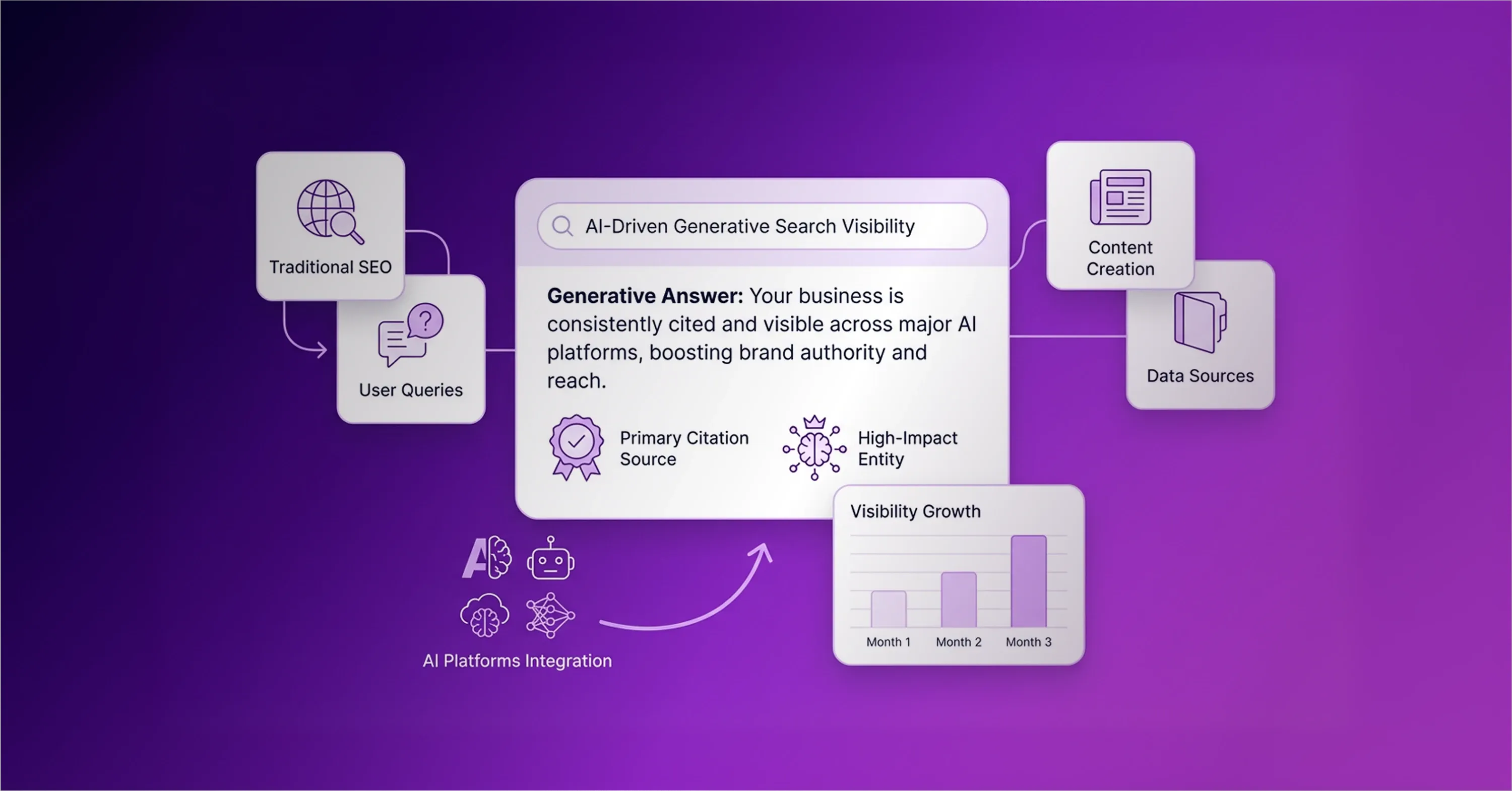
visual diagram showing transition from traditional SEO and user queries to AI-driven generative search visibility with content creation, data sources, and increasing visibility growth

AI Brand Marketing: Framework For Authority In Generative Search 2026

In this article, we explain how generative search engines change digital visibility strategies. We detail a framework to secure third-party citations and adapt content architecture to meet machine learning model requirements.

Content authorJevgenia Pogadajeva, MBA, MScPublished onReading time10 min read

Introduction

Traditional search engine optimization focused on securing blue links on results pages to drive website traffic. For two decades, marketing professionals structured content to satisfy crawler algorithms and rank highly for specific queries. Today, large language models synthesize information and deliver complete answers directly in the search interface. According to Neotype.ai, between 60% and 70% of all Google searches will end without clicks to external websites in 2025. This zero-click reality fractures conventional discovery pathways and makes traditional traffic metrics less reliable indicators of market presence. AI brand marketing requires a transition from website optimization to off-site entity recognition. Organizations need multi-platform citation authority to maintain market presence because generative engines bypass isolated domains. A strong citation strategy ensures consistent brand visibility across all major artificial intelligence platforms.

Zero-Click Paradigm Shift

Major artificial intelligence platforms are reshaping how people find information and fragmenting traditional search mechanics. Modern language models synthesize data to deliver complete answers directly in the interface. This zero-click environment eliminates the need for users to navigate through multiple website links. A synthesized answer provides more value than a blue link on a results page. If a language model resolves the query immediately, the user has no reason to visit external domains.

This shift forces marketing professionals to question whether traditional search engine optimization remains relevant. The answer points to a fundamental evolution rather than complete obsolescence. Companies are shifting their focus toward ai brand marketing to secure visibility in these new environments. Website optimization alone no longer guarantees that potential buyers will see a company’s message. Recent survey data confirms this behavioral change: 27% of Americans now use AI chatbots instead of traditional search engines.

Companies establish brand authority when they appear in generated responses. Organizations secure this presence by providing clear signals that machine learning models can easily process. Many professionals use specific Generative Engine Optimization tools to monitor how these models perceive their digital footprint. When a company appears as the definitive answer within a generative interface, it builds confidence among buyers who rely on the machine’s recommendation.

AI Model-Specific Citation Preferences

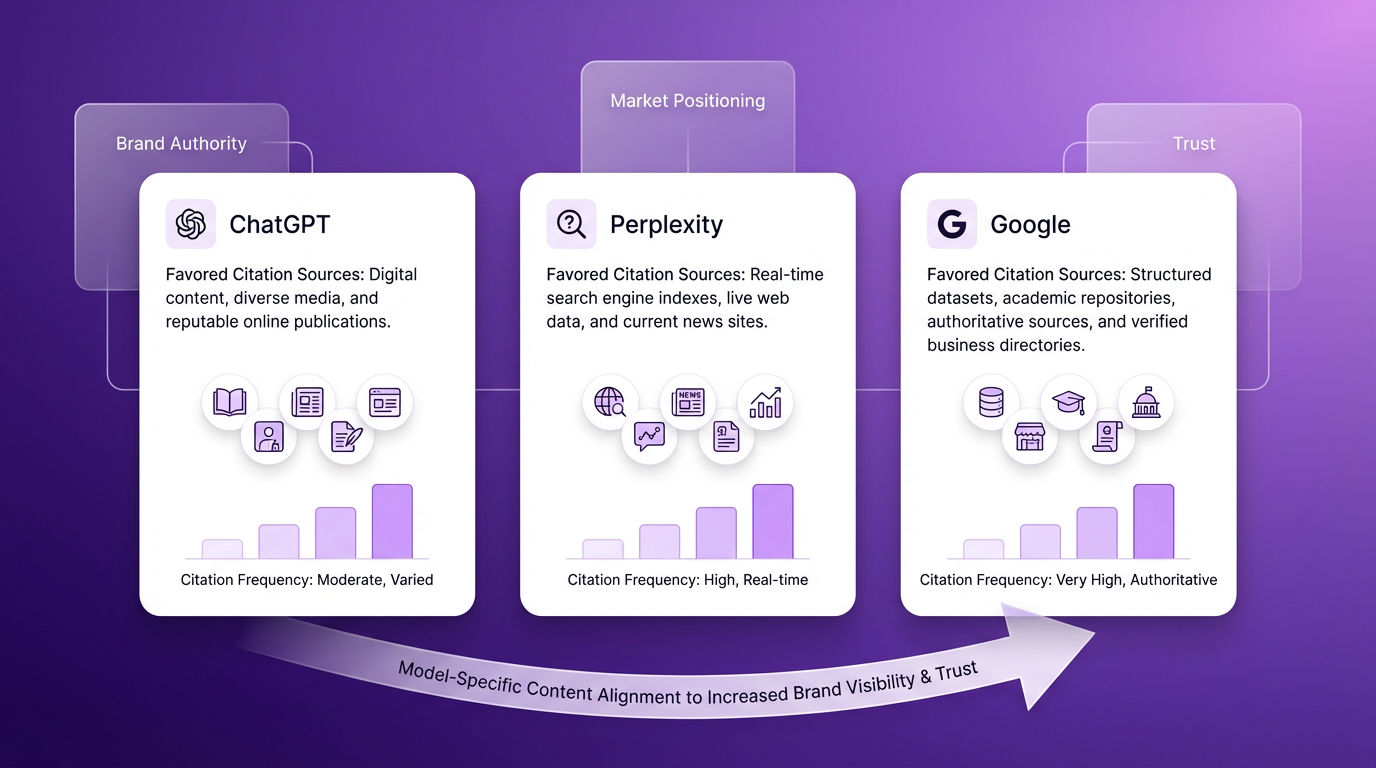
Three rounded UI cards labeled ChatGPT, Perplexity, and Google, with citation summaries and pastel bar charts, set against a deep purple gradient.

Companies secure visibility across artificial intelligence platforms when they understand how different generative engines evaluate data. Each system uses distinct algorithms that prioritize specific information sources over others. Because these systems behave differently, a monolithic approach to digital branding usually fails. Marketing teams develop targeted strategies that address the specific preferences of each language model.

Engineers train these models to recognize patterns and extract information from platforms that demonstrate high user engagement. When companies align their content distribution with these model-specific preferences, they strengthen their market positioning. Different platforms look for specific signals:

  • Conversational models prioritize established encyclopedic domains and major editorial publications.

  • Research-focused engines extract data from professional networking sites and peer-to-peer discussion boards.

  • Local search interfaces rely on aggregated review platforms and regional business directories.

Despite these differences, community-driven platforms command significant attention across all systems. An analysis of major platforms revealed that Reddit serves as the most-cited domain in AI-generated answers across various language models. Marketing professionals who secure mentions across these diverse sources earn the trust of the language models that synthesize this information.

Editorial Citations For Digital Brands

ChatGPT constructs its responses by extracting data from established knowledge graphs and recognized publications. This system prefers sources that demonstrate strict editorial standards and historical reliability. A recent platform analysis showed that ChatGPT favored specific editorial sites, including Wikipedia, Reddit, and Forbes.

Organizations integrate their core narratives into these highly visible domains. When a company earns mentions in major editorial publications, ChatGPT recognizes that entity as a legitimate market participant. This integration signals authority to the language model. Companies secure placements in top-tier business magazines or contribute structured data to public encyclopedias, ensuring that the generative engine includes the entity in relevant industry answers.

Perplexity And Professional Networks

Perplexity operates as a research engine that synthesizes professional consensus to answer complex business queries. This system bypasses generic content and specifically seeks out peer-to-peer discussions and verified user experiences. A thorough evaluation of the system showed that Perplexity emphasized Reddit, LinkedIn, and G2 for B2B queries.

Active engagement within professional networks builds brand authority on this platform. Companies foster discussions on LinkedIn and cultivate detailed customer reviews on software directories such as G2. When industry peers discuss a product across these networking sites, Perplexity extracts those insights to form its recommendations. Consistent participation in these professional environments helps companies command attention within generated research summaries.

Preference For Local Entities

Google integrates its massive geographic database directly into its generative search interface. The artificial intelligence overview logic specifically prioritizes businesses that maintain active profiles across established review platforms and regional directories. The system cross-references these local citations to verify business operations before it generates a recommendation.

Consistent information across local directories solidifies market presence in the Google ecosystem. The generative engine looks for matching details across mapping services, aggregate review sites, and localized business listings. When the algorithm detects positive customer interactions and frequent profile updates, it elevates the business in local query responses. This verification process helps ensure the reliability of the data Google delivers to users seeking regional solutions.

Framework For Ai Brands

Companies must adopt a dual process that combines technical on-site architecture with strong off-site validation to pass the strict verification process across generative engines. Language models first scan a company’s owned domains to understand the core narrative, but they rely on external sources to verify those initial claims. This evaluation mechanism requires marketing teams to pair front-loaded key information on their websites with aggressive third-party profile building.

Companies structure their internal pages clearly to satisfy strict machine extraction rules. Websites present direct answers to common industry questions in the first few paragraphs of any given article. While this structured architecture helps models process information efficiently, owned content alone does not guarantee a citation. Artificial intelligence needs external validation to form a firm belief about a company’s market position.

A multi-layered approach to content distribution solves this validation problem. Organizations actively push their narratives onto external platforms, major industry blogs, and professional discussion forums. Recent research on language model extraction patterns indicates that 85% of brand mentions come from third-party pages, not from brands’ own websites. This metric proves that off-site entity recognition carries more weight for AI brand marketing than isolated website optimization. Marketing teams treat external domains as primary distribution channels. Companies secure consistent mentions across independent websites, feeding language models the third-party validation they require to generate accurate answers.

Content Structure for LLM Extraction

Content optimization for large language models requires specific technical standards that facilitate rapid data extraction. Artificial intelligence engines scan pages differently from traditional web crawlers. They look for direct answers located near the top of the page. A recent analysis demonstrated that 44% of ChatGPT citations come from the first third of content, proving that these models favor front-loaded information. This reality requires a new content architecture.

Writers establish brand authority within generative interfaces when they place the most important information early in the text. Teams optimize existing assets through several specific steps. First, they restructure articles to place direct answers in the first two paragraphs. Second, they format headings as common industry questions to guide model extraction. Third, they upload an llms.txt file to the root directory to map content for language models.

Developers recently introduced the llms.txt file format to help artificial intelligence interpret website structures. However, adoption remains low across the industry. A recent study showed that 10.13% of analyzed domains use the llms.txt file for optimization. This low adoption rate gives early adopters of AI brand marketing an advantage over competitors. Marketing departments monitor these structural improvements using AI visibility tracking software to verify how well language models extract their data.

First 60 Days: Technical Baselines and Content Structure

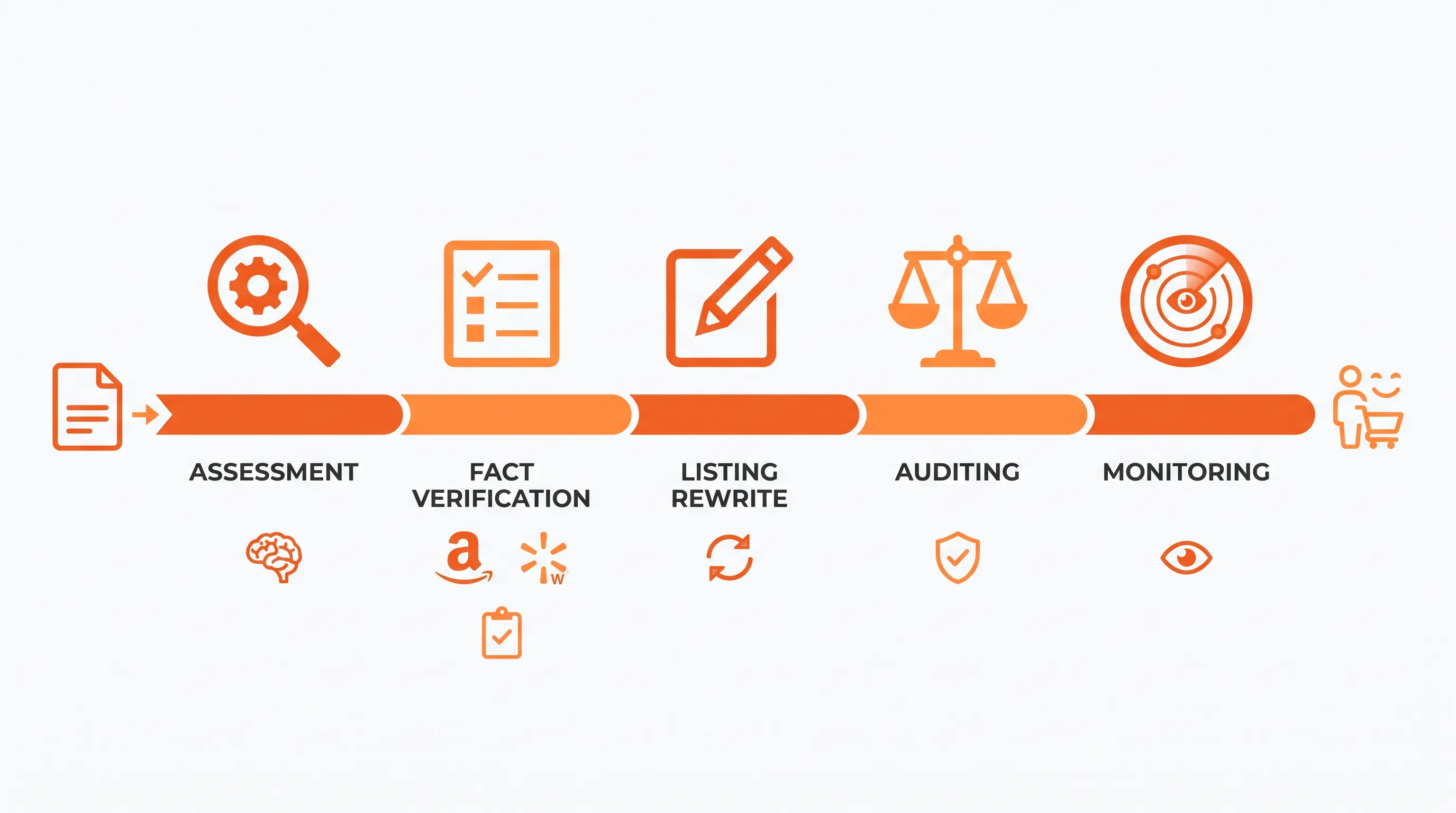
The first phase of the implementation roadmap focuses on technical baseline audits and repairs for content eligibility blockers. Marketing teams begin by evaluating how artificial intelligence currently perceives the company. They use this initial assessment to allocate resources properly. Teams often run traditional search engine optimization ranking checkers to understand current website performance, then compare it with their visibility in generative engines.

These new baselines require updated measurement frameworks. Industry experts note that an AI visibility score and share of voice serve as critical metrics for measuring optimization success in modern search environments. Teams establish these baselines and then restructure existing assets. This asset structure forms the core of digital branding during the first two months. Teams evaluate historical blog posts, product pages, and whitepapers to identify extraction barriers.

Language models skip pages when content hides direct answers behind long introductions. Writers fix these blockers by moving definitions and statistics to the top of the page. This structural shift ensures compliance with machine extraction rules. Brand authority requires this technical foundation because language models do not extract disorganized data. Companies shift their focus to external signals after the internal architecture meets these new standards.

Final 30 Days: Source Strategy and Measurement

The final phase of the roadmap focuses on external signals and executes a targeted off-site source strategy to measure return on investment. Teams optimize website architecture and secure mentions on third-party platforms to validate market position. These mentions provide the external verification that generative engines need to trust a company’s claims. A recent industry analysis revealed that approximately 90% of AI citations come from earned and owned media rather than paid placements.

Marketing teams use this data to participate actively in professional networks and aggregate review sites. Press releases and editorial placements in major publications strengthen this off-site digital branding strategy. Marketing departments link citation frequency directly to revenue impact to justify their budgets. Recent studies show that ChatGPT traffic generates 31% higher conversion rates than non-branded organic search for ecommerce brands.

Buyers arrive with higher purchase intent when an artificial intelligence engine recommends a product. This increased conversion rate offsets the decline in traditional website traffic. This future AI content marketing landscape requires accurate share-of-model measurement. Teams monitor how often the brand appears in generated responses and track the corresponding sales data. This approach turns AI brand marketing efforts into a measurable revenue driver.

Conclusion

Companies turn AI brand marketing into a measurable revenue driver when they secure digital visibility through off-site entity recognition and multi-platform citation authority. An AI brand marketing strategy provides a structural advantage over competitors still chasing traditional algorithmic rankings. As language models evolve, early investments in third-party citations will compound into a strong market presence that late adopters struggle to disrupt. A strict tracking protocol helps monitor brand mentions and citation frequency across all major conversational interfaces through reliable performance marketing metrics.

You should train your current content writers to focus on off-site publishing instead of internal blog posts. Your technical staff can shift from keyword optimization to data structuring so language models can read your content easily. This transition helps your team adapt to new requirements without losing their productivity.

You need to allocate most of your budget toward digital public relations and third-party content placement. Companies usually redirect half of their traditional search marketing funds to secure mentions on external platforms. You'll also need to buy software that tracks how often language models mention your product.

Business software providers and healthcare companies achieve the best results from their optimization efforts. Buyers rely on language models to summarize complex technical products and medical information before making purchasing decisions. You'll see faster growth if your business operates in a technical market that requires deep research.

You can't directly edit the answers that language models generate, but you can publish corrected information on external websites. You should update your company profiles on major review platforms and post accurate specifications on industry forums. The models will read these new sources and update their generated responses.

You can manage your ai brand marketing internally or use Snoika to handle the workload. Snoika operates as an AI marketing SaaS platform that helps businesses become visible in search engines like ChatGPT and Perplexity. It combines content optimization with visibility analytics to secure your brand presence in AI-generated answers.

Schedule a Meeting

Book a time that works best for you