
Blog post format for AI search
A blog post format for AI search puts a direct answer at the top of the post and under every heading, so a machine can lift any single section and quote it without the surrounding text. In practice that means one H1 and question-shaped H2s, each with a 40 to 60 word answer beneath it. Every figure needs a named source, and the markup must match what the reader sees. Here's how to build each part.
 Artem LozinskyOperations and product, Snoika · 8 min read

























Structure posts for AI extraction
To get an AI system to cite a post, put the answer first and make every section stand on its own. Answer engines read the top of a page more closely than the rest. Kevin Indig, a growth advisor, analyzed 1.2 million ChatGPT answers and found that 44% of ChatGPT citations came from the first third of the content. So if your answer sits in paragraph eight, the model has probably moved on before it gets there.
Build or rebuild a post in this SEO content writing order:
- Write the question the reader typed as a single sentence. That question decides the H1 and the opening.
- Answer it in the first 40 to 80 words, with no preamble and no links.
- List the follow-up questions the reader will have next, and turn each one into an H2.
- Open every H2 with a sentence that answers its heading outright, then add the evidence.
- Name a source for each number, and link the figure itself to that source.
- Add structured data that describes the visible page, then check that the post is indexed.
Step 3 changes most between posts. A definition post needs 5 H2s, while a comparison needs a table and fewer headings. In both formats, every section must make sense when read by itself.
What is a good structure
A good structure gives the reader the answer once at the top and a short self-contained answer under each heading. Evidence follows each section's answer closely. AI search tools favor posts that look like this because each block can be pulled out cleanly. In a Search Engine Land analysis, 72.4% of cited blog posts contained an "answer capsule", a short direct answer right after a heading. The table below shows the parts of a blog post structure and what each one does for a machine reader.
| Element | Where it goes | What it does for AI extraction | What to check |
|---|---|---|---|
| H1 | Top of page, once | Names the topic the whole page answers | One H1 only, matching the search question |
| Opening answer | First 40 to 80 words | Gives a quotable definition or answer | No links, no preamble |
| H2 headings | Each major subtopic | Splits the page into retrievable chunks | Each reads as a question or a plain claim |
| Answer capsule | First 1 to 3 sentences under each H2 | Supplies the passage the model quotes | Makes sense read alone |
| Evidence | After the capsule | Backs the claim with named sources | Every figure links to its source |
| Table or list | Where items share attributes or steps run in order | Gives a model a clean comparison or sequence | Header row present, real HTML table |
| Structured data | Page code | Describes the page in a fixed vocabulary | Matches the visible text |
H1
- Where it goes
- Top of page, once
- What it does for AI extraction
- Names the topic the whole page answers
- What to check
- One H1 only, matching the search question
Opening answer
- Where it goes
- First 40 to 80 words
- What it does for AI extraction
- Gives a quotable definition or answer
- What to check
- No links, no preamble
H2 headings
- Where it goes
- Each major subtopic
- What it does for AI extraction
- Splits the page into retrievable chunks
- What to check
- Each reads as a question or a plain claim
Answer capsule
- Where it goes
- First 1 to 3 sentences under each H2
- What it does for AI extraction
- Supplies the passage the model quotes
- What to check
- Makes sense read alone
Evidence
- Where it goes
- After the capsule
- What it does for AI extraction
- Backs the claim with named sources
- What to check
- Every figure links to its source
Table or list
- Where it goes
- Where items share attributes or steps run in order
- What it does for AI extraction
- Gives a model a clean comparison or sequence
- What to check
- Header row present, real HTML table
Structured data
- Where it goes
- Page code
- What it does for AI extraction
- Describes the page in a fixed vocabulary
- What to check
- Matches the visible text
The same research found that over half of cited posts also carried original data or insight owned by the brand. Structure gets a passage noticed, and the SEO content optimization behind it decides whether the passage is worth quoting.
Heading hierarchy signals topic
Headings tell a machine which passage answers which question, so write them as the question or as a plain statement of the answer. Google's own guide to generative AI features says, "People generally appreciate it when web pages are organized by paragraphs and sections, along with headings that provide a clear structure to navigate content." A model that splits your page into chunks uses those headings as labels for each chunk.
How to word an H2
Word each H2 so it matches a question someone types, or a claim someone can check. "Pricing" tells a model little. "How much a retained search costs" tells it exactly which query the section answers. Keep the main term in the heading and drop clever wordplay, because a pun can't be matched to a query. Leave links out of headings too.
When to add H3s
Add H3s when one H2 splits into separate sub-questions that readers scan for, such as two options or two steps. Use at least two, or none, because a single H3 just repeats its parent. Never skip a level by going from H2 to H4, as that breaks the outline a parser builds from your page. And if a section runs under 150 words, it doesn't need subheadings at all.
Semantic anchors per section
A semantic anchor is the opening passage of a section that names the topic in full and answers the heading without leaning on anything above it. AI Overviews pull sections built this way as sources because the passage survives being cut out of the page. Use "Answer capsules are 40 to 60 word answers placed under a heading" in place of the vague wording "These are short answers placed there." A model that lifts the second version gets a sentence with no subject.
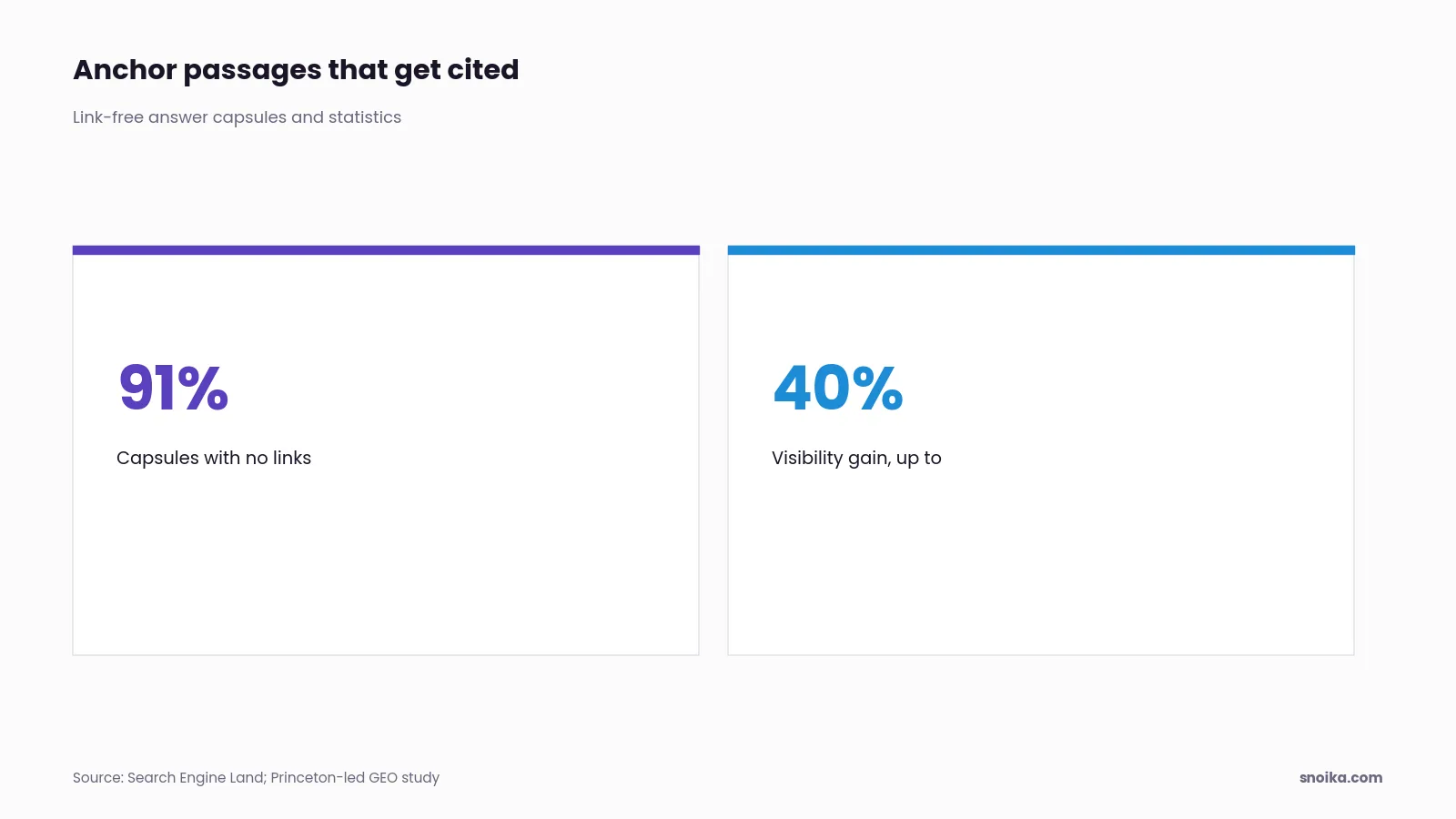
First, repeat the full term in place of a pronoun in the first sentence of each section to keep the anchor clear. Second, keep links out of the anchor. In the Search Engine Land data, roughly 91% of answer capsules had no links, so citations belong in the support sentences that follow. Third, put a specific fact in or near the anchor. The Princeton-led study that coined generative engine optimization (GEO) found that methods like adding statistics and citing sources can lift visibility by up to 40% in generative engine responses.
A definition fits in 40 words, while a process answer needs 3 sentences. If you read the anchor aloud to someone who hasn't seen the page and they understand it, it's done.
FAQ blocks boost citations
FAQ blocks help citations when they answer real follow-up questions in short, self-contained pairs, because each pair is a ready-made passage for an answer engine. The rich result Google once showed for them is gone, though. Google limited FAQ rich results to well-known government and health sites in August 2023. Its documentation updates log later recorded the feature's removal from Search from May 7, 2026.
So the case for a FAQ block now rests on content alone. Pick questions from search data or from your sales team, which hears them every week. Leave out filler questions that the body already answers. Answer each one in 2 to 4 sentences, with the answer in the first sentence. A FAQ that just repeats the body adds weight to the page without giving a model anything new to quote.
Internal linking reinforces context
Internal links tell crawlers which pages belong to the same topic and help them find otherwise unvisited posts. Google's guidance on AI features and your website lists "making your content easily findable through internal links" among the fundamentals that still matter for AI Overviews. A post with no links pointing to it is harder to find and has less context around it.
Link from a post to the page that covers a subtopic in depth, and use anchor text that describes that page. "Answer capsule examples" beats "this guide." Link back up from detail pages to the main topic page as well, so the cluster reads as one subject. A blog on the main domain keeps every link inside one site. That's why Snoika uses a DNS connection to publish client pages on their own domain while the existing site stays in place. Check for orphan pages after every batch of new posts.
Schema markup aids AI parsing
Schema markup helps machines read a page's author and date alongside its page type, though it doesn't unlock AI citations by itself. Google says in its optimization guide, "Structured data isn't required for generative AI search, and there's no special schema.org markup you need to add." The same guide still recommends it as part of normal search engine optimization.
For a blog post, Article or BlogPosting markup with author and date fields is the base, and BreadcrumbList shows where the post sits on the site. The rule that trips teams up is consistency. Google's AI features page asks site owners to make sure "structured data matches the visible text on the page." Markup that names a different author, or a FAQ schema for questions the page no longer shows, works against you. Run the page through a validator after each template change, and compare the markup with the rendered page.
Measuring AI-driven discoverability
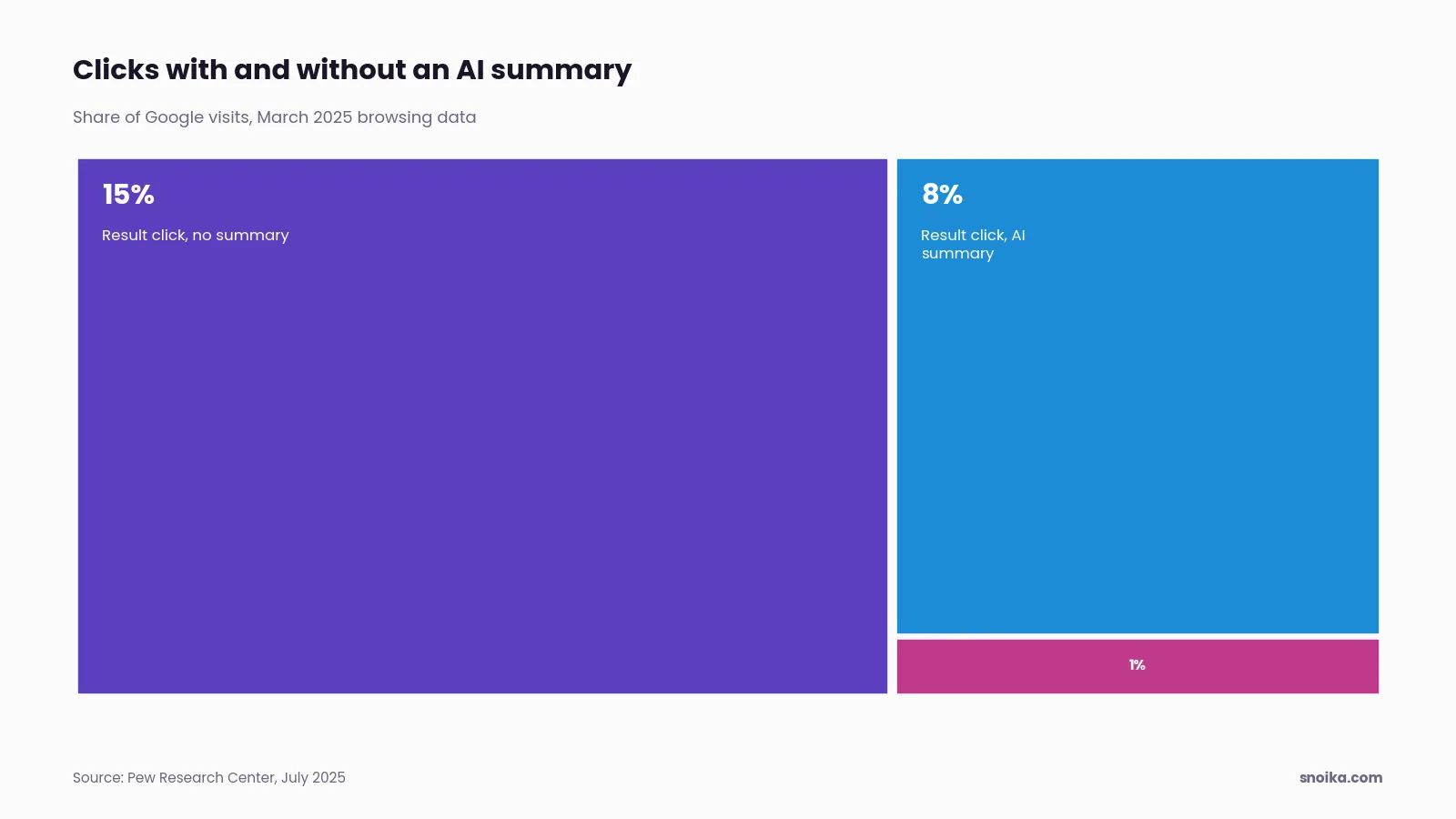
You measure AI-driven discoverability by testing a fixed set of prompts in AI assistants every week and recording whether your brand is mentioned or cited. Search traffic alone undercounts it. A Pew Research Center study found that users who saw an AI summary clicked a traditional result in 8% of visits, against 15% without one. They clicked a link inside the summary in just 1% of visits. Your post can shape the answer and still get no click.
The Search Console Performance report counts AI Overview and AI Mode appearances inside the "Web" search type without a separate filter. For direct checks, write 20 to 50 prompts that match your target questions and run them on a schedule. Log whether you're mentioned or cited for each answer. Record which competitors appear and the tone to complete the four checks. Snoika uses weekly prompt sets to track mentions and share of voice in ChatGPT and Google AI Overviews. It also tracks sentiment and citations in those answers. Expect the numbers to move over weeks. Snoika's founder Anton Vedeshin reported to Startup Reporter 1StopVAT's move from 2.7% to 28.3% ChatGPT visibility in 16 weeks. Compare like with like by keeping the prompt set fixed between runs.
Maintaining structure at scale
Structure holds at scale only when it lives in a blog post template and a checklist. Once a content marketing strategy has a team publishing more than a handful of posts a month, a headline gets clever or an opening drifts into a preamble. Each lapse costs a citation, and nobody notices until the prompt tests show it.
Turn the format into a short pre-publish check:
- The opening answers the H1 in 40 to 80 words with no links.
- Every H2 opens with a sentence that answers it on its own.
- Each figure links to a named source.
- Any H3s appear in pairs.
- Structured data matches the visible page.
- The post has at least one internal link pointing to it.
Translated posts must keep the same structure as the original, since a translator who merges two sections breaks the anchors. Snoika's SEO content writing services cover 135+ languages and regional variants, and the same check runs on each version. Older posts drift as facts change, so set a review date on any post that carries statistics. Rewrite the answer capsule first when a number goes out of date.
What to do next
Start with the 5 posts that already get the most impressions in Search Console. Those pages are indexed and trusted, so a rewrite of their openings and H2 anchors will show results in your weekly prompt tests faster than a new post. Record a baseline before you change anything, then fix the blog post format there first. Compare after 6 to 8 weeks. Our team at Snoika audits sites and tracks how brands appear in ChatGPT and Google AI Overviews. For a baseline before you start, get a free AI visibility report.
FAQ
Use one H1 for the main question and question-shaped H2s for follow-ups. Check that each heading identifies its topic without relying on the previous section. If a section is under 150 words, keep it under one H2 rather than adding subheadings.
Write each section's opening so it makes sense outside the post. Name the topic instead of using pronouns such as “these,” then answer the heading in 40 to 60 words. Keep links in the supporting sentences and test whether the opening makes sense when read alone.
Start by applying the blog post format to five existing posts with the most Search Console impressions. These pages are already indexed, making them a practical starting point. Record a baseline before editing so later prompt tests can show whether citations change.
Run weekly checks and compare results after six to eight weeks. Keep the same set of 20 to 50 prompts throughout the test so comparisons stay consistent. That review window is a checkpoint, not a promised deadline for gaining citations.
Yes, a post can be cited in an AI answer without receiving a click. Track citations separately from visits using a fixed prompt set. Search Console includes AI Overview appearances within Web reporting, but it doesn't provide a separate filter for those appearances.


