
GEO KPIs for revenue teams
GEO KPIs show whether AI assistants name your brand when buyers ask about your category and whether those answers lead to pipeline. Generative engine optimization (GEO) is the work of getting your brand mentioned and cited in tools such as ChatGPT and Google AI Overviews. A revenue team needs key performance indicators (KPIs) at every funnel stage, with citation rate at the top and measures of the pipeline that AI answers start or influence at the bottom.
 Denys SuliatytskyiHead of Growth, Snoika · 7 min read

























GEO KPIs by funnel stage
Each funnel stage has one GEO KPI that answers the question leadership asks about that stage. Early-stage metrics show whether AI answers include you at all, while later-stage metrics show whether those answers send buyers who convert and then buy. The table maps the four stages a B2B funnel report covers.
| Funnel stage | GEO KPI | What it tells you | Where the data lives |
|---|---|---|---|
| Awareness | AI share of voice | How often AI answers name you compared with competitors | Weekly prompt tracking |
| Consideration | Citation rate on comparison prompts | Whether AI cites your pages when buyers compare vendors | Prompt tracking, cited URLs |
| Conversion | AI-referred conversion rate | How often visitors from AI answers sign up or request a demo | GA4 channel group |
| Revenue | AI-sourced and AI-influenced pipeline | The deal value that started with or passed through an AI answer | CRM fields, self-reported attribution |
Awareness
- GEO KPI
- AI share of voice
- What it tells you
- How often AI answers name you compared with competitors
- Where the data lives
- Weekly prompt tracking
Consideration
- GEO KPI
- Citation rate on comparison prompts
- What it tells you
- Whether AI cites your pages when buyers compare vendors
- Where the data lives
- Prompt tracking, cited URLs
Conversion
- GEO KPI
- AI-referred conversion rate
- What it tells you
- How often visitors from AI answers sign up or request a demo
- Where the data lives
- GA4 channel group
Revenue
- GEO KPI
- AI-sourced and AI-influenced pipeline
- What it tells you
- The deal value that started with or passed through an AI answer
- Where the data lives
- CRM fields, self-reported attribution
The top rows matter more than their distance from revenue suggests. The 6sense 2025 Buyer Experience Report found that buyers buy from a vendor on their Day One shortlist 95% of the time, and they make that shortlist before they talk to sales. If AI answers leave you off the list early, the lower rows have little left to measure. Sales-led companies with long cycles read the bottom rows quarterly, while product-led teams see conversion changes within weeks.
What GEO metrics are
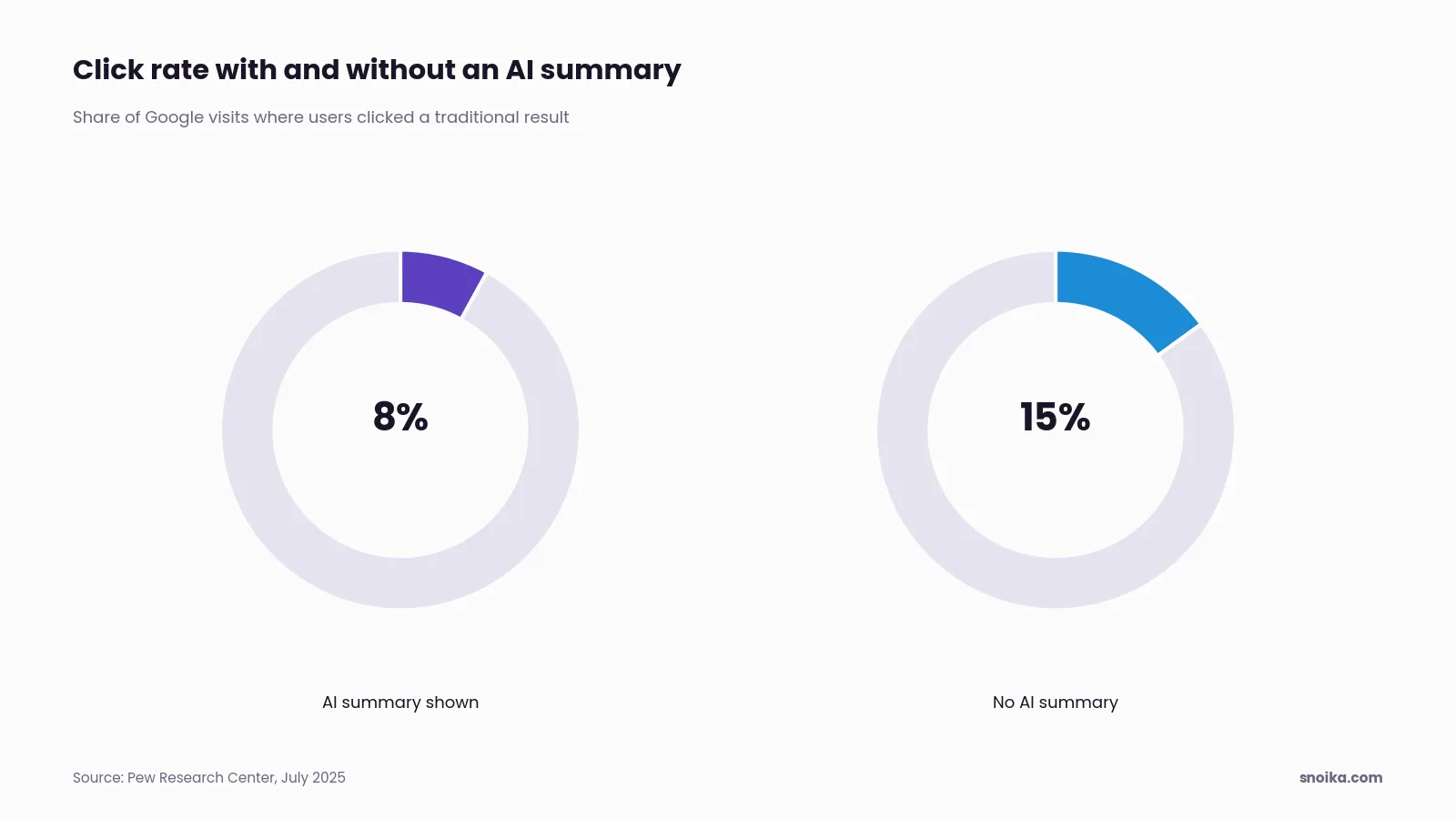
GEO metrics measure how your brand appears inside AI-generated answers, which click-based reports can't see. Buyers now get answers without visiting your site. A Pew Research Center study of 68,879 Google searches found that users clicked a traditional result in 8% of visits when an AI summary appeared, compared with 15% when none did. Forrester's Buyers' Journey Survey found that 94% of business buyers used AI in their buying process in 2025.
The two groups of GEO metrics separate presence inside the answer from outcomes recorded afterward in your analytics and your customer relationship management (CRM) system. Snoika uses weekly prompt sets to record mentions and share of voice in ChatGPT and Google AI Overviews, where most AI search traffic happens. The same tracking records sentiment and citations. An answer mentions your brand when it names you and cites your page when it links to it as a source. Only citations can send traffic. Answer engine optimization (AEO) KPIs overlap almost completely with GEO metrics, so one report can cover both, next to your existing marketing KPIs.
AI citation rate
AI citation rate is the share of tracked prompts where an AI answer cites a page on your domain. To calculate it, divide the number of prompts that cited you by the total number of prompts you ran. Do this for each platform, every week. Say a team tracks 100 buying-intent prompts and gets cited on 18 of them. That week's citation rate is 18%.
Treat citation rate as a percentage across many runs, never as a ranking. SparkToro and Gumshoe ran the same brand-recommendation prompts hundreds of times. ChatGPT and Google's AI returned the same list of brands in fewer than 1 in 100 runs. Rand Fishkin, SparkToro's cofounder, wrote: "Thinking of them as sources of truth or consistency is provably nonsensical." A percentage across a whole prompt set is far more stable than any single answer.
Most of the variation comes from the prompt set itself. Prompts that include your product name push the rate up, so build the set from questions buyers ask before they know you exist, such as category comparisons and requests for alternatives. Keep the set fixed for at least a quarter, because changing it breaks the trend line. Map each prompt to a funnel stage, so you can split the rate by stage in your report.
Pipeline attribution from AI
AI pipeline attribution needs both referral data for buyers who click through and self-reported data for buyers who don't. Neither works alone. ChatGPT and Perplexity pass referrers that you can capture. But clicks from Google AI Overviews show up as ordinary Google organic traffic in Google Analytics 4 (GA4). And a buyer who saw your name in an answer and typed your URL days later shows up as direct traffic.
Connect AI citation rate to revenue with these four attribution steps.
- Create a custom channel group in GA4 that matches chatgpt.com and perplexity.ai as AI referrers. Include gemini.google.com and copilot.microsoft.com in the same group.
- Store the first-touch source in a hidden form field, so the CRM records it on both the lead and the opportunity.
- Add an open "How did you hear about us?" field to demo forms, and tag any answer that names an AI assistant as AI-influenced.
- Each month, compare citation rate with pipeline for each topic. Split that pipeline into AI-sourced and AI-influenced deals. Then check whether they move together over two or three quarters.
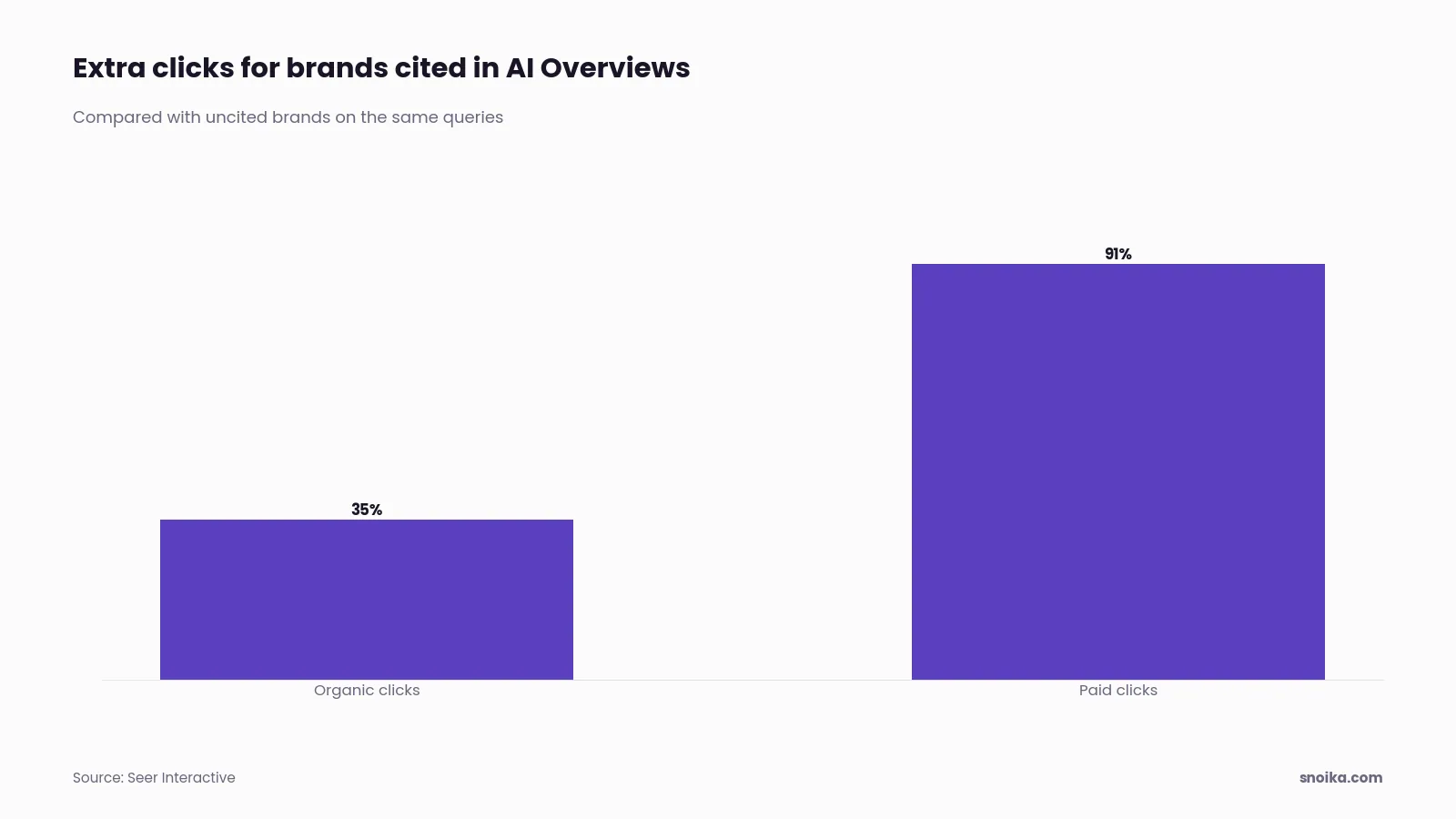
Report the result as a correlation. Seer Interactive found that brands cited in AI Overviews earned 35% more organic clicks and 91% more paid clicks than uncited brands on the same queries. Tracy McDonald, who led the study, cautioned: "We cannot definitively prove that citation causes higher CTRs." The link still holds up in practice. 3DPrinterOS reached #1 visibility in ChatGPT for industry-specific queries and turned AI search into a steady inbound lead source of 3–4 qualified inbound leads/day. Setting up these steps needs analytics access. That's why Snoika's onboarding asks for GA4 and Google Search Console access. It also asks for Google Tag Manager access for the form fields.
Revenue signals to track
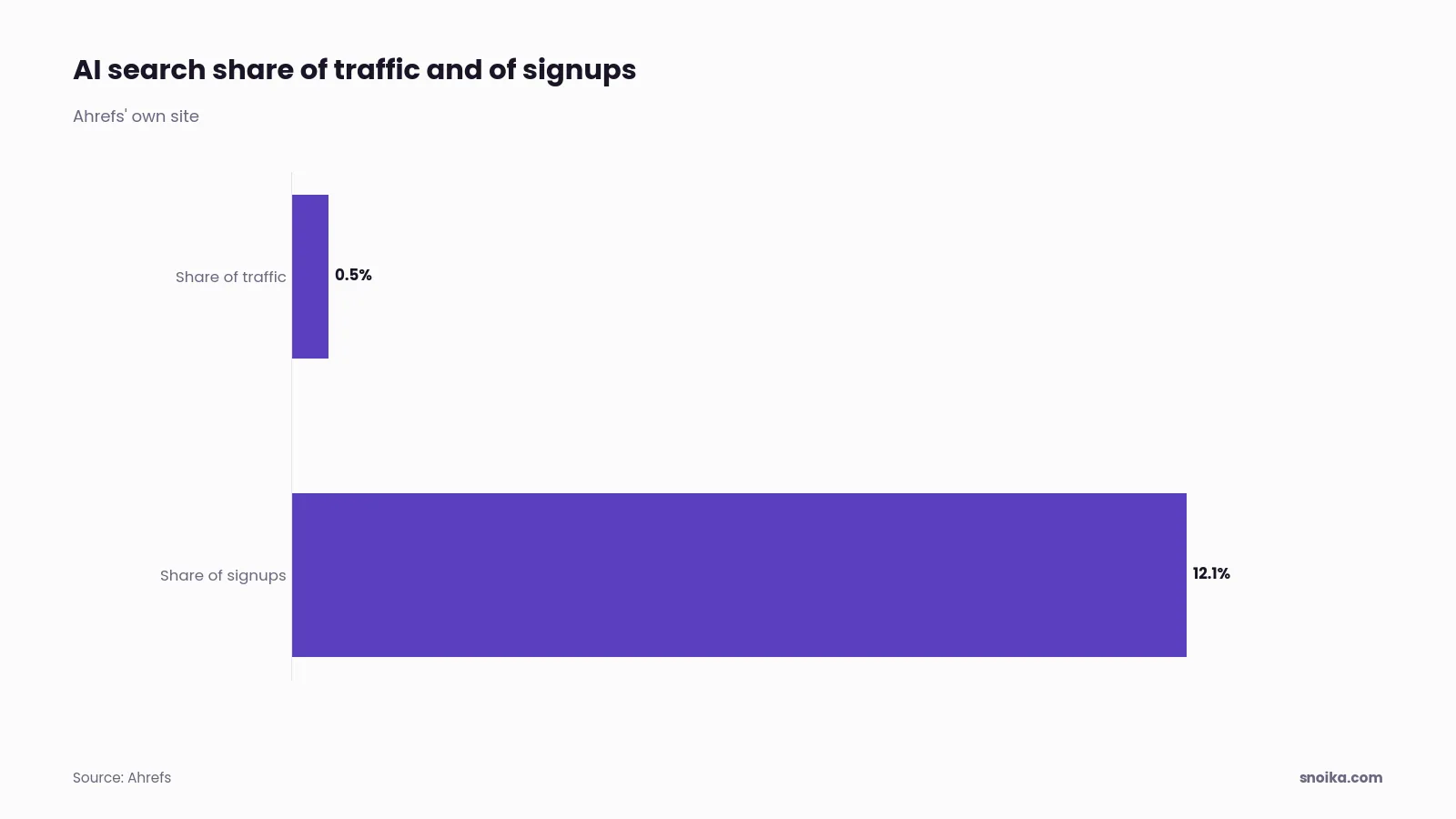
Track revenue signals that show how AI visitors differ from other traffic, because visitor counts alone understate their value. Ahrefs reported that AI search brought 0.5% of its traffic but 12.1% of its signups. Semrush found that the average AI search visitor is worth 4.4 times a traditional organic visitor, measured by conversion rate.
Track these four AI search KPIs in your revenue report.
- AI-referred conversion rate on the same pages used to measure organic and paid conversion rates, for comparison.
- Branded search volume in Google Search Console. It goes up when AI answers introduce buyers to your name.
- Win rate on AI-influenced deals, compared with your overall win rate.
- Sales cycle length for deals where the buyer arrived with a shortlist built in an AI tool.
Self-serve products can also track registrations. 3DOS reached top visibility in ChatGPT for targeted industry queries and saw 2x registered users growth. Small samples distort these ratios. Wait for a full quarter of data before you present any of them to leadership as a trend.
Benchmarks for B2B SaaS
For B2B SaaS, the benchmark that holds up is your share of voice against named competitors on the same prompt set, because no public industry average for citation rate exists yet. Published figures come from single vendors or single clients, and you can't see the prompts behind them. Your competitors face the same AI models and the same buyers, so they're a fair comparison.
Share of voice against competitors
Pick four to six competitors that appear in your lost-deal notes. Run your prompt set for all of them every week. Share of voice is your mentions divided by all brand mentions across the prompt set. Report your position and your gap to the leader for each topic cluster. A lead on "alternatives" prompts alongside a lag on pricing prompts tells you where to put your content work. Watch sentiment as well. A mention that calls your product expensive helps the competitor named next to you.
Rate of change from a baseline
The second benchmark measures how far your visibility moves from its starting point in a set period. Snoika's founder Anton Vedeshin reported to Startup Reporter 1StopVAT's move from 2.7% to 28.3% ChatGPT visibility in 16 weeks. Vespia, a fintech SaaS, recorded a 220% increase in AI brand mentions. These are results from single companies, though. The number to beat is your own AI visibility baseline, measured before the work starts.
Reporting cadence for leadership
Report four GEO KPIs to leadership every month, with AI share of voice against your top competitors alongside citation rate on buying-intent prompts. Include AI-sourced and AI-influenced pipeline in the same report. The fourth is AI-referred conversion rate. Weekly numbers are for the team doing the work. AI answers change from run to run, so a drop in a single week is noise.
Show leadership four-week rolling averages. Add one line on what changed in the content program that month. Pipeline numbers matter most in quarterly reviews, because B2B deals take months to close and monthly pipeline swings mislead.
Keep the AI visibility report to one page. Lead with share of voice and pipeline. Sentiment flags and prompt-level detail can go in an appendix for anyone who asks. Before you send it, make sure every figure uses the same prompt set and the same date range as last month's report.
Connecting GEO to forecasts
GEO feeds into forecasts through share of voice, which moves before pipeline by an interval you measure in your own data. In its 2024 prediction, Gartner said traditional search engine volume will drop 25% by 2026. Alan Antin, Vice President Analyst at Gartner, said: "Generative AI (GenAI) solutions are becoming substitute answer engines, replacing user queries that previously may have been executed in traditional search engines." A forecast built only on organic traffic misses demand that has moved to AI answers.
Start the model with conversion ratios from your attribution data that your finance team can check, such as AI-referred sessions to leads and leads to opportunities. Then measure the delay between a share-of-voice gain on a topic and the pipeline from that topic. Apply both to next quarter's expected share of voice. Since AI answers vary, present the result as a range with a low case and a high case. Keep organic search in the same model, because the same pages earn both rankings and citations.
Next steps
Fix your prompt set and record a baseline this month, before anyone asks for results. Because you can't rebuild a baseline later, every later gain will lack a point of comparison if you skip it. Add the GA4 channel group and the self-reported form field at the same time, because attribution only covers deals created after those fields exist. Choose your share-of-voice competitors now too, so your first leadership report on GEO KPIs already shows a gap and a direction.
We track brand visibility in Google and AI assistants and create the content that earns citations, with a human review layer on top of automated workflows. To set up these KPIs with your own data, talk to an AI search expert.
FAQ
Report geo kpis covering AI share of voice and buying-intent citation rate. Include AI-referred conversion rate and pipeline, separating AI-sourced from AI-influenced deals. Use four-week rolling averages in monthly reports, with pipeline reviewed quarterly because long sales cycles can make monthly changes misleading.
Compare citation rate with AI-sourced and AI-influenced pipeline by topic over two or three quarters. Capture referral sources in analytics and carry first-touch data into the CRM. Add self-reported attribution for buyers who don't click, and report any relationship as correlation rather than proof of causation.
Use AI share of voice for awareness and comparison-prompt citation rate for consideration. Measure AI-referred conversion rate at conversion, then AI-sourced and AI-influenced pipeline at revenue. Assign each tracked prompt to a stage so overall citation rates don't hide differences in buyer intent.
Compare share of voice against four to six competitors using the same weekly prompt set. Report the gap to the leader by topic, and track changes against your starting baseline. There isn't a public industry average for citation rate, so individual company results aren't reliable targets.
Treat a single weekly drop as noise rather than evidence of declining performance. Check that the prompt set and reporting window are consistent, then review four-week rolling averages. Keep the prompt set fixed for at least a quarter to preserve a comparable trend.