
SEO content writing services for AI search
When your buyers ask ChatGPT which vendors to shortlist, the answer names a few brands, and it takes them from a small set of pages. Snoika's SEO content writing services write those pages. Each one is answer-first and published on your own domain, and after publication the same team checks every week whether assistants cite it.
Trusted by





















Snoika is an all-in-one search engine optimization (SEO) platform that also supports generative engine optimization (GEO) and answer engine optimization (AEO). The usual first step is a free AI visibility report. It shows which buyer prompts name you today and which name a competitor.
Written to win AI citations
GEO content writing means writing a page that an AI assistant picks as a source, so it names your brand in the answer it writes. Classic SEO aims for a ranked position, while GEO aims for a place inside the answer. The term comes from Princeton and IIT Delhi researchers, who found that changes to the content itself boost visibility by up to 40% in AI answers. They also found that the gain varied by subject area, so the same method won't work equally well in every category.
Most of the selection happens before a model reads your body text. CXL's review of third-party data reports that ChatGPT pulls about 33 pages per query and cites about half of them, deciding on the title, URL and snippet. Snoika builds its AI content creation around how large language models (LLMs) find and pick sources, so we work on titles and snippets as carefully as on the article itself.
How answer-first structure works
Answer-first structure means every section opens with a sentence that answers its heading. The evidence follows, then the exceptions. An AI assistant lifts one passage rather than a whole page, and it can quote a passage as written when it opens with the answer, but skips it when it opens with 200 words of warm-up.
In Snoika's content, claims carry figures, and structured data tells search engines which company the page belongs to. We match each section's format to the question it answers:
- Definitions — Open with a one-sentence answer.
- Comparisons — Set the options in a table with the same attributes for each.
- Processes — Use numbered steps in the order the reader follows them.
- Pricing — Give a range with the year.
You can test any page in two minutes by reading only the first sentence of each section. If those sentences don't answer the headings, the page won't get quoted, however good the rest is.
Cluster briefs built for context
At Snoika, every brief comes from the content map. So each writer knows which buyer question the page answers and which nearby pages cover the related questions. AI models look at how well a brand covers a whole subject before they name it, and a single strong article rarely gets you there.
Clusters turn single keywords into coverage of the whole category, including the comparison questions and the objections your sales calls already hear. Without a map, briefs drift so that two pages end up answering the same question while a third goes unanswered. You see our map before the first brief, and every page in it covers a different question.
Human editing that machines miss
Snoika runs an AI content generator with a human review layer on top. The same team runs the platform and the content operations. English drafts go to in-house editors, native specialists handle other languages, and content is available in 135+ languages and regional variants. Our editors catch what automation misses:
You also approve every page yourself. Pages wait in the dashboard until you sign off, then publish automatically and go live on your own domain through a DNS connection. That works on any content management system (CMS), including WordPress, and needs no migration.
Brand mention tracking post-publish
You can tell whether AI cites your content by running your buyers' prompts every week and recording which pages each answer cites. One manual check won't tell you much, because assistants give different answers to the same prompt from one run to the next. Snoika tracks ChatGPT and Google AI Overviews, where most AI search traffic happens. The prompts come from your content map inside the app, or you add your own, and we record each week:
The number of AI platforms monitored depends on your plan, and plans are on the pricing page. Tracking starts before your first page goes live, because without a baseline nobody can show what the AI content marketing changed.
With access to Google Analytics 4 (GA4), Google Search Console and Google Tag Manager from onboarding, we match AI mentions to sessions and leads. So the results show up in pipeline as well as in visibility charts, which is what a team needs when it has to prove to its board that AI assistants name the brand.
Results clients already see
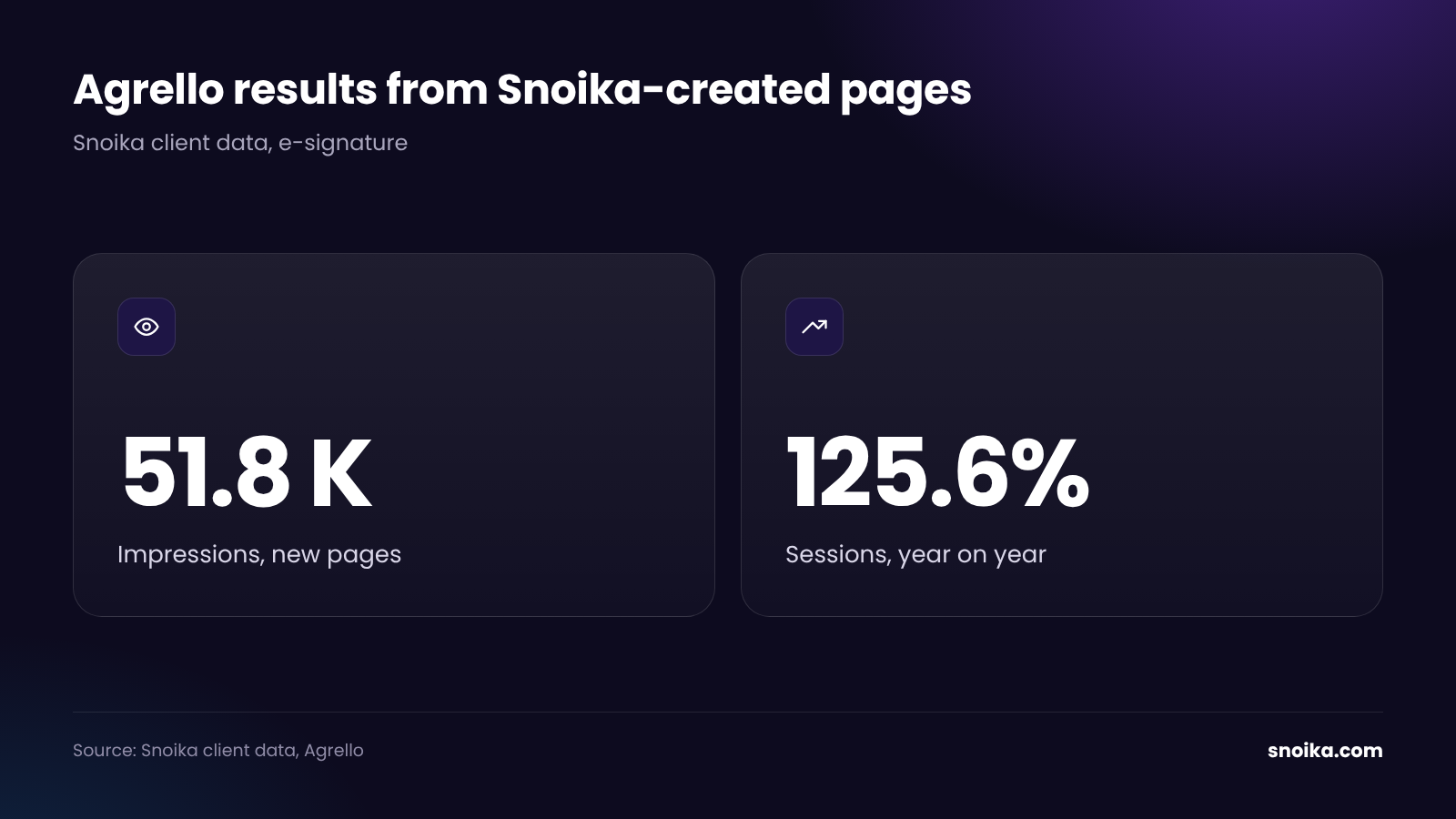
Snoika's clients report gains in both AI answers and Google search, and we quote the figures as they reported them. Snoika's Visionary Anton Vedeshin reported to Startup Reporter 1StopVAT's move from 2.7% to 28.3% ChatGPT visibility in 16 weeks. Agrello, in e-signature, saw +125.6% organic search sessions year over year and generated 51.8K impressions from Snoika-created pages. Results differ by category, so we share the case closest to your market.
Where classic SEO content fails
Classic SEO content fails when it ranks but the buyer gets their answer somewhere else. SparkToro's clickstream study found that 68.01% of Google searches ended without a click in the first four months of 2026. Your reports then fail to explain why your impressions go up while your sessions stay flat.
The usual fix of publishing more, longer posts with one keyword per page came from the days of ten blue links, and it can't identify your buyers' prompts, the competitors named in the answers or the sources the model used. Indexing still matters, because it gets you into the pool of pages a model considers, but it doesn't get you into the answer. That's why Snoika reports AI mentions and citations alongside rankings, so the gap stays visible.
Classic SEO content fails when it ranks but the buyer gets their answer somewhere else.
FAQ
Answer-first structure means each section starts with a sentence that answers its heading, followed by evidence and exceptions. Snoika writes every section this way, so AI assistants can quote a passage as written.
Snoika runs your buyers' prompts every week and records the exact pages cited in each answer. Tracking starts before publication to set a baseline, and repeated runs account for answers changing between checks.
GEO content writing means writing pages that AI assistants use as sources in the answers they generate. Classic SEO targets rankings, while GEO targets a place inside the answer, and Snoika's content is written for both.
Yes. Approved pages go live on your own domain through a DNS connection, with no migration and on any CMS. Drafts stay in the dashboard until you approve them.