
SEO agency platform for multi-brand work
Snoika gives your agency one SEO agency platform for every client brand. Each brand keeps its own competitors and prompts, along with a separate content plan and reports, while your team works from a single login. We audit sites and track visibility in Google and AI assistants, and the same team that builds the platform also runs the services, with human review on top of the automated work. The first step is a free AI visibility audit for one client brand, which needs no access to any client system and runs in about two hours, so you can judge the output before you move the others.
Trusted by

























One workspace for many brands
Snoika lets an agency run several client brands in one workspace, and each brand sits in its own project. A project holds that brand's domain and markets, and its competitors and prompts stay in the same project. So when you open Client B, nothing from Client A shows up. Your account managers switch between projects instead of juggling separate logins and exports.
Before you move your clients over, decide which account manager owns which brand project. Agencies that skip this step end up with half-configured projects and nobody responsible for them.
Reports per client
Every brand project produces its own AI visibility report, ready to send to the client as it is. The report covers one brand only, so you never have to strip another client's data out of a shared export.
When an engagement starts, we ask for access to Google Analytics 4 (GA4), Google Search Console and Google Tag Manager. With that access, the report ties AI visibility to the traffic the client already measures. A brand with years of GA4 data gives you trends from the first month, while a new site shows a baseline instead.
Separate competitor tracking
Each brand project keeps its own competitor set, so we measure a fintech client against fintech rivals and a retail client against retail rivals. We track four signals per brand in ChatGPT and Google AI Overviews:
Mentions
How often the assistant names the brand.
Share of voice
The brand's share of answers compared with each competitor.
Sentiment
Whether the answer describes the brand favorably.
Citations
Which of the brand's pages the assistant links to as a source.
Competitor data stays inside each client's project and comes out in a report you can forward, which is what a white label SEO platform has to deliver. If your contracts require your agency's branding on every export, confirm that during onboarding.
Per-brand content plans
Each client brand gets its own researched content map, and every page we create comes from that map. We create every kind of page in 135+ languages and regional variants, from product and service pages to guides and blog posts. The work follows four steps:
Map
We research the brand's category and buyers, then plan the pages it needs.
Create
Our team writes each page from the map, with human review on top of the automated drafts.
Approve
The client reviews and approves every page in the dashboard before it's published.
Publish
Pages go live on the client's own domain through a DNS connection. It works on any CMS, with no migration.
Approval timing is set per client, so a client with legal review can take a week while another can approve the same day.
AI prompt sets per brand
You give each client their own SEO prompts by building a separate prompt set inside each brand project. We write the set from the category and buyers we cover in onboarding, with the client's goals in mind, then run it every week. The prompts read like the questions a buyer would type. 1StopVAT, in tax and fintech, saw 10x growth in ChatGPT visibility in 7 weeks.
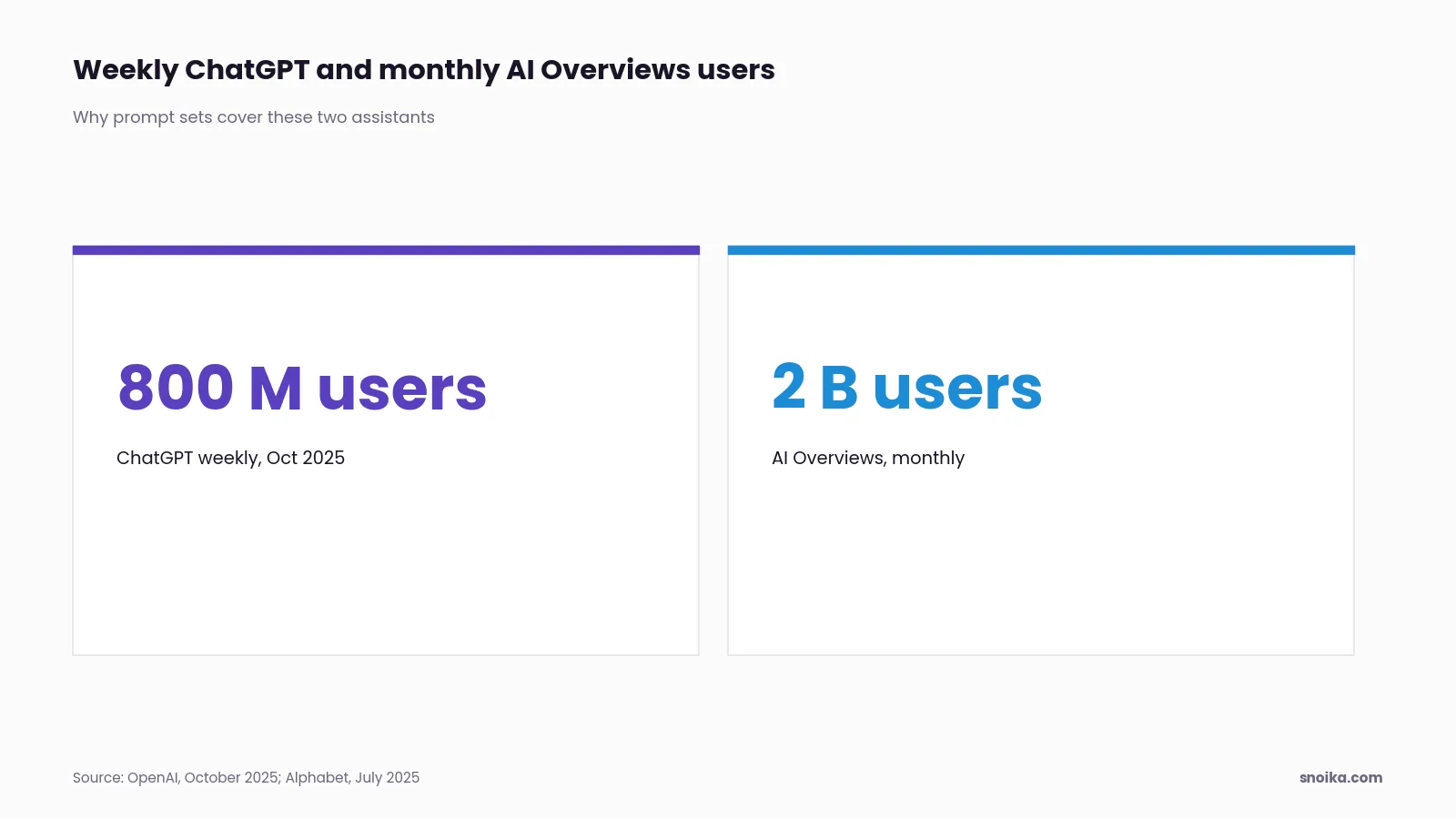
We focus on ChatGPT and Google AI Overviews because that's where most AI search traffic happens. OpenAI CEO Sam Altman said ChatGPT reached 800 million weekly users in October 2025. On Alphabet's Q2 2025 earnings call, Google CEO Sundar Pichai said AI Overviews had 2 billion monthly users. Each set covers every market the client sells in, because answers differ by market.
Our agency SEO dashboard
Our agency SEO dashboard keeps every brand's data separate and lets you act on it in the same place, because visibility numbers alone won't move a client forward. It is built around four things an agency needs:
Separate data
Each brand's figures stay inside its own project.
Client-ready reports
Reports go to clients without rework.
Google plus AI
Tracking covers AI assistants as well as Google.
Content output
The workspace creates and publishes content, not only reports on it.
A monitoring-only tool is enough if your agency only reports. If you also plan and publish content for several brands, one workspace removes the hand-offs between tools.
Scalable multi-brand architecture
Multi-brand management is part of our Enterprise plan, and adding a brand means adding a project inside the same workspace. For larger agencies, the Snoika MCP server and the Snoika API give access outside the dashboard:
AI assistants
Your team can use visibility data and content maps inside Claude, ChatGPT or Cursor, where page creation is also available.
BI dashboards
You can pull data into your BI dashboards and automate client reporting.
Content workflows
You can trigger content workflows through the same connections.
We set up access with each agency directly. Check how your reporting stack expects to receive data before you add your tenth brand.
Brand isolation without tool sprawl
Brand isolation means each client's data stays inside its own project while your team works in a single tool. With tool sprawl, your team needs one login per client and deals with figures that don't match between tools, and sooner or later a competitor name ends up pasted into the wrong client's report.
We keep the separation in the project structure, and our team checks the automated output before it reaches anyone. Because the same people run the platform and the services, a question about a report goes to the team that built it.
FAQ
Snoika runs several client brands in one workspace, with each brand in its own project. Account managers switch between clients without mixing their data, and we recommend assigning an owner to each project before setup.
In Snoika, each brand project keeps its own competitor set and produces its own client report. If your contracts require your agency's branding on every export, confirm that with us during onboarding.
A monitoring-only dashboard can suit an agency that only reports. If your agency also plans and publishes content, Snoika keeps each brand separate and handles tracking, content maps and publishing in the same workspace.
We build a separate prompt set inside each brand project, written from the client's category, buyers and goals. The prompts run every week and cover every market the client sells in.