Introduction
Advertisers constantly seek methods to increase advertising budgets and maintain campaign efficiency. Historically, advertisers increased their daily spend whenever platform dashboards reported strong return on ad spend. Today, advertisers face rising customer acquisition costs and complex privacy regulations that obscure actual performance data. Many organizations push their budgets higher because they rely on these flawed dashboard metrics, and this inevitably leads them into cash flow problems. Research shows that 70-90% of startups fail within five years, and many collapse because they scaled too quickly without solid financial foundations. Companies protect themselves from significant financial losses when they establish strict margin ceilings before they decide to scale paid media. Advertisers prevent costly mistakes and ensure sustainable business expansion when they understand the true economics behind advertising efforts.
Uncover Dashboard Deception
Advertisers struggle to understand the true economics behind advertising efforts when media buyers review Return on Ad Spend (ROAS) on digital advertising dashboards. They receive an incomplete picture of campaign performance from this gross metric. These buyers overlook critical business expenses, such as agency fees, cost of goods sold, and shipping costs, when they rely on platform-reported ROAS. Marketers scale paid media based on these incomplete gross revenue figures. Consequently, they fund campaigns that operate at a net loss.
Marketing teams cannot rely on these platform metrics to sustain paid ads growth. They miss revenue targets at 63 cents on the dollar because of the misalignment between gross and net ROAS. Advertisers need precision when they measure digital marketing ROI to bridge this departmental gap.
Marketing teams achieve this accuracy when they adopt Profit On Ad Spend (POAS). They gain accurate profitability insights from this metric because it accounts for hidden costs, such as product margins and fulfillment fees. Marketing teams either transition to profit-based tracking, or they overspend on campaigns that look successful on a digital screen but fail in the bank account.
Calculate Break-Even ROAS
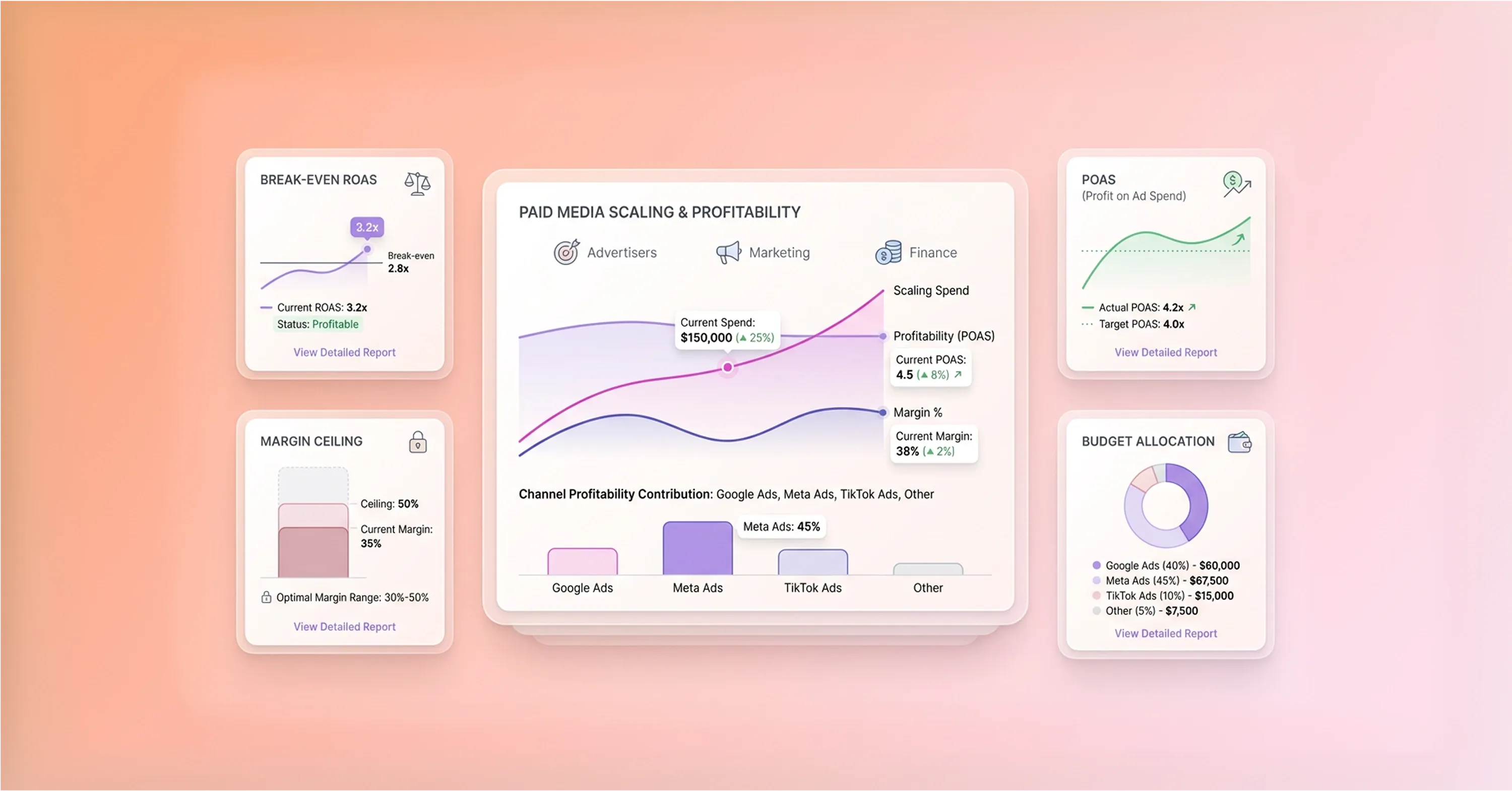
Marketing teams transition to profit-based tracking when they calculate their minimum return threshold before they increase daily advertising budgets. They prevent unproductive scaling and protect bottom-line revenue with this financial soundness. Advertisers build trust with their finance departments when they calculate the break-even ROAS. These professionals use this calculation as a core formula for profitable scaling across advertising channels.
Media buyers pay attention to associated costs to do the math. They gather financial data from their operations team to calculate the break-even point. These buyers define the following components:
-
Product manufacturing and raw material costs
-
Fulfillment, packaging, and shipping expenses
-
Payment gateway processing fees and taxes
-
Agency retainers and creative production expenses
Marketing teams determine their profit margin once they identify these costs. They use a formula that dictates break-even ROAS equals one divided by profit margin. They see a 4:1 break-even ROAS, for example, if a product carries a 25% profit margin. These teams know the campaign must generate four dollars in revenue for every dollar spent to avoid losing money. Companies lose money if they increase ad spend on campaigns that fall below this break-even threshold.
Apply Profitability Ceiling Framework to Scale Paid Media

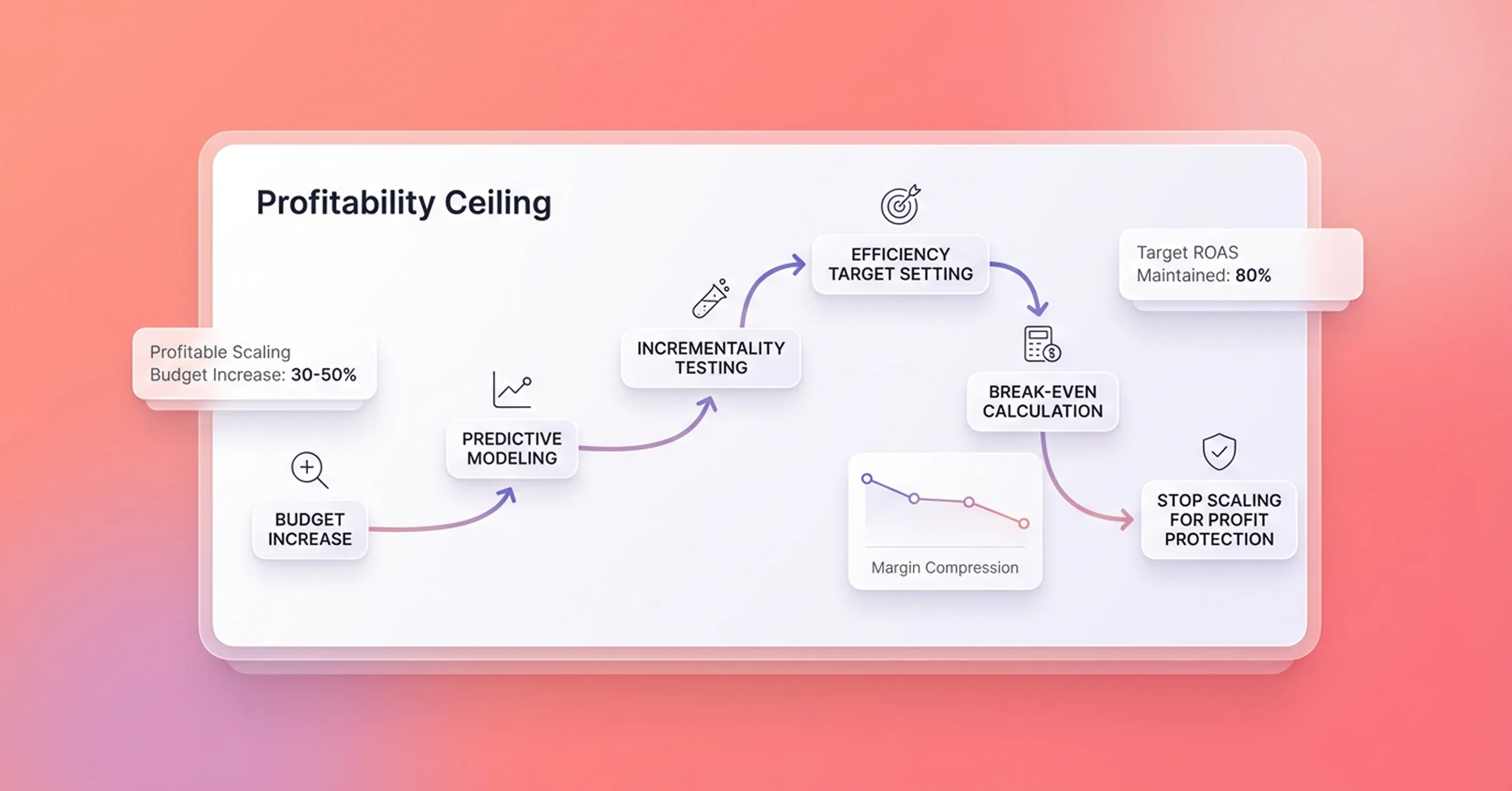
Media buyers track this break-even threshold because they notice margin compression in every advertising campaign as daily budgets increase. They use a predictive system to map out this timeline and identify the budget level where scaling reduces bottom-line profit. These buyers rely on the profitability ceiling framework to protect against overspending. Advertisers maintain better control when they establish realistic efficiency targets during scaling phases.
Companies notice that return metrics decline when they push for rapid paid ads growth. They achieve realistic and profitable scaling with a 30-50% month-over-month budget increase that maintains 80% of the current ROAS. Marketers face decreased margins if they expect returns to remain identical at higher spend levels.
Media buyers use incrementality testing to build predictive models and adjust their performance marketing strategy. They need stable traffic data and clear confidence intervals to avoid inaccurate projections with these models. These buyers use the profitability ceiling framework to calculate their maximum viable cost per acquisition beforehand. Advertisers stop increasing budgets before they eliminate the company's monthly profit because they know exactly when a campaign hits its break-even wall.
Execute Vertical and Horizontal Strategies
Advertisers push past this break-even wall and scale paid media successfully when they combine vertical budget increases with horizontal audience expansion. Advertisers establish a systematic method to expand daily ad spend and maintain campaign performance through this dual approach. Media buyers gain confidence in their decisions when they follow strict rules to maintain algorithm stability. Algorithms need time to process new budget constraints and optimize delivery toward the right users before advertisers push more money into the system.
Marketers balance aggressive growth tactics with careful performance reviews to push volume higher. Teams achieve comfort during this process and track net margins alongside daily spend changes. The combination of vertical and horizontal strategies ensures sustained profitability across all advertising channels. Vertical methods push more money into winning ad sets. Horizontal methods find new winning combinations. Together, these tactics protect the baseline return metrics and capture new market share. Media buyers prevent algorithm resets and protect the company's financial resources when they execute both approaches systematically.
Vertical Rules for Profitable Growth
Marketers execute the vertical approach and achieve profitable scaling when they increase the daily budget on active ad sets that meet performance targets. Advertisers secure financial safety when they wait for specific stability periods before they adjust spending limits. Sudden budget spikes shock the platform algorithms and force campaigns back into the learning phase. Data shows that budget increases of 15-20% every 3-5 days give algorithms enough time to adjust and do not trigger learning phase resets and performance drops. Media buyers protect their margins when they adhere to these conservative bump caps. The algorithm maintains its optimization momentum and continues to deliver ads to high-intent users. Marketers review performance metrics after each incremental bump to confirm the campaign still operates above the break-even threshold before they initiate the next increase.
Use Horizontal Expansion Tactics
Marketers supplement these vertical budget increases when they use horizontal tactics to test new audiences, formats, and creative concepts alongside existing campaigns. Advertisers drive paid ads growth through horizontal expansion because pure budget increases eventually exhaust the target audience. Creative assets degrade over time because users see the same images and videos repeatedly. Industry data indicates that creative fatigue happens quickly on platforms like TikTok, and horizontal expansion through creative variations often outperforms pure budget increases. Media buyers introduce fresh visuals and varied ad copy to maintain high engagement rates. These variations capture the attention of different user segments and improve the overall ad quality score. Marketers launch new ad sets with these fresh creatives to expand the account volume and do not overload the original winning campaigns.
Monitor Ad Cannibalization
Marketers expand the account volume safely because horizontal expansion requires strict audience exclusion protocols to prevent active campaigns from competing against each other. Marketers duplicate ad sets to manage rising costs, but this strategy often creates internal bidding wars. The advertising platform forces the company to bid against itself for impressions if multiple ad sets target the identical user pool. Research shows that ad cannibalization increases acquisition costs and fails to bring new conversions, and this inflates Cost Per Click and Cost Per Acquisition. Media buyers avoid this overlap when they implement mutually exclusive targeting across all active ad sets. They analyze audience overlap reports within the platform dashboard to identify conflicting campaigns. Advertisers pause overlapping ad sets or consolidate them into a single campaign to stabilize acquisition costs.
Manage Campaign Budget Distribution
Advertisers further stabilize acquisition costs when proper budget allocation across the marketing funnel ensures continuous performance sustainability. Advertisers support profitable scaling when they distribute funds strategically between prospecting and retargeting campaigns. Media buyers balance immediate conversion efficiency against long-term demand creation. A strategy that allocates the entire budget to bottom-of-funnel retargeting yields quick returns, but this approach quickly depletes the audience pool and stalls future growth. Marketing teams prevent this stagnation when they prioritize top-of-funnel awareness campaigns.
A structured approach helps marketers allocate funds effectively across different buyer journey stages. Experts recommend a conservative 60-30-10 budget split that directs 60% to awareness, 30% to retargeting, and 10% to hot leads. This budget distribution model introduces new users to the brand and captures existing demand. The marketing department achieves certainty in their growth projections because the awareness campaigns constantly replenish the retargeting audiences. A balanced funnel helps reduce customer acquisition cost over time because educated prospects convert more efficiently during the retargeting phase. Marketers adjust these percentages slightly based on seasonal demand, but they maintain the core equilibrium to maintain steady acquisition rates.
Fix Attribution Blind Spot
Marketers find it difficult to maintain steady acquisition rates when advertising platforms struggle to measure campaign performance accurately due to strict privacy regulations and browser cookie restrictions. Marketers fail to scale paid media efficiently when they rely on default platform tracking because it often miscredits or loses conversion data. Media buyers secure long-term paid ads growth when they transition their tracking infrastructure away from outdated models and implement server-side tracking solutions. Server-side connections transmit data directly from the company's server to the advertising platform, and this bypasses browser limitations entirely.
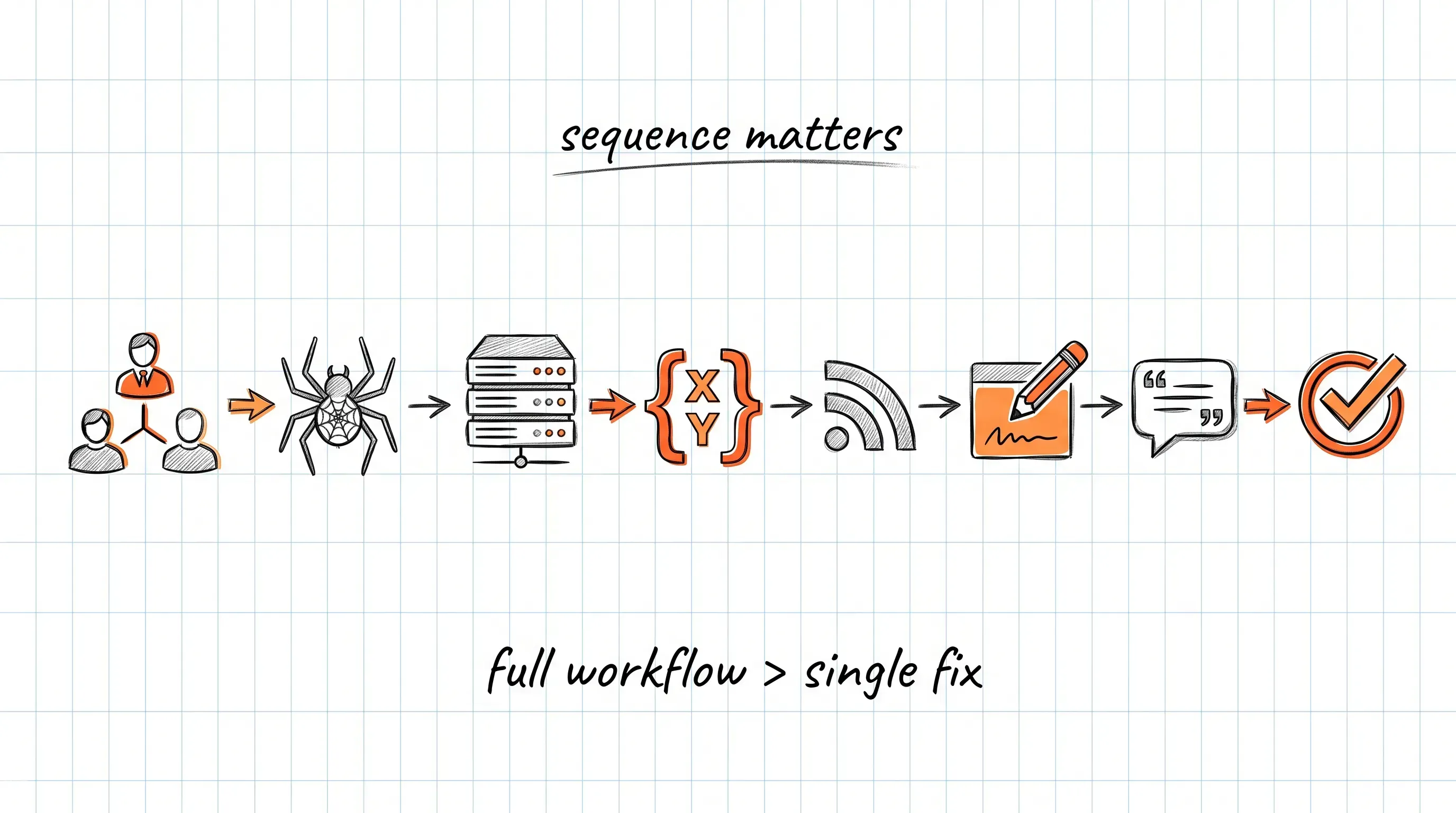
Modern measurement frameworks capture actual revenue impact rather than vanity metrics. Marketers follow three steps to modernize their attribution infrastructure:
-
Multi-touch attribution tools analyze the entire customer journey because last-touch attribution ignores earlier touchpoints and overvalues bottom-of-funnel activities.
-
Server-side tracking Application Programming Interfaces restore lost conversion signals and reduce acquisition costs by up to 33% and increase conversion rates.
-
Layered marketing attribution models compare platform-reported data against internal server metrics for accurate reporting.
These technical upgrades provide the final safeguard for continuous expansion. Media buyers evaluate campaign performance with precision because the server-side data matches the actual bank deposits. The finance department builds trust in the marketing team's reporting, and this alignment allows the company to approve higher daily budgets.
Conclusion
To summarize, companies approve higher daily budgets and achieve sustainable business expansion when they trust internal business metrics and respect structural margin ceilings. Businesses destroy profitability and create unnecessary financial risks when they blindly force budget into winning campaigns. They protect overall margins by establishing a clear break-even point and disciplined budget rules. Companies that implement strong financial frameworks navigate rising acquisition costs and maintain profitability over the long term. These companies calculate the true break-even return on ad spend and configure server-side tracking before they increase the budget to scale paid media. They also review best practices for Facebook and Instagram ads to find additional strategies for managing campaign budgets.