
AI search attribution
AI attribution means giving credit for leads and revenue to the moments when an AI assistant, such as ChatGPT or Google AI Overviews, showed your brand to a buyer. Most of those moments produce no click, so AI search attribution can't run on referrer data alone. It combines assistant referrals with what buyers say about how they found you. Branded search trends and visibility tracking fill in the rest, and together they give a defensible estimate instead of an exact count.
 Denys SuliatytskyiHead of Growth, Snoika · 11 min read

























Why last-click misses AI
Last-click attribution gives all the credit to the final touch before a conversion. In AI-influenced journeys, that final touch is a branded search or a direct visit that happened after the assistant had already made the case. The model credits the step that collected the decision while overlooking the step that shaped it.
The persuasion now happens inside the chat window. In G2's March 2026 survey of 1,076 buyers, 51% of B2B software buyers named AI chatbots as their more frequent starting point for software research compared with Google, and 69% said they picked a different vendor than planned because of chatbot guidance. After reading the shortlist, a buyer like that closes the tab and types your name into Google two days later. Last-click files the lead under "Organic Search (branded)" or "Direct."
Clicks are shrinking even inside Google. Pew Research Center tracked 68,879 searches and found users clicked a traditional result in 8% of visits with an AI summary, against 15% without one. They clicked a link inside the summary in only 1% of visits.
A B2B deal with a three-month cycle loses the AI touch completely, while an impulse ecommerce buy still passes a referral. Check Direct and branded traffic growth on pages nobody would type by hand to see the gap in your own data.
How AI search breaks attribution
AI search breaks attribution when buyers leave without a click or their clicks arrive without a label. Classic tracking assumes every visit carries a source. Assistants disrupt source tracking at four separate points.
- Answers without a web lookup. Growth Method cites a Profound analysis of 700,000 conversations showing that only about 18% of ChatGPT conversations trigger a web search. The rest come from the model's training data, so your brand can be named with no URL at all.
- Stripped referrers. Copied links and in-app browsers drop the referrer header. GA4 then files the visit under Direct.
- AI Overviews inside Organic. Google counts clicks from AI Overviews and AI Mode as ordinary organic search, so you can't separate them in standard reports.
- Unstable answers. The same prompt can return different brands from one day to the next. A single spot check gives limited information.
Tags and landing page analysis recover part of the traffic lost to stripped referrers. Answers with no link can only be measured upstream, by tracking whether and how assistants mention you. And the overlap with Organic is a reporting limit you can only estimate around, because no setting removes it.
Before you trust any AI traffic number, check which of these four gaps it covers. A dashboard that shows "AI referrals" measures only the visits that arrived with a referrer, which is the smallest and best-labeled slice of the channel.
Referral data from assistants
You can directly measure AI traffic attribution for sessions that arrive with a recognizable assistant referrer or tag. This gives you an exact floor for your AI impact. It also tells you which pages assistants send people to.
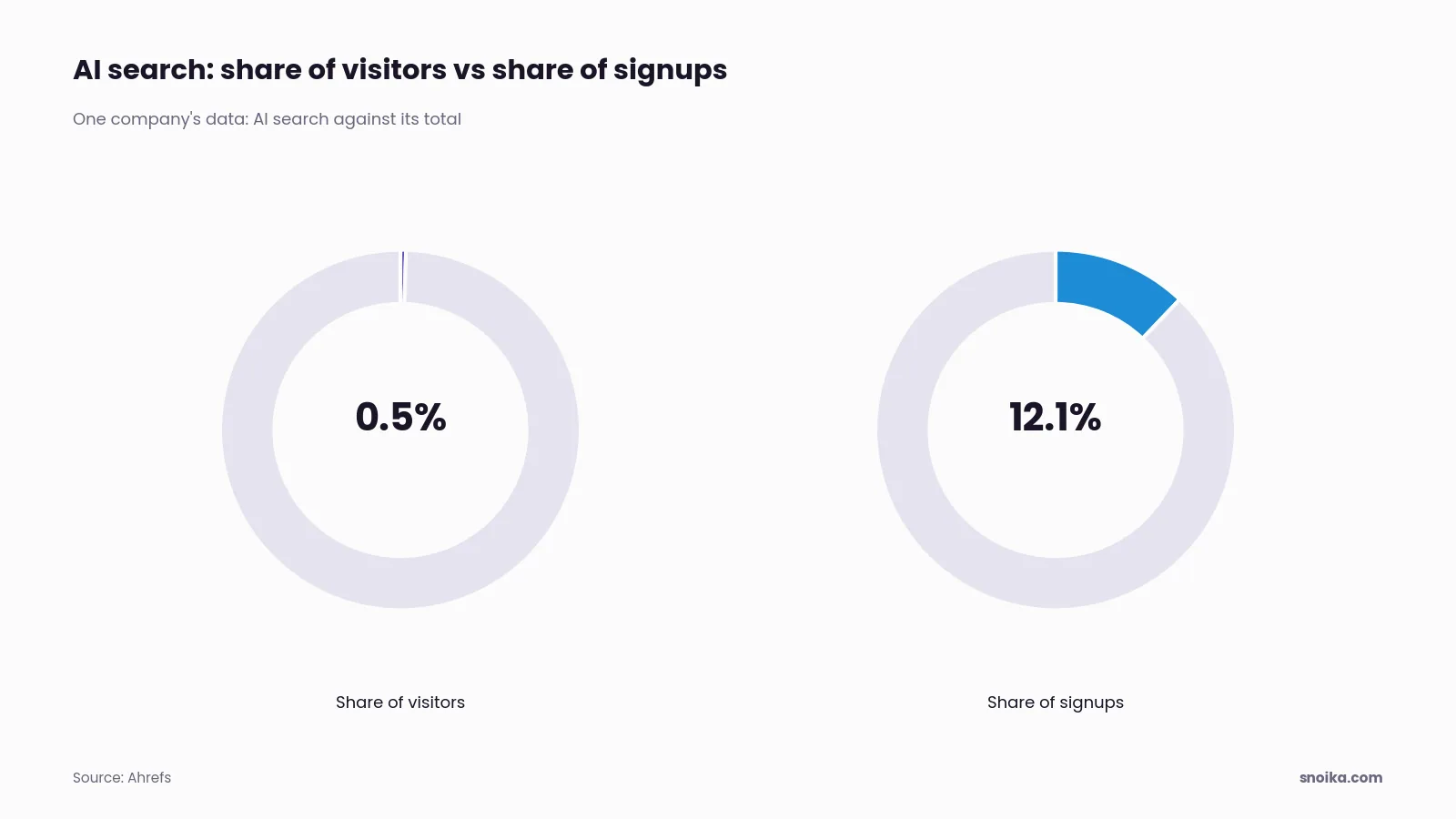
Ahrefs found that AI search brought 0.5% of its visitors but produced 12.1% of its signups, a conversion rate 23 times higher than traditional organic search. That's one company's data, and your ratio will differ. Still, it shows why a small referral line can carry real pipeline.
What GA4 now captures automatically
Google Analytics added an AI Assistant channel to its default channel group on May 13, 2026. When the referrer matches a recognized assistant such as ChatGPT or Gemini, GA4 sets the medium to "ai-assistant" without any setup. Search Engine Journal notes that Google hasn't published the full list of recognized referrers. Sessions with no referrer still fall into Direct. Before the change, the same visits sat in Referral, so treat comparisons across May 2026 with care.
What to add on top
ChatGPT appends a source tag to the links it shows. In Clickport's April 2026 sample, 35.7% of recognized AI sessions had a source tag but no referrer, so the tag recovered visits the referrer alone would have lost. Build a custom channel group or exploration that matches both the referrer and utm_source values for the assistants you care about. Then add links you control, such as those in your own profiles and directory listings, with your own UTM parameters.
Our onboarding asks for GA4 and Google Search Console access. We also ask for Google Tag Manager access because the referral layer is configured across those three places, and the other layers are read against it. Check monthly that the AI channel's landing pages match the pages you expect assistants to cite.
Self-reported attribution
Self-reported attribution asks the buyer how they found you and stores the answer as a source. It's the one method that sees an AI recommendation that produced no click. When the field works, it captures the conversation that last-click files as Direct.
Falora, which runs self-reported attribution for B2B teams, counts answers that name ChatGPT or Claude. It also counts Perplexity, and reports that these assistants made up 8 to 22% of answers across its deployments in the first half of 2026, up from zero two years earlier. These are vendor figures from its own clients, so set your own baseline before you plan around them.
An open text field ("How did you hear about us?") collects honest, messy answers like "asked ChatGPT for VAT tools." A dropdown is easier to report but nudges people toward the options you listed. If you use one, put "ChatGPT or another AI assistant" on it and keep an "Other" box. For B2B, ask again on the first sales call, since buyers remember more when a person asks.
Buyers' answers are biased toward the most recent or most memorable touch. They also say "Google" when they searched your name after an assistant suggested it. Code the open answers every month into a fixed set of categories, and read the AI share as a trend.
Branded search as signal
Branded search is the clearest trace AI exposure leaves in data you already own. Buyers who see your brand named in an assistant's answer without clicking through then search for your name. Rising branded impressions in Google Search Console, with no matching rise in ads or PR, point to demand that started somewhere you can't see.
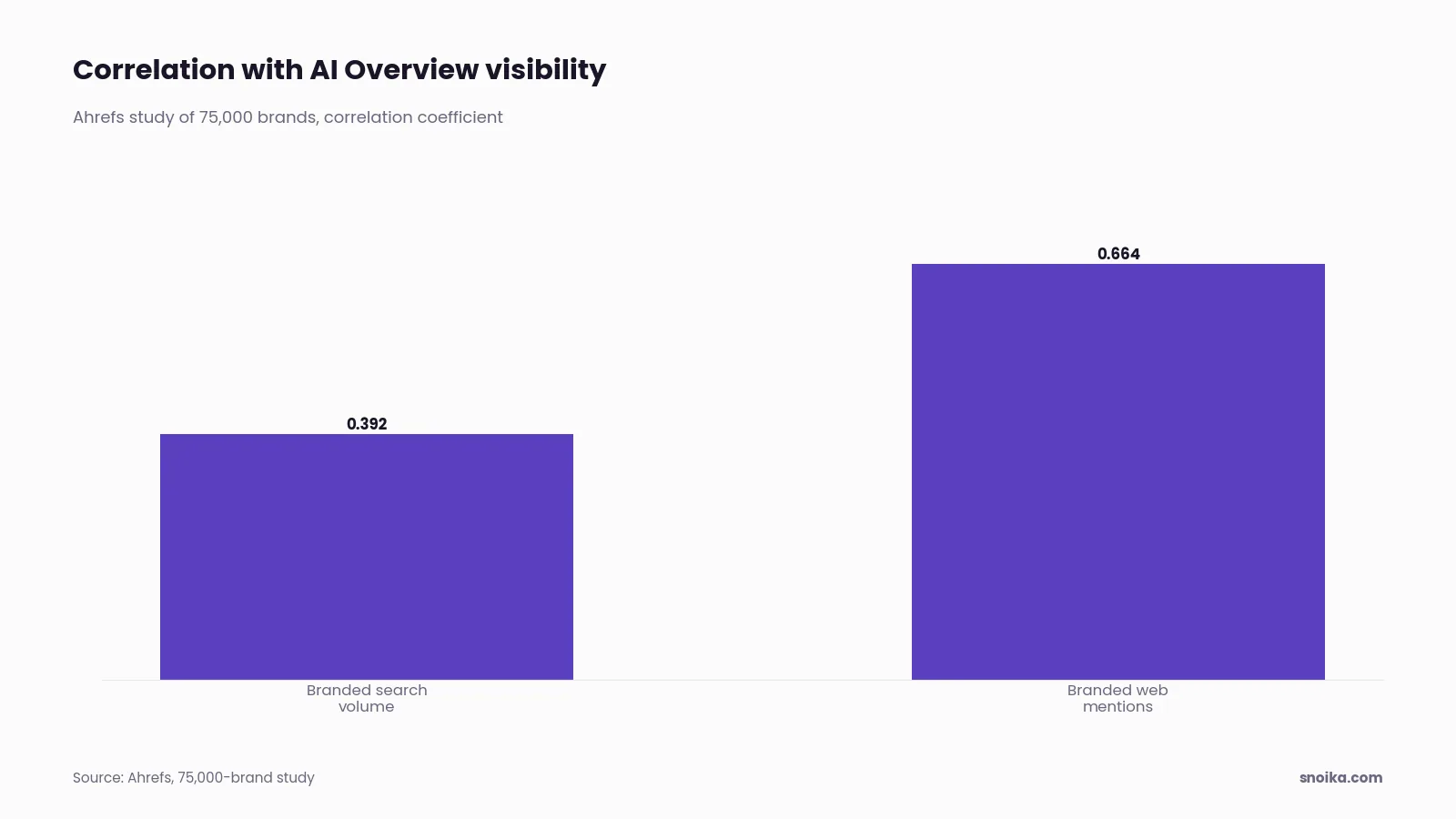
Ahrefs studied 75,000 brands and found branded search volume correlates with AI Overview visibility at 0.392. Branded web mentions correlated even more strongly, at 0.664. The correlation supports brand demand as a proxy while leaving causation an open question.
Self-reported data and branded search work best side by side, because each covers the other's weakness. Self-reported answers explain why buyers came, subject to memory bias, while branded search measures how much demand grew with the cause still unknown. Start with branded queries and compare the signals month by month.
- Filter Search Console to branded queries that cover misspellings and product names, and export monthly impressions and clicks.
- Take the monthly share of self-reported answers that name an AI assistant.
- Plot both against your AI visibility data for the same months.
- Note campaigns and launches in those months as other demand drivers. Record press coverage too, so you don't credit AI for their effect.
- Read the pattern. When visibility rises first and both signals follow within one or two months, you have a credible case for AI influence.
Seasonality and paid brand campaigns distort branded search, so compare year on year where you can. If branded impressions rise while self-reported AI answers stay flat, look for another cause before you credit assistants.
Dark traffic from LLMs
Dark traffic from large language models (LLMs) is the share of AI-driven visits that arrives with no referrer and lands in Direct. To track leads from ChatGPT with no referrer data, flag Direct sessions on deep pages and compare them with pages assistants cite. Ask the lead as well. Each clue offers partial evidence, and together they narrow the uncertainty.
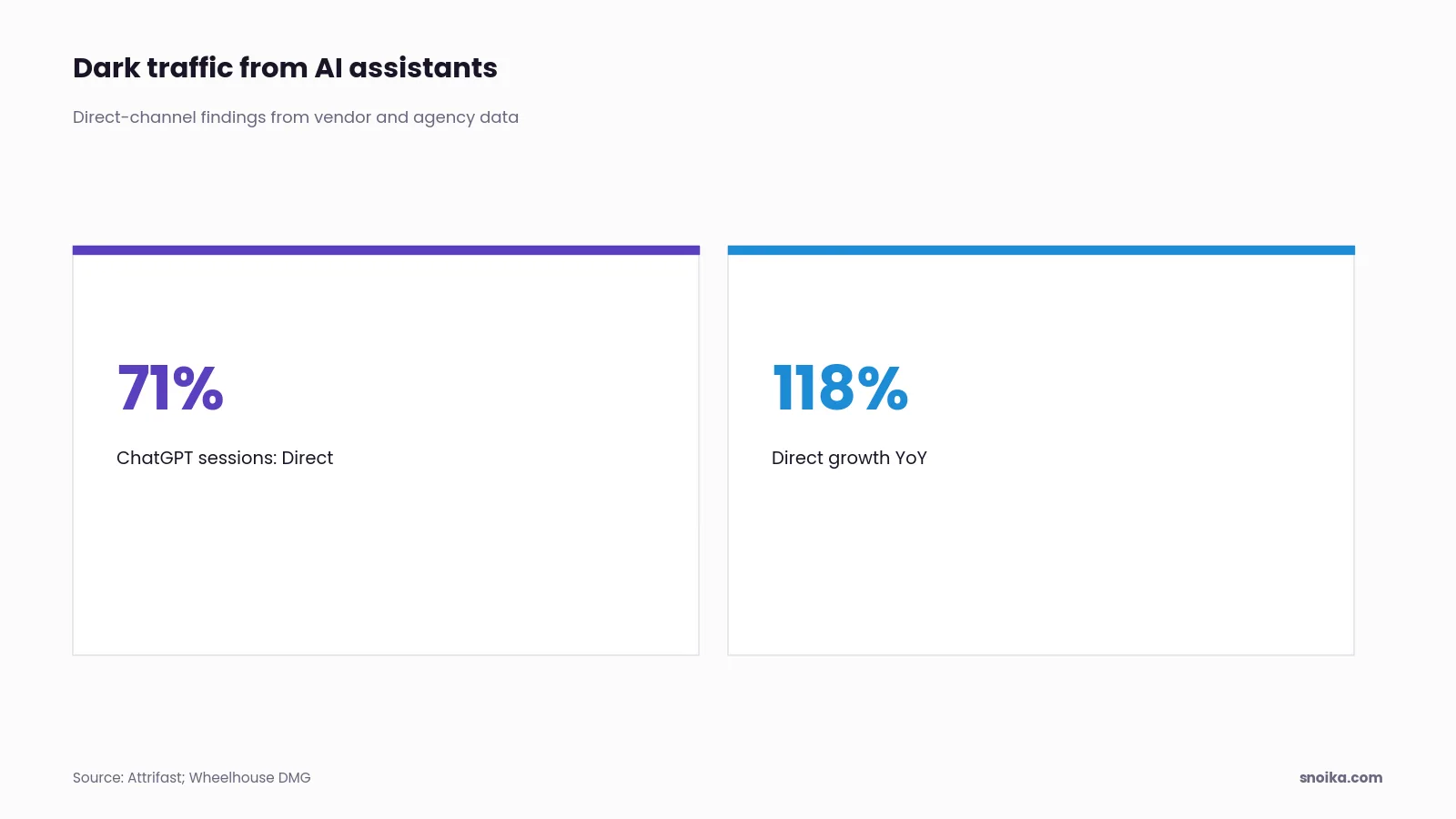
GrowthX summarizes vendor studies that put 65 to 82% of AI-referred traffic in GA4's Direct channel. One Attrifast analysis of 38 sites found a median of 71% for ChatGPT sessions. Those findings apply to the vendors' own cohorts. They suggest that most LLM attribution happens outside the referral report.
Start recovery with Direct sessions on deep pages and work toward the leads' self-reported answers.
- Segment Direct sessions by landing page and isolate long, multi-level URLs that people rarely type or bookmark.
- Compare that list with the pages assistants cite for your category prompts.
- Track year-on-year growth in Direct sessions to those cited pages. The agency Wheelhouse DMG saw Direct sessions to one client's cited content grow 118% year over year in a 90-day window.
- Test it yourself. In the assistant's mobile app, ask a question that surfaces your page. Tap the link and check your server logs to see whether a referrer arrived.
- Join the flagged sessions to form fills and read the self-reported answers for those leads.
The mix of devices and apps affects referrer loss, so mobile-heavy audiences have a higher dark share. Check that bookmarked pages like login or pricing aren't inflating your deep-page Direct count before you call it AI.
Survey-based attribution
Survey-based attribution asks a sample of customers or prospects how they research and decide, instead of asking each lead at the form. A survey captures which assistants your audience uses and at what stage. It also records whether an AI answer changed their shortlist, which goes beyond what a single field captures.
The self-reported field gives a source for each lead, while a survey covers the broader market. That survey reaches buyers who saw you in an answer and chose someone else. That second group matters, because a lost deal after a weak AI mention is a cost your CRM never records.
Run it quarterly. Send it to recent customers and to lost opportunities, and keep the questions stable so the trend means something. Ask which tools they used to research the category and whether an assistant named you. If it did, ask what it said about you. That last answer catches sentiment problems, such as an assistant repeating outdated pricing or a competitor's comparison page.
Forty responses offer directional findings with limited support for segment-level analysis. Win and loss interviews add depth where the numbers are thin. Check whether the people who answer look like your buyers, because happy customers reply more often than lost prospects.
A layered attribution model
The model that fits AI-influenced buyers is a layered one. Each signal measures what it can see, and you read the layers together instead of trusting one dashboard. Single-touch and multi-touch marketing attribution models both depend on tracked clicks, and AI journeys produce too few of them. A layered model accepts that and replaces precision with triangulation.
Amanda Natividad, VP of Marketing at SparkToro, recommends that marketers "Retire traffic-as-scoreboard" and set up a correlation dashboard. A layered model is that dashboard with a defined role for each signal.
| Layer | What it measures | Blind spot | Review cadence |
|---|---|---|---|
| AI visibility tracking | Mentions, citations, share of voice and sentiment in assistant answers | Says nothing about clicks or revenue | Weekly |
| Assistant referrals | Sessions with an AI referrer or source tag | Misses no-referrer and no-click journeys | Weekly |
| Dark traffic flags | Direct sessions on deep pages assistants cite | Estimate only, can include bookmarks | Monthly |
| Self-reported field | Source named by each lead | Memory bias, "Google" overreported | Monthly |
| Branded search | Demand for your name in Search Console | Can't name the cause | Monthly |
| Surveys and interviews | Research habits, lost deals, sentiment | Small samples, response bias | Quarterly |
AI visibility tracking
- What it measures
- Mentions, citations, share of voice and sentiment in assistant answers
- Blind spot
- Says nothing about clicks or revenue
- Review cadence
- Weekly
Assistant referrals
- What it measures
- Sessions with an AI referrer or source tag
- Blind spot
- Misses no-referrer and no-click journeys
- Review cadence
- Weekly
Dark traffic flags
- What it measures
- Direct sessions on deep pages assistants cite
- Blind spot
- Estimate only, can include bookmarks
- Review cadence
- Monthly
Self-reported field
- What it measures
- Source named by each lead
- Blind spot
- Memory bias, "Google" overreported
- Review cadence
- Monthly
Branded search
- What it measures
- Demand for your name in Search Console
- Blind spot
- Can't name the cause
- Review cadence
- Monthly
Surveys and interviews
- What it measures
- Research habits, lost deals, sentiment
- Blind spot
- Small samples, response bias
- Review cadence
- Quarterly
How to weight the layers
Give the most weight to self-reported answers and tagged referrals tied to closed deals because these layers are closest to revenue. Treat visibility and branded search as leading indicators that explain why those numbers moved. Report a range to account for the same buyer's possible appearance in four layers. Use referral-attributed pipeline as the low end and add self-reported AI leads and flagged dark sessions with deduplicated contacts for the high end.
When the layers disagree
If visibility rises and nothing downstream moves, assistants are naming you for prompts your buyers don't ask. If self-reported AI answers climb while referrals stay flat, your traffic is going dark. If branded search jumps with no visibility change, look at PR or events first. Write down which layer moved first each month. After two quarters you'll know your own lag between exposure and pipeline.
Measuring AI visibility ROI
AI visibility ROI compares the pipeline your layered model credits to AI with what you spent to earn that visibility. You can now measure visibility precisely, while revenue remains an estimate expressed as a range. Report both, and say plainly which part is measured and which is estimated.
Start with visibility, because it moves first. Our tracking measures mentions and share of voice in ChatGPT and Google AI Overviews, where most AI search traffic happens. It also measures sentiment and citations through weekly prompt sets so a single unstable answer doesn't skew the trend. Without a visibility baseline, you can't tell whether a later rise in leads followed your work or came from something else.
Compare visibility gains with downstream outcomes and the cost of your work.
- Fix a prompt set that reflects real buyer questions and record your starting share of voice.
- Record the starting values for each downstream layer in the same month.
- Total your costs for content production and tools, then add the cost of staff or agency hours.
- Each quarter, calculate pipeline at the low and high ends of your attribution range and divide by cost.
- Note the lag you observed between visibility gains and pipeline.
Snoika's founder Anton Vedeshin reported to Startup Reporter 1StopVAT's move from 2.7% to 28.3% ChatGPT visibility in 16 weeks. 3DPrinterOS achieved #1 visibility in ChatGPT for industry-specific queries and turned AI search into a steady source of 3–4 qualified inbound leads/day. The first number is a visibility metric and the second is pipeline. An ROI assessment requires both metrics.
A narrow niche with few cited sources can move in weeks, while a crowded category takes longer. Check that your prompt set still reflects how buyers ask questions each quarter, because a stale set measures a market that no longer exists.
Next steps
Add an open "How did you hear about us?" field to your main form this week, before you change anything else. Past data lets you rebuild every other layer, while self-reported answers require collection at the time. Each week without the field permanently loses a week of AI attribution. Once a month of answers is in, pull branded search and referral data for the same period and you'll have your first baseline.
Snoika tracks brand visibility in ChatGPT and Google AI Overviews and connects it to the GA4 and Search Console data you already have. Talk to an AI search expert about setting up your attribution layers.
FAQ
In AI search, ai attribution estimates how assistant recommendations contribute to leads and revenue. It combines tracked visits with buyers' reported sources, using visibility and branded search trends to assess influence that doesn't produce a click.
Check source tags first, since they can identify assistant visits even when referrers are missing. For untagged visits, compare Direct traffic to deep pages with pages assistants cite, then connect form submissions to buyers' reported sources. Treat those matches as supporting evidence rather than confirmed AI referrals.
A layered model fits because AI recommendations often leave no tracked click. Give the most weight to tagged referrals and buyers' reported sources tied to closed deals. Use visibility and branded search as supporting signals, and deduplicate contacts before reporting an attribution range.
Compare the monthly share of buyers naming AI assistants with branded search impressions for the same months. Check whether visibility gains preceded both by one or two months, accounting for campaigns and seasonality. When the signals rise together, they support AI influence without proving causation.
One month of self-reported answers provides an initial baseline when paired with referral and branded search data. Track which signals move first each month. After two quarters, you can assess your own lag between AI exposure and pipeline rather than assuming an immediate return.