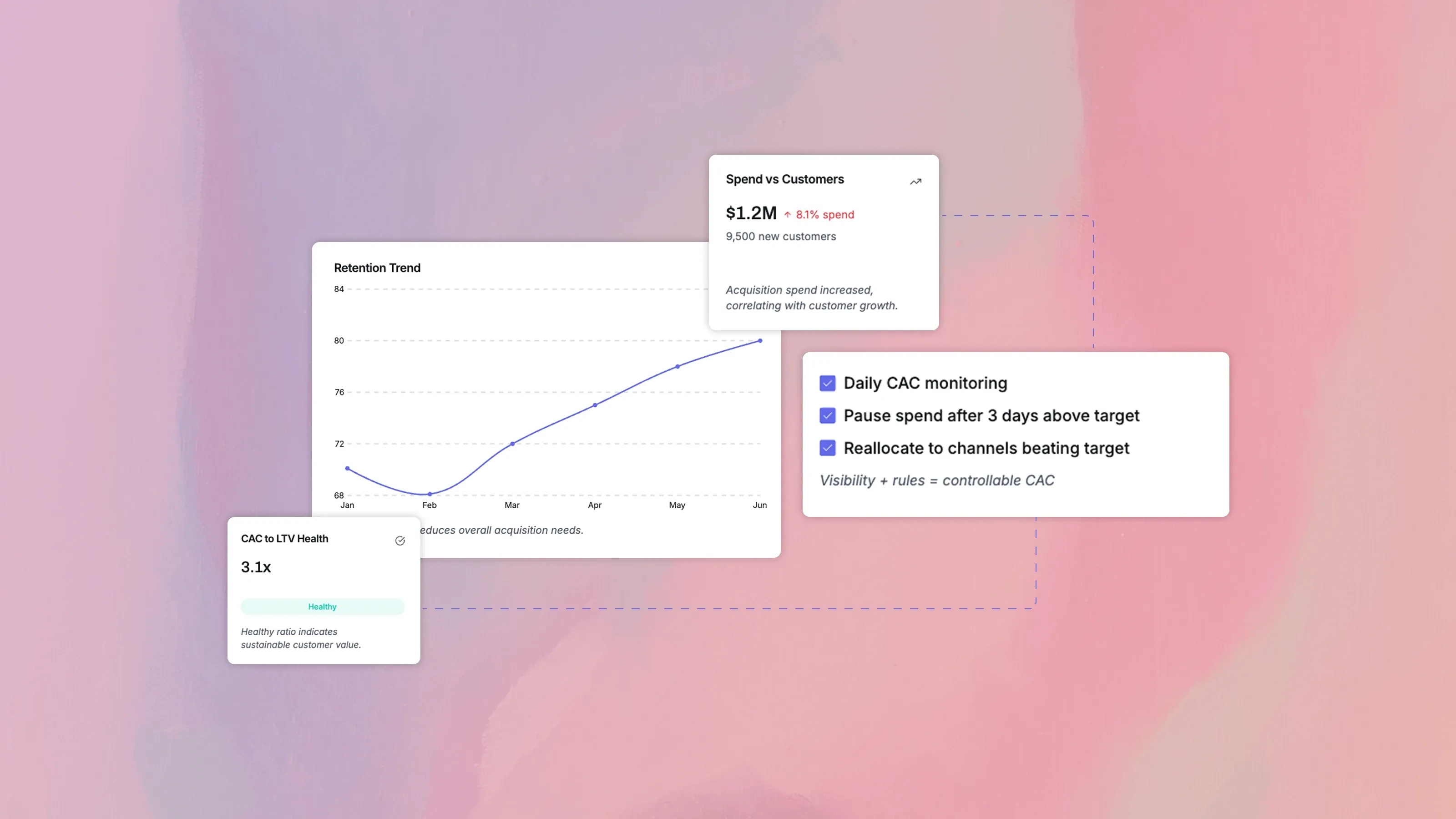
A customer acquisition dashboard visualizing CAC to LTV ratio, retention trends, spend versus customers, and budget control rules for data-driven growth optimization

How to Reduce CAC with Smarter Performance Marketing

Customer acquisition costs are rising across nearly every channel. Left unchecked, each new customer consumes a larger share of your budget, putting pressure on growth and margins. With smarter performance marketing, you can rein in acquisition costs while continuing to scale efficiently.

Content authorJevgenia Pogadajeva, MBA, MScPublished onReading time11 min read

Overview

This guide breaks down how to take control of CAC instead of merely tracking it. You’ll learn what CAC truly represents, why it tends to creep upward over time, and which practical levers consistently bring it back down. While many teams treat CAC like the weather, something to monitor but not influence, we’ll flip that mindset. We’ll start by clarifying CAC’s real business impact, move through the most common mistakes that inflate costs, and then outline proven, field-tested tactics supported by real-world examples and data. By the end, you’ll have a clear, repeatable playbook for lowering CAC without sacrificing growth velocity.

What CAC Really Means

Customer acquisition cost, or CAC, is the total sales and marketing spend needed to earn one paying customer. Think ads, salaries, software, creative, and commissions divided by new customers in the same period. A lower CAC means more cash for product, retention, or profit.

How CAC is calculated

  • Formula:

    • Total acquisition spend ÷ Number of new customers = CAC
  • Example:

    • $50,000 spend / 200 new customers = $250 CAC

Why it Matters

CAC influences far more than marketing efficiency. It directly affects cash flow, investor confidence, and where teams choose to focus their time and budget.

Here’s why CAC matters beyond the marketing team:

  • Cash runway: High CAC drains funds faster than revenue can replace.

  • Valuation signal: Investors favor efficient growth, not growth at any cost.

  • Resource focus: Clear CAC highlights channels and audiences worth doubling down on.

Keeping this metric healthy is non-negotiable if you want sustainable scale. By the end of this section, remember this: CAC isn’t just a number on a dashboard. It’s a real-time pulse check on whether your marketing engine is generating value, or quietly draining it.

Common Customer Acquisition Cost Mistakes

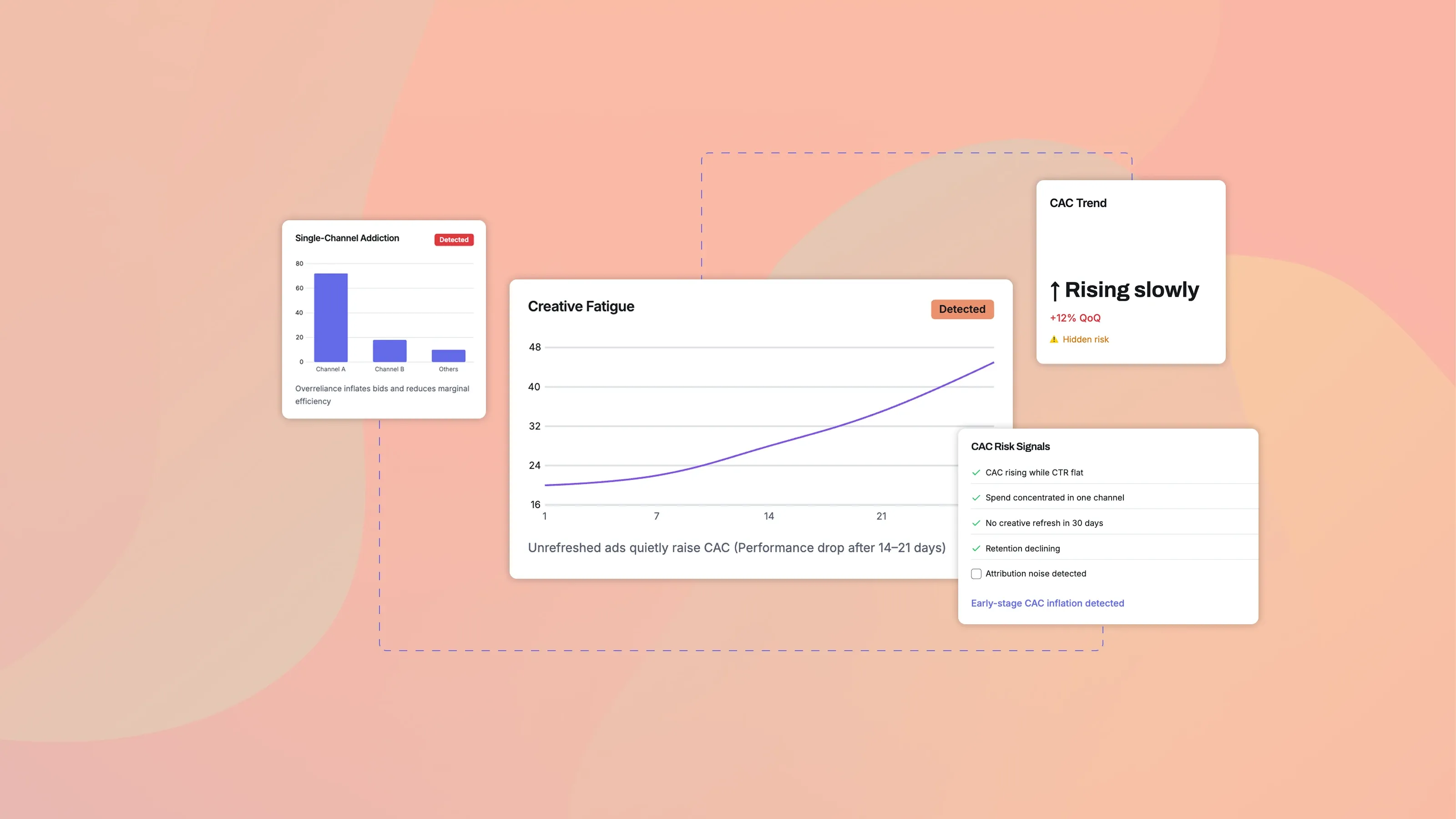
A marketing analytics dashboard detecting creative fatigue, rising CAC trends, single-channel spend risk, and early warning signals that indicate increasing customer acquisition costs

Many teams see customer acquisition costs climbing and assume it’s simply the price of growth. In reality, CAC usually rises because of a handful of repeatable mistakes—not external forces alone. When these issues go unchecked, costs creep up quietly while performance appears “stable” on the surface.

Below are the most common culprits:

  • Single-channel addiction: Relying on one paid channel until bids skyrocket.

  • Blurry attribution: Counting assisted conversions twice, which hides waste.

  • Ignoring retention: Chasing new logos while churn erodes lifetime value.

  • Overlooking creative fatigue: Running the same ad set long after audiences tune out.

  • Manual bidding: Letting gut feeling trump data signals.

Individually, each of these issues nudges CAC upward. Together, they compound, hiding inefficiencies and blocking meaningful improvement. Spotting them early is half the battle. Once the mistakes are clear, the path to lower CAC becomes far more obvious, and we can move from diagnosis to execution.

Optimization Tactics to Reduce CAC

Reducing CAC isn’t about slashing budgets or pulling back on growth. It’s about making every dollar work harder. McKinsey research shows that top-performing growth teams often spend the same or more than peers, but allocate budget far more efficiently. While tactics vary by channel, the principles below consistently lower acquisition costs across industries.

1. Tighten Audience Targeting

Broad targeting often masquerades as scale, but in practice it burns budget on users who were never likely to convert. Efficiency starts with relevance. Brands that prioritize first-party data report up to 25% lower CPA and significantly higher ROI compared to campaigns relying on third-party targeting.

Start with first-party data. CRM lists, product usage signals, and email engagement provide direct insight into who already shows buying intent. These audiences consistently outperform cold traffic.

Next, layer intent signals such as high-value search terms, on-site behavior, and relevant contextual placements. This ensures ads appear when users are already primed to act.

Finally, exclude low-value segments - churned users, repeat converters, or unqualified leads that inflate costs without contributing revenue.

The goal is simple: show ads only to people who can, and are likely to, buy. When reach is intentional, waste drops and CAC follows

2. Automate Bidding with AI

Manual bid adjustments simply can’t keep up with modern ad auctions. Prices shift by the second, intent signals change constantly, and reacting by hand almost always means reacting too late. This is where machine learning earns its place. When used correctly, automated bidding adapts faster than any human team, and often drives lower CAC in the process. A 2025 industry survey found AI-driven bidding strategies can reduce acquisition costs by up to 50%.

The key is to give algorithms the right objectives and inputs, then manage the system strategically instead of micromanaging it.

In practice, this means doing three things well:

  • Set clear target CPA or ROAS goals inside the ad platform so the algorithm knows exactly what efficiency looks like for your business. Vague goals produce vague results.

  • Feed quality conversion signals, not just volume. Optimize toward revenue, qualified leads, or downstream actions - not raw form fills that inflate numbers but dilute value.

  • Review performance weekly and adjust constraints, not individual keywords. Fine-tune targets, budgets, and caps while letting the system handle real-time bidding decisions.

When humans define the strategy and machines handle execution speed, bidding becomes more efficient, more consistent, and far less reactive. That shift alone can unlock meaningful CAC reductions at scale.

A 2025 survey shows AI can lower acquisition costs by up to 50 %, freeing dollars for creative testing. For a comprehensive blueprint on incorporating AI into your campaigns, see AI-Powered Marketing: How to Use Artificial Intelligence for Better Results.

3. Refresh Creative Often

Ad fatigue sets in faster than most teams expect, often within a few weeks. WordStream data shows ad engagement drops sharply after 2–4 weeks without creative refresh, leading to higher CPM and CPA. When audiences see the same message repeatedly, engagement drops, costs rise, and CAC quietly climbs. The fix isn’t more spend; it’s proactive creative rotation that stays ahead of performance decay.

To keep ads effective over time, focus on three core creative habits:

  • Refresh visuals every 2–4 weeks to prevent banner blindness and keep ads feeling new. Even small changes can reset attention.

  • Test copy hooks that mirror real customer pain points, not generic benefits. Language that sounds like your customer consistently outperforms polished but abstract messaging.

  • Repurpose user-generated content and customer proof to add authenticity. Real voices cut through skepticism and often convert at a lower cost.

Creative momentum is a force multiplier. To supercharge your content output and creative variety, learn the workflow in How to Master AI content creation in 7 Simple Steps.

4. Shorten the Conversion Path

Every extra step in the conversion path creates friction, and friction leaks revenue. Baymard Institute research shows over 17% of cart abandonments are caused by unnecessary friction in the checkout process. The longer it takes a user to act, the more likely they are to drop off, driving CAC higher with every unnecessary click.

To reduce friction and capture intent while it’s hottest, focus on the following:

  • Use single-page checkouts or direct calendar booking links to shorten the path from interest to action.

  • Pre-fill forms with known data to eliminate repetitive effort and speed up completion.

  • Offer instant demos or self-serve trials so high-intent users can move forward without waiting.

The rule is simple: fewer clicks mean fewer drop-offs, and cheaper customers.

5. Align Offers with Buyer Stage

A cold prospect doesn’t need a hard sell - they need the right next step. Pushing a purchase too early creates resistance, while relevant offers move buyers forward naturally and efficiently.

To align offers with intent, structure your funnel deliberately:

  • Map each funnel stage - awareness, consideration, and decision, so you know what mindset the buyer is in.

  • Match assets to each stage, from blog articles and guides at the top to webinars, demos, and pricing calls closer to conversion.

  • Retarget users based on stage progression, advancing the message as intent increases instead of repeating the same ask.

When offers meet buyers where they are, conversion rates rise and CAC steadily falls.

6. Boost Retention to Offset CAC

High retention gives you leverage. Harvard Business Review reports that increasing retention by just 5% can raise profits by 25–95%. When customers stick around longer, you can afford to spend more to acquire better customers, and still remain profitable. Retention turns CAC from a constraint into a strategic advantage.

To strengthen retention and compound its impact, focus on three proven levers:

  • Launch loyalty or rewards programs that give customers a reason to stay engaged beyond the first purchase.

  • Offer proactive support and onboarding to solve problems early and reduce preventable churn.

  • Upsell and expand with satisfied users, increasing lifetime value without restarting the acquisition cycle.

The impact is meaningful. Sometimes the cheapest new customer is the one you never lose.

7. Measure, Then Multiply What Works

CAC only becomes useful when it’s visible at the right level of detail. Tracking a single blended number hides problems and delays action. To keep costs under control, CAC must be monitored by channel, campaign, and cohort.

To turn CAC tracking into a decision system, focus on the following:

  • Build dashboards that update daily so shifts in performance are caught early, not weeks later.

  • Pause or throttle spend that exceeds target CAC for three consecutive days, preventing small inefficiencies from turning into major losses.

  • Reallocate budget toward channels and campaigns beating target CAC, doubling down where efficiency is proven.

When CAC is tracked this way, optimization becomes proactive instead of reactive—and budget naturally flows to what works best. For actionable guidance on building metrics-driven feedback loops and dashboards, consult The Role of Data in Modern Performance Marketing.

Case Studies: Marketing Efficiency in Action

Real firms prove the theory.

SaaS Startup Embraces Content and AI

A mid-market SaaS firm relied on paid search where bids had doubled in a year. They introduced educational content optimized for AI search tools like ChatGPT. Using Snoika, an AI marketing platform that maps brand mentions in AI answers, they published 25 razor-focused articles. Organic leads rose 35 % in three months, while paid spend stayed flat. Net result: CAC dropped from $410 to $275.

For more case studies showing how analytics and AI drive measurable growth, read the SaaS and retail stories in The Role of Data in Modern Performance Marketing.

Retailer Uses Retention to Fund Growth

An e-commerce retailer saw repeat purchase rates sag. They built a post-purchase email flow with personalized product picks and a points program. Churn shrank 18 % and average order value climbed. Freed budget went back into prospecting ads, driving a 22 % reduction in customer acquisition cost within two quarters.

Both stories show different routes to the same goal: smarter processes, cheaper customers. For a broad strategic framework to scale your own performance program, see How to Build a Performance Marketing Strategy That Scales.

How Can You Reduce Customer Acquisition Cost (CAC)?

To reduce CAC, focus on two levers: raise conversion rate and lower spend wasted on poor-fit audiences. Sharpen targeting with first-party data, automate bids with AI, refresh creative, shorten the path to purchase, align offers to buyer stage, invest in retention, and reallocate budget using real-time CAC dashboards. This blend often trims acquisition costs by 30-50 % while sustaining growth.

Conclusion

Rising acquisition costs are not fate. They signal that it is time to refine audiences, lean on automation, refresh creative, smooth the buyer journey, and care for existing customers. Data shows firms that act shrink CAC by double-digit percentages and free cash for further growth. Use the tactics above, watch the numbers daily, and for an industry-tested roadmap, explore How to Build a Performance Marketing Strategy That Scales. Your marketing engine will run leaner, last longer, and drive sustainable returns.

There is no single dollar figure for all businesses. A good CAC keeps your customer lifetime value (LTV) at least three times higher than the cost to acquire that customer. Track the ratio, not only the raw number.

Monthly is standard for stable businesses, but high-growth startups should check weekly so they can act before spend balloons. Always pair CAC with channel breakdowns.

Yes. Strong brand awareness improves click-through and conversion rates across channels. Over time, direct traffic and organic search rise, reducing paid dependency and cutting CAC.

No. AI automates bidding and surfaces insights, but humans still craft strategy, creative angles, and customer empathy. The best results come from a mix of human judgment and machine speed.

By treating CAC as a controlled metric, not a retrospective one. Set target CAC ranges by channel, monitor trends rather than snapshots, and intervene early when efficiency slips. Regular creative refreshes, landing page optimization, and spend reallocation help prevent slow creep and keep acquisition costs predictable.

Schedule a Meeting

Book a time that works best for you

You Might Also Like

Discover more insights and articles

A product feed quality dashboard displays an 88% feed quality score with attribute completeness, policy compliance, identifier accuracy, and shopping ads performance funnel metrics

Product Feed Optimization for Ecommerce Performance

Many online retailers face a frustrating reality where they have excellent inventory, but their shopping ads fail to generate clicks. The issue often lies not in the product itself, but in how the product data is communicated to search engines and marketplaces. Without clear, structured data, algorithms cannot match your items with the customers looking for them.

An affiliate marketing analytics dashboard displays a click-to-commission funnel, conversion distribution, and revenue by channel charts

Affiliate Marketing Explained: A Performance Channel Breakdown

Affiliate marketing keeps growing, yet many teams still wonder how it really fits into a modern performance mix. How does the money flow, who gets paid, and when is the channel worth the effort? That is exactly what we will unpack here.

An AI-powered marketing dashboard visualizes campaign structure, conversion performance, and account health score to optimize digital advertising efficiency

Facebook & Instagram Ads: Best Practices for 2026

Social media advertising keeps getting pricier and more crowded, yet the brands that refine structure, creative, and targeting continue to scale profitably. What will separate winners and also-ran campaigns in 2025?

A marketing analytics dashboard showing ad schedule performance heatmap, revenue and CPA trends, task completion status, and reporting checklist insights

Google Ads Optimization Checklist for Better ROI

Google Ads can be a revenue machine or a money pit. The difference lies in how you tune each lever, from campaign structure to copy. Use this checklist to cut waste, raise conversion rates, and prove that every dollar spent pulls its weight.

A2025 survey showsbusinesses already earn$2 for every $1invested in Google Ads. With tight optimization, that return can be much higher for you.