What You’ll Learn
This guide breaks down the three pillars that matter most on Facebook and Instagram in 2026:
-
Campaign structure: how to organise objectives, budgets, and ad sets to speed up learning and avoid wasted spend
-
Creative approaches: the formats, hooks, and placements that stop thumbs, hold attention, and earn clicks
-
Audience targeting: practical ways to reach the right people while keeping acquisition costs predictable. Learn how to optimize campaign structure, creative, and targeting for success.
Each section is grounded in real-world performance data, supported by mini case studies and quick checklists you can apply immediately. By the end, you’ll be able to audit your own account with confidence, identify weak spots, and tighten execution before competitors catch up.
What Actually Works in Facebook and Instagram Ads in 2026
Social media advertising on Facebook and Instagram in 2026 hinges on three core levers: a simplified campaign structure built around one clear objective per campaign, mobile-first creative designed for fast consumption and refreshed every 7–10 days, and layered targeting that combines high-quality first-party data with broad, AI-driven expansion. Meta’s own delivery guidance confirms that cleaner objective signals and fewer ad sets shorten learning phases and improve budget efficiency.
Individually, each lever improves performance. Together, they create a system that feeds cleaner signals into the algorithm, shortens learning cycles, and reduces wasted spend. When structure, creative, and targeting are aligned, brands can scale budgets confidently, without sacrificing efficiency or return on ad spend.
Campaign Structure That Wins in 2026

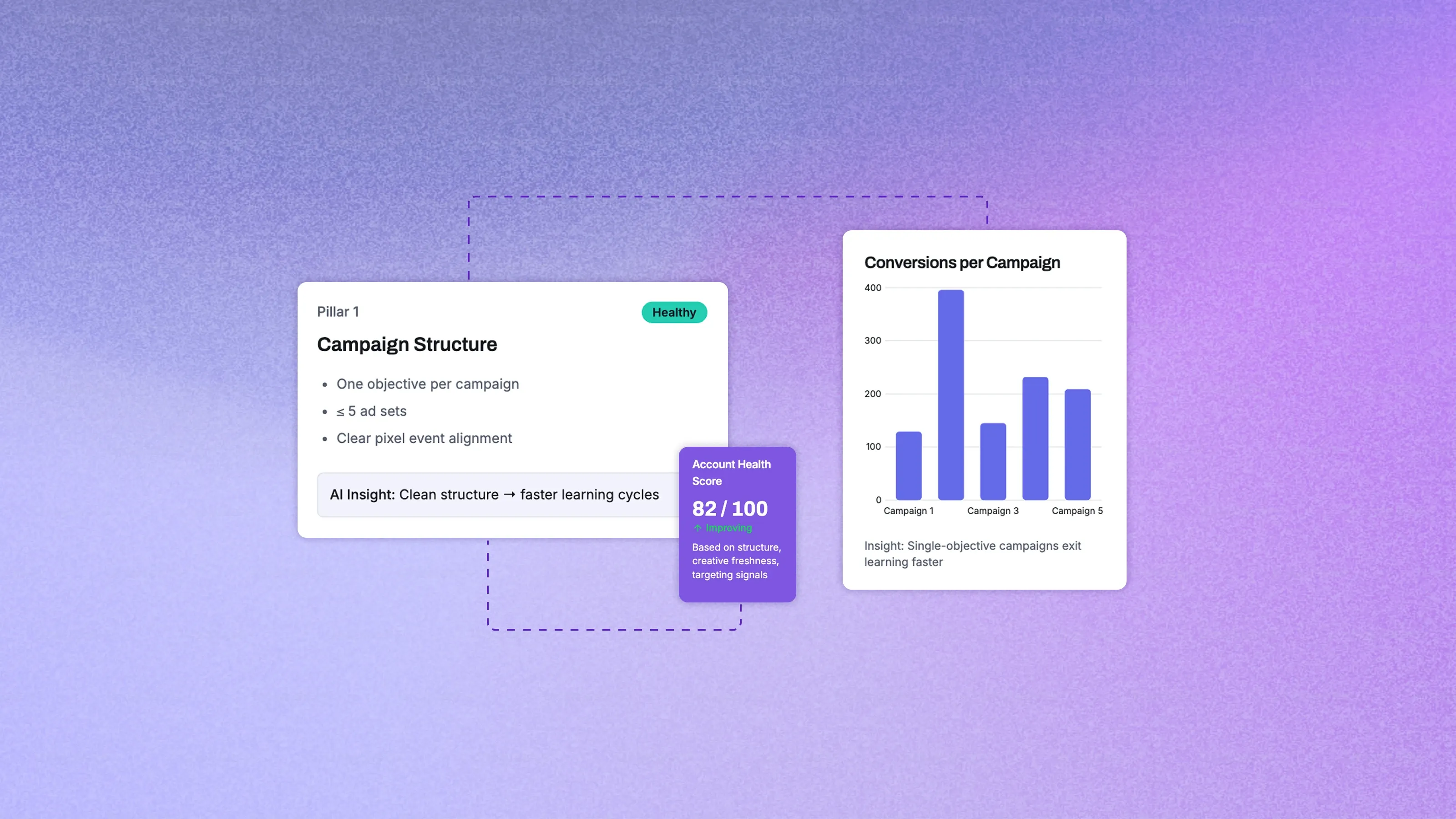
A tidy account structure lets Meta’s AI learning phase gather data quickly. Start with a clear goal and let everything else flow from that decision.
Keep one objective per campaign
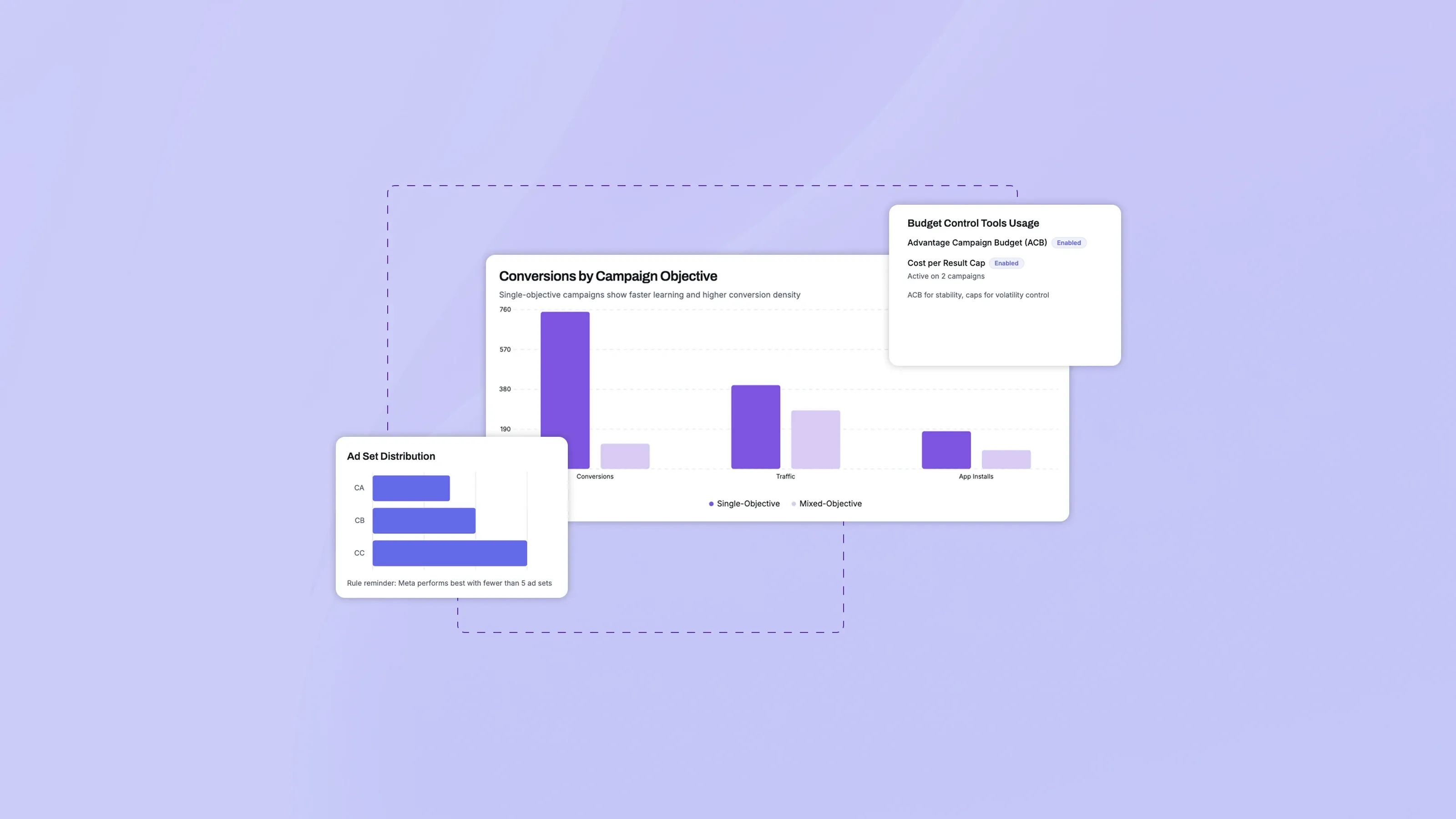
Running conversion, traffic, and video-view ads in the same campaign muddies optimisation signals and slows learning. Meta performs best when each campaign is built around a single, clear goal.
Instead, choose a single objective:
This clarity helps the algorithm learn faster, allocate spend more efficiently, and drive more predictable results.
Case Study: Structure Simplification
Instead of mixing objectives, many DTC brands have seen performance lift after restructuring campaigns around a single optimisation event. Multiple Meta case studies and agency benchmarks report CPA reductions of 10–30% after separating traffic and conversion campaigns.
Limit ad sets, but test budgets
Meta recommends fewer than five ad sets per campaign.
That rule still holds, yet 2026 brings two wrinkles:
Used together, these tools keep campaigns lean while protecting performance.
Before hitting launch, a quick pre-flight check helps avoid stalled learning and wasted spend.
Checklist before you launch:
-
Set daily or lifetime budgets large enough to exit learning in 50 conversions.
-
Use one pixel event per campaign.
-
Pause any ad set that stays in learning limited for seven days.
A slim, objective-focused structure feeds clearer data to Meta’s AI, speeding up optimization and preparing us for standout creatives. For a systemized approach to scaling campaigns and optimizing budgets, see How to Build a Performance Marketing Strategy That Scales.
Creative Approaches That Convert
Even the tidiest structure fails if ads are dull. Here are the Facebook Ads tips that matter most visually.
Build for sound-off, swipe-fast feeds
People scroll faster every year, which means attention is earned; not given. Your ad has only a split second to stop the thumb.
Here's what you can do:
-
Lead with motion in the first 1–2 seconds
-
Show product or benefit instantly
-
Use captions or on-screen text since 80 % watch without sound
Ads that communicate instantly don’t just get seen, they get remembered and clicked.
Rotate creative every 7–10 days
Ad fatigue hits sooner as platforms prioritise fresh content.
The most effective response is to systemise creative production from the start:
-
Pre-build batches as three square videos, three vertical reels, three static images
-
Label by theme (problem, social proof, offer) for faster analysis
-
Archive winning ads and bring them back during promos
Scaling your creative process and keeping ads fresh can be achieved with modular production and regularly scheduled reviews—explore expert workflow tips in How to Master AI content creation in 7 Simple Steps.
Let platforms auto-adjust placements
In 2026, effective Instagram Ads strategy relies on bundled placements across Feed, Stories, Reels, and Explore rather than manual segmentation. Meta’s delivery system performs best when it can dynamically route spend to the placements generating the strongest engagement at any given moment.
To support this, use Adaptive Creative and design vertical-first assets that can scale, crop, or extend cleanly across formats. Avoid over-optimising for a single placement; instead, prioritise clarity, motion, and legibility that hold up in multiple contexts.
Winning creative in 2026 is flexible by design - short, varied assets that invite engagement wherever the algorithm finds attention.
Audience Targeting Tips for High ROAS
Privacy shifts removed many third-party signals, but precise targeting is still possible.
Combine first-party data with broad expansion
Upload your CRM list and enable Advantage+ Audience Expansion. Meta uses this seed data to model high-intent users while still exploring new pockets of demand.
In practice, that means:
-
Seed size sweet spot: 10k–100k emails
-
Refresh lists monthly to keep signals accurate
-
Exclude converters when running top-funnel campaigns
When set up correctly, this hybrid approach guides the algorithm without limiting it - driving both efficiency and scalable growth.
Lean into interest themes, not single interests
Instead of narrow interests like “running,” group broader themes such as “fitness,” “health,” or “sportswear.” Meta’s AI performs best when it has room to explore.
Quick segmentation model:
-
Warm: website visitors, engagers, customer list
-
Cool: look-alikes of customers, high-intent video viewers
-
Cold: broad interest clusters or Advantage Detailed Targeting (ages 18–54)
This structure preserves relevance while giving Meta the freedom to efficiently uncover new demand at scale.
Layer geography with value
For global brands, tier countries by purchase value. Allocate 70 % of budget to tier-one (e.g., US, UK), 20 % to emerging markets, 10 % to test new regions. An e-learning firm layered a US look-a-like with English-speaking Europe. Blended CPA improved 15 % and revenue in the UK rose 27 %.
For added audience targeting sophistication and automation using predictive analytics, learn from AI-Powered Marketing: How to Use Artificial Intelligence for Better Results.
Smart targeting mixes owned data, AI expansion, and value tiers. Done right, even rising CPMs (up 150 % since 2019) will not crush profit.
Measurement and Continuous Optimization
Results matter more than vanity metrics. Benchmark data shows average Facebook CTR sits around 0.9% and Instagram around 0.7%, making CPA a more reliable optimisation signal.
Standardise a weekly review cadence
Results matter more than vanity metrics, but consistency is what sustains performance. A structured testing rhythm keeps decisions grounded and spend under control.
A simple weekly cadence keeps this disciplined and repeatable:
-
Mondays: review 7-day performance and flag high-CPA ad sets
-
Wednesdays: introduce two new creatives per campaign
-
Fridays: scale budgets on ad sets with CPA at least 20% below the account average
Over time, this cadence compounds gains and turns optimisation into a repeatable growth habit.
Align pixel events with funnel health
Many accounts still optimise for Add to Cart because it exits the learning phase faster. That shortcut made sense when signal quality was weak. In 2026, improved Conversion API coverage and stronger event matching allow most accounts to optimise directly for Purchase without stalling delivery.
The key is aligning your optimisation event with the true health of your funnel. If purchases are frequent enough, optimising higher up the funnel only dilutes intent and slows revenue learning. When data quality is strong, optimising for real outcomes produces cleaner signals, faster learning, and more predictable growth.
Use AI tools, but keep human oversight
Platforms like Snoika help marketers spot gaps in AI search visibility by showing where brand and paid messages surfacev (or don’t) inside tools like ChatGPT. When this visibility data is cross-checked against live ad performance, it often highlights creative angles, value props, or positioning themes that are already resonating and worth reinforcing across channels.
For agencies, this kind of signal can be especially useful at scale: it adds another layer of feedback beyond clicks and conversions, helping teams prioritise what to test next rather than guessing. For agencies seeking repeatable, data-driven results at scale, see Marketing Agencies: Scale Your SEO Strategy with Snoika.
Consistent, lightweight testing still beats sporadic overhauls. Protect learning phases, monitor diagnostics closely, and iterate weekly to turn insight into compounding gains.
Conclusion
Facebook and Instagram ads remain a core growth engine for brands in 2026, but success now comes from execution, not hacks. The fundamentals are well established: build a clean campaign structure around clear objectives, release thumb-stopping creative at a steady pace, and pair advanced targeting with enough discipline to keep signals clean.
The accounts that win aren’t chasing every new feature; they’re measuring what matters, iterating consistently, and giving the algorithm room to do its job. When structure, creative, and targeting work together, spend becomes more predictable and performance more scalable. Keep testing, keep learning, and keep refining, and your social media advertising budget will continue to pay you back over time.