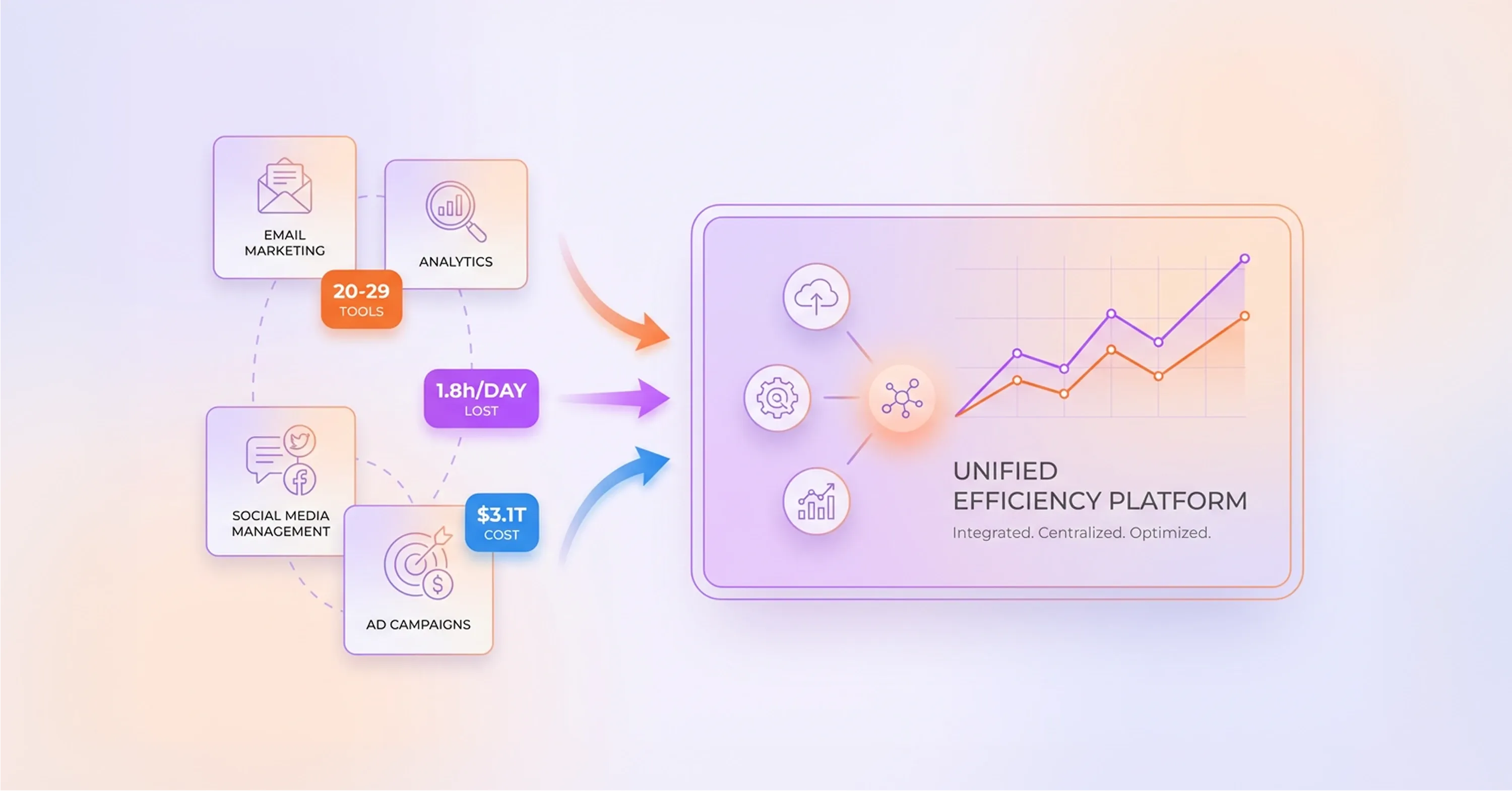
Unified marketing platform integrating email, analytics, social media, and ad campaigns to improve efficiency and reduce costs.

Complete Guide To Performance Marketing Tools: Stack Fragmentation Prevention

In this article, we examine how the rapid adoption of specialized software creates integration debt and fragments data across organizations. We provide a strategic framework for selecting and uniting these systems around a centralized core platform to protect data governance and improve campaign returns.

Content authorJevgenia Pogadajeva, MBA, MScPublished onReading time9 min read

Introduction

Modern organizations frequently adopt various performance marketing tools to track campaigns, capture leads, and analyze user behavior. Over the past decade, the rapid software expansion encouraged teams to acquire highly specialized applications for every new marketing challenge. Today, the average marketing team employs 20 to 29 tools, and this expansion creates complex environments that require constant maintenance. While these applications offer specific features, their continuous adoption causes companies to struggle with severe integration debt and fragmented data. When platforms cannot communicate effectively, teams lose visibility into actual campaign performance and customer journeys. To solve this fragmentation, organizations must shift how they architect data ecosystems. This guide explores how to identify integration debt and outlines a thorough roadmap to unite software around a centralized core platform.

Reality of Disconnected Performance Marketing Tools

Companies damage data governance and create severe integration debt when they accumulate specialized performance marketing tools. These companies constantly adopt new software to solve immediate problems. They buy separate platforms for email tracking, social media monitoring, and lead generation. This rapid software expansion destroys system stability. Companies lose the necessary structure to govern their data effectively when they stack too many applications together. A recent Phenome Cloud report notes that systems accumulate integration debt when they are siloed, poorly connected, or rely on fragile information exchange methods.

Because these platforms do not communicate well, daily operations become frustrating. A recent McKinsey research report shows that employees spend 1.8 hours daily to search for information across disconnected systems. Marketing professionals constantly switch between dashboards to piece together campaign results. If these professionals use isolated PPC tools alongside disconnected analytics platforms, they inevitably face inconsistent reporting. The reporting numbers almost never match because one platform claims fifty conversions, and another records only thirty.

This discrepancy forces staff to export data into spreadsheets and manually reconcile the differences. This manual reconciliation introduces human error and wastes valuable time that professionals should spend on campaign analysis. A fractured technology environment obscures the complete customer journey for organizations. Companies can fix this operational friction when they track and measure how their layered marketing attribution models perform.

True Cost of Fragmented Data

However, disconnected systems waste advertising budgets and break these specific models that companies use to track campaign success. Organizations base their strategic decisions on inaccurate information when they lack proper alignment between applications. Teams inevitably execute campaigns blindly when information cannot flow freely between platforms. This lack of visibility costs businesses significant money. An IBM estimate shows that poor data quality costs organizations $3.1 trillion annually. Furthermore, a Gartner research report indicates that fragmented integrations cause 20% efficiency loss across teams.

This financial drain happens because disconnected marketing software creates specific operational blind spots. Companies suffer these financial losses through three main channels:

  • Wasted ad spend: Marketers bid on the wrong keywords because they cannot see which advertisements actually generate revenue.

  • Broken attribution: Teams cannot identify which touchpoints influence buyers when customer information lives in separate software silos.

  • Delayed responses: Staff respond slowly to rapid market changes because they must manually compile their performance reports.

Organizations require discipline to manage a complex marketing tech stack. Departments will continue to buy overlapping tools that drain budgets if leaders do not enforce strict software standards. This resulting chaos hides underperforming campaigns and obscures the return on investment. These expensive strategic performance marketing mistakes happen whenever business leaders prioritize individual software features over overall data quality.

Centralized Data Architecture

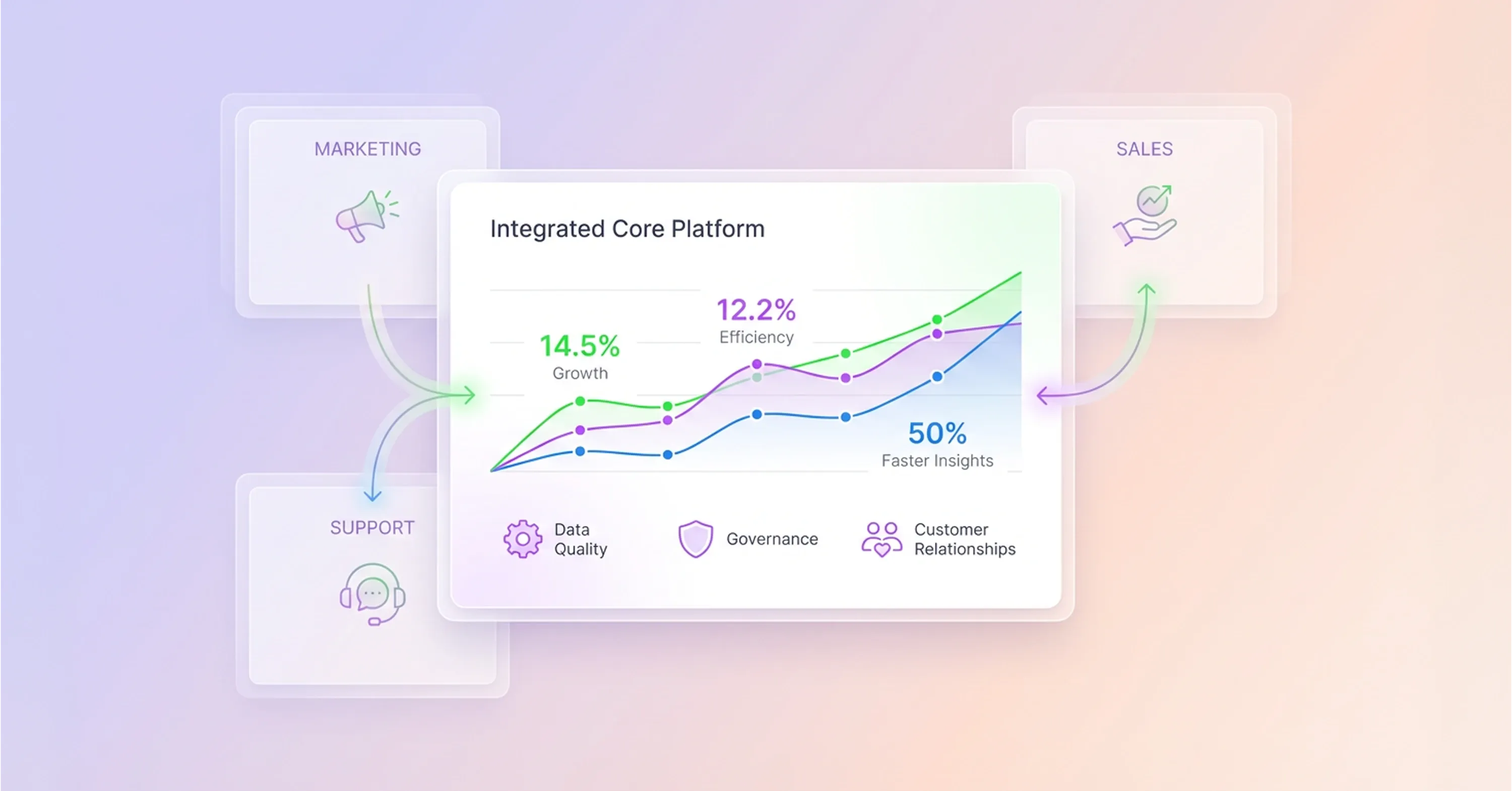
Integrated business platform connecting marketing, sales, and support with analytics to drive growth, efficiency, and faster insights.

Business leaders prioritize overall data quality and resolve reporting inconsistencies when they build a digital ecosystem around a core platform. Organizations gain a strategic advantage when they centralize their daily operations. Successful businesses avoid dozens of separate performance marketing tools when they anchor their operations to a single customer relationship management system. This core platform serves as the central hub for all customer interactions and campaign metrics.

Teams establish authority over their data when they rely on one primary system. These teams share information smoothly across departments, and this information does not get trapped in isolated applications. The marketing department can finally see how their advertising campaigns affect the sales pipeline. This unified approach helps teams eliminate the need to cross-reference multiple spreadsheets just to understand basic performance metrics.

Centralization helps marketing professionals achieve mastery over their daily workflows. Staff can focus their energy on campaign strategy and execution because they do not have to learn fifteen different software interfaces. A single source of truth ensures that everyone in the company looks at the same numbers. The entire organization trusts a specific conversion rate if the customer relationship management system reports it. Business leaders establish this centralized foundation when they prioritize platforms that cover their most critical needs first.

Core Technological Foundation

A strong marketing tech stack core serves as this centralized foundation, and it improves sales productivity and reduces administrative overhead. Leaders take full command over their technological resources when they implement a centralized system. Organizations streamline how their departments function when they unite their operations within a primary customer relationship management system. This structural benefit translates directly into measurable financial gains. A recent Nucleus Research report shows that marketing automation that integrates with a core system drives a 14.5% sales productivity increase and a 12.2% reduction in overhead.

Companies easily evaluate which specific advertising channels drive the best results when they maintain a strong central platform. These companies eliminate redundant software subscriptions because the core system already handles basic email distribution, lead scoring, and reporting tasks. This structural efficiency helps business leaders measure digital marketing ROI accurately and allocate future budgets with confidence.

Data Silos and Governance

This structural efficiency requires integrated data that directly improves the customer experience and increases overall operational efficiency. A unified data architecture removes the operational barriers that frustrate both employees and buyers. Companies create a smooth experience for their audience when they connect their commerce and marketing information. Internal data regulation ensures that privacy standards remain intact across all customer touchpoints.

This integrated approach solves tangible business problems. For example, a recent Salesforce report indicates that e.l.f. Cosmetics reduced service tickets by 50% after they integrated their marketing and commerce data. Support agents could finally see a customer's entire purchase history alongside their marketing engagement. This visibility helps staff avoid repetitive questions about basic information during support calls. Organizations build stronger customer relationships when they base their governance strategies on integrated data ecosystems instead of isolated tools.

Strategic Ecosystem Expansion

To protect these integrated data ecosystems, companies maintain a clear direction when they evaluate their software gaps carefully before they buy new applications. The market offers thousands of specialized performance marketing tools that claim to improve campaign results. But companies often purchase these platforms because they do not verify whether their existing core system already provides the needed features. If organizations buy standalone PPC tools to track ad spending, they must ensure these applications feed information back into the central system. This data connection creates unity across departments and keeps metrics out of isolated dashboards. Teams need this connected data to understand how specific advertisements influence the final sale. They build a strong foundation rather than a scattered collection of specialized software when they understand the role of data in performance marketing.

Organizations waste significant money when they adopt applications that employees rarely use. Companies often assume that more specialized PPC tools will fix their conversion problems. Instead, they create complex environments that staff simply avoid. The Pedowitz Group reports that 72% of organizations cut their technology vendors recently but still overspend on underutilized platforms. Departments experience this financial drain because they buy software based on isolated features rather than overall system compatibility. Businesses protect their budgets when they require every new tool to integrate natively with their core platform. They maximize their existing technology before they request new subscriptions when they enforce a strict integration policy.

Integration Without Disruption

When organizations execute this strict integration policy, their marketing departments risk significant operational downtime if they attempt to replace all their software at once. They disrupt daily workflows and destroy historical campaign data with a complete system overhaul. Companies achieve better results when they consolidate their marketing tech stack incrementally. They bring exactness to the transition process through this measured approach. Teams can maintain their current campaigns while they safely move information to the core platform. Organizations follow specific steps to combine their software ecosystems efficiently because a phased migration requires precision:

  1. Audit current software subscriptions to find features that overlap.

  2. Identify the core platform that will serve as the central data hub.

  3. Migrate basic customer records from isolated applications into the primary system.

  4. Connect specialized marketing applications to the central hub through native integrations.

  5. Cancel redundant platforms after they verify that the core system captures all necessary metrics.

Companies eliminate expensive software overlap and protect active ad campaigns through this systematic consolidation method. When organizations remove duplicate tools, they save money for advertising. Businesses often discover they pay multiple vendors for the exact same analytics features, and they only realize this when they map their systems. They directly improve their financial health when they remove these redundant applications. For example, Urban Armor Gear achieved a 64% cost reduction through systematic platform consolidation. Companies build a stronger data foundation when they remove unnecessary applications and focus their resources on a single core system.

Conclusion

To summarize the major points, building this stronger data foundation to prevent data silos is far more important than acquiring isolated software features. Consolidating performance marketing tools around a single core platform gives teams the visibility they need to make accurate strategic decisions. A centralized architecture helps teams scale performance strategies confidently and allocate budgets toward initiatives that generate measurable business growth. Auditing current systems to eliminate redundancies provides the best next step to establish a unified data foundation that ensures campaigns drive actual revenue.

You need to export your historical data and map your business processes before migrating to a new system. A phased approach prevents data loss during the transition. Your IT team manages the connections so your marketing records don't break.

Privacy regulations extend your consolidation timeline because your legal team must review each data transfer. You must secure customer consent before moving personal records between databases. This compliance step prevents costly legal penalties while your staff sets up the new system.

AI visibility platforms use secure APIs to connect with your central infrastructure. For example, Snoika operates as an AI marketing SaaS platform that helps organizations become visible in AI-driven search engines. Your team uses these insights to optimize brand authority without disrupting your core database.

You build a standardized training program that teaches specific daily workflows instead of general features. Your department heads assign a mentor to guide new employees through the system. This hands-on practice helps your staff master the performance marketing tools, so they don't make initial reporting errors.

You should hire an external agency if your internal staff lacks the technical skills to maintain complex database connections. An agency provides dedicated administrators who monitor data flow and fix broken integrations. However, you must designate an internal manager so you don't lose control over your company data.

Schedule a Meeting

Book a time that works best for you

You Might Also Like

Discover more insights and articles

Diagram of a hybrid marketing framework combining internal first-party data with external testing and execution to improve retention and performance

In-House vs Agency Marketing: B2B Framework For Hybrid Performance Teams

In this article, we examine how artificial intelligence and automated media buying change traditional marketing departments. We explain how organizations construct hybrid frameworks that combine internal strategic control with external execution speed to increase revenue.

Marketing analytics dashboard showing paid media scaling, ROAS break-even analysis, POAS profitability, margin ceiling, and budget allocation across ad channels

How To Scale Paid Media: Advanced Profitability Guide 2026

In this article, we explain how companies systematically increase advertising budgets while they defend bottom-line profit. We break down the exact margin calculations and tracking infrastructure that organizations require to grow campaigns without financial losses.

Infographic showing factors that sabotage marketing campaign ROI including broken attribution, data corruption, targeting mismatch, and budget burn

Performance Marketing Mistakes: 7 Strategic Errors Sabotage Campaign ROI

In this article, we examine hidden technical and strategic errors that drain advertising budgets. We discuss how a focus on data integrity and creative strategy corrects common performance marketing mistakes.

Diagram of an AI performance marketing framework for startups showing AI integration, marketing actions, and business outcomes

Performance Marketing for Startups: Practical Framework for AI Era

In this article, we explain how to build a sustainable growth strategy. This strategy combines disciplined paid acquisition with AI visibility. We discuss the specific steps required to transition from a pure arbitrage model to a hybrid strategy that prioritizes answerability and trust.