Introduction
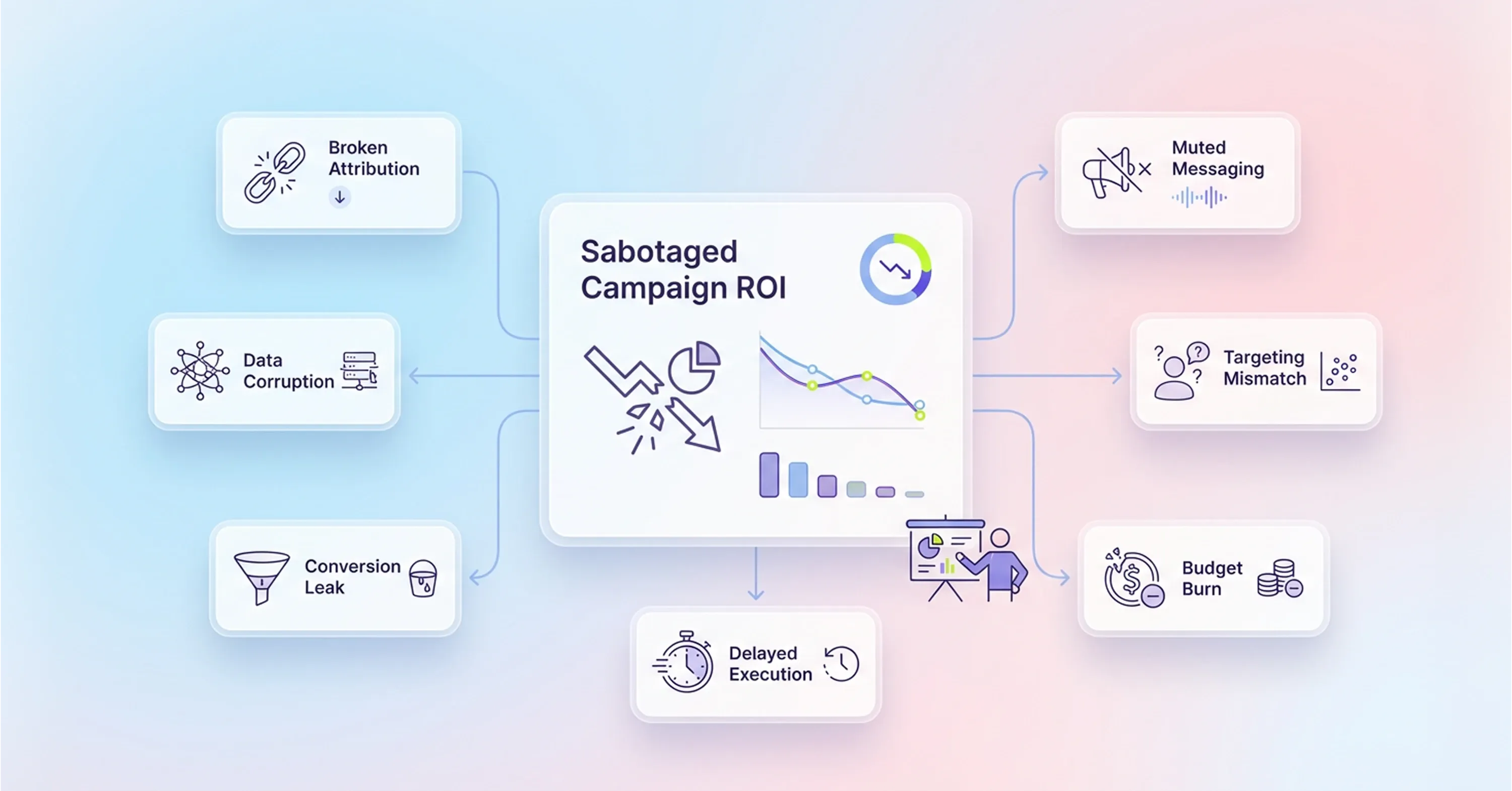
Performance marketing evolved from manual arbitrage to a discipline that relies on automation and machine learning. Platforms like Google and Meta handle more execution now. However, this shift paradoxically increased the margin for strategic error. Many teams still operate with playbooks from 2020. They do not realize that their daily habits kill budgets and confuse algorithmic learning.
The stakes for these errors have never been higher. Recent data indicates that the cost per MQL on Google Ads increased by 24.7% between 2022 and 2023. In this environment, budgets cannot accommodate waste on duplicate tracking signals or vanity metrics. Success in 2026 requires a fundamental pivot. Strategies must shift from out-bidding competitors to out-strategizing them through superior data inputs and creative speed. This guide outlines seven critical performance marketing mistakes and provides the strategic framework to fix them.
Over-Optimization Trap
Constant activity creates a common PPC mistake, even though many advertisers believe it leads to better results. Marketing teams often fall into a cycle of "tinkering," where they adjust bids, budgets, and targeting parameters every 24 to 48 hours. This frequency disrupts the learning phase of modern algorithms, which require stability to predict conversion probabilities accurately. When a campaign manager changes a target CPA or swaps out a creative asset too quickly, the platform’s machine learning model resets and essentially erases the progress it made toward finding the ideal customer.
A "set and forget" approach is equally dangerous, as market conditions and competitor behaviors shift rapidly. Success lies in the middle ground, where Google Ads bidding strategies receive enough time to mature before human intervention occurs. A balanced cadence allows the algorithm to gather statistical significance while the team monitors for major anomalies. This approach requires discipline, as the urge to fix a single day of poor performance can be overwhelming. Marketers must exercise precision in their optimizations and make fewer but more impactful changes based on aggregated data rather than reacting to daily volatility. However, the data sources must report the truth for this approach to work.
Attribution Mirage
Platform-reported data rarely matches the financial reality seen in a company's CRM. Ad platforms like Google and Meta naturally claim credit for as many conversions as possible to prove their value, and they often rely on attribution models that favor their own touchpoints. This discrepancy creates an attribution mirage, where decision-makers make budget decisions based on inflated numbers rather than actual revenue contribution. Relying on these platform-centric views without validating them against backend data threatens the integrity of the entire marketing strategy.
The reliance on last-click attribution exacerbates this issue, specifically in complex B2B buyer journeys or high-ticket consumer purchases. Last-click attribution ignores the upper-funnel interactions that introduce a customer to the brand, and it assigns all value to the final search or retargeting ad. Research highlights the financial impact of this error. According to the Journal of World Archives, companies that use flawed attribution approaches experience 18% reduction in campaign performance. Furthermore, a study by EA Journals found that last-click attribution overvalued branded search by up to 23% versus incrementality tests. This skewed data leads teams to overfund branded keywords and starve the awareness campaigns that actually feed the funnel. True campaign optimization requires accuracy in measurement, which often means building a cross-channel attribution guide that triangulates platform data with CRM truth. With accurate data in hand, the team can focus on the variables that drive performance.
Creative Stagnation in "Andromeda" Era
Automated targeting capabilities on major ad platforms leave creative strategy as the primary lever for performance. Yet, many teams continue to treat creative production as a quarterly task rather than a weekly necessity. This stagnation is a critical error because algorithms need a constant stream of new variables to test against audience segments. In the current "Andromeda" era of advertising, creative velocity determines whether a brand scales or stalls. A resilient account structure relies on a diverse library of assets to combat ad fatigue and maintain engagement.
The math supports this shift toward volume. Recent data indicates that top DTC brands create 50-70 new ads weekly to achieve 30-50% ROAS improvements. This high output allows the algorithm to find the right message for specific pockets of users. However, increasing volume does not mean increasing production value. In fact, highly polished ads often perform worse than native-style content. Barry Hott works as a performance marketing expert, and he advocates for "ugly ads" that emphasize relatability over polish. This approach creates a creative strategy framework that prioritizes testing new concepts, iterating on winning angles, and discarding losing variations quickly. Avoiding performance marketing mistakes now means embracing a messy, high-volume creative process. This process changes how teams approach campaign optimization.
Campaign Optimization Through Creative Tests
Effective campaign optimization now functions more like a scientific experiment than a media buying exercise. Instead of isolating demographic segments, modern strategies isolate creative variables. This systematic process involves testing specific elements such as visual hooks, headline structures, and video lengths to understand what drives action. Teams that master this loop can lower costs significantly. For instance, AdAmigo.ai reports that one brand lowered CPA from £58 to £34 and achieved 3.4 ROAS by testing 12 hooks and 8 iterations. The algorithm uses these inputs to match the right version of an ad to the right user. When marketers feed the system better creative inputs, the automated bidding systems work more efficiently. These systems work even better when the inputs defy traditional branding standards.
Power of Lo-Fi Assets
The trend toward "lo-fi" or low-fidelity assets challenges traditional branding guidelines but delivers superior results in performance channels. Users on platforms like TikTok and Instagram Reels have developed "banner blindness" for content that looks like a commercial. Assets that appear to be user-generated content (UGC) bypass this mental filter because they feel native to the feed. Authenticity captures attention faster than high production value. Data supports this observation, as International Bunch noted that lo-fi videos receive 40% more views and 30% higher reach compared to high-production content. Marketers who refuse to use unpolished assets often commit one of the most damaging PPC mistakes because they prioritize aesthetics over performance. This priority leads to lost revenue, yet technical errors often cause similar damage.
Technical Performance Marketing Mistakes That Corrupt Data
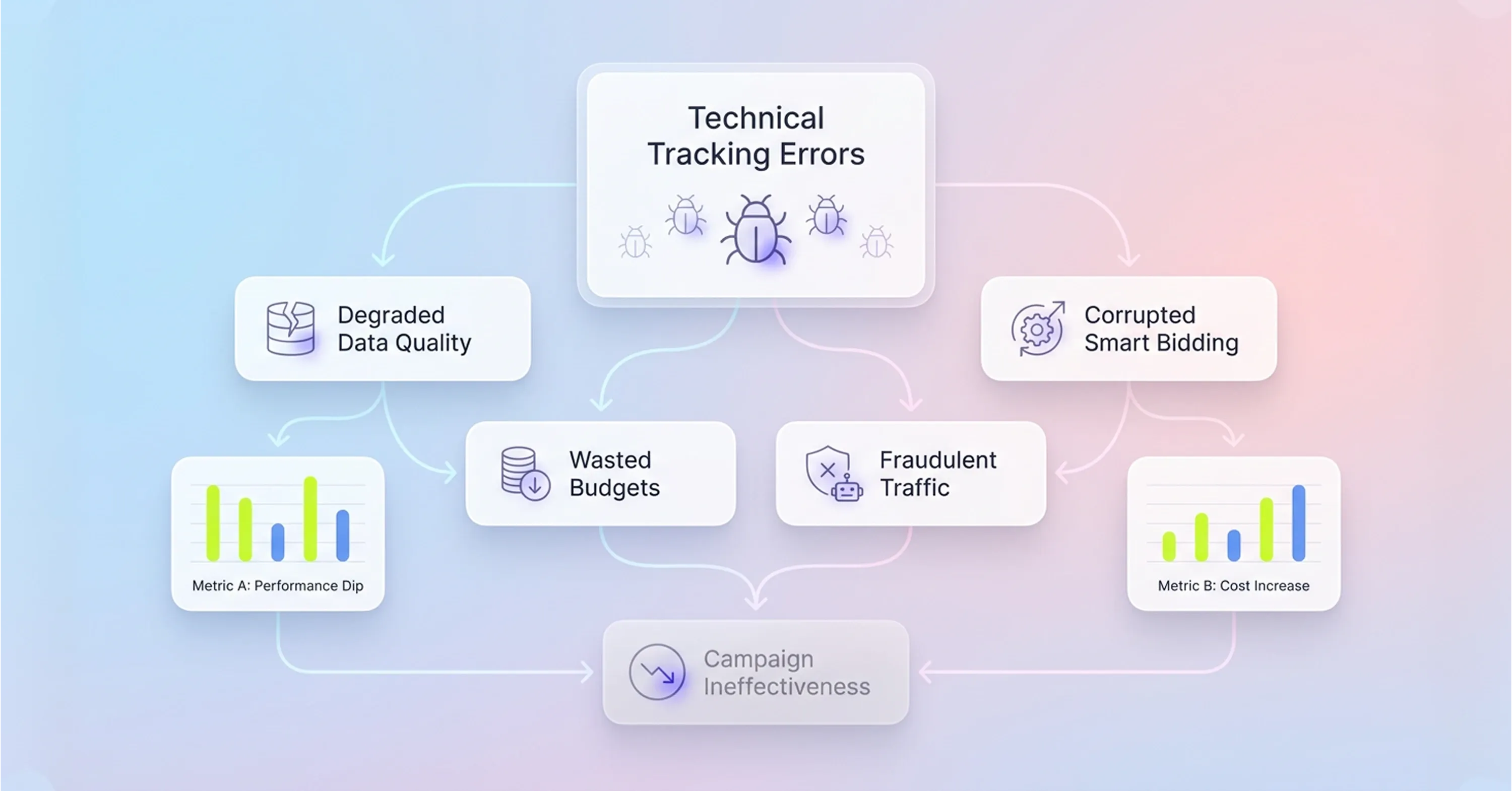
Creative strategy captures attention, but the technical foundation ensures that machine learning algorithms receive accurate signals. Technical tracking errors act as "silent killers" in ad accounts because campaigns often appear to run normally while data quality degrades. Common issues include duplicate conversion actions, where a single purchase counts twice, or missing data layer variables that fail to pass the correct revenue value to the platform. These broken signals corrupt Smart Bidding strategies, and this causes the algorithm to optimize for the wrong outcomes.
The financial impact of technical negligence is severe. eMarketer reports that 12% of ad budgets worldwide are wasted due to martech solutions not working together properly. Additionally, without strong bot protection, campaigns often optimize toward fraudulent traffic that mimics high-intent behavior. Data from PPC Shield indicates that 25-45% of affiliate marketing traffic is fraudulent. Maintaining integrity in data requires regular audits for:
-
Duplicate pixel fires on confirmation pages.
-
Missing value parameters for dynamic revenue tracking.
-
Discrepancies between Google Analytics 4 and backend sales data.
-
Unusually high conversion rates from display or partner networks.
Ignoring these performance marketing mistakes ensures that even the best creative strategy will fail to deliver profitable returns. Yet, a perfect technical setup cannot fix a strategy that relies too much on the tools.

Automation Complacency
Artificial intelligence excels at execution but lacks the context required for strategy. Marketing teams often mistake the efficiency of tools like Performance Max or Meta’s Advantage+ for strategic competence because they assume the algorithm will naturally find the best customers. This complacency leads to a scenario where automation scales a flawed strategy just as efficiently as a successful one. While the machine can test thousands of variables instantly, it cannot discern if the offer itself creates a loss for the business or if the messaging misaligns with brand values.
This distinction matters because the machine’s ability to generate engagement is undeniable. Zebracat found that AI-generated ad creatives show 47% higher CTR compared to manually designed versions. However, a high click-through rate on a misleading ad or a poor landing page simply depletes the budget faster. Campaign optimization requires strict human oversight to ensure the automated inputs align with business goals. Marketers remain intentional about the signals they feed the system. This often involves auditing the post-click experience and applying conversion rate optimization tips to ensure the destination fulfills the promise made by the AI-optimized ad. But optimization strategies must also account for potential customers who never visit the website.
Zero-Click Reality
The search landscape has shifted from a list of blue links to direct answers provided by generative engines like ChatGPT and Perplexity. Consumers now frequently receive complete solutions to their queries without ever visiting a brand's website. Marketers who fail to adapt to this "zero-click" environment commit one of the most dangerous PPC mistakes because they optimize only for traffic rather than presence. If a brand does not appear in the source material that trains these models, such as authoritative reviews, PR articles, and influencer content, it effectively becomes invisible to the AI and the user.
Securing visibility in AI-generated answers requires brands to prioritize content creation that these engines cite as credible sources. This necessity drives the strategic pivot toward creator-led advertising. According to eMarketer, 57% of ad buyers prioritize influencer and creator ads as their top investment focus for 2026. These creators generate the authentic, high-engagement signals that AI models view as trustworthy data. Relevance in the modern search era depends on having others talk about the product, not just bidding on keywords. Strategies that ignore this pre-click influence lose the battle for mental availability before the search even happens. Once the campaign captures attention, the metrics used to measure success often mislead the business.
Vanity Metrics Versus Unit Economics
Marketers often celebrate low Cost Per Acquisition (CPA) while the business silently suffers from poor unit economics. A focus on the cost to acquire a lead without analyzing the value of that lead creates a false sense of success. This focus on vanity metrics ignores the critical relationship between Customer Lifetime Value (LTV) and Customer Acquisition Cost (CAC). A campaign that generates leads for $10 appears successful on a weekly report, but if those customers churn immediately or never purchase, the strategy actually destroys value. Profitability depends on the quality of the customer, not the cheapness of the click.
Investors and financial officers clearly understand this distinction. Investors consider a 3:1 LTV/CAC ratio ideal for seed-stage ecommerce startups, according to Qubit Capital. Marketing teams adopt this financial mindset to avoid common performance marketing mistakes. True campaign optimization shifts the objective from "lowest possible CPA" to "maximum revenue per lead." This approach ensures long-term sustainability because it aligns marketing spend with actual business health. When teams validate their campaigns against LTV data, they often find that more expensive traffic sources actually yield higher returns because they attract customers who buy more and stay longer. This insight prepares the team to implement a holistic framework.
Conclusion
Fixing these seven performance marketing mistakes requires a fundamental shift from activity-based management to outcome-based strategy. Scaling creative production or increasing budgets requires a solid technical foundation and clean data signals. A rigorous quarterly audit of tracking and attribution frameworks catches errors before they compound into significant losses. Prioritizing data integrity and creative variety builds a resilient engine capable of weathering algorithmic changes. Our guide on marketing analytics audits explains how to maintain this technical health and secure the campaign's future.