
Retail marketing strategy for AI discovery
A retail marketing strategy for AI discovery gets your stores into the short list that ChatGPT or Google's AI answers give when a shopper asks where to buy something nearby. It depends on structured location and live stock data that machines can read, backed by reviews and local pages that agree with each other. Assistants recommend stores they can verify, so your job is to make each store easy to check.
 Jevgenia PogadajevaCFO, Snoika · 7 min read

























AI discovery reshapes retail marketing
AI assistants now handle the first step of a shopping trip, and they return a few named stores where a search engine returned a page of links. Adobe Analytics found that AI traffic to US retail sites grew 393% in Q1 2026 compared with a year earlier. In March 2025 AI traffic converted 38% worse than other sources, and by March 2026 it was converting 42% better.
BrightLocal's Local Consumer Review Survey found that 45% of consumers now ask AI tools for local business recommendations, up from 6% the year before. Ads and a decent map listing used to be enough to win retail foot traffic. Now the store also has to win a sentence inside an AI answer. How far this has gone depends on your category, so start by asking the assistants the questions your customers would ask and note which stores they name.
Why assistants name specific stores
Google's AI features recommend the nearby stores whose data they can confirm from several sources at once. Google checks the Business Profile and product listings that show local stock, then looks for enough strong reviews to make the recommendation safe. Google says AI Mode runs on its Shopping Graph, which holds more than 50 billion product listings, with 2 billion of them updated every hour. If your stock isn't in that graph, the assistant has nothing to match against a shopper's request for a product nearby.
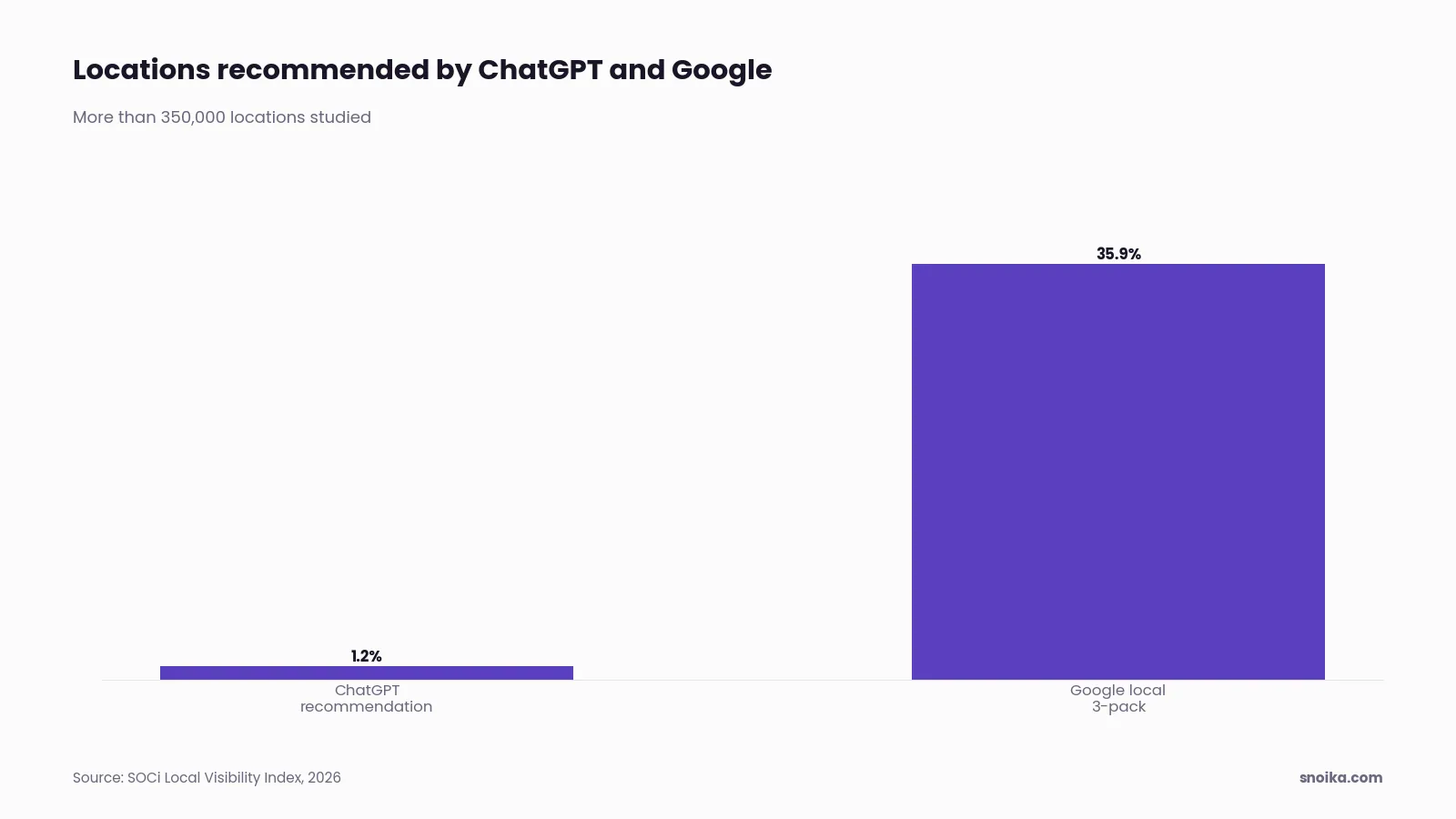
SOCi's 2026 Local Visibility Index studied more than 350,000 locations and found that ChatGPT recommended 1.2% of locations, while Google's local 3-pack showed 35.9% of them. The locations ChatGPT recommended averaged 4.3 stars. A store with middling ratings can still rank on Google Maps because it's close by, but it drops out of AI answers altogether. Check your rating and confirm that your name and address are identical on every platform. Your hours should match across platforms too.
Structured data drives visits
To appear in AI shopping answers, a physical store needs 4 layers of structured data, and every layer has to agree with the others. Structured data is code that labels each fact on a page so a machine can read it without guessing. Google's local inventory data specification requires a `store_code` that exactly matches the code in your Business Profile, and the field is case-sensitive. One mismatched code is enough to cut a store's stock off from its location.
| Data layer | What it tells the assistant | What to check |
|---|---|---|
| `LocalBusiness` or `Store` schema on each store page | Which store this is, where it sits, how to reach it | Name and address match the Business Profile character for character |
| `openingHoursSpecification` | When the store is open, including holidays | Holiday hours are added before the date arrives |
| `Product` with `Offer` and `availability` | What the item is and whether it's in stock | Availability values match the shelf |
| Local inventory feed in Google Merchant Center | Which store holds which product, at what price | Product IDs match the main feed, and the feed updates at least daily |
`LocalBusiness` or `Store` schema on each store page
- What it tells the assistant
- Which store this is, where it sits, how to reach it
- What to check
- Name and address match the Business Profile character for character
`openingHoursSpecification`
- What it tells the assistant
- When the store is open, including holidays
- What to check
- Holiday hours are added before the date arrives
`Product` with `Offer` and `availability`
- What it tells the assistant
- What the item is and whether it's in stock
- What to check
- Availability values match the shelf
Local inventory feed in Google Merchant Center
- What it tells the assistant
- Which store holds which product, at what price
- What to check
- Product IDs match the main feed, and the feed updates at least daily
Google's LocalBusiness structured data guide also covers a `department` property for stores with a pharmacy or service counter inside. Use it when those departments keep their own hours. Before you add more markup, test what you already have. Schema with errors does more harm than having none, because it puts conflicting facts into the systems you're trying to win over.
In-store signals models trust
What shoppers say about their visit becomes data an assistant reads, so in store marketing now feeds AI visibility too. Reviews are the strongest in-store signal; Elev8 Operations reports, based on BrightLocal's 2026 survey, that 47% of consumers won't use a business with fewer than 20 reviews. Assistants read the same review platforms, which is why a store with a handful of reviews gives a model little reason to name it.
Detailed reviews count for more than a high star count alone. A review that names a product line or a repair service gives the model a fact it can match to a shopper's question. A mention of a helpful staff member gives it another such fact. Ask for reviews at the till or on the receipt, and suggest the shopper mention what they came in for. Store photos and answered questions on your Business Profile work the same way. Read your last 30 reviews and count how many name a product or service. That number shows how much the assistants can learn about you from shoppers.
Physical store content strategy
Each store needs its own page with facts that only that store can claim. A page that repeats the chain's homepage with a new address on it gives an assistant nothing to quote. BrightLocal's research on ChatGPT Search found that business websites made up 58% of its local sources, ahead of business mentions and directories. Your own pages are the first place a model looks when it's deciding about you.
Write those pages around questions a shopper would put to an assistant. Which brands does this branch carry? Does it fit wheelchairs or cut keys? Does it take trade-ins? Where do you park, and how long does click-and-collect take? Put each answer in a plain sentence near the top of the page, because a model takes text it can lift whole. A page full of checkable facts for each location improves the store's online presence for AI assistants. Then compare each page with the one for your nearest competitor and look for something they answer that you don't.
Local SEO meets AI citations
Local SEO is still the foundation for AI SEO, because AI systems build their answers from the same profiles and reviews. Vendasta reports a 0.72 correlation between traditional local search performance and AI visibility based on SOCi's research. A store with a weak Business Profile seldom makes up the gap in AI answers.
Search Engine Land's write-up of SOCi's data notes that fewer than half of brands that lead in Google local visibility also rank among the most visible in AI results. Assistants draw on a wider range of sources than Google does, with Yelp and Facebook among them. They also consult editorial "best of" lists. Keep the core profile work going, then audit each outside listing with SEO solutions for differences in hours or categories. Check phone numbers for consistency too. Every mismatch gives the model a reason to pick a competitor whose facts line up.
Measuring AI-driven store visits
You measure AI-driven store visits in layers, because no single report links a ChatGPT answer to someone walking through the door. Put these 4 steps in place:
- Separate AI referrals in Google Analytics 4 (GA4). ChatGPT Search adds `utm_source=chatgpt.com` to outbound links. Digital Power recommends a custom channel group that catches this tag along with referrer domains like gemini.google.com, placed above generic referral traffic.
- Accept that some visits arrive unlabeled. Rankshift notes that free ChatGPT users don't send referrer data, so some AI clicks show up as Direct. Watch for direct traffic landing on store pages.
- Track Business Profile actions per store. Direction requests are the closest digital proxy for a visit. Vendasta reports that direction requests rose 21–31% year over year in 2026, while calls and website clicks fell.
- Run a fixed prompt set every week. Ask the same 20 or 50 local shopping questions in ChatGPT and Google AI Overviews, and log whether each store is named. For each mention, record its position and the competitors named alongside it.
Then compare the trend with your footfall counters. SOCi and Placer.ai found a 0.72 correlation between growth in foot traffic and growth in local visibility scores, so a rising visibility score is a reasonable early sign of more visits.
Retail marketing ideas for GEO
Generative engine optimization (GEO) is the practice of shaping how AI models describe and recommend you. The retail marketing ideas that work give a model a new, checkable fact about a particular store.
Publish shelf-level stock for each store
A local inventory feed lets an assistant answer "who has this in stock near me" with your store's name. Start with your 200 fastest sellers, and make sure the counts come from the point-of-sale system so they reflect what's on the shelf.
Turn staff expertise into store-page answers
Your floor staff hear the same questions every day. Collect 10 of them from each branch and answer them on that branch's page. A garden center that explains which tomato varieties do well in its own climate zone has written something no national competitor can copy.
Get listed in local editorial roundups
City guides and "best of" articles are among the sources assistants quote. Give local journalists a concrete reason to mention you, such as a repair clinic or a range nobody else nearby stocks.
Prepare for agents that call your store
Google's AI can now phone nearby stores to check stock and prices, and Google says this gives merchants a new way to drive foot traffic. Train whoever answers the phone to give plain stock and price answers, since the agent passes those answers to the shopper.
Owning the recommendation loop
You own the recommendation loop when every visit leaves behind data that makes the next recommendation more likely. Near Media's summary of SOCi's 2026 consumer research explains how shoppers circle back through local discovery in a loop rather than a funnel. Shoppers move between search and social to confirm a choice before they act, with AI and reviews also part of that process. In the same discussion, Damian Rollison, Senior Director of Market Insights at SOCi, noted that only 19% of shoppers act directly on what the AI tells them.
So a recommendation starts a check, and the shopper finishes it somewhere else. To get recommended, a retailer needs matching facts in its profile and on its store page, and those facts must agree with recent reviews. Then make sure each visit adds to that record, with a review request after the sale and stock data that stays current. A store that runs this cycle every week builds up evidence that a competitor can't produce in a month.
Next steps
Your first decision is which 3 stores to audit, and you can make it this week. Pick your busiest location and your weakest, then add one in a competitive area. Ask ChatGPT and Google AI Overviews 10 local questions for each and write down who gets named. Before you spend on any wider retail marketing strategy, use the gaps between those 3 stores to decide whether data or reviews need attention first, or whether content should take priority over both. Snoika audits websites and tracks how brands appear in Google and AI assistants, with a human review layer over the automated work. A free AI visibility report is the usual first step, so you can check your AI visibility free.
FAQ
Recommendations depend on the product and location in your question. To check nearby results, ask an assistant where to buy a specific item in your area. Compare the named stores' published stock and opening hours before visiting.
Make your store's details consistent wherever assistants check them. Start your retail marketing strategy by comparing your business profile with your store page, correcting conflicting addresses or hours. Review customer feedback for details that help assistants match your store to shopping questions.
Give each branch its own page with answers specific to that location. Put practical details, such as collection times or parking instructions, near the top. Compare competing store pages to find shopper questions yours doesn't answer.
Use LocalBusiness or Store structured data to identify the location, with openingHoursSpecification for its hours. Product data with Offer and availability describes stock. A separate local inventory feed connects products to individual branches, so website markup alone doesn't cover every data layer.
A mismatched store code can disconnect inventory from its location. Check that store_code matches your business profile's code exactly, including capitalization. If it matches, check product IDs against the main feed and confirm inventory updates at least daily.


