LLM seo: a practical framework for AI visibility

Content authorArtem Lozinsky, EMBA, MScPublished onReading time9 min read
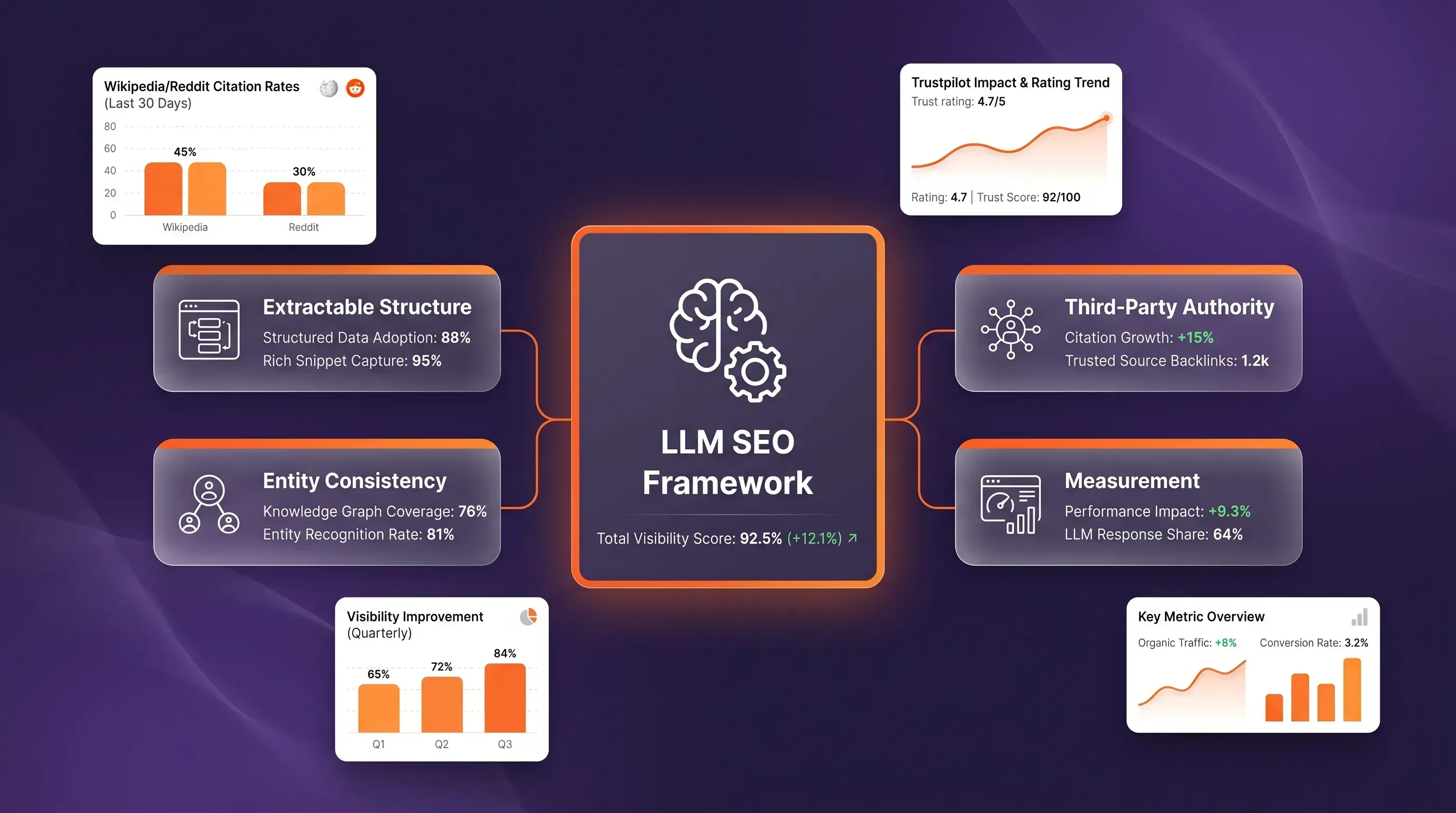
A modern SaaS dashboard featuring a central 'LLM SEO Framework' card surrounded by four pillar cards, all on a deep purple gradient background.

This article gives you a vendor-neutral framework for LLM SEO, the practice of getting your brand cited inside AI-generated answers and included when those answers discuss your category. It explains source selection and measurement, with the carryover from your existing program built into the signal framework.

What LLM seo actually means

LLM SEO is the work of getting a brand cited and recommended inside the answers that systems like ChatGPT and Google AI Overviews generate. You already feel the shift behind it. Discovery is moving from a ranked list of ten blue links toward a single synthesized answer, and the gap between the two is real. A page can hold position one and still never appear in the answer that sits above it. Across thousands of keywords where Wikipedia ranks and an AI Overview is present, Wikipedia makes the overview on fewer than half of those queries.

You will see this discipline called generative engine optimization or answer engine optimization. The terms overlap more than they differ. Treat what follows as llm seo best practices inferred from how these systems behave, because no one outside these companies can see the weights.

How answer engines pick sources

The mechanism behind every one of these surfaces is retrieval followed by generation. The retrieval stage selects candidate documents by semantic relevance. Quality filters then re-rank that set before the system writes an answer with citations attached to specific passages. Perplexity runs this as a six-stage RAG pipeline that pulls 5 to 10 pages per query and cites 3 to 4 of them. ChatGPT's search mode runs queries through Bing, then crawls a selection of results based on, in the words of OpenAI's support team, "the relevance of the title, the content within the snippet, the freshness of the information, and the credibility of the domain."

For answer engine optimization, this differs from classic ranking in two ways that change how you work. Because models cite passages, a buried answer inside an otherwise strong article can be passed over. And corroboration matters, because a claim that several independent sources agree on is safer for the model to repeat than one that appears in a single place.

The platforms also source from different parts of the web. A study of 30 million citations by Profound found ChatGPT pulled 47.9% of its answers from Wikipedia. In the same analysis, Google AI Overviews leaned on Reddit at 21%, and Perplexity on Reddit at 46.7%. Gemini grounds its answers in real-time Google Search results when it decides the web will improve the response. One tactic will not perform identically across all four. Keep this model in mind, because the three signal groups ahead only make sense once you see how selection works.

What carries over and what changes

The fundamentals that earned you rankings still do real work here, so a competent program already gives you a base. Crawler accessibility and content quality continue to feed the same retrieval and ranking stages that AI systems borrow from search, with domain authority reinforced by reputation across the web. The Princeton GEO study on generative engine optimization, presented at KDD 2024, confirmed that quality and credibility signals carry over, while the old keyword-density playbook does not.

What changes is the goal you are optimizing toward. In answer engine optimization, the new goal is answer inclusion, with citation visibility tied to entity clarity and whether you get recommended when someone asks for the best option in your category. Here is the clean boundary worth holding in your head:

  • Still counts: technical accessibility, along with genuinely useful content whose authority is backed by a clean reputation across the web.

  • Newly weighted: answer inclusion and source citation, with entity resolution tied to the recommendation set.

This reframes llm seo work you already do around the new targets. The starting point is to point your existing muscle at these new targets.

Need help with your AI visibility?

Book a free consultation with our experts we'll help you determine exactly which services your organization needs.

Three signal groups to optimize

There are dozens of llm seo tactics floating around for AI visibility, and most of them collapse into three groups of signals you can actually influence. The first is your owned content and how easily a model can extract a quotable answer from it. The second is how consistently the web describes your brand, so a model can resolve who you are. The third is what other sources say about you, which you can shape only indirectly.

The order matters. You move from what you write to how you are described and vouched for elsewhere. Each of the three subsections below stands on its own, so you can hand any one of them to the team that owns that surface. These levers improve the odds, which is the most honest claim anyone can make about systems this opaque.

Extractable content structure

Because models cite passages, the unit of optimization is the self-contained chunk. Structure beats narrative here. A clear heading hierarchy gives the section a liftable shape, and a direct answer near the top makes your content easier to lift cleanly when paragraphs stand alone without leaning on a previous sentence. Lists and tables help too, since parseable data is easy for a model to extract and attribute. The Princeton researchers found that adding statistics and quotations improved visibility by up to 40% in generative responses.

None of this matters if the crawler cannot reach the page. AI crawlers do not execute JavaScript. An analysis of over 500 million GPTBot fetches by Vercel found no evidence of JavaScript rendering, which means client-side content shows up as an empty shell. Server-side rendering is the precondition. So is your robots.txt, where the split between training crawlers and search crawlers trips up most teams. A 2026 cohort audit by CapstonAI found that 41% of B2B sites still block at least one major AI bot, a leftover from the 2023 panic. Blocking OAI-SearchBot, for instance, removes you from ChatGPT's search citations even if GPTBot is allowed.

Consistent entity descriptions

Entity clarity means the web describes your brand and category with the same core facts everywhere. When a model encounters your name, it tries to resolve it to a known entity and pull together what it knows. Contradictions raise its uncertainty and lower the chance it cites you. As one entity-recognition guide put it, "models choose silence over citing you" when brand data is inconsistent or unverifiable.

The fix is consistency across every property that mentions you. Use the same name and description on your site, then mirror it across public profiles and structured data. Organization schema with the sameAs property links your site to authoritative references like Wikidata and LinkedIn, which is the single highest-leverage schema implementation available because it tells a model that all these profiles point to the same entity. This ties directly back to corroboration. When independent sources agree on what you are, they reinforce each other, and the model grows more confident every time.

Need help with your AI visibility?

Book a free consultation with our experts we'll help you determine exactly which services your organization needs.

Third-party authority and generative engine optimization

The signals that sit outside your direct control predict inclusion more strongly than anything on your own page. Citations and reviews from sources the model already trusts build the consensus these systems rely on. An analysis of 30 million sources by Peec AI found Reddit and YouTube among the most-cited domains across the major engines. LinkedIn was part of that group, and review platforms like Yelp and G2 appeared in recommendation queries. ChatGPT's own pattern reflects this: sites with Trustpilot presence averaged 4.6 to 6.3 citations versus 1.8 for sites without reviews.

This is the area where generative engine optimization and answer engine optimization reward patience over tricks, and the work means coordinating with PR and partnerships over months. Resist the manipulative shortcuts. The Princeton study found keyword stuffing performed 10% worse than the baseline on Perplexity, and forced brand-phrase repetition can backfire the same way. There is a subtler trap too. Lily Ray's analysis of 100 B2B queries found Google AI Overviews cited brands' own "best software" listicles, yet recommended competitors 69% of the time. Calling yourself the best can hand the recommendation to a rival the answer trusts more.

Measuring AI visibility

AI visibility measurement for llm seo requires active samples from a representative query set across each platform and a record of what comes back, because the answers shift from run to run. SparkToro's study of 2,961 prompts across ChatGPT and Claude, with Google AI included in the dataset, found a less-than-1-in-100 chance of getting the same brand list twice. Rand Fishkin, SparkToro's co-founder, concluded that "any tool that gives a 'ranking position in AI' is full of baloney." Yet the same study found a stable consideration set; top brands appeared in 55% to 77% of responses. Presence frequency is the metric that matters.

Here are the core signals worth tracking across your query set:

  1. Citation frequency: how often your domain is named as a source. A drop points back to extractability or crawler access.

  2. Share of AI answers: the percentage of answers in your category that mention you against the total. This is your headline number for stakeholders.

  3. Branded mention rate and recommendation inclusion: whether you are named, and whether you are recommended when someone asks for the best option. These are two different outcomes, and a citation is not a recommendation.

  4. Source mix and competitor co-mentions: which domains the answer pulls from, and who shows up beside you. This tells you where to invest in earned authority.

  5. Description accuracy: whether the model gets your category and core facts right. Errors here send you straight back to entity consistency.

Numbers vary by platform, so treat them as directional and run enough samples per query to separate a pattern from noise. AthenaHQ's State of AI Search 2026 report put the average brand mention rate at 17.2% which gives you a rough benchmark for where most brands sit before any focused work.

Where to start

Sequence the work, and the whole thing stops feeling overwhelming. Fix crawler accessibility and entity consistency first, because a model that cannot reach your pages or resolve your name will not cite you no matter how good the content is. Then improve extractable structure on the pages that answer your highest-value questions. Then build earned authority through PR and community presence, which compounds slowly. Run measurement alongside all of it from day one, so you can see what moves.

This extends a healthy SEO program into llm seo, and the gains accumulate as consistency and authority build. Every move here improves your odds of inclusion. Since 60% of US adults now read AI summaries in search, the first concrete steps of your LLM SEO work are worth taking this quarter.

Need help with your AI visibility?

Book a free consultation with our experts we'll help you determine exactly which services your organization needs.

Check AI visibility at least monthly, and weekly during active content or PR work. AI answers change across runs, so use the same query set, platform list, and sample count each time. Track presence frequency instead of treating one answer as a fixed ranking.

Yes, you can allow AI search crawlers while blocking training crawlers. Review robots.txt by crawler name because GPTBot and OAI-SearchBot serve different purposes. If you block the search crawler, your pages can disappear from citation results even when normal search crawling still works.

Start with pages that answer buying, comparison, and category questions. These pages have the highest chance of appearing in AI answers because they match recommendation prompts. Add direct answers near the top, use clear headings, and make sure the key facts stand alone without needing the full page context.

You know AI misunderstood your brand when answers use the wrong category, outdated facts, or names that don't match your official profiles. Compare ChatGPT, Google AI Overviews, Perplexity, and Gemini against your approved description. If errors repeat, fix your site copy, schema, LinkedIn profile, and public directories.

Yes, use a tool or spreadsheet if it records prompts, platforms, dates, citations, and mentions consistently. A Snoika report, for example, should separate citation frequency from recommendation inclusion because those are different outcomes. The useful output is trend data, not a single claimed AI ranking.

Schedule a Meeting

Book a time that works best for you

You Might Also Like

Discover more insights and articles

Comparison visual of AI search optimization tools with overlapping cards for Tool A and Tool B, featuring charts and evaluation criteria.

Choosing AI search optimization tools for your team

This article clears up the confusion between AI visibility tools and the keyword trackers you already run, then walks through the criteria that matter when you're buying for a team. By the end, you'll be able to run a fair trial and defend your pick.

A luminous SaaS marketing illustration with a central UI card labeled 'AI Answer Engine Citations' surrounded by seven floating cards.

How to Improve Your AI Visibility and Get Cited by Answer Engines

This article explains the mechanics of how AI answer engines decide which sources to name and link, then walks through the concrete moves that raise your odds of being cited. It treats AI visibility as its own discipline next to the SEO you already run and shows where the two overlap before ending with what to audit and how to measure progress.

A luminous SaaS dashboard with a deep purple gradient, featuring a central audit card and three overlapping cards with icons and charts.

Lighthouse agentic browsing: Google’s New AI Agent Readiness Audit Explained

This article explains the new Agentic Browsing category in Lighthouse: its checks and the workflow from running the audit to reading its unusual pass-ratio output. It connects each signal to how autonomous browsing agents behave, so you can decide where to spend your effort first.

A vibrant SaaS dashboard comparing 'Traditional SEO' and 'Generative Engine Optimization' with layered cards and charts on a purple gradient background.

Generative Engine Optimization: What Changes When AI Answers Before the Click

This article explains what generative engine optimization is and how it differs from the SEO you already run, with concrete tactics for earning visibility inside AI-generated answers. It skips the basics and focuses on the line between what changes and what carries over.