Choosing the Right AI Visibility Term for Budget Planning and Team Ownership

Content authorJevgenia Pogadajeva, MBA, MScPublished onReading time10 min read
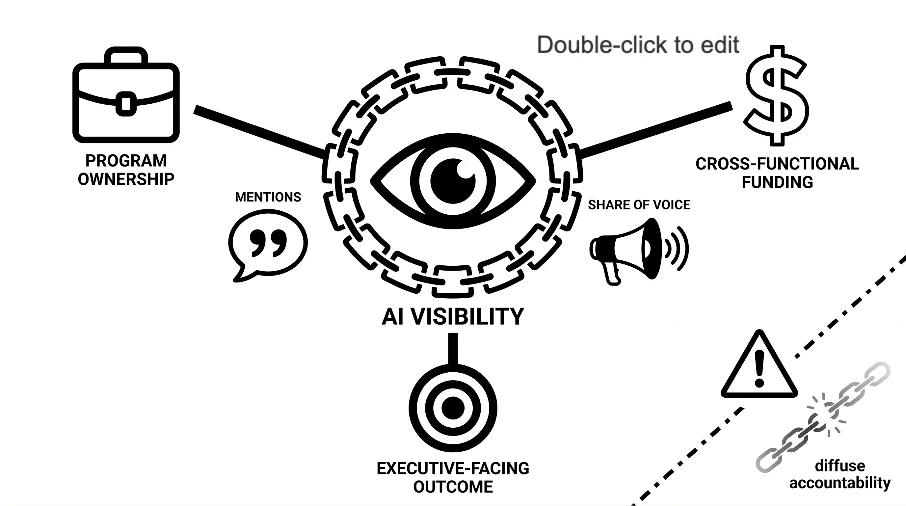
Black-and-white comic-style SaaS cluster diagram featuring an eye icon, briefcase, dollar sign, bullseye, and warning triangle.

Use "AI visibility" as the outcome word your executives approve against, then pair it with one operational term like GEO or AI search optimization for the tactics and the owner. The umbrella wins budget conversations. The specific term wins scoping conversations. Documenting what your chosen word covers matters more than picking the "correct" one.

Choose language that clarifies the work

Pick two words, not one: a business-outcome term for the approval conversation and an operational term for the scope document. AI visibility answers the question a chief financial officer actually asks, which is whether customers encounter the brand at the moment of decision. GEO or AI search optimization answers the question your delivery team asks, which is what gets built and by whom.

The gap between those two questions is where budgets die. Forrester's research found that 70% of marketers say AI visibility is a top priority for their CMO or CEO, yet only 30% have named a discrete owner for answer-engine visibility. That's a 40-point accountability hole sitting behind an approved priority.

So the terminology problem isn't semantic. A word that executives understand but that no team can translate into a work plan produces exactly that pattern: high stated priority and no named owner. Name both layers before you present the number.

No term is universally standard

There's no industry consensus on any of these terms, and waiting for one costs you a planning cycle. GEO and AEO describe heavily overlapping work with different origins and different implied boundaries, and so do LLMO and AI search optimization. Each carries assumptions your stakeholders will fill in differently if you don't fill them in first.

The origins explain the mess. GEO was formally defined by Princeton researchers in November 2023, and AEO predates it from the voice-search and featured-snippet era. LLMO emerged from practitioner communities as ChatGPT scaled. EMARKETER reported that 59% of SEO influencers reference GEO as a term while others prefer AEO or LLMO, with fewer than a third using consistent terminology through 2025.

If the people who write about this for a living can't hold one word steady, your finance partner reading a budget request has no chance of inferring your meaning. Write a one-paragraph definition into the planning brief and treat it as binding for the fiscal year. Consistency inside your organization beats correctness across the industry.

Which term fits your operating model?

Match the term to the decision you need it to survive: a budget approval or an ownership assignment. Each label carries a different default owner and a different measurement scope.

Here's how the five options compare on the dimensions that matter for planning:

  • AI visibility: executive-facing outcome, owned by a program lead, funded as a cross-functional line, measured on mentions and share of voice. Risk is diffuse accountability.

  • GEO: dedicated program, coordinated by search, funded as a named workstream, measured on citations and source authority. Risk is acronym unfamiliarity outside marketing.

  • AI search optimization: plain-language extension of existing search spend, easiest approval path, measured on visibility plus referral quality. Risk is being mistaken for rankings work only.

  • AEO and LLMO: narrow technical scopes with narrow metrics. Risk is excluding platforms and brand work that belong in the program.

Conductor's 2026 survey of 250-plus enterprise digital leaders found enterprises allocating 12% of digital budgets to AEO and GEO while AI referrals account for 1.08% of total website traffic. That ratio only survives scrutiny if your term signals influence.

Need help with your AI visibility?

Book a free consultation with our experts we'll help you determine exactly which services your organization needs.

AI visibility frames a shared outcome

AI visibility is the right umbrella when your program spans search and content, and no single function can deliver the result alone. It reads as an outcome, which is why it moves through executive review with less friction than any acronym.

The evidence supports the breadth. AirOps classified 21,311 brand mentions from more than 500 commercial discovery queries and found 85% of mentions attributed to third-party sources, with only 13.2% coming from the brand's own domain. Listicles, along with comparisons and reviews, accounted for nearly 90% of that third-party share.

Which means an owned-content team that works alone is optimizing the smaller share of the surface. That's the argument for the umbrella. But the same breadth creates the failure mode: five contributing functions and no accountable name. Pair the term with named workstreams in the same document, or the shared outcome becomes a shared excuse.

GEO defines a dedicated program

Use GEO when you're funding coordinated work on citations and source authority across generative engines, and you want that work visible as its own line. The term has an academic definition behind it, which helps when someone asks where the discipline came from.

GEO fits a program with real operating cadence because the underlying volatility demands one. AirOps research based on 45,000 citations found only 30% of brands stay visible from one AI answer to the next, and just 20% remain present across five consecutive runs of the same query.

Read that as a staffing signal. Visibility that resets between runs can't be maintained by a quarterly content push, so a GEO program needs continuous measurement and a standing content and authority workstream. Search coordinates well here because the diagnostic habits transfer. Content and public relations contribute against the same citation targets.

AI search optimization eases approvals

Choose plain-language AI search optimization when your approval path runs through finance or a leadership team that already funds search and needs the connection stated without translation. No acronym and no meeting spent explaining what the letters stand for.

The trade-off is that the word "search" invites a rankings-and-traffic assumption you have to correct in the same breath. Do it with the conversion argument. Ahrefs found AI search visitors generated 12.1% of signups despite making up 0.5% of total traffic, roughly a 23x conversion edge over traditional organic, while Similarweb's 2026 cross-site analysis put the premium at a more conservative 11.4% versus 5.3%.

Two studies, one direction. The honest framing for a budget meeting is that AI search volume stays small while its qualified share runs high, so the investment case rests on pipeline contribution. Say that before someone benchmarks your program against organic traffic volume and finds it wanting.

AEO and LLMO require boundaries

Reserve AEO for extractable answers and LLMO for large-language-model presence, and only when that narrower scope is a deliberate choice. Both terms are legitimate. Both quietly draw lines around your program that your stakeholders won't see.

AEO grew out of featured snippets and answer boxes, so it leans toward concise question-and-answer content. LLMO targets language models specifically, which is precise now and fragile later. As Olaf Kopp, who introduced the term in a Search Engine Land post in October 2023, has noted, the abbreviation is unambiguous but the term stops fitting if language models are replaced by another technology.

The practical consequence shows up at renewal time. A label scoped to one interface or one model family gives a skeptical reviewer an easy reason to exclude review platforms or brand work from your budget. If you use the narrow term, write the exclusions down deliberately so they're a decision.

Need help with your AI visibility?

Book a free consultation with our experts we'll help you determine exactly which services your organization needs.

Ownership should follow promised outcomes

Name one accountable program lead, then list every contributing function underneath with what each one delivers. Shared execution is fine. Shared ownership is how programs quietly stop having anyone to ask for a status update.

Writer created the role internally and moved Christian Westcott from Head of Inbound Marketing to Director of AI Visibility, with responsibility for share of model and citation rate alongside sentiment across AI engines and the workflow that moves them. One person and one metric set.

That structure works because the metric follows the title. Contributors from search and content touch the outcome, but only the lead answers for the number in a quarterly review. The rule I'd apply when writing the plan: if a deliverable appears under two functions with no named individual, it will not ship. Assign it to one and let the second function support. Legal belongs in the list because brand representation in AI answers raises claims and disclosure questions that surface after publication.

Budget should reflect capability layers

Break the request into capability layers instead of asking for one undifferentiated GEO budget, because a single lump sum invites a single yes-or-no answer. Layered requests let a reviewer fund the foundation now and stage the rest, which is a better outcome than a deferred decision.

Six layers cover most programs:

  1. Monitoring and measurement tooling, since you can't report on what you don't track.

  2. Content production and refresh of existing pages.

  3. Technical work covering structure, schema, and crawl access.

  4. Authority and earned presence across third-party sources.

  5. Experimentation budget for prompt testing and format trials.

  6. Cross-functional labor, costed honestly as time from teams you don't manage.

Gartner's 2026 CMO Spend Survey put the mean share of marketing budget allocated to AI at 15.3% overall and 21.3% at organizations ready to scale, while only 30% of chief marketing officers reported mature AI readiness. The readiness gap is the argument for layer one. Fund monitoring first, because organizations that spend ahead of their ability to measure are the ones producing the mature-readiness shortfall in that data.

Reporting must match the chosen term

Your dashboard has to report on the scope your term promised, or the first quarterly review will expose the mismatch. Broad language obligates broad metrics. Narrow labels obligate metrics that map directly to the boundary you drew.

If you sold AI visibility, report mentions and citations. If you sold AEO, report answer-level performance and don't pad the deck with brand metrics you didn't scope. AirOps recommends treating both signals separately because a citation means an engine linked to your content while a mention means it named your brand in the answer text, and you can have either without the other.

That distinction decides what your program is optimizing. Citations reward content and technical work. Mentions reward earned presence and brand strength. Reporting them as one blended visibility number hides which of your funded layers is actually working, which is the fastest way to lose the second year of budget.

How should teams finalize terminology?

Run a single 60-minute alignment session and produce a written definition. Seven questions cover who the term is for and what it includes, plus who owns it and who contributes. They also settle which budget funds it and which metrics prove it. A final question records what the term excludes.

Record the answers in the planning brief and mirror them as the dashboard's definitions page so nobody relitigates scope from a slide. The urgency behind the exercise is measurable. Zero-click behavior reached 68.01% of U.S. Google searches in the first four months of 2026, according to SparkToro research using Similarweb clickstream data, up from 60.45% in 2024.

Seven and a half points in two years is faster than most annual planning cycles can absorb. Which means the cost of a long terminology debate is now higher than the cost of picking a reasonable term and correcting it next year. Write the definition and schedule one review at the next planning cycle.

Benchmark AI visibility with Snoika

Get baseline data before the ownership meeting, because a scope argument settles faster with evidence than with opinion. Knowing which prompts surface your brand and which competitors appear instead turns a terminology debate into a work plan with owners attached.

Snoika is a San Francisco-based AI search visibility platform that tracks brand mentions across ChatGPT and Gemini. It reports mentions and citations in one view, plus the entity signals and content gaps behind those numbers. The company launched free AI visibility monitoring, so you can pull a baseline before committing to a budget line.

Start with a report on your top 20 buyer prompts. That single artifact tells you whether your program needs the broad umbrella or the narrower label and which layer of the budget deserves the first dollar.

Need help with your AI visibility?

Book a free consultation with our experts we'll help you determine exactly which services your organization needs.

Yes, provided both documents point to the same written definition and metric set. Use the executive term to describe the approved outcome, then use the delivery term for assigned work. Include a crosswalk in the planning brief so departments don't treat the labels as separate programs.

Choose prompts that reflect questions buyers ask before contacting sales or requesting a quote. Pull candidates from sales-call notes and search-query reports, then remove duplicates. Include category and comparison questions, since they can surface different sources and competitors.

No. An agency can handle measurement, content, or outreach, but an employee should answer for budget, priorities, and results. The internal lead can assign work to the agency and use its reporting. This prevents a vendor from having to settle conflicts between departments without decision authority.

Include an exact definition and a named data source for every metric. Document its update frequency and owner. State what counts as a mention and what counts as a citation, then keep those rules unchanged during the fiscal year. This prevents reporting changes from looking like performance changes.

Fund a pilot when the organization lacks baseline data or can't yet assign ongoing staff time. Give it a fixed duration and a named owner. Set a decision rule for expansion before work begins, such as a target for qualified referrals or citation coverage that supports the next budget layer.

Schedule a Meeting

Book a time that works best for you

You Might Also Like

Discover more insights and articles

A bold AI assistant icon at the center, surrounded by negative space and a sparse ring of simplified brand icons in vibrant orange.

AI Visibility Diagnostic: Why Assistants Overlook Your Brand

Assistants overlook your brand for one of four reasons: your content doesn't answer the questions buyers actually ask or your pages can't be crawled or read. Positioning that confuses the model about what category you're in and third parties that validate competitors instead of you belong on that same list. A structured prompt audit tells you which one before you spend anything.

A minimalistic illustration of a segmented arrow representing the citation readiness process for AI search engines, featuring sleek icons.

First AI SEO Steps to Make Content More Citation-Ready

Pick a small set of commercially valuable pages and score each one for clarity and accessibility. Fix only the lowest scores. Citation readiness means a page is easy for an AI engine to find and quote. You raise the odds of being cited. You never guarantee it.

Title:
First-Priority WordPress Audit Areas for AI Answer Readiness

Meta description:
Improve your AI SEO WordPress audit to earn AI citations. Learn how to fix crawler access and format content for

First-Priority WordPress Audit Areas for AI Answer Readiness

Audit access first. If AI crawlers can't fetch and read your priority pages, nothing else you fix will matter. After access, work through page clarity and entity consistency, then schema accuracy and internal links, and finish with content quality. Score each issue by business value against effort, then fix blockers before you touch anything cosmetic.

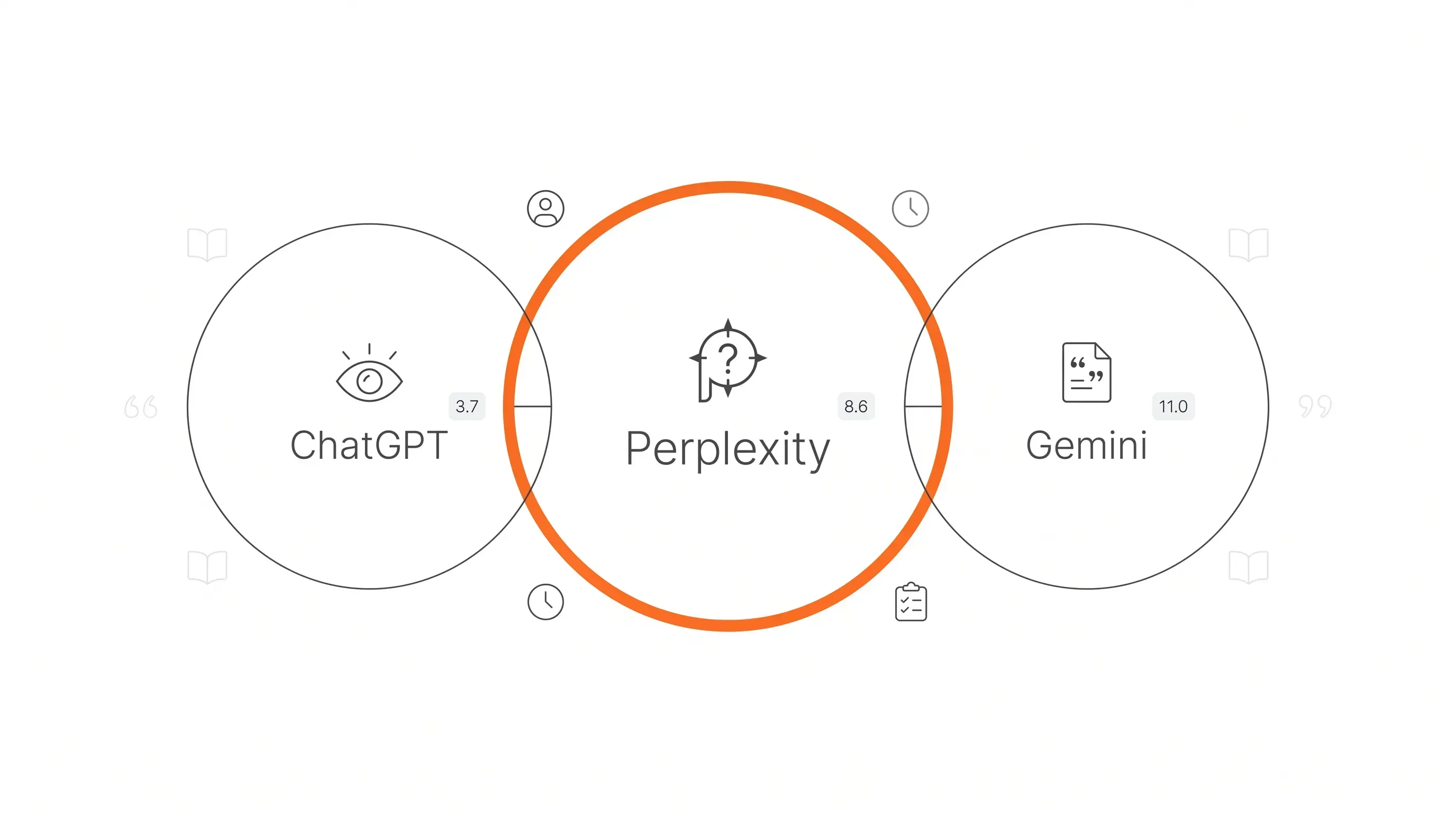
Minimalist design featuring three overlapping circles labeled 'Perplexity', 'ChatGPT', and 'Gemini', with icons and numeric tags.

Perplexity vs Other AI Search Tools: Where Brands Should Prioritize Visibility

Prioritize Perplexity separately when your buyers research with evidence in hand and when Perplexity's cited sources differ from what ChatGPT or Gemini surface for the same prompts. Perplexity shows citations on every answer, which makes source ownership measurable. Test your own prompts before you move budget, because priority depends on your category.