Choosing AI search optimization tools for your team

Content authorJevgenia Pogadajeva, MBA, MScPublished onReading time8 min read
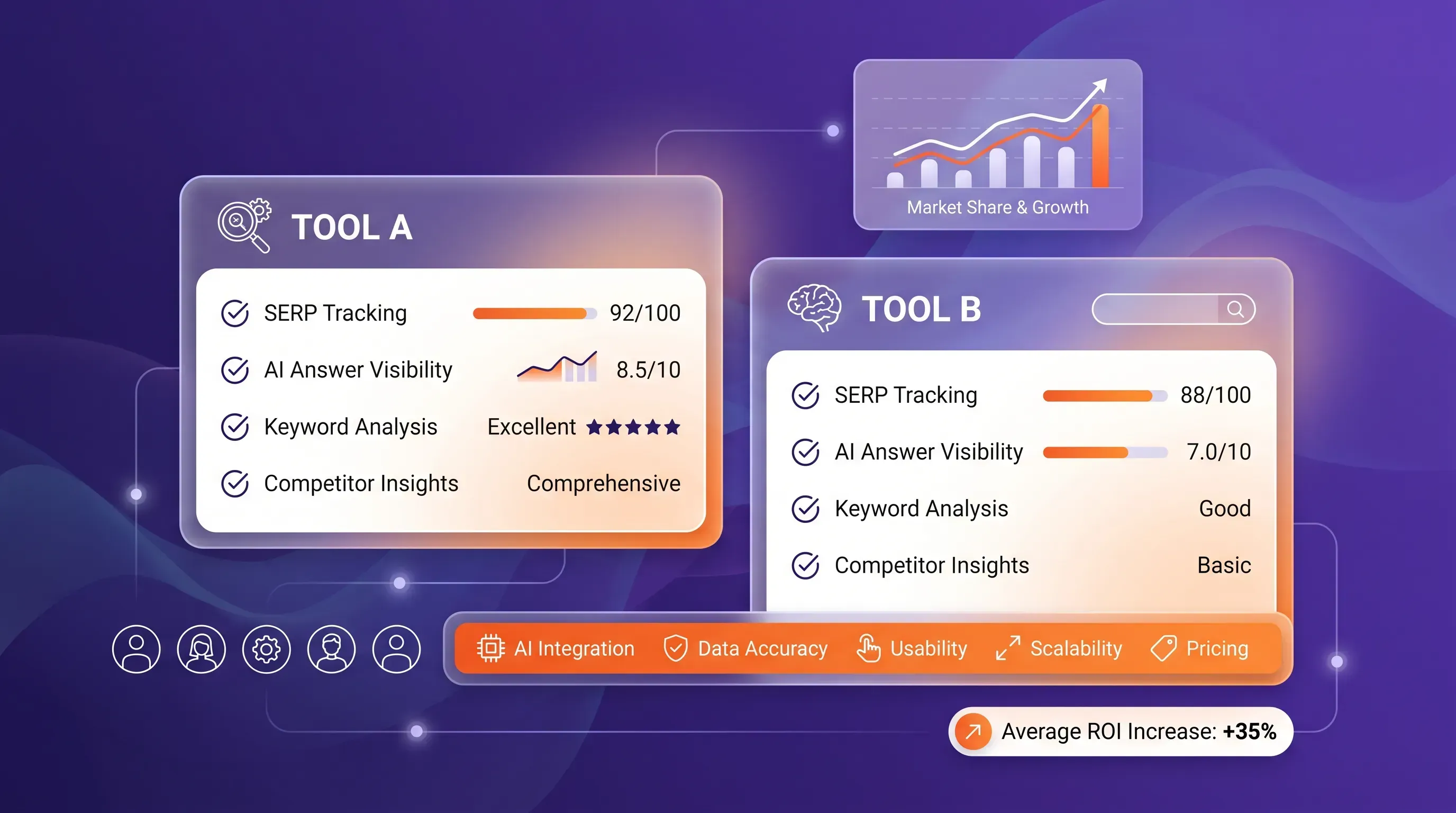
Comparison visual of AI search optimization tools with overlapping cards for Tool A and Tool B, featuring charts and evaluation criteria.

This article clears up the confusion between AI visibility tools and the keyword trackers you already run, then walks through the criteria that matter when you're buying for a team. By the end, you'll be able to run a fair trial and defend your pick.

Why this decision feels harder now

You run a working SEO program. Then leadership asks you to start tracking AI search optimization tools and report on visibility inside ChatGPT and AI Overviews, and the software market in front of you is a wall of overlapping claims. The hard part is that you can't tell what you're comparing. Some vendors look like the rank trackers you already pay for. Others speak a language you don't fully recognize yet.

What changed is where people get answers. In 2024, 58.5% of U.S. Google searches ended without a click, according to SparkToro's study with Datos. ChatGPT reached 400 million weekly active users in February 2025. Your brand presence is now split across surfaces that behave nothing alike, which is why getting the comparison framework right has to come before any vendor name. This guide assumes you know rankings and keywords already, so it won't re-teach those.

AI SEO platform vs keyword tracker

Here's the distinction that resolves most of the confusion. The tools you already use and the newer category of ai search optimization tools you've been told to evaluate do different jobs. They measure different things and answer different questions, so one cannot stand in for the other.

A keyword tracker speaks in rankings and click-through rate. An ai seo platform speaks in mentions and share of voice. The first assumes a results page with ordered links a user can click. The second deals with a generated answer where there are no positions and no clicks at all. Reading the two sections below side by side makes the contrast concrete.

What a seo keyword tracker does

A seo keyword tracker monitors where your target terms rank in standard search results over time. It reports your position and how that position moves week to week. You already know this tool because it's been the backbone of SEO reporting for years.

The metrics are familiar. Rank position and click-through rate both assume the same thing: a search engine returns an ordered list of links, and movement up or down that list changes how much traffic you capture. A seo keyword tracker is built entirely around that model. It's the baseline you'll contrast everything else against.

What an ai seo platform measures

An ai seo platform measures whether and how your brand appears inside AI-generated answers across engines like ChatGPT and Google AI Overviews. It reports mention rate and citation share. The question shifts from "where do we rank" to "are we named, and how are we described when we are."

The conceptual jump matters here. An ai seo platform measures presence and framing because AI answers lack a ranked position or a click to count. And because an AI answer changes across prompts and time, visibility becomes a distribution. The same question asked five times can name your brand three times and skip it twice. That variation is the data.

Need help with your AI visibility?

Book a free consultation with our experts we'll help you determine exactly which services your organization needs.

Why you should measure both

Track only AI answers or only SERP rankings and you see half your visibility. Buyers move between both surfaces in a single decision because they check an AI answer for a shortlist and then run a standard search to verify. The two data sets answer different business questions, which is the whole reason a seo keyword tracker and an ai seo platform exist as separate categories.

Traditional rankings still drive measurable traffic. AI presence increasingly shapes what people think before they ever reach your site. The risk of watching one surface alone is real, because AI Overviews now appear in over 60% of U.S. queries as of November 2025, per Advanced Web Ranking data, and Ahrefs found their presence cuts CTR by 58% for the top-ranking page. The most useful thing you get from seeing both together is the gap: when AI engines cite a competitor for a term you already rank well on organically. That single view is the lens to carry into every tool evaluation.

How to evaluate AI search optimization tools

Treat the criteria below as a checklist your team applies during shortlisting. Score each AI search optimization tools candidate against the same questions so your comparison stays consistent across demos. Priorities shift with team size and maturity, so a three-person team and a thirty-person team will weight these differently.

Keep the framing vendor-neutral until you've agreed on what matters. The longest feature list rarely wins, because half of purchased martech goes unused. The Fall 2024 CMO Survey found only 50% of bought tools are in active use.

Engine and SERP coverage

Coverage is the first filter. Check which AI engines a tool tracks, and whether it reports standard SERP rankings in the same place:

  • AI engines like ChatGPT and Google AI Overviews

  • Standard search results alongside those AI answers, so you aren't running two products

Map coverage to where your audience actually searches. If your buyers live in ChatGPT and Google, a tool that tracks six engines you don't care about adds noise. A platform covering both AI answers and SERPs reduces stack sprawl among ai search optimization tools, which matters when the average B2B organization runs 12 to 20 marketing tools already and you're trying not to pay for two overlapping ones.

Need help with your AI visibility?

Book a free consultation with our experts we'll help you determine exactly which services your organization needs.

Data accuracy and method

AI answers vary across prompts and time, so how a tool collects data shapes what it tells you. Real query-based monitoring and API-only sampling can produce different results for the same brand, and if you're making content decisions on that data, the difference is your problem. Ask the vendor directly how they collect.

Two questions cut through most of it. How often does the data refresh? And does the tool store historical AI responses so you can track shifts over time? Without stored history, you can't tell whether a drop in mentions is a trend or a single bad run. A seo keyword tracker has solved historical data for years, so hold ai search optimization tools to the same standard.

Fit for a team

You're buying for a group, which changes what counts. Look at access controls and whether the reporting is readable by people who don't live in SEO. Leadership needs a view they can interpret without a translator.

Watch for the limits that quietly cap a growing team:

  • Usage caps on prompts or tracked keywords that throttle you as you scale

  • Security needs like single sign-on (SSO) or role-based access for larger organizations

Integrations with your existing stack matter too, because a tool that doesn't connect to what you already run becomes another silo. A good ai seo platform adapts to the team's workflow.

Running a fair trial

Demos are sales theater. A fair trial is a controlled test you run yourself, with the same inputs across every shortlisted tool. Define a small set of real priority prompts tied to your business, then test that identical set across each candidate for AI presence and SERP rankings.

Remember that AI visibility is a distribution, so a single snapshot misleads. Run the trial long enough to see variation across days and runs:

  1. Pick 10 to 20 priority prompts and the keywords tied to them

  2. Run the same set across each tool over a window of two to four weeks

  3. Compare AI mention rate and SERP position for each

  4. Score every ai search optimization tools candidate against the criteria from the previous section

Scoring against fixed criteria is what makes the choice defensible. When someone asks why you picked one tool over another, you point to the numbers from a test you designed. A seo keyword tracker comparison works the same way, and you already know how to run that half.

Where Snoika fits in

Now that you have the framework, Snoika is one option worth including in your trial. It measures presence in AI answers alongside standard SERP rankings in one place, which maps directly to the measure-both argument from earlier. Its free AI Visibility Monitoring feature tracks mentions and competitor attention across AI and search.

"Snoika shows whether your brand is the answer," said Jevgenia Pogadajeva, CEO and founder of Snoika, at its enterprise launch. On the evaluation criteria, it covers multiple AI answer engines and reports standard search results in the same view, with a team-readable dashboard that benchmarks you against competitors. Test it against the same prompts and the same scorecard you'd use for any other tool. That's the honest way to find out whether it fits your situation.

Making the call

You now know the difference between a tracker and a platform, plus the trial method built around your own criteria. The right choice depends on your team's goals and existing stack.

So run a structured trial that includes Snoika and pick the tool that best covers both AI answers and SERPs for your situation. The best AI search optimization tools for your team are the ones that survive your own test, scored against your own priorities.

Need help with your AI visibility?

Book a free consultation with our experts we'll help you determine exactly which services your organization needs.

Plan the budget around trial scope, not a fixed tool category average. Include license cost, setup time, prompt volume, user seats, and any reporting work your team must do outside the platform. If pricing depends on tracked prompts or engines, ask vendors for a quote based on your exact test list.

Review AI visibility weekly during a trial and monthly after adoption. Weekly checks help you spot prompt-level changes without overreacting to one answer variation. Monthly reporting gives leadership a steadier view of mention rate, citation share, and competitor movement across the prompts tied to business priorities.

Yes, but the data should guide content priorities over time. AI search optimization tools show where engines name competitors, misdescribe your brand, or skip useful pages. Use those findings to improve source pages, comparison content, and entity clarity while keeping your existing keyword tracking in place.

Include paid search data if your team uses it to judge demand or conversion value. AI visibility data won't replace paid metrics, but it can help you decide which prompts deserve closer review. Compare high-value paid terms with AI answer presence to find gaps between demand and brand visibility.

Snoika fits as a candidate when your shortlist requires AI answer tracking and standard SERP reporting in one view. Test it with the same prompts, keywords, time window, and scoring sheet as every other vendor. That keeps the comparison fair and shows whether it matches your team’s workflow.

Schedule a Meeting

Book a time that works best for you

You Might Also Like

Discover more insights and articles

A modern SaaS dashboard featuring a central 'LLM SEO Framework' card surrounded by four pillar cards, all on a deep purple gradient background.

LLM seo: a practical framework for AI visibility

This article gives you a vendor-neutral framework for LLM SEO, the practice of getting your brand cited inside AI-generated answers and included when those answers discuss your category. It explains source selection and measurement, with the carryover from your existing program built into the signal framework.

A luminous SaaS marketing illustration with a central UI card labeled 'AI Answer Engine Citations' surrounded by seven floating cards.

How to Improve Your AI Visibility and Get Cited by Answer Engines

This article explains the mechanics of how AI answer engines decide which sources to name and link, then walks through the concrete moves that raise your odds of being cited. It treats AI visibility as its own discipline next to the SEO you already run and shows where the two overlap before ending with what to audit and how to measure progress.

A luminous SaaS dashboard with a deep purple gradient, featuring a central audit card and three overlapping cards with icons and charts.

Lighthouse agentic browsing: Google’s New AI Agent Readiness Audit Explained

This article explains the new Agentic Browsing category in Lighthouse: its checks and the workflow from running the audit to reading its unusual pass-ratio output. It connects each signal to how autonomous browsing agents behave, so you can decide where to spend your effort first.

A vibrant SaaS dashboard comparing 'Traditional SEO' and 'Generative Engine Optimization' with layered cards and charts on a purple gradient background.

Generative Engine Optimization: What Changes When AI Answers Before the Click

This article explains what generative engine optimization is and how it differs from the SEO you already run, with concrete tactics for earning visibility inside AI-generated answers. It skips the basics and focuses on the line between what changes and what carries over.