First AI SEO Steps to Make Content More Citation-Ready

Content authorArtem Lozinsky, EMBA, MScPublished onReading time10 min read
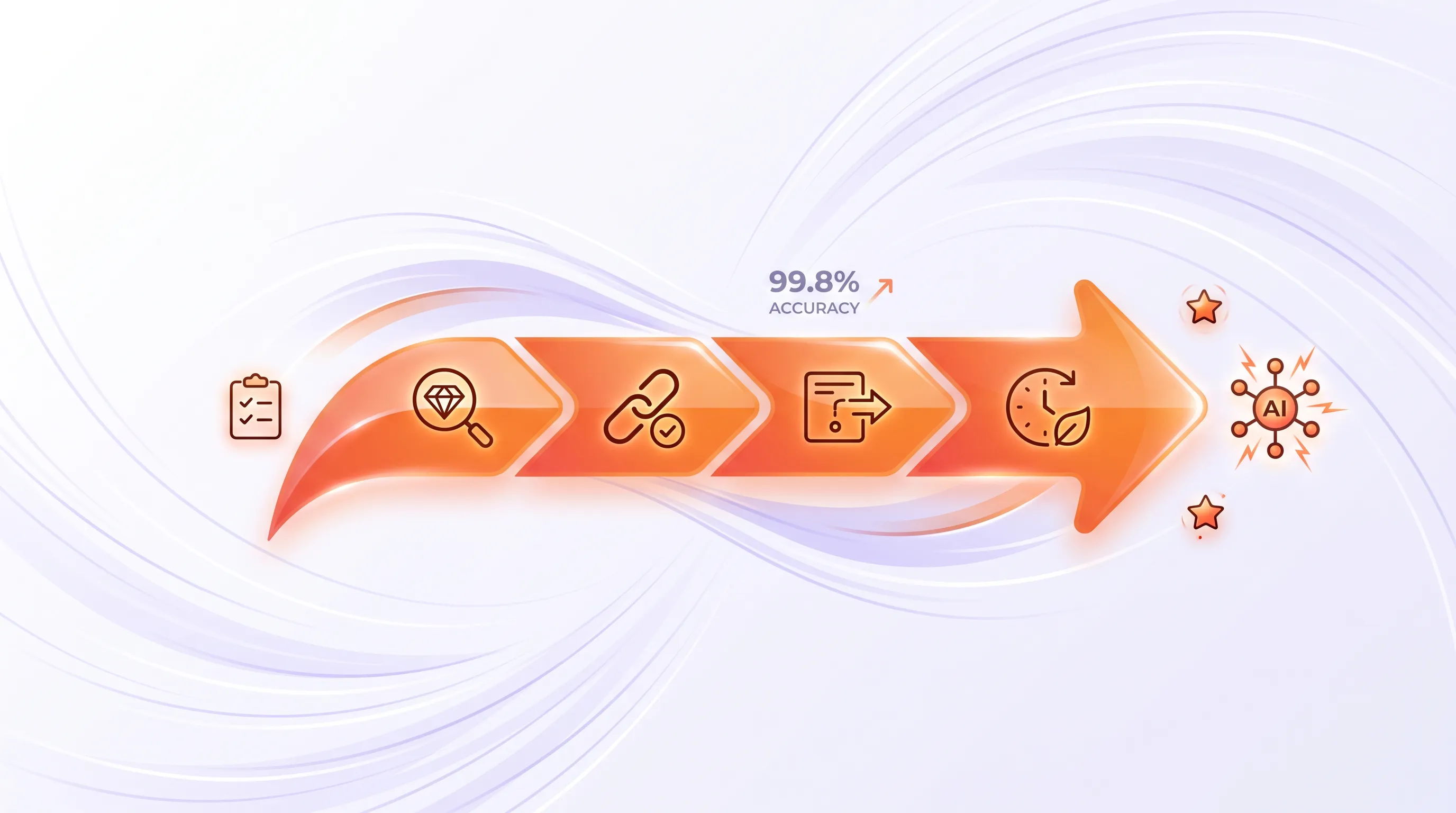
A minimalistic illustration of a segmented arrow representing the citation readiness process for AI search engines, featuring sleek icons.

Pick a small set of commercially valuable pages and score each one for clarity and accessibility. Fix only the lowest scores. Citation readiness means a page is easy for an AI engine to find and quote. You raise the odds of being cited. You never guarantee it.

Citation-ready content reduces retrieval friction

Citation readiness is the state of a page that a retrieval system can locate and parse, then confirm and lift a clean answer from without doing extra work. Each of those four steps is a place where your page gets dropped, and most pages fail at more than one. The fix is to remove friction.

There's evidence that the friction is content-shaped. The team behind the KDD 2024 paper on generative engine optimization tested nine tactics across 10,000 queries and found that adding statistics lifted visibility by 41% on position-adjusted word count, while keyword stuffing performed worse than doing nothing.

Read that result carefully and it tells you something the paper doesn't say outright: the tactics that worked are the ones that make a claim independently checkable. A machine that can verify a sentence has a reason to reuse it. So citation readiness is a byproduct of writing verifiable content, and no amount of formatting compensates for a page with nothing checkable in it.

Which pages should teams improve first?

Improve the pages where buyer demand and a realistic shot at citation overlap, which is almost never your highest-traffic list. A pilot works because it's small. Twelve to twenty pages is enough to produce a signal you can read.

The reason to be selective is that AI surfaces don't share a source pool. Ahrefs analyzed 15,000 prompts and found that on average only 12% of links cited by ChatGPT and Gemini appear in Google's top 10 results for the same prompt, with Perplexity the outlier at roughly one in three.

What that gap means for your shortlist: your existing ranking report is a weak proxy for citation opportunity, so you can't just export the top 50 URLs and call it a plan. You need a second filter built on buyer questions and a third built on what the engines are already saying. The three subsections below give you those filters in order.

Start with commercially valuable questions

Pick pages that answer the questions someone asks while deciding. Comparison and evaluation queries sit close to a purchase, which is why they're worth the editing hours.

The buying behavior supports this. 6sense's 2025 Buyer Experience Report found that first contact with a seller now happens at 61% of the journey, and that the vendor already ranked first on the Day One shortlist wins about four out of five deals.

Here's the implication 6sense doesn't spell out. If the shortlist is formed before anyone talks to you, then the pages that shape that shortlist are your comparison and evaluation content, and those are the pages an AI answer summarizes on your behalf. An awareness article with 40,000 sessions influences nothing at that stage. Sequence your pilot accordingly.

Favor pages with existing authority

Pick pages that have already proven something: rankings or referring domains. A page with signals attached is a shorter path to citation than a new page starting from zero, because retrieval systems already have reasons to fetch it.

Ahrefs studied 1,885 pages that added JSON-LD schema between August 2025 and March 2026 against 4,000 matched controls and found no meaningful citation lift on ChatGPT or Google AI Mode. Every page in that dataset already carried 100+ AI Overview citations before treatment.

The design of that study is the useful part for you. Ahrefs could only measure pages already inside the consideration set, which tells you those pages exist as a distinct group, and that being in the set is a precondition. Your job in a pilot is to find your own version of that group and make its answers better.

Need help with your AI visibility?

Book a free consultation with our experts we'll help you determine exactly which services your organization needs.

Check relevant AI answers

Run 20 to 30 real buyer prompts across your target engines and write down what comes back before you edit anything. You're looking for prompts where no one credible is cited and prompts where your page appears once and vanishes on the rerun.

That last pattern is normal. SISTRIX tracked citations over 17 weeks and found Google AI Mode responses rotate 56% of cited domains weekly while ChatGPT rotates 74%, with a stable core of a few domains present for 86% of prompts.

The core-and-carousel split changes what you're testing for. A single appearance tells you the engine can reach your page. Repeated appearance across runs tells you it trusts the page enough to keep it. Run each prompt at least three times on separate days, and treat the difference between those two outcomes as your real baseline.

How should citation readiness be scored?

Score every shortlisted page on four factors, zero to two points each, for a maximum of eight. Zero means absent and two means present, with one covering a partial case. Low scores tell you what to edit and nothing else, which is the point.

Copy this table into a sheet, one row per URL:

  • Columns: URL, primary question, purpose score, evidence score, extractability score, accessibility score, total out of 8

  • Then: evidence noted, required action, business value (high, medium, low), effort in hours, priority rank

Priority rank is business value divided by effort, filtered to pages scoring 4 or below. That keeps you from spending a week on a page worth almost nothing.

The scoring cutoff matters more than the scale. Because AI-cited content skews recent, with Ahrefs finding cited pages run 25.7% fresher than typical organic results, a page scoring 6 or 7 today will drift downward without you touching it. Rescore quarterly.

Is the page purpose unmistakable?

Score two if one primary question and one outcome are obvious from the title and the first paragraph alone. Score zero if the page covers four loosely related topics under a headline that names none of them.

Ambiguity is expensive here because retrieval happens at the passage level. The Columbia Journalism Review's Tow Center tested eight AI search tools and found they returned incorrect answers to more than 60 percent of queries about news article provenance, with Grok 3 wrong 94 percent of the time.

If engines misattribute content that has a clear author and publication attached, a page whose subject is genuinely unclear has almost no chance of being read correctly. That's the argument for cutting scope. One page, one question, answered in the first 60 words, gives the retrieval step something unambiguous to match against.

Can important claims be verified?

Score two when the page's central claims carry a named source and a working link, plus at least one piece of evidence that exists nowhere else, whether that's your own data or a documented customer outcome. Score one when sources exist but are generic or undated.

Verification failure is systemic across the engines themselves. The SourceCheckup study published in Nature Communications by Wu and colleagues in April 2025 evaluated seven models across 800 medical questions and found that between 50% and 90% of responses were not fully supported by the sources they cited.

Since models extrapolate past what they retrieve, the pages that get misquoted least are the ones where the claim and its support sit in the same sentence. Splitting a statistic from its attribution across two paragraphs invites the model to reassemble them wrong. Keep the number and the source together, and you've reduced your own misattribution risk without touching anything else.

Need help with your AI visibility?

Book a free consultation with our experts we'll help you determine exactly which services your organization needs.

Are answers easy to extract?

Score two when the sentence directly beneath a heading answers that heading's question completely, and that sentence still makes sense with the rest of the article deleted. That last test is the whole factor. Read the sentence in isolation and see whether it holds.

Length interacts with this in a way that surprises people. The ConvertMate GEO Benchmark 2026 found pages above 20,000 characters averaged 10.18 AI citations against 2.39 for pages under 500 characters, while the KDD 2024 research found adding words alone produced no improvement.

Put those two findings side by side and the resolution is straightforward: long pages win when the length is made of distinct, self-contained answers, and lose when it's padding around a single thin point. So a refresh that adds three genuinely new answered questions helps. A refresh that stretches an existing answer to hit a word count does not.

Is the information current and accessible?

Score two when the page's main content renders as visible HTML and every factual claim has been checked within the last six months. Score zero for anything blocked or JavaScript-dependent.

Rendering is the part teams miss. A searchVIU experiment on ChatGPT and Google AI Mode found that during direct retrieval every system extracted only visible HTML and ignored JSON-LD entirely.

Which settles the schema question for scoring purposes. Structured data earns its place for rich results and entity association, and it belongs on your site. It just isn't a citation lever, so don't award points for it and don't let a schema deployment ticket stand in for the content work this factor is measuring.

What should the first edits change?

Fix the lowest-scoring factor on each page and stop there. A pilot that changes one thing per page produces a readable result. A pilot that rewrites everything produces a mystery.

The edits, in the order they pay off:

  1. Rewrite the opening so it answers the page's primary question in the first two sentences, then delete the throat-clearing paragraph that used to sit there

  2. Replace every unsupported assertion with a sourced claim, or cut the assertion

  3. Add one thing only you can say: internal data or a documented result from your own work

  4. Update stale figures and fix dead links

  5. Merge or redirect any near-duplicate page competing for the same question

That last step matters more than its position suggests. Because only 11% of domains are cited by both ChatGPT and Perplexity, according to Profound's dataset of 680 million citations, you're already fighting fragmented visibility across engines. Splitting your own answer across three competing URLs makes a hard problem harder for no benefit.

How should teams measure early progress?

Log the exact prompt wording and the date and time of the response for every prompt you test. Without the timestamp, you can't interpret anything you collect later.

Consistency in retesting is what turns the log into evidence. Trakkr's ten-month longitudinal study across 10,000 brands and seven models measured a citation half-life of 30 days, which means peak visibility for a given source halves within a month.

A 30-day half-life sets your minimum cadence. Test monthly and you're sampling near the point where a real gain has already decayed by half, so gains look smaller than they were and losses look like failures when they're drift. Biweekly is the floor for a pilot.

Track citations with a link to your URL and brand mentions without a link separately, because they answer different questions. Conflating mentions and citations is the most common way a pilot reports a win it didn't earn.

Turn readiness scores into Snoika priorities

Your audit tells you what to fix. Monitoring tells you whether the fix registered anywhere an engine can see it, and that's the part manual prompt logging stops handling once your pilot grows past a few dozen prompts.

Snoika is an AI-first visibility and growth platform that launched its SaaS product in June 2026 with a free AI Visibility Monitoring feature. It tracks brand mentions and citations across ChatGPT and Perplexity, alongside execution work across SEO content and Reddit.

Run your scorecard on twelve pages first, then check those same prompts in Snoika's free monitoring to see whether the engines agree with your scores.

Need help with your AI visibility?

Book a free consultation with our experts we'll help you determine exactly which services your organization needs.

Run it for at least eight weeks, with the same prompts checked every two weeks. That creates four observation points, enough to separate a one-off citation from a repeated result while allowing for the 30-day citation turnover described in the article. Keep page edits frozen after the initial change so results remain attributable.

State what you measured and the collection period next to the finding. Include the dataset size, then define any metric whose meaning isn’t obvious. Link to a short methodology page if readers need fuller context. This connects the number to its scope instead of leaving a retrieval system with an unsupported claim.

Remove the claim unless you can locate a reliable archived version or a replacement primary source that supports the same wording. Don’t cite a secondary page that repeats the figure without evidence. Record the replacement source and review date in editorial notes, then update the visible page.

Yes, use a private browser window where the engine offers web access, and stay signed out when possible. This reduces influence from account history and saved preferences. Record the engine and date with each result. Also note location settings, since they can affect the sources an engine retrieves.

Yes, publish an accurate last-updated date after you review a page’s factual content. The date should reflect a substantive check or change, rather than a minor layout edit. Pair it with current sources, since a date label alone doesn’t demonstrate that the underlying information is current.

Schedule a Meeting

Book a time that works best for you

You Might Also Like

Discover more insights and articles

A bold AI assistant icon at the center, surrounded by negative space and a sparse ring of simplified brand icons in vibrant orange.

AI Visibility Diagnostic: Why Assistants Overlook Your Brand

Assistants overlook your brand for one of four reasons: your content doesn't answer the questions buyers actually ask or your pages can't be crawled or read. Positioning that confuses the model about what category you're in and third parties that validate competitors instead of you belong on that same list. A structured prompt audit tells you which one before you spend anything.

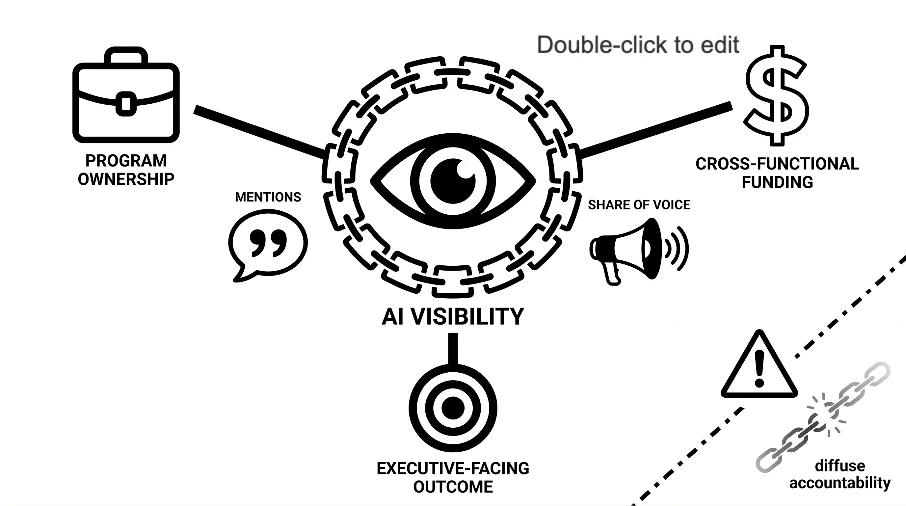
Black-and-white comic-style SaaS cluster diagram featuring an eye icon, briefcase, dollar sign, bullseye, and warning triangle.

Choosing the Right AI Visibility Term for Budget Planning and Team Ownership

Use "AI visibility" as the outcome word your executives approve against, then pair it with one operational term like GEO or AI search optimization for the tactics and the owner. The umbrella wins budget conversations. The specific term wins scoping conversations. Documenting what your chosen word covers matters more than picking the "correct" one.

Title:
First-Priority WordPress Audit Areas for AI Answer Readiness

Meta description:
Improve your AI SEO WordPress audit to earn AI citations. Learn how to fix crawler access and format content for

First-Priority WordPress Audit Areas for AI Answer Readiness

Audit access first. If AI crawlers can't fetch and read your priority pages, nothing else you fix will matter. After access, work through page clarity and entity consistency, then schema accuracy and internal links, and finish with content quality. Score each issue by business value against effort, then fix blockers before you touch anything cosmetic.

Minimalist design featuring three overlapping circles labeled 'Perplexity', 'ChatGPT', and 'Gemini', with icons and numeric tags.

Perplexity vs Other AI Search Tools: Where Brands Should Prioritize Visibility

Prioritize Perplexity separately when your buyers research with evidence in hand and when Perplexity's cited sources differ from what ChatGPT or Gemini surface for the same prompts. Perplexity shows citations on every answer, which makes source ownership measurable. Test your own prompts before you move budget, because priority depends on your category.