
How to build an SEO strategy
An SEO strategy is a written plan that connects the searches your buyers make to revenue targets your company has already set. Set goals first, then use them to prioritize keywords. Those priorities guide the content and technical work, which you measure to close the loop. In 2026 the plan also has to cover AI assistants such as ChatGPT, because buyers now ask them the questions they used to type into Google.
 Jevgenia PogadajevaCFO, Snoika · 12 min read

























Set goals before tactics
Start with the revenue number the business needs, then work backward to the organic traffic and rankings that will produce it. Teams that pick tactics first end up with traffic nobody can tie to pipeline, and the budget gets cut at the first quarterly review. A search engine optimization (SEO) roadmap tied to revenue reverses that order. Each piece of work then traces back to a sales target.
Build the roadmap in this sequence:
- Take the target from the sales plan. Ask finance or sales what share of next year's pipeline should come from inbound, and agree on a number for organic search.
- Map your conversion path. Use Google Analytics 4 (GA4) and your customer relationship management (CRM) system to find how many visitors become leads, and how many leads become opportunities. Industry averages are a poor substitute for your own rates.
- Turn the target into a traffic goal. Divide the pipeline number by your conversion rates to get the qualified organic visits you need each month.
- Audit where you stand. Pull your current queries and pages from Google Search Console (GSC) and list the technical errors. Note which competitors hold the positions you want.
- Sequence the work by quarter. Fix whatever blocks indexing first. Then build the pages closest to a purchase, and only then expand into wider educational topics.
- Set review dates. Agree on which metrics you'll check monthly and which you'll judge quarterly, before the work starts.
Maile Ohye, then a developer programs tech lead at Google, said in a Google video that "SEOs need four months to a year" to implement improvements and then see a benefit. New domains and crowded categories sit at the slow end of that range. Before you sign off the plan, check that every line item has an owner and a metric, and that the metric connects to the number in step 1.
Why growing companies need SEO
Growing companies need SEO because B2B buyers do most of their research alone, and search is where that research starts. A Gartner survey of 632 buyers found that 61% of B2B buyers prefer a buying experience with no sales rep involved. If your company doesn't show up while they research, you aren't on the shortlist when they finally talk to a vendor.
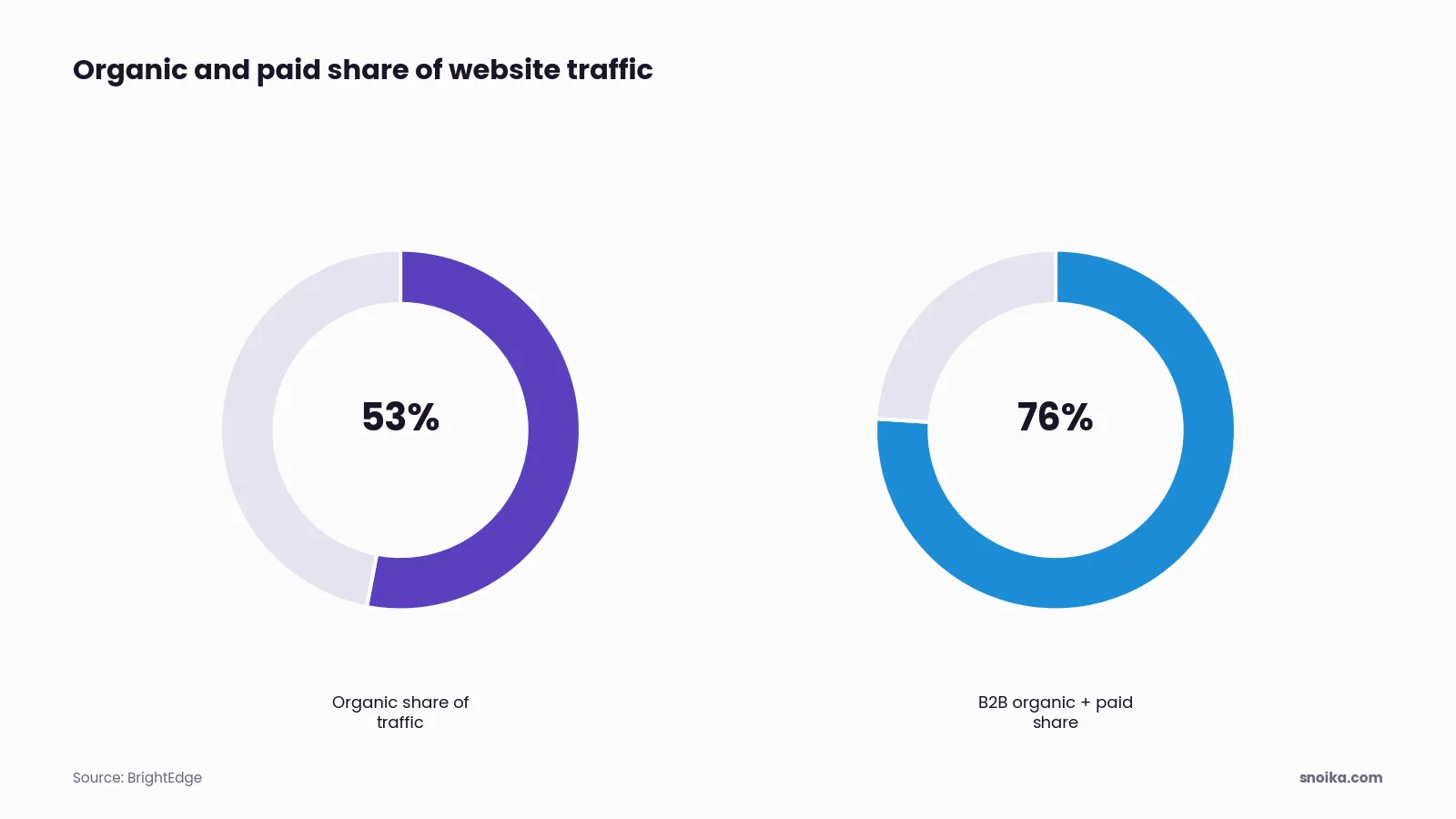
Search also carries more traffic than any other channel. BrightEdge research found organic search drives 53% of trackable traffic across websites. For B2B sites, organic and paid search combined reached 76%. Paid search stops the day the budget stops, while organic rankings keep paying back for as long as the page holds its position.
Growing B2B companies should start with a narrow focus close to revenue. Your first pages should answer searches for comparisons and alternatives from people who already have the problem your product solves. Pages about use cases by industry and integrations address those searches too. Pricing explanations also belong in this first set. Broad thought leadership can come later. Keeping the list small matters, because most published pages fail. An Ahrefs study of about 14 billion pages found 96.55% get no traffic from Google at all.
How much SEO you need depends on your sales cycle and deal size. A company with $50,000 contracts can justify a single page that brings in 2 leads a quarter. A low-priced self-serve product needs volume. Before you commit, check whether your buyers are moving to AI assistants. Alan Antin, a vice president analyst at Gartner, predicted that search volume will drop 25% by 2026. In his words, "Generative AI (GenAI) solutions are becoming substitute answer engines." Your SEO plan should treat those engines as a second channel to plan for, alongside Google.
Keyword priorities that drive pipeline
Rank keywords first by how close the searcher is to buying, then by whether you can realistically win the position. Look at search volume last. Most SEO plans reverse this order because volume is the easiest number to sort by. A keyword with 10,000 monthly searches from students brings in no pipeline. One with 90 searches from operations managers comparing vendors can fill a quarter.
Score each keyword on four attributes
Give every keyword on your long list a score from 1 to 3 on each attribute below. Business value counts double, because it decides whether a ranking ever turns into revenue.
| Attribute | Question to ask | Scores 3 when | Scores 1 when |
|---|---|---|---|
| Business value (x2) | Would this searcher buy what you sell? | The query names your category or the exact problem you solve | The topic is only loosely related to your product |
| Intent stage | Is the searcher learning or choosing? | Query includes "best", "vs", "alternative", "pricing" or "software for" | Query asks for a definition or a general explanation |
| Ranking feasibility | Can your domain reach page one within 6 months? | Current top results come from sites with authority close to yours | Top results all come from major publishers with large link profiles |
| Search volume | Is there enough demand to justify a page? | Volume is high for your niche | Volume is close to zero in every keyword tool |
Business value (x2)
- Question to ask
- Would this searcher buy what you sell?
- Scores 3 when
- The query names your category or the exact problem you solve
- Scores 1 when
- The topic is only loosely related to your product
Intent stage
- Question to ask
- Is the searcher learning or choosing?
- Scores 3 when
- Query includes "best", "vs", "alternative", "pricing" or "software for"
- Scores 1 when
- Query asks for a definition or a general explanation
Ranking feasibility
- Question to ask
- Can your domain reach page one within 6 months?
- Scores 3 when
- Current top results come from sites with authority close to yours
- Scores 1 when
- Top results all come from major publishers with large link profiles
Search volume
- Question to ask
- Is there enough demand to justify a page?
- Scores 3 when
- Volume is high for your niche
- Scores 1 when
- Volume is close to zero in every keyword tool
The highest possible score is 15. Put the volume score in context before you add it up. In niche B2B markets, a query with 50 monthly searches can still score 3.
Sort the scores into tiers
Group the results so the roadmap has an order. Keywords scoring 12 or more are tier 1, and they become the pages you build this quarter. Scores of 9 to 11 make up tier 2, which fills the next two quarters. Anything below 9 goes on a watch list, and you'll review it when your domain has more authority.
Next, group keywords that share an intent into one page. "Invoice automation software" and "automated invoice processing tool" are the same buyer asking the same thing. Two pages targeting them would compete with each other. Google the top candidates yourself and look at what ranks. If the results are product pages and you planned a blog post, change the format or drop the keyword.
Where volume figures mislead
Keyword tools estimate volume from clickstream samples, and their numbers for low-volume B2B terms are wrong. Your own GSC data is more reliable. It shows queries you already appear for with real impressions, even when the tools list those terms as zero. Check that report before you discard a keyword as "too small".
Building your content plan
A content plan turns the prioritized keyword list into a publishing schedule, with pages grouped by topic so each one strengthens the others. In a topic cluster, one broad pillar page covers a subject, and supporting pages cover its sub-questions in depth. The pages link to each other, which helps search engines understand that your site covers the subject thoroughly.
Write a brief for every page before anyone writes the page itself. The brief should cover:
- the target query and the secondary queries it absorbs
- the search intent and the page format that matches it
- what the current top results miss, which becomes your angle
- the internal links into and out of the page
- the subject-matter expert who will review it
- the conversion action the page should lead to
Publishing 4 strong pages a month for a year builds more than 30 pages in January followed by silence. A page that ranked in 2024 slips because competitors refreshed theirs, so schedule a review of every tier 1 page at least twice a year.
If you sell in more than one country, plan for localization from the start. Buyers in Germany and Brazil search with different terms and expect different examples, so a straight translation of an English page rarely ranks. SEO solutions built for this produce pages per market. Snoika, for example, creates content in 135+ languages and regional variants. Whatever you use, have a native speaker check the keyword choices for each market.
The common mistake is a calendar built around topics the team finds interesting. Before a page goes on the schedule, check that it maps to a scored keyword, and that no page you've already published targets the same intent.
Technical foundations that unlock growth
Technical SEO decides whether search engines can find and index your pages, and no content plan works until that's true. A single misconfigured robots.txt line or a canonical tag that points to the wrong URL can keep a whole section of your site out of Google, while the pages look fine to every visitor.
Run these checks before you scale content:
- Crawl access. Confirm robots.txt allows search engines, and that no hosting or firewall rule blocks their crawlers.
- Indexing. Compare the pages in your XML sitemap with the "Pages" report in GSC, and investigate every important URL marked "not indexed".
- Canonical tags. Each page should point to itself or to the one version you want ranked.
- Internal links. Every page you care about should be reachable within 3 clicks of the homepage.
- Structured data. Add schema markup where it fits, and make sure it matches the visible text on the page.
- Mobile rendering. Google indexes the mobile version first, so test key templates on a phone.
Google measures page experience with Core Web Vitals, and web.dev publishes the thresholds for a good experience:
| Metric | What it measures | Good | Poor |
|---|---|---|---|
| Largest Contentful Paint (LCP) | How fast the main content loads | 2.5 seconds or less | Over 4 seconds |
| Interaction to Next Paint (INP) | How fast the page responds to input | 200 milliseconds or less | Over 500 milliseconds |
| Cumulative Layout Shift (CLS) | How much the layout jumps while loading | 0.1 or less | Over 0.25 |
Largest Contentful Paint (LCP)
- What it measures
- How fast the main content loads
- Good
- 2.5 seconds or less
- Poor
- Over 4 seconds
Interaction to Next Paint (INP)
- What it measures
- How fast the page responds to input
- Good
- 200 milliseconds or less
- Poor
- Over 500 milliseconds
Cumulative Layout Shift (CLS)
- What it measures
- How much the layout jumps while loading
- Good
- 0.1 or less
- Poor
- Over 0.25
Google judges these at the 75th percentile of real visits, so one fast test on your office connection proves little.
A blog on a separate subdomain can be treated as a separate site, while pages on your own domain share the authority of your main domain. You can have the pages on your own domain without rebuilding your site. Snoika uses a DNS connection to publish pages on your own domain on any CMS without a migration. Fix indexing first, because that's where the fastest gains are. ABS Technologies saw "6x SERP impressions; improved keyword indexability and significantly increased search visibility within the first 30 days."
Link acquisition at scale
Links at scale come from publishing material other sites need to cite, and from outreach you repeat every month. A Backlinko analysis of 11.8 million Google results found the #1 result has 3.8x more backlinks than positions 2 through 10. The study shows correlation, but no other ranking signal has held up across so many studies.
The methods that keep working for B2B companies:
- Original data. Publish findings from customer surveys or an analysis of your product data. Journalists and bloggers link to numbers they can't get anywhere else.
- Expert commentary. Answer reporter requests in your field and offer your specialists as sources for trade publications.
- Partner and integration pages. If your product connects with other software, ask those vendors to list you in their directories and partner pages.
- Unlinked mentions. Search for your brand name on sites that mention you without a link, and ask them to add one.
- Free tools and templates. A calculator or checklist that solves a real task earns links for years.
Relevance matters more than raw count. One link from the leading publication in your industry does more than dozens from general directories. Avoid buying links that pass ranking credit, because they put the whole domain at risk for a short-term gain. When you check a link opportunity, ask whether a buyer can reach your site through it. If the answer is no, the link probably carries little value.
Track mentions as well as links. A brand named on a respected site without a link still counts for AI visibility, which the section below covers.
Measuring what actually matters
Measure organic pipeline and revenue first, then track the leading indicators that predict them. Rankings and traffic are useful early signals, but a report that ends with them can't answer the question your CFO will ask.
Leading indicators move first, within weeks.
- impressions for tier 1 keywords in GSC
- average position for those keywords
- number of indexed pages
- AI assistant mentions for your priority prompts
Organic leads and opportunities created from organic sessions are lagging indicators that move later and carry more weight. Closed revenue attributed to organic search is another. To see them, mark form submissions and demo requests as conversions in GA4 through Google Tag Manager (GTM). Then pass the source into your CRM so sales can see which page a deal started on. Any SEO partner needs that data. During onboarding, before any content work starts, Snoika asks for access to GA4 and Google Search Console. It also asks for Google Tag Manager access.
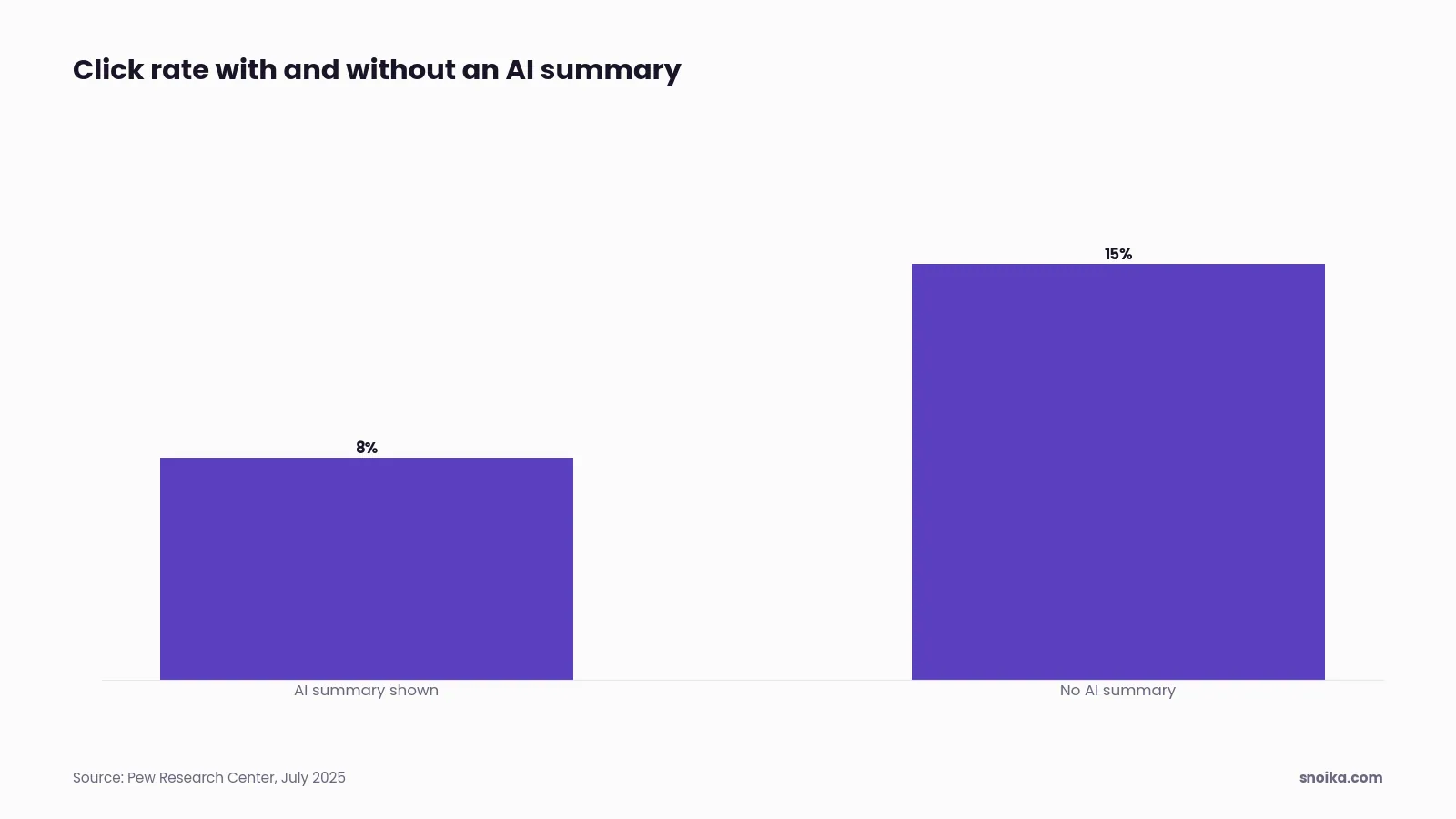
Pew Research Center analyzed 68,879 searches and found users clicked a result in 8% of visits when an AI summary appeared, against 15% when none did. If your impressions grow while clicks stay flat, AI summaries are absorbing the clicks even if your content strategy is working. Look at conversion rate and lead quality before you change course.
Attribute results to specific pages wherever you can. Agrello, an e-signature company, tracked "+125.6% organic search sessions YoY" and "generated 51.8K impressions from Snoika-created pages," which separates the new pages' contribution from the site's overall growth. Review leading indicators monthly and lagging ones quarterly. Judging revenue every month leads teams to abandon pages that need another quarter to mature.
Making your brand AI-visible
You get into AI-generated answers when assistants can find your pages, and when enough other sources mention your brand for the model to treat it as a credible answer. Sam Altman, CEO of OpenAI, said at the company's DevDay in October 2025 that ChatGPT had reached 800 million weekly users. Buyers use these tools to build shortlists, and a brand that never appears in the answer isn't on the shortlist. The work goes by names such as generative engine optimization (GEO) and answer engine optimization (AEO), but it splits into three tasks.
Make your pages eligible and easy to quote
Google's AI features need nothing beyond classic SEO. Google Search Central's documentation says a page must be indexed and eligible to show a snippet, and that "there are no additional technical requirements" for AI Overviews or AI Mode. The technical work above already covers eligibility.
How you write decides whether the assistant quotes you. Put the answer in the first sentence under each heading. Use specific numbers, and name your sources. Researchers at Princeton and partner universities tested content edits against a generative engine and found that additions of statistics and quotations, as well as edits to add citations, lifted a source's visibility by up to 40%. In the same tests, keyword stuffing made pages less visible.
Earn mentions beyond your own site
Your own pages are only part of what an assistant reads. In an Ahrefs study of 75,000 brands, branded web mentions correlated with AI Overview visibility at 0.664, against 0.218 for backlinks. Reviews and industry roundups count, as do mentions in podcasts or community threads where buyers discuss vendors. The brand name alone in the right context is what matters, so your PR and partner work feeds AI visibility directly.
Track prompts the way you track keywords
Write the 20 to 50 questions a buyer would ask an assistant about your category, and test them on a regular schedule. Answers change from run to run, so a single check tells you little. Snoika's tracking, for example, runs weekly prompt sets in ChatGPT and Google AI Overviews, where most AI search traffic happens. It measures mentions and share of voice. It also tracks sentiment and citations. Look at the competitors that appear when you don't, then study which sources the assistant cites for them.
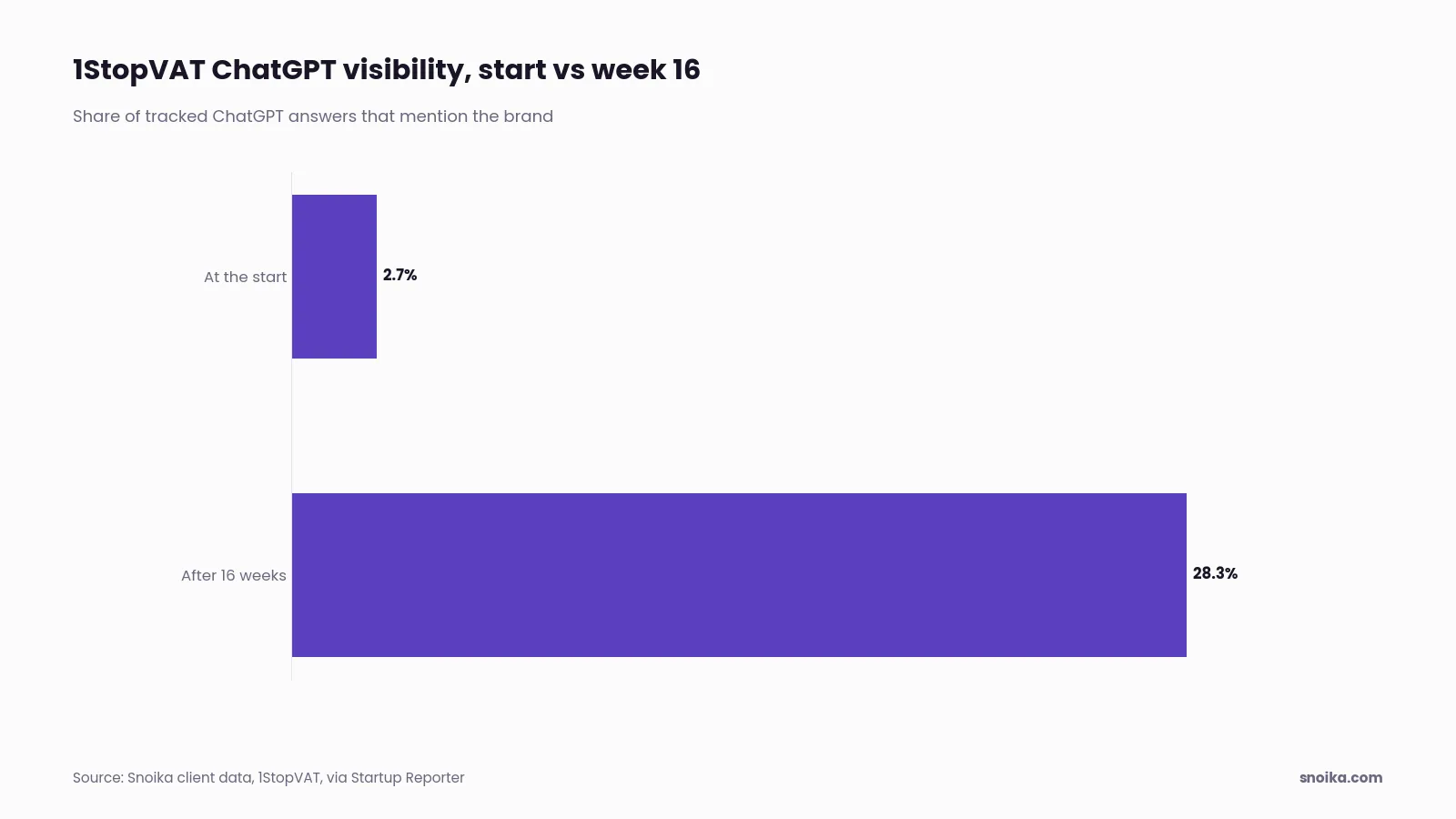
Results move faster here than in classic SEO when the groundwork is in place. Snoika's founder Anton Vedeshin reported to Startup Reporter 1StopVAT's move from 2.7% to 28.3% ChatGPT visibility in 16 weeks. 3DPrinterOS "achieved #1 visibility in ChatGPT for industry-specific queries and turned AI search into a steady inbound lead source: 3–4 qualified inbound leads/day."
Next steps
Take a baseline before you commit SEO budget to any tactic. Pick your 20 highest-scoring keywords and 20 buyer prompts, then record where you rank in Google and whether ChatGPT and AI Overviews name your brand. That snapshot shows which gap is bigger, and it gives every later report a fixed starting point. Without it, you can't show what your SEO strategy changed. Do it this month, even if the full roadmap takes longer to write.
At Snoika, we audit websites and track brand visibility in Google and AI assistants, with a human review layer on top of automated workflows. If you'd like a second opinion on your plan, book a call with our team.
FAQ
Focus your seo strategy on searches from buyers comparing options or checking pricing. Resolve indexing problems before expanding content, so those pages can appear in search. Judge their contribution by qualified leads and pipeline rather than traffic alone.
Start with the pipeline contribution expected from organic search, then use your own conversion data to estimate the traffic needed. Assign each planned task an owner and a metric tied to that target. Review early search signals monthly and pipeline results quarterly.
Use the page's 15-point scoring framework. Score business value and buying intent from 1 to 3, doubling business value. Score ranking feasibility and search volume from 1 to 3 each. Build pages scoring 12 to 15 first, checking that their format matches what currently ranks.
Make your pages accessible to search engines and write answers that assistants can quote. Support claims with named sources, and earn relevant mentions beyond your own site. Test buyer questions repeatedly to track inclusion, since answers change between runs.
The budget depends on your sales cycle and deal size, alongside the work your site needs. Audit technical barriers before estimating content costs. High-value contracts can justify pages that produce few qualified leads, while low-priced self-serve products need greater volume.


