Answer engine optimization tools for AI search dashboards

Content authorJevgenia Pogadajeva, MBA, MScPublished onReading time11 min read
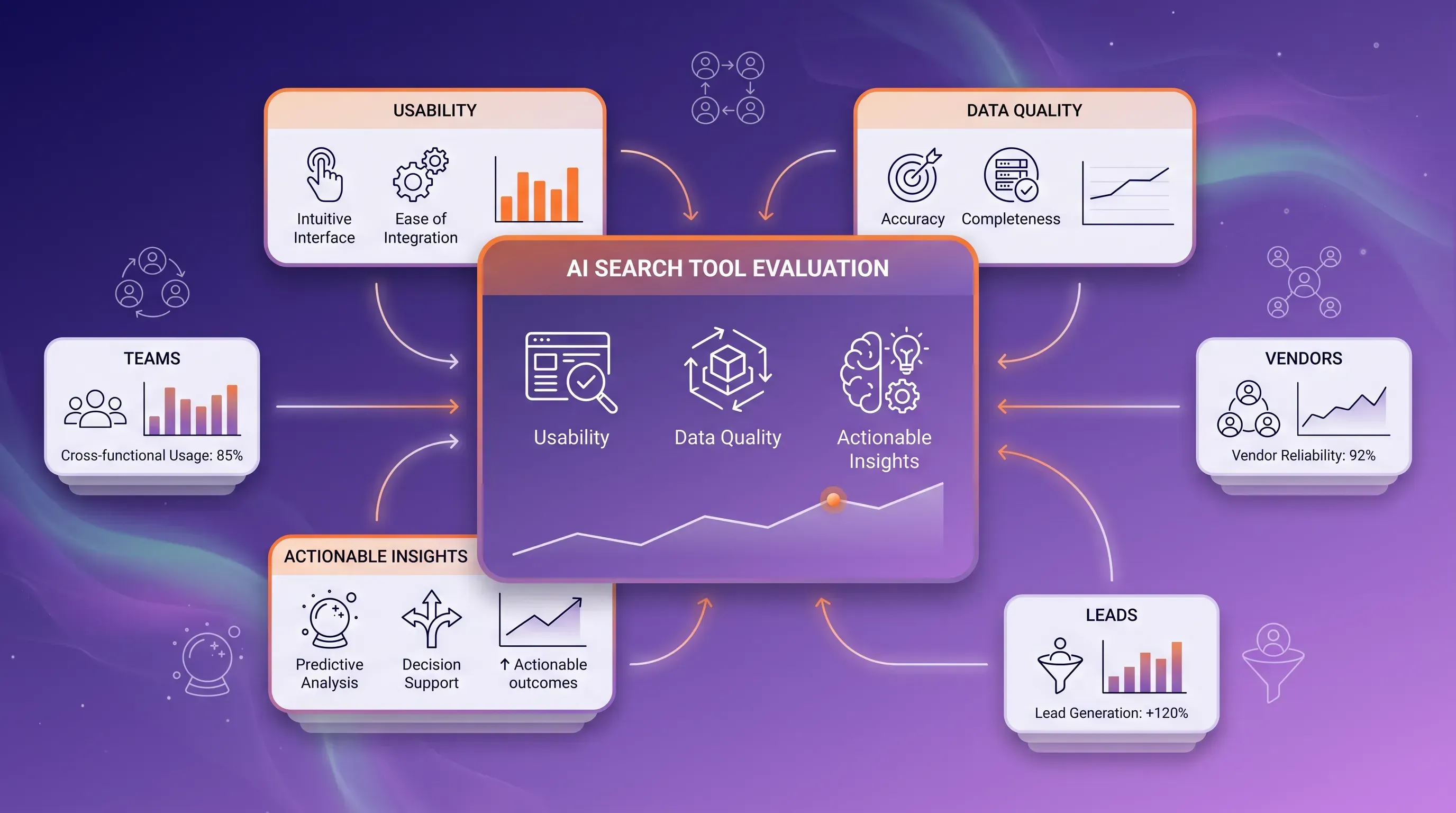
Abstract SaaS dashboard infographic with a deep purple gradient, featuring a central floating card and minimal icons for AI tool evaluation.

This article shows you how to evaluate answer engine optimization tools against the way your team actually works. It covers what makes a dashboard usable across roles and how trusted answer tracking data turns a screen reading into work.

Where tool comparisons leave you stranded

You have read the roundups. You can recite the metrics every vendor advertises, and you know which answer engine optimization tools track share of voice through brand mentions and citations. You have probably sat through a demo where the screen looked impressive. And you still cannot decide which one to buy or how to run it once the contract is signed.

That gap is not your fault. Most coverage lines up platforms feature by feature and stops exactly where the hard question begins. It tells you that Profound has citation tracking, and Peec AI, Otterly, and AthenaHQ all track citations across ChatGPT and Perplexity. What it does not tell you is whether the dashboard those tools produce is one a real team opens every morning and acts on. The market itself is crowded enough that this matters, with dozens of platforms now tracking brand mentions in AI answers in some form.

Think about how little of the buying decision a feature list actually settles. Two answer engine optimization tools can both claim competitor gap analysis. One surfaces the exact prompts where a rival is cited and you are missing, and the other draws a colored bar that says you hold 22% share of voice. Both tick the box. Only one changes what your writers do on Monday.

So the rest of this piece is the layer that sits between the feature list and the purchase order. You will leave able to judge answer engine optimization tools on whether the dashboard fits how your roles work and whether AI answer tracking data is trustworthy enough to drive a decision. That is the missing evaluation layer, and it is where the money you spend either earns out or sits idle.

What a usable AI search dashboard needs

A demo dashboard is built to sell. It loads fast, and the presenter drives a populated screen with practiced hands. A dashboard your team returns to is a different thing entirely, because it has to survive contact with four people who each want something different from it and none of whom have time to learn a new tool. The distance between those two experiences is where most AEO purchases quietly fail.

The reason this matters more now than a year ago is adoption. McKinsey's CMO survey, fielded to Fortune 500 consumer brands in September 2025, found that just 16% of brands systematically track AI search performance with AI answer tracking. Buying a tool puts you in the minority that measures at all. Getting the dashboard right is what separates measuring from acting.

Use the three requirements below as the checklist you carry into your next demo. Each one is something you can verify while a salesperson is sharing their screen, and each one is where a polished pitch falls apart under a direct question.

Role specific views

The same underlying data means different things to different people on your team, and a single generic view forces most of them to look away. Your content lead does not care about the leadership trend line. Your CMO does not want a prompt-level export. When one screen tries to serve everyone, it ends up owned by no one.

Here is what each role actually needs from the same dataset:

  • Content wants prompt-level gaps: the specific questions where your pages need citation, so a brief can be written against them.

  • SEO wants to see which URLs and sources the engines pull from, so the substrate underneath can be shaped.

  • PR wants cited sources and sentiment, so earned-media targets are obvious and tone problems surface early.

  • Leadership wants the trend and share of voice over time, without the operational detail underneath it.

When you sit in the demo, ask the vendor a plain question: do these views exist natively, or does someone rebuild them by exporting to a spreadsheet every week? The answer tells you whether the tool is a dashboard or a data source pretending to be one. A tool that needs manual export to serve a second role will be abandoned by that role inside a month, even among answer engine optimization tools with strong feature lists.

Need help with your AI visibility?

Book a free consultation with our experts we'll help you determine exactly which services your organization needs.

Competitor gaps in the AI search dashboard

Seeing your own visibility is the easy half. The half that changes decisions is seeing where a competitor is cited and you are absent, at the level of the individual prompt and topic. This is the single feature where answer engine optimization tools separate into the useful and the decorative.

A vanity view gives you a weekly share of voice donut where you hold 18% and a rival holds 30%. It feels like insight and produces no action. A genuinely useful competitor gap view names the prompt and shows the cited source for each competitor, with topic filters for the areas you have decided to own. That is a brief.

The reason gap specificity matters is that AI engines cite unevenly and unpredictably. A study by the Tow Center for Digital Journalism at Columbia found that across 1,600 queries, eight AI search tools cited sources incorrectly more than 60% of the time. If the engines themselves are that loose about attribution, a directional share-of-voice number tells you almost nothing about where to intervene. To test answer engine optimization tools, pick a topic you know cold and ask the vendor to show you the exact prompts where a named competitor beats you. If they can only show you a percentage, the gap data is not specific enough to act on.

Prompt set governance

The prompt set behind your AI search dashboard is the thing that decides whether any of the numbers mean anything, and it is the part almost nobody thinks about until it breaks. Every metric you read is downstream of the questions the tool asks the engines on your behalf. Change the questions and you change the story, whether you meant to or not.

Two failures come from ungoverned prompts. The first is staleness. A prompt set built around last quarter's product launch keeps reporting on a campaign the business has moved past, so the dashboard looks healthy while measuring the wrong thing. The second is volatility from ad hoc edits. When anyone can add or reword a prompt, your trend line jumps for reasons that have nothing to do with your visibility, and trend reporting becomes noise.

Treat the prompt set as an asset that needs an owner and change control. When you evaluate a tool, ask whether it lets you do the following:

  1. Assign ownership of the prompt set so someone is accountable for what it measures.

  2. Version prompts and see a history of changes, so a jump in the data can be traced to an edit.

  3. Tie groups of prompts to strategic initiatives, so a campaign's visibility can be read on its own without contaminating the baseline.

An answer engine optimization tools platform that lets anyone edit prompts with no version history will hand you a dashboard you cannot trust six weeks in. Governance is boring to demo and decisive in practice.

Need help with your AI visibility?

Book a free consultation with our experts we'll help you determine exactly which services your organization needs.

Judging AI answer tracking quality

Here is the trust problem stated plainly: a dashboard is only as good as the data feeding it, and AI answers are probabilistic by design. The same prompt run five times can return five different answers. The linked breakdown of probabilistic sampling, personalization, model version, and live retrieval shows how the output shifts before you even change a word. That means a single point estimate, one run of one prompt on one day, is close to worthless as a basis for a decision.

So the first question that separates defensible answer engine optimization tools from black boxes is how many times each one runs each prompt. Brand presence is a rate. If a tool checks a prompt once, you learn whether you appeared in that one sample, which tells you little about whether you appear reliably. A tool that runs each prompt multiple times and reports a frequency gives you something you can act on, because it treats the channel as the non-deterministic thing it is.

Refresh cadence is the second question, and it matters because the ground moves fast. Model behavior changes without warning, and market share among the engines is shifting month to month. Similarweb data compiled by Momentic shows ChatGPT's share of worldwide chatbot visits fell from 79% in May 2025 to 54% a year later, while Gemini climbed to 28% over the same stretch. A dashboard refreshed monthly will lag reality in a market moving that quickly, so ask exactly how often the tool re-queries the engines.

Cross-engine coverage is the third requirement for AI answer tracking, and single-engine tracking is a genuine blind spot. Similarweb cross-panel data shows about 20% of ChatGPT weekly users also use Gemini, and that 79% of OpenAI's paying customers also pay Anthropic. Buyers use two or three assistants, so tracking one means missing most of the picture for a typical customer. Confirm the tool covers ChatGPT and Gemini at minimum.

One more thing to press on: whether platform scores are kept separate or blended into a single number. A blended visibility score hides the fact that you dominate Perplexity and are invisible in Gemini, which is exactly the kind of difference that drives where you spend. Ask whether the tool stores raw answers for auditing, too. If you cannot go back and read the actual answer that produced a number, you are trusting a figure you can never check. A vendor confident in their data will let you audit it. A black box will change the subject.

From dashboard signal to action

A signal with no owner and no path to action is just a prettier version of not knowing. The whole point of the evaluation so far is to produce readings you can route to work. So the last thing to test in a tool is whether its signals connect to decisions, because the dashboard's job is to trigger the right team.

Different readings route to different work. Map them like this:

  • A visibility or content gap, where competitors are cited on a topic and your pages are absent, routes to content production. This is a brief and a page, owned by your content lead.

  • A cited-source or sentiment problem, where the engines pull from sites you have no presence on or describe you in the wrong tone, routes to PR and earned media. You cannot write your way onto a source that will not cite you.

  • A weak or inconsistent brand signal, where the engines are unsure what you are or confuse you with someone else, routes to authority and entity building. That is the slow work of becoming a clear entity through structured data and consistent naming.

This is why AEO ownership is cross-functional and cannot live inside SEO alone. The tool that helps you is the one that makes the routing obvious, so a reading lands on the right desk without a meeting to decide whose problem it is.

One discipline holds all of this together: react to confirmed trends. Because answers are probabilistic, one bad reading is a sample. Before you commission a page or brief a PR push, confirm the reading holds across repeated runs and across a refresh or two. The value of AI-referred visitors makes the patience worth it, since AI-referred visitors converted at 14.2% against 2.8% for Google organic in one analysis of over 12 million visits. The traffic is worth chasing. It is not worth chasing on a fluke.

Running your evaluation

Pull the pieces together into one repeatable routine. Score each tool in order: dashboard usability across your real roles first, then AI answer tracking data quality and its connection to decisions. Run a structured trial with your own team and your own prompts, and ask the questions this piece raised about data reliability and prompt governance. The best option among answer engine optimization tools is the one your specific team opens every day and acts on, matched to your stage and roles. If you are standing up an AI search dashboard and weighing answer engine optimization tools, use these questions to run the trial before you commit.

Need help with your AI visibility?

Book a free consultation with our experts we'll help you determine exactly which services your organization needs.

Test the tool with your own prompts, competitors, and team roles. Ask each role to complete one real task, such as finding a prompt gap or checking cited sources. A trial should show whether the dashboard supports daily work, not whether a demo account looks organized.

Weekly checks work for active programs because AI answers and model behavior change quickly. Daily checks help during launches or reputation issues, but they create noise if nobody reviews the results. Set a fixed review schedule and compare trend data across repeated runs before acting.

One team can coordinate reporting, but AEO work needs shared ownership. Content handles missing topic coverage, PR handles cited-source problems, and SEO supports technical and entity signals. Snoika’s article treats the dashboard as a routing system because different signals point to different workstreams.

A single score is useful only as a summary, not as the basis for decisions. Ask to see scores by engine, prompt group, and source type. The raw answer text matters too, because it lets your team verify why the platform counted a mention or citation.

Answer engine optimization tools should export prompt text, engine name, run date, cited URLs, brand presence, competitor presence, and the raw answer. Those fields let analysts audit changes and rebuild reports outside the platform. If exports only include summary scores, the data is hard to verify.

Schedule a Meeting

Book a time that works best for you

You Might Also Like

Discover more insights and articles

Title:
How to analyze competitors in AI search in 2026

Meta description:
Learn how AI search competitor analysis lets you map rival mentions and sources across platforms, so you can focus your next v

How to analyze competitors in AI search in 2026

This article is a step-by-step method for tracking where your competitors show up across ChatGPT and Perplexity. It explains how a prompt set becomes a per-platform competitive map through a log of each answer.

Title:
12 ai seo tools to improve rankings in 2026

Meta description:
Compare ai seo tools to find options that fit your budget and help you improve rankings or earn AI answer mentions.

Article:
# 12

12 AI SEO tools to improve rankings in 2026

This article walks through 12 AI SEO tools and names the one thing each does best, so you can tell which help with classic Google rankings and which earn you mentions inside AI answer engines. By the end, you can shortlist two or three that fit your budget and your priority.

Luminous SaaS workflow flowchart with a deep purple gradient, featuring a central 'Measurement Loop' card and surrounding UI cards.

LLM visibility as an AI search analytics workflow

This article turns a one-time LLM visibility check into a repeatable measurement loop you can run on a schedule and defend to leadership. It walks through the full workflow, from building prompt sets to reading competitor share of voice, and it draws a clear line between what the data proves and what it cannot.

Luminous abstract SaaS dashboard featuring a central card with a line chart and rounded bar widgets, set against a deep purple gradient.

LLM visibility tools: how to evaluate and use them

This article explains what LLM visibility tools do and which metrics deserve your attention, with context on how they generate their numbers. It gives you a methodology-first way to compare vendors and a workflow for turning a visibility gap into a move your team can own.