How to Help Your Business Appear in AI Answers and Overviews

Content authorArtem Lozinsky, EMBA, MScPublished onReading time11 min read
A professional family meeting in a bright office, with engaged expressions and soft shadows, emphasizing interaction and collaboration.

No submission form exists. Your business appears in AI answers when answer engines can crawl your pages and verify your claims against other sources they already trust. You improve the odds by fixing access and publishing answers to real buyer questions.

Can you submit your business directly?

There's no button. ChatGPT and Google's AI Overviews don't accept submissions, and any vendor selling you a guaranteed slot is selling something that doesn't exist. What you control is eligibility: whether the systems can reach your pages and understand what you sell.

The mechanics have also drifted away from the old ranking playbook. Ahrefs analyzed 863,000 keywords and 4 million AI Overview URLs and found that 38% of AI Overview citations come from pages in Google's top 10, down from roughly 76% in mid-2025. Google splits a query into sub-queries and pulls sources from each one.

Which means a page one ranking is a good thing to have and a weak thing to rely on. If you've been measuring your AI visibility by checking your rankings, you're watching a proxy that's getting looser every quarter.

What makes AI answers mention businesses?

Three things have to happen in order. An answer engine has to find your page and interpret what it says about your business before it will trust the claim enough to repeat it. Skip any one of those and the other two stop mattering. Most businesses that feel invisible in AI answers have a problem at step one or step two.

Cyrus Shepard's May 2026 Zyppy meta-analysis of 54 separate studies ranked the top five citation factors by evidence strength, and URL accessibility scored 9.5 out of 10. Accessibility outranking everything else tells you where the cheap wins are.

That ordering is worth taking literally when you plan work. An agency proposal that opens with a content calendar and never mentions crawler access has skipped the single best-evidenced factor in the entire list.

AI must discover your pages

Crawler access is the floor. If a bot can't fetch a page, nothing downstream happens, so your sitemap and your robots.txt rules are the first place to look. The wrinkle most teams miss is that training crawlers and retrieval crawlers are different animals with different user-agents.

Cloro checked 1,058 prominent domains and found OAI-SearchBot blocked by 3.4% against 13.9% for GPTBot. Blocking GPTBot keeps your content out of model training. Blocking OAI-SearchBot removes you from ChatGPT's live answers.

So the two decisions are separable, and you should make them separately. Plenty of businesses blocked the training bot for sound reasons, then assumed they'd made a single privacy choice, when what they actually did was one thing and not the other. Access creates eligibility without creating a mention.

AI must understand your business

Interpretation depends on consistency more than markup. Your name and service descriptions should read the same on your About page and your Google Business Profile. Contradictions force a model to guess, and a guess is where wrong answers come from.

Schema helps with clarity, but it won't manufacture authority. Ahrefs tracked 1,885 pages that added JSON-LD schema between August 2025 and March 2026 against 4,000 matched controls and measured no meaningful citation lift.

Read that as a ceiling. Structured data is how you stop a machine from misreading a page it already reached, which is a real job. It's just not the job of getting reached or getting believed, and treating it as a growth lever burns budget that belongs somewhere else.

AI needs evidence worth citing

Models cite claims they can corroborate. A page that states something specific and matches what third parties say about your business is easier to verify than a page of adjectives. Depth matters too, because fan-out queries reach sideways into related topics rather than hitting one head term.

Ahrefs studied 75,000 brands and found branded web mentions correlate 0.664 with AI Overview visibility, against 0.218 for backlinks. The top quartile by mentions averaged 169 AI Overview mentions compared with 14 for the next tier down.

That gap changes what a budget should buy. Being talked about consistently across the web now predicts AI visibility roughly three times better than being linked to, which puts reviews and editorial coverage ahead of a link-building retainer for most businesses.

Need help with your AI visibility?

Book a free consultation with our experts we'll help you determine exactly which services your organization needs.

What should your visibility audit check?

A baseline audit covers what AI platforms currently say about you and whether your site is technically ready to be read. It also checks whether anyone else on the web backs up your claims. Run it as a repeatable process, because AI answers move week to week.

They move more than most people expect. AirOps found in its 2026 State of AI Search that only 30% of brands stay visible from one AI answer to the next, and just 20% remain present across five consecutive runs of the same prompt.

So a single screenshot of ChatGPT naming your company proves almost nothing. Neither does a single screenshot of it naming a competitor. Your audit needs repetition built in from the start, because the difference between a real gap and normal output variance only shows up across multiple runs of the same prompt set.

Test buyer prompts across every platform

Build a fixed prompt set that mirrors how people actually shop, then run it across every platform your buyers use. Cover branded prompts and category prompts. Log the mention and every competitor that shows up instead of you.

Platform-by-platform testing isn't optional busywork. BrightEdge's Generative Parser found in March 2026 that answer engines disagree on brand recommendations 61.9% of the time across identical queries.

Nearly two-thirds disagreement means your visibility is not one number. You can be the default answer in Perplexity and absent from Gemini for the same buying question, and an audit that samples one platform will hand you a conclusion that's confidently wrong about the other three.

Check technical and entity readiness

Confirm that your money pages are crawlable and readable without JavaScript rendering getting in the way. Check canonicals and check that your organization and product details are accurate wherever they appear.

Two things to verify beyond robots.txt:

  • Your sitemap exists and is declared. A live crawl of roughly 50,000 connected sites by mySites.guru found 12.5% of WordPress sites declare no sitemap at all, and 9.6% serve no readable robots.txt.

  • Your edge security isn't overriding your intent. Cloudflare's September 2026 defaults challenge training and agent bots on ad-serving pages for new and unchanged free-plan sites.

A permissive robots.txt and a blocking firewall produce the same outcome as a block. That's the failure mode nobody catches, because the file looks right in every audit tool while the crawler never gets past the edge.

Map citation and authority gaps

Look at which domains the AI answers actually cite for your category, then ask whether you appear anywhere in that set. This is the layer where most gaps live, because AI citation pools are narrower than organic search results ever were.

The 5WPR Citation Source Index, built on 680 million citations, found that 15 domains control 68% of the citation pool. Verticals concentrate harder still. In B2B SaaS CRM, TechRadar alone accounts for 8.86% of category citations.

Your authority work should therefore target the specific gatekeepers your category uses. Pull the cited domains from your own prompt tests where a competitor appears and you don't, and treat that list as your outreach and review roadmap for the next two quarters.

Which improvements should come first?

Sequence by impact against effort, and the order is close to fixed. Blocked access and factually wrong descriptions come first because they're cheap to fix and they cap everything else. High-value questions you haven't answered come second. Authority building comes third because it's slow, not because it's optional.

Scarcity is the argument for ruthless prioritization. seoClarity's analysis found that as of October 2025 each AI Overview included an average of 3 URLs from the top 20 organic results, down from 5 in May of that year.

Fewer slots per answer means marginal improvements stop paying. Going from unreadable to readable earns you a seat at the table. Going from good to slightly better, on a page nobody can retrieve anyway, earns you nothing, which is why the ordering below isn't a preference.

Need help with your AI visibility?

Book a free consultation with our experts we'll help you determine exactly which services your organization needs.

Fix access before polishing content

Resolve retrieval problems first, then write. Indexing errors and blocked retrieval bots produce the same result: content that exists and can't be used.

The size of that penalty is measurable. Cloro's cross-reference of robots.txt rules against real citation data found the median GPTBot-blocking domain earns 0.003 ChatGPT citations per Google ranking it holds, against 0.417 for domains that let the crawler in.

That's a two-orders-of-magnitude difference in return on the exact same ranking strength. Whatever equity your site has already earned in classic search is sitting there unconverted while the crawler is locked out, and the fix is a text file edit plus a firewall rule.

Answer valuable questions with expertise

Build pages that answer one real buyer question at the top, in a sentence that survives being lifted out of context. Then earn it with firsthand evidence and original examples from your own work. Link related pages together so a fan-out query hits your cluster instead of one orphan post.

Structure does independent work here. Yu and MuFeng's March 2026 paper with Ding and Sato on structural feature engineering measured a 17.3% citation-rate improvement across six generative engines from structural changes alone as the semantic content stayed constant.

Same information, formatted for extraction, cited 17% more often. That's the cheapest content win available to you, and it applies retroactively to every decent page you've already published, which makes a restructuring pass better value than a new article.

Build corroboration across trusted sources

Strengthen what other people say about you, and favor accuracy over volume. Accurate reviews and editorial mentions in the outlets your category's answers already cite give a model the same story from multiple angles.

Distribution changes the math in a way most teams underestimate. Machine Relations' December 2025 study of eight stories found 19.2% of citations went syndicated-only, which means AI systems cited the third-party version of a piece and never cited the brand's original at all.

In nearly one answer in five, the brand did the work and the syndicated copy took the credit, which is a reason to place your material widely rather than guarding it. A mention you don't own still teaches the model who you are and what you're good at.

Should you invest in AEO or GEO?

Invest when your buyers research with AI and your category's prompts trigger substantive answers. You also need competitors already occupying those citations and someone who can maintain content and relationships past the first quarter. If your buyers still arrive through referral and outbound, spend there first.

Budget behavior suggests most companies have already answered yes. Conductor's State of AEO/GEO 2026 reports that enterprises allocated an average of 12% of digital budgets to answer engine optimization in 2025, with 56% of digital marketing leaders describing their generative engine optimization investment as high or significant.

Treat that as a benchmark for pace. The claim to reject outright is guaranteed placement, because no vendor controls which sources a model selects for a given prompt on a given day. What a good partner sells you is measurement and execution against the factors evidence actually supports.

How should you measure progress?

Measure a fixed prompt set on a schedule and watch the trend, because single answers are noise. Run the same prompts at the same interval across the same platforms, then track mention share and citation share.

Rotation is the reason a stable set matters. Profound's 2026 tracking found URL-level citation persistence of 10.6% across 28 days, with only 119 of 1,127 tracked URLs appearing in all three measurement waves, and roughly 40% to 60% of cited sources rotating monthly.

Here's what to do with that. Compare month over month at the prompt-set level, never at the individual-answer level, and give any change at least two measurement cycles before you act on it. A citation that vanished in week three came back in week six without you touching anything.

How can Snoika guide your roadmap?

Start by measuring, then work the priority order this article laid out. Snoika is an AI visibility platform built for exactly that sequence: it tracks brand mentions and citations across ChatGPT and Gemini, and shows which competitors appear when you don't.

The platform then turns those findings into a prioritized roadmap covering entity optimization and the corroboration signals that make claims verifiable. Founder Anton Vedeshin, previously co-founder and CTO of Vespia, reported client figures to Startup Reporter that covered 1StopVAT's move from 2.7% to 28.3% ChatGPT visibility in 16 weeks and 3DPrinterOS's 87% increase in LLM brand mentions.

Run your own baseline first. Snoika's AI visibility audit tests your brand across the major platforms and returns the prompt set and competitor list you'd otherwise spend a week assembling by hand.

Need help with your AI visibility?

Book a free consultation with our experts we'll help you determine exactly which services your organization needs.

Correct the source information first, then check the other pages that repeat it. Update your website, Google Business Profile, and relevant directory listings so the business name and service details match. Record the incorrect answer and rerun the same prompt later, because answer engines can retain outdated information after a page changes.

Review CDN and server logs for crawler requests, then compare those results with your robots.txt rules. A permissive robots.txt doesn't help if the firewall challenges or rejects the request. Test important pages from outside your normal browser session and ask your hosting or security provider to confirm which bot traffic reaches the origin.

There isn't a fixed waiting period for AI visibility changes. Run the same prompt set on the same platforms at regular intervals, then wait for at least two measurement cycles before judging an update. Source rotation is common, so one answer disappearing doesn't prove that your changes failed.

No, paid advertising can't guarantee inclusion in ChatGPT or Google AI Overviews. Advertising placements and answer citations use separate selection systems, and no vendor controls which sources an engine chooses for a particular prompt. Paid campaigns can support awareness, but they don't replace crawl access, clear information, or independent corroboration.

Encourage honest reviews that describe the service, location, and outcome in specific terms. Keep business details consistent across review platforms and your own pages, and don't script or fabricate customer comments. Accurate reviews give answer engines third-party evidence, which helps them connect your business with the services buyers ask about.

Schedule a Meeting

Book a time that works best for you

You Might Also Like

Discover more insights and articles

Minimalistic abstract SaaS marketing visual featuring a marketing team icon, split paths for 'SEO' and 'GEO', and essential line icons.

How Marketing Teams Can Decide If GEO Fits Their Search Strategy

Fund generative engine optimization (GEO) when your buyers consult artificial intelligence (AI) answers during research and your high-value queries already return synthesized responses you can measure at the prompt level. If any one is missing, fix the gap first. GEO is an addition to search investment.

Minimalistic SaaS marketing visual featuring a bold orange flow arrow connecting icons for exposure, traffic, and brand discovery.

How to Measure Whether Google AI Overviews Improve Brand Discovery

Measure discovery. Track how often your brand is cited and named inside AI Overviews and how your presence compares with competitors on the same queries. Then check whether branded search and revenue move in the same direction over the following weeks.

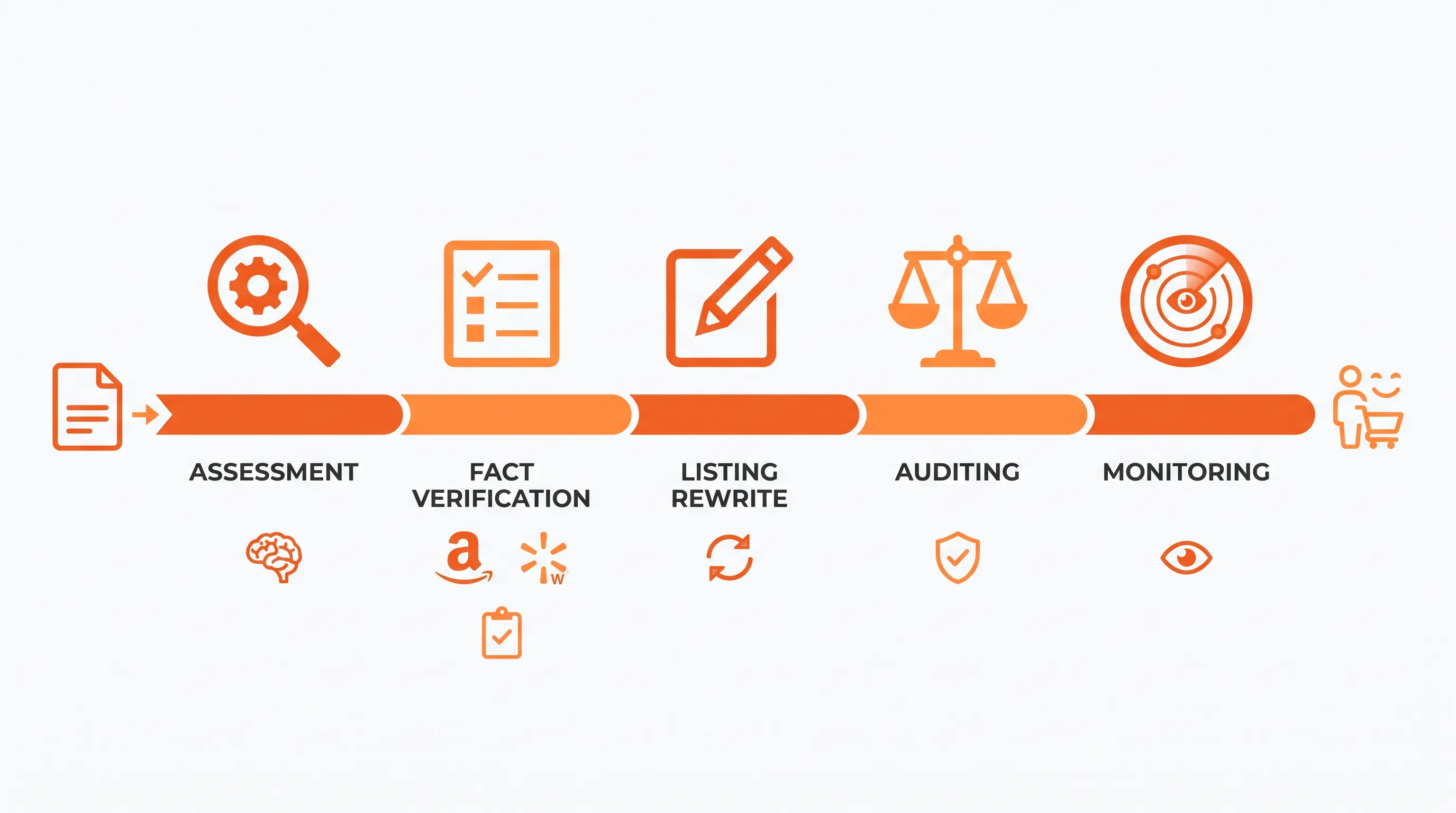
Minimalistic flow-based process illustration on a white background, featuring five icons for optimization stages with ample negative space.

How to optimize marketplace listings for AI search across Amazon and Walmart

This article gives you a repeatable workflow for improving how your products get found and recommended by Amazon's Rufus and Walmart's Sparky. It walks through baselining and rewriting each marketplace's fields on its own terms.

Minimalistic illustration of a sleek scorecard icon divided into 'Your Brand' and 'Competitors', surrounded by glowing line icons.

Benchmarking Brand Visibility in AI Answers Against Competitors

A benchmark of brand visibility in AI answers runs one fixed prompt set across chosen AI platforms and scores how often each brand appears and how it's described. You compare your brand against named competitors under identical conditions across repeated runs and treat differences as priorities rather than trivia.