How to optimize marketplace listings for AI search across Amazon and Walmart

Content authorArtem Lozinsky, EMBA, MScPublished onReading time11 min read
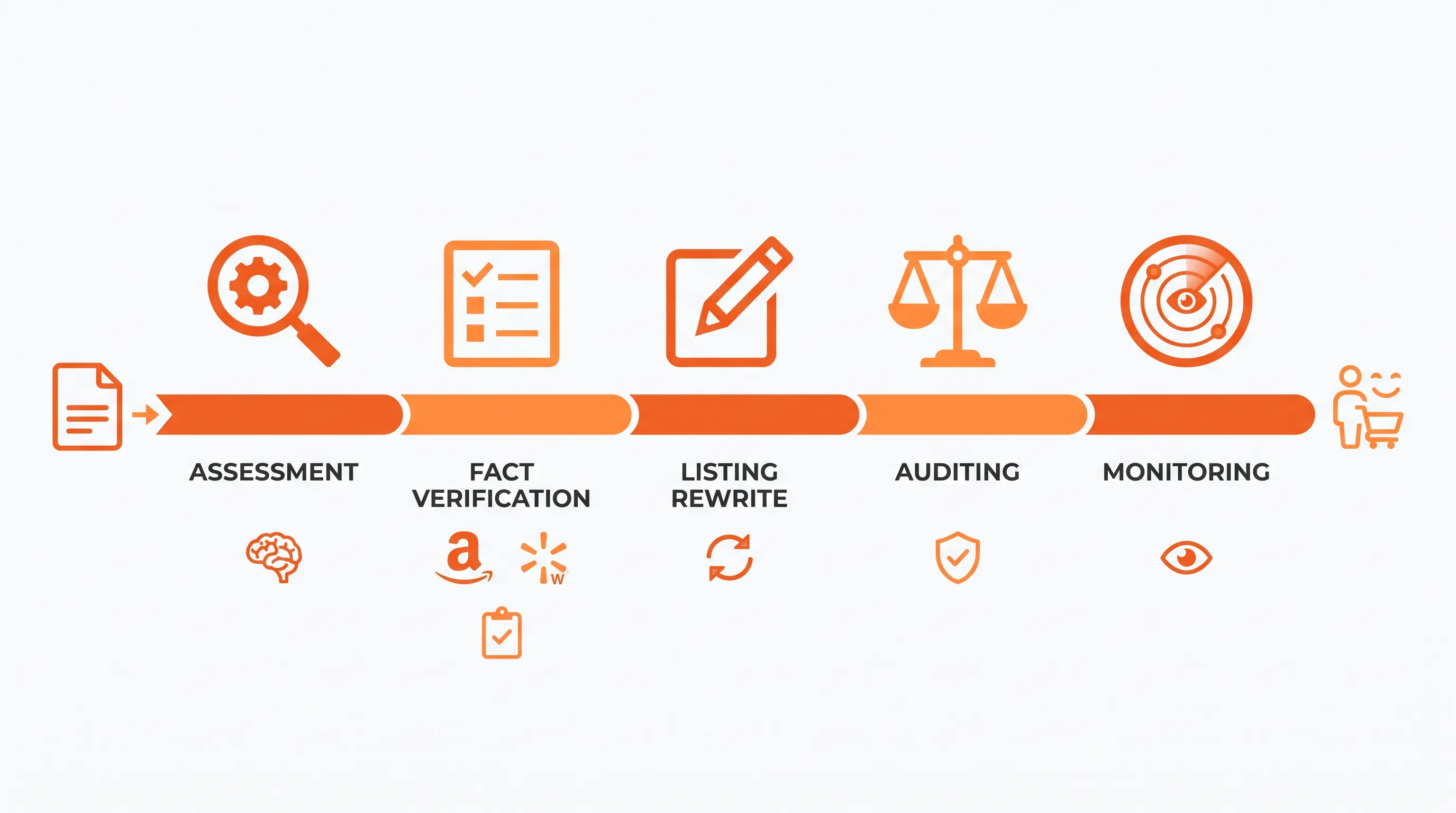
Minimalistic flow-based process illustration on a white background, featuring five icons for optimization stages with ample negative space.

This article gives you a repeatable workflow for improving how your products get found and recommended by Amazon's Rufus and Walmart's Sparky. It walks through baselining and rewriting each marketplace's fields on its own terms.

Why your catalog needs a second read

If you want to optimize marketplace listings for AI search, start by accepting that Rufus and Sparky read your catalog differently than the ranking systems you already know. They answer questions. They compare items. And they refuse to recommend anything they can't explain.

The scale is no longer speculative. Amazon reported that more than 300 million customers used Rufus during 2025. The assistant drove close to $12 billion in incremental annualized sales. On Walmart's side, roughly half of Walmart app users had tried Sparky by the Q4 FY26 earnings call, and those shoppers averaged about 35% higher order values.

You already know Seller Central and Walmart Seller Center. What follows is a process for turning that familiarity into AI visibility, one priority product at a time.

Establish an AI baseline

Pick six to ten products that matter to the business before you touch a single field. Then write a fixed set of natural-language shopping questions, the kind a person actually types: "what's a good cutting board for raw meat that won't warp" and "which one works in a small apartment." Ask the identical questions in Rufus and in Sparky, and save the answers.

The gap between traditional ranking and assistant answers is real. One analysis of Rufus recommendations found that only 22% of the products on Amazon's first results page matched what the assistant suggested, while 36% of its suggestions never appeared on that page at all. A listing can rank and still be invisible in the answer, which is why you optimize marketplace listings for AI search.

Record five things for every question you run:

  • Which products appeared, both yours and the ones that displaced you

  • The exact language the assistant used to justify each recommendation

  • The buying criteria it emphasized, such as material, capacity, or care requirements

  • Any direct comparison it drew between two items

  • The objections it raised or left hanging, like "reviewers mention it stains"

That log is your before picture. Everything you do to optimize marketplace listings for AI search from here gets judged against it, so keep it in a shared file with dates.

Build one fact sheet

Before editing anything, build a verified source of truth for each priority product. One document with one owner. It covers materials and finish, with exact dimensions in both inches and centimeters.

The discipline here is resolving conflicts. If your Amazon listing says bamboo and your Walmart listing says hardwood, someone has to open the spec sheet and decide. If marketing claims "lasts a lifetime" and the warranty says three years, the claim gets cut or rewritten to something you can support.

Walmart's own content policy is blunt about this. Its product detail page guidance states that all claims and descriptions "must match the actual product delivered, including size, color, quantity, materials/ingredients, features, benefits and limitations," and that requirement applies to AI-generated content as well. Unsupported copy is a liability that gets you rewritten or suppressed, and it's the reason a single verified fact sheet has to exist before you optimize marketplace listings for AI search on either platform. A product data audit can also help identify inconsistencies across catalog sources.

Optimize marketplace listings for AI search

Now translate. You have verified facts from the sheet and shopper questions from the baseline log, and the job is to connect them in language a person would recognize. Amazon's own seller guidance puts it plainly: make sure your titles, bullets, and descriptions "clearly answer common who, what, when, where, why, and how questions," because complete and accurate attributes help Rufus surface your product.

Assistants read for meaning, so a sentence that explains why the 12-inch depth matters in a standard kitchen drawer outperforms conversational phrases pasted into a keyword field. Each marketplace needs its own copy when you optimize marketplace listings for AI search.

Treat each platform's fields as a different container for the same set of verified facts. That's the practical core of how you optimize marketplace listings for AI search. For broader AI visibility, connect those listing improvements to the way assistants evaluate product information across the web.

Need help with your AI visibility?

Book a free consultation with our experts we'll help you determine exactly which services your organization needs.

Update Amazon fields

Titles come first, and they come with rules. Since January 21, 2025, Amazon has enforced a 200-character limit on most categories and banned decorative special characters. Lead with brand and product type, then the one or two attributes that decide the purchase.

Bullets should each answer a question from your baseline log. The description carries secondary use cases and compatibility details your bullets couldn't fit. Backend attributes in Seller Central do the classification work, so item type keyword and every category-specific field get filled from the fact sheet instead of left blank.

A Plus Content is where objection handling lives. A comparison module that spells out how your standard model differs from your pro model gives Rufus something structured to cite when a shopper asks about the cheaper version. Answer customer questions on the page too, because those answers become part of what the assistant reads.

Adapt Walmart content

Walmart wants shorter and cleaner. Its guidance recommends brief titles and caps each key feature at 80 characters, while also prohibiting retailer references and promotional claims. An Amazon bullet pasted straight across will almost always break one of those rules.

So rewrite. Use the description to carry the longer explanation and confirm the product type is correct before anything else, since the wrong product type means the wrong attribute set and the wrong search eligibility. Then let the Listing Quality dashboard grade the work. The score runs 0 to 100 and breaks down into content and discoverability and offer competitiveness, with recommendations attached to each gap.

Pay attention to the threshold effect. Walmart notes that items with low traffic, weak conversion, or a Listing Quality score under 50 can be omitted from Search Insights entirely, which means a weak listing loses you the diagnostic data you'd use to fix it. Clearing that floor is step one when you optimize marketplace listings for AI search on Walmart.

Add decision-making context

Assistants don't reward adjectives. They reward facts that help a shopper choose, which is why "holds a 9x13 baking dish with room for two mugs" does work that "spacious design" never will. Write use cases with the activity and the audience attached, and pull the phrasing from the questions your baseline log captured.

Comparison facts are the second layer. Say what your 24-hour battery does that the 12-hour model doesn't, and say it with numbers you can verify. Images carry the same weight, since dimension graphics and what's-included shots answer sizing questions that text alone leaves fuzzy. Accuracy matters more than polish here, because misleading images generate returns.

The third layer comes from your own returns and reviews. Sort the last quarter of return reasons and negative review themes, then answer the two that repeat directly in the listing. Given that an estimated 19.3% of online sales were returned in 2025 according to the National Retail Federation and Happy Returns, and that Akeneo found 59% of consumers returned an item because the online description was misleading or inaccurate, this is the cheapest fix available to you. What you can't do is claim superiority you can't support, because both marketplaces prohibit it and the assistants have your reviews to check against. E-commerce teams can use ecommerce teams workflows to connect these insights with broader marketing decisions.

Need help with your AI visibility?

Book a free consultation with our experts we'll help you determine exactly which services your organization needs.

Check listing consistency

Once the edits are live, audit them against the fact sheet. Read the visible copy and the structured attributes. You're looking for one thing: any place where the listing contradicts itself.

Contradictions are common and boring. The title says 6-pack, the attribute says 4. The Amazon page says dishwasher safe, the Walmart page says hand wash only. A shopper who notices gets confused and buys elsewhere, and a shopper who doesn't notice buys and returns it.

The AI cost is separate and worse. An assistant that finds conflicting data in your listing has no confident answer to give, so it recommends the product it can explain instead. Consistency is what makes your product safe to recommend.

Avoid discovery blockers

Some mistakes suppress AI visibility faster than any optimization can recover it. Each one below has a straightforward correction:

  • Keyword stuffing in titles. Amazon now rewrites non-compliant titles automatically, so trim to the attributes that decide the purchase and move the rest into the description.

  • Blank optional attributes. Treat every empty field as a question the assistant can't answer, and fill it from the fact sheet.

  • Wrong category or product type. Fix this before touching copy, because it determines which attributes you're even allowed to complete.

  • Contradictions between the title, bullets, and specification table. Run the consistency audit described above and make the fact sheet the tiebreaker.

  • Copy duplicated verbatim across both marketplaces. Rewrite for each platform's character limits and content rules instead.

  • Rewriting the entire catalog in one sprint. Change too much at once and you lose any ability to tell what worked.

That last one is the trap that catches experienced teams. Discipline about scope is what lets you optimize marketplace listings for AI search and actually learn something from the result.

Test priority listings first

Choose the test group deliberately. Revenue importance is the obvious filter, but the more useful signals are products with healthy traffic and weak conversion, and products your baseline showed missing from assistant answers where a competitor appeared instead. Six to ten items is enough to learn from and small enough to control.

Then rerun the same question set on a fixed cadence. Every two weeks works for most catalogs, so give backend attribute changes a week or two before judging them. Use the identical wording each round, because changing the question invalidates the comparison.

Log every content change with a date and the field edited. When visibility moves three weeks later, that log is the only thing that tells you which edit moved it.

Measure results separately

Assistant visibility is evidence. Neither marketplace reports how many sales came through a conversational answer, so treat your question-set results as a diagnostic that sits alongside the reporting you already trust.

On Amazon, that means the Search Query Performance dashboard in Brand Analytics, which shows impressions and purchases for the queries leading to your products, plus your share of each against the category total. On Walmart, the Search Query Report in Search Insights covers impression share and click share by query, and the Listing Quality dashboard tracks whether your content gaps actually closed. A visibility report can provide an additional view of how your brand appears across AI search results.

Read them together. If Rufus started naming your product for "best option for small kitchens" and your Amazon cart-add share rose on related queries in the same window, that's a coherent story worth acting on. If the assistant now names you and nothing downstream moved, the listing fixed a discovery problem and left a pricing or review problem untouched. Keeping those signals in separate columns is how you optimize marketplace listings for AI search without fooling yourself about causation.

Check broader AI visibility

Rufus and Sparky aren't the only assistants describing your products. Walmart's Sparky began operating inside ChatGPT in March 2026, and shoppers research purchases in Perplexity and Google AI Overviews well before they reach a marketplace. Your Amazon and Walmart pages get cited in those answers, and so does your own site and your reviews on third-party sites.

Snoika monitors that layer. The platform runs continuous prompt analysis across ChatGPT, Perplexity, Google AI Overviews. It records whether your brand is mentioned and how your mention rate compares to competitors over time.

Keep this reporting in its own file. Off-marketplace citations tell you how your brand is described in the wider research phase, which is a different question from how your listing performs inside Amazon or Walmart. Mixing the two produces a dashboard nobody can act on.

Where this leaves you

Nothing here requires new tooling to begin. A verified fact sheet and platform-specific rewrites will move six priority products within a quarter, and that result tells you whether to scale the process to the rest of the catalog.

Snoika tracks the AI answers your marketplace pages and brand content show up in, across ChatGPT and Perplexity, so you can see the visibility Seller Central never reports. Start a free trial and get a read on where you stand before you optimize marketplace listings for AI search at scale.

Need help with your AI visibility?

Book a free consultation with our experts we'll help you determine exactly which services your organization needs.

Use six to ten priority products first. Choose items with meaningful revenue, healthy traffic but weak conversion, or competitor recommendations that displaced your products. This controlled group helps you optimize marketplace listings for AI search and identify which edits deserve wider use.

Check both listings against one verified product fact sheet, then correct the marketplace fields that conflict. Confirm materials, dimensions, quantities, care instructions, and warranty terms before rewriting copy. The fact sheet should decide which claim stays when marketing language and product records disagree.

Rerun the identical question set every two weeks. Keep the wording, products, and logging format consistent so changes remain comparable. Give backend attribute updates one or two weeks before judging them, and record each edit with its date and affected field.

Compare assistant recommendations with marketplace performance reports. Amazon’s Search Query Performance dashboard provides query impressions, purchases, and share data, while Walmart’s Search Query Report shows impression and click share. If visibility rises without stronger downstream results, investigate price, reviews, or conversion factors.

Yes. Snoika tracks brand mentions and competitor comparisons across ChatGPT, Perplexity, and Google AI Overviews. Keep this broader visibility data separate from Amazon and Walmart reports because it describes research-stage exposure. You can start a free trial on the Snoika platform to review your current visibility.

Schedule a Meeting

Book a time that works best for you

You Might Also Like

Discover more insights and articles

Minimalistic illustration of a sleek scorecard icon divided into 'Your Brand' and 'Competitors', surrounded by glowing line icons.

Benchmarking Brand Visibility in AI Answers Against Competitors

A benchmark of brand visibility in AI answers runs one fixed prompt set across chosen AI platforms and scores how often each brand appears and how it's described. You compare your brand against named competitors under identical conditions across repeated runs and treat differences as priorities rather than trivia.

A bold AI assistant icon at the center, surrounded by negative space and a sparse ring of simplified brand icons in vibrant orange.

AI Visibility Diagnostic: Why Assistants Overlook Your Brand

Assistants overlook your brand for one of four reasons: your content doesn't answer the questions buyers actually ask or your pages can't be crawled or read. Positioning that confuses the model about what category you're in and third parties that validate competitors instead of you belong on that same list. A structured prompt audit tells you which one before you spend anything.

A minimalistic illustration of a segmented arrow representing the citation readiness process for AI search engines, featuring sleek icons.

First AI SEO Steps to Make Content More Citation-Ready

Pick a small set of commercially valuable pages and score each one for clarity and accessibility. Fix only the lowest scores. Citation readiness means a page is easy for an AI engine to find and quote. You raise the odds of being cited. You never guarantee it.

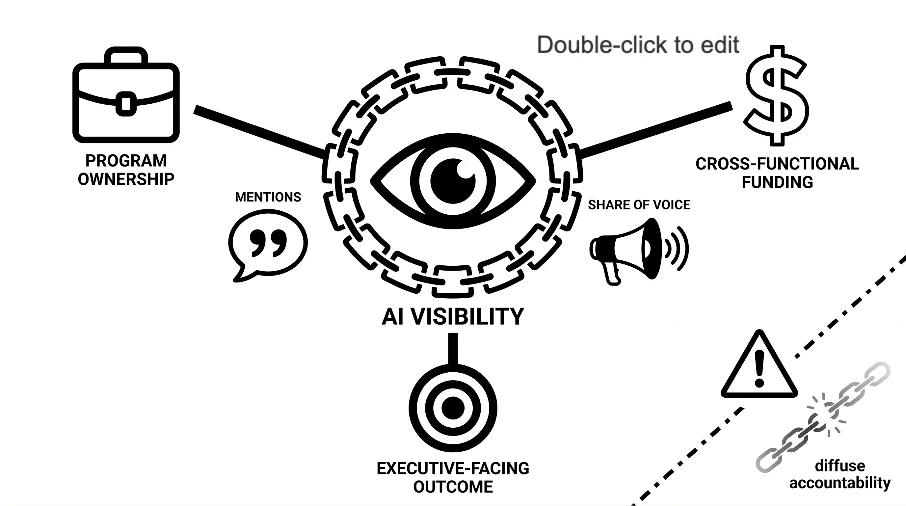
Black-and-white comic-style SaaS cluster diagram featuring an eye icon, briefcase, dollar sign, bullseye, and warning triangle.

Choosing the Right AI Visibility Term for Budget Planning and Team Ownership

Use "AI visibility" as the outcome word your executives approve against, then pair it with one operational term like GEO or AI search optimization for the tactics and the owner. The umbrella wins budget conversations. The specific term wins scoping conversations. Documenting what your chosen word covers matters more than picking the "correct" one.