
Content marketing trends for 2026
The content marketing trends that matter most in 2026 reflect how buyers now read an AI-written answer before they open your website. Google's AI Overviews and ChatGPT choose a small set of sources and quote them. A page earns its value by being one of those sources. That puts original data and deep topic coverage at the top of any content marketing strategy, and it makes your share of AI answers a number you report next to rankings.
 Jevgenia PogadajevaCFO, Snoika · 10 min read

























AI is rewriting content discovery
For a large share of searches, an AI assistant now stands between your buyer and your website. Alphabet CEO Sundar Pichai told investors that AI Overviews reached 2 billion monthly users in July 2025, up from 1.5 billion in May. A few months later, OpenAI CEO Sam Altman said ChatGPT had hit 800 million weekly users. Your buyer sees a summary first and your page second, if they see it at all.
A good ranking no longer guarantees a place in that summary. In July 2025, Ahrefs found that 76% of AI Overview citations came from pages in Google's top 10. When Ahrefs ran the study again in March 2026 across 4 million cited URLs, only 38% came from the top 10. Ahrefs puts the drop down to Google retrieving sources for sub-questions it writes itself, instead of the query the user typed.
Queries for quick facts get answered on the spot, and the search ends there. Comparisons and vendor evaluations produce longer answers that cite more sources, and those queries sit closest to revenue. AI Overviews run in more than 40 languages, and an answer written in Spanish has to cite something. We create content in 135+ languages and regional variants because a page that exists only in English is a weak candidate for a Portuguese or Polish answer.
Start by listing the 20 queries closest to a sale. Run each one in Google and in ChatGPT, then note whether an AI answer appears and whose pages it cites.
How AI filters content
AI search retrieves pages for a set of sub-questions in its first pass, then keeps the passages that answer one of them plainly in its second. According to Google's I/O 2025 announcement, AI Mode "uses our query fan-out technique, breaking down your question into subtopics and issuing a multitude of queries simultaneously on your behalf." One buyer question turns into a dozen narrower searches, and your page competes in each one.
The second pass favors brands the wider web already talks about. In an Ahrefs study of 75,000 brands, branded web mentions correlated with AI Overview visibility at 0.664 against 0.218 for backlinks. So off-site reputation now carries more weight than the link profile most SEO budgets were built around.
Both passes also involve quality checks. Liz Reid, VP and head of Google Search, explained the value of depth in a Wall Street Journal interview: people skip "surface-level AI-generated content" because "if they click on that, they don't actually learn that much more than they previously got." Google wants the click to go somewhere that adds something.
Pages get dropped for two failures: an answer buried under a long introduction or content that repeats what ten other pages already say. The first of two questions to ask about your priority pages is whether the first sentence under each heading answers that heading on its own. And do sites you don't own mention your brand by name?
Optimizing for zero-click answers
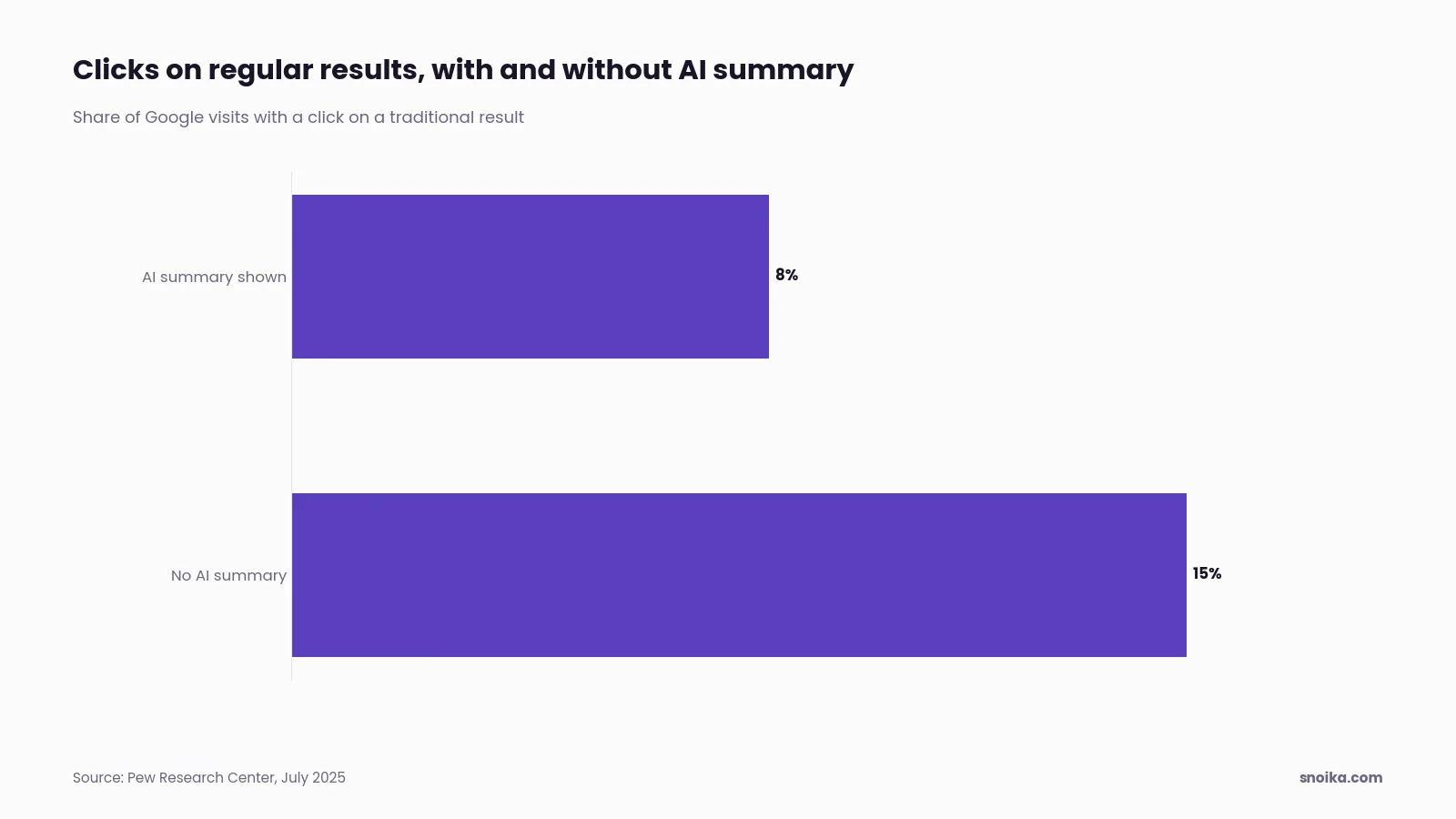
With AI Overviews, an SEO content marketing plan needs to earn citations inside the answer and convert the smaller group who still click. Pew Research Center tracked 68,879 real Google searches and found users clicked a traditional result in 8% of visits with an AI summary, against 15% without one. Users also ended their browsing session after 26% of visits that showed a summary.
Seer Interactive found that sites cited in AI Overviews earned a 35% higher organic click-through rate (CTR) than sites left out. Tracy McDonald, who led the study, said, "We cannot definitively prove that citation causes higher CTRs; it's equally possible that brands with stronger authority and higher baseline CTRs are simply more likely to be cited by Google's AI." Either way, the cited brand gets the clicks that remain.
Four changes for zero-click content
- Put a complete answer in the first sentence or two under every heading, so a passage can be lifted without its context.
- Write for compound questions a summary can't settle. Pew found the typical AI summary runs a median of 67 words, which is too short for "which option fits a 40-person team on a fixed budget."
- Give landing pages a clear next step, because the visitors who click arrive further along in their decision.
- Report leads from AI-referred visits.
3DPrinterOS achieved #1 visibility in ChatGPT for industry-specific queries and turned AI search into a steady source of 3–4 qualified inbound leads/day. Traffic volume told them less than lead count did.
B2B content trends shaping 2026
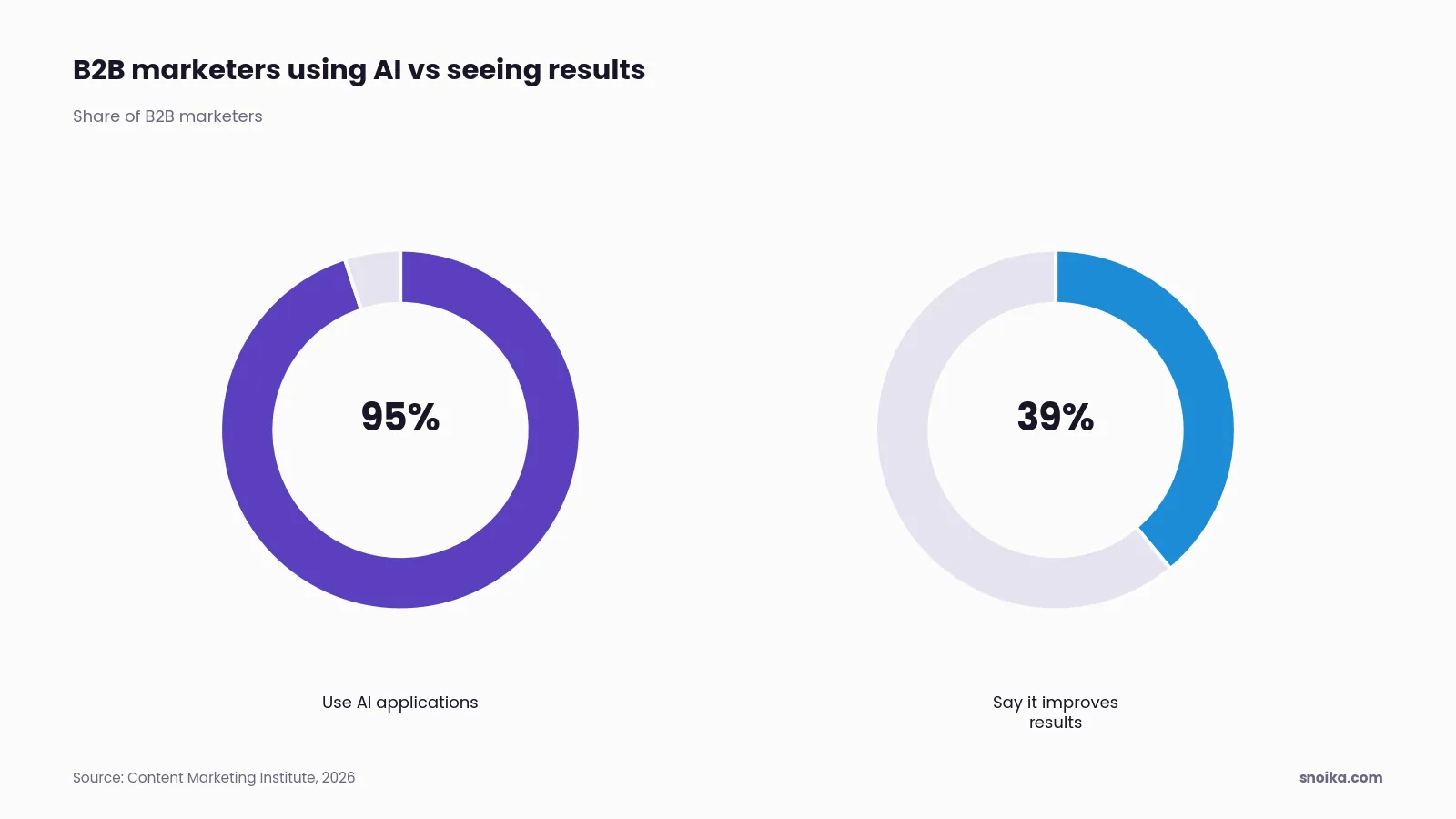
B2B buyers now do most of their vendor research inside AI tools, and B2B content marketing teams are still catching up. Forrester's Buyers' Journey Survey found that 94% of business buyers used AI in their buying process. Twice as many named generative AI their most meaningful source as named any other source. Sellers have adopted AI too. The Content Marketing Institute (CMI) reports that 95% of B2B marketers use AI applications, but only around 39% say it improves performance.
Which content types AI tools recommend to B2B buyers
AI tools draw most on content that helps a buyer compare and verify. Forrester's 2026 data shows 55% of buyers compare vendors in AI tools, and 54% research products there. Answers to those prompts pull from comparison pages and public pricing, then check them against third-party coverage. Semrush's three-month citation study found PR Newswire and Forbes among the biggest ChatGPT citation gainers, so earned media sits alongside your own pages.
So build the pages a buyer's prompt asks about. An honest comparison against the alternatives comes first, and a pricing page with real figures or ranges comes next. After those, add documentation on integration and security. Include case studies that state numbers.
Why thought leadership needs proof
Opinion pieces now blend together because almost everyone publishes them. CMI counts 96% of B2B brands producing thought leadership. An AI answer can paraphrase a view without naming anyone. It has to name the source of a figure or a named method. Thought leadership that gets cited carries something checkable. Vespia, a fintech SaaS, recorded a 220% increase in AI brand mentions as a result.
How shortlists form before the first sales call
Buyers settle their shortlist before they talk to you. The 6sense Buyer Experience Report found the winning vendor was on the buyer's day-one shortlist 95% of the time. If AI answers leave you out during that early research, a strong sales team rarely gets the chance to fix it.
Original research earns citations
Original data earns citations because an AI answer that states a number needs a source to attach it to. In the 2024 paper that named generative engine optimization (GEO), researchers from Princeton and Georgia Tech worked with colleagues from IIT Delhi to show that optimizing content can raise visibility in AI answers by up to 40%. Adding statistics and quotations were among the methods they tested. When you are where a figure comes from, every page that repeats it points back to you.
Your research doesn't need a big budget. A survey of your customers or anonymized usage data from your product counts. A yearly pricing benchmark does too. What changes from one study to the next is credibility, and that comes down to sample size and how often you update. A yearly index beats a one-off report, because each edition gives AI tools and journalists a fresh date to cite.
Most original research fails because teams lock the findings in a gated PDF that crawlers can't read or publish a headline number with no methodology behind it. The first of four pre-publication checks is that the key finding appears in the first paragraph of an open HTML page. The sample and the dates go beside it. Each chart gets a sentence that states its number. And the page carries the year in its title, so it can be updated before content decay sets in.
Building topical authority fast
You build topical authority for AI answers by giving every sub-question in your topic its own page on one domain, all linked together, so fan-out queries keep landing on you. Ahrefs found that only 12% of AI-cited URLs rank in Google's top 10 for the original prompt. Its advice was "optimizing for query variations, building topic clusters, and 'owning the entity'." Depth across a topic counts for more than one strong page.
- Collect the questions buyers ask from sales call notes and Google Search Console queries. Add the prompts you tested earlier.
- Group them into one pillar topic, with a page for each distinct question.
- Write the pages that sit closest to purchase first, such as pricing and comparisons. In SaaS content marketing, implementation pages also belong in this group.
- Publish in batches, because a cluster of 20 pages shows coverage that four pages spread across a quarter can't.
- Link each page to its pillar and to its nearest neighbors.
- Revisit the cluster every quarter to add pages for new prompts and update figures.
We publish on the client's own domain because where the pages live matters as much as how many there are. Pages go live through a DNS connection. This works on any CMS without a migration. The client approves each page in the dashboard before it goes live. Agrello, in e-signature, saw +125.6% organic search sessions YoY and generated 51.8K impressions from Snoika-created pages. A cluster on the main domain adds to the authority you already have instead of starting from zero on a new site.
Video in AI search
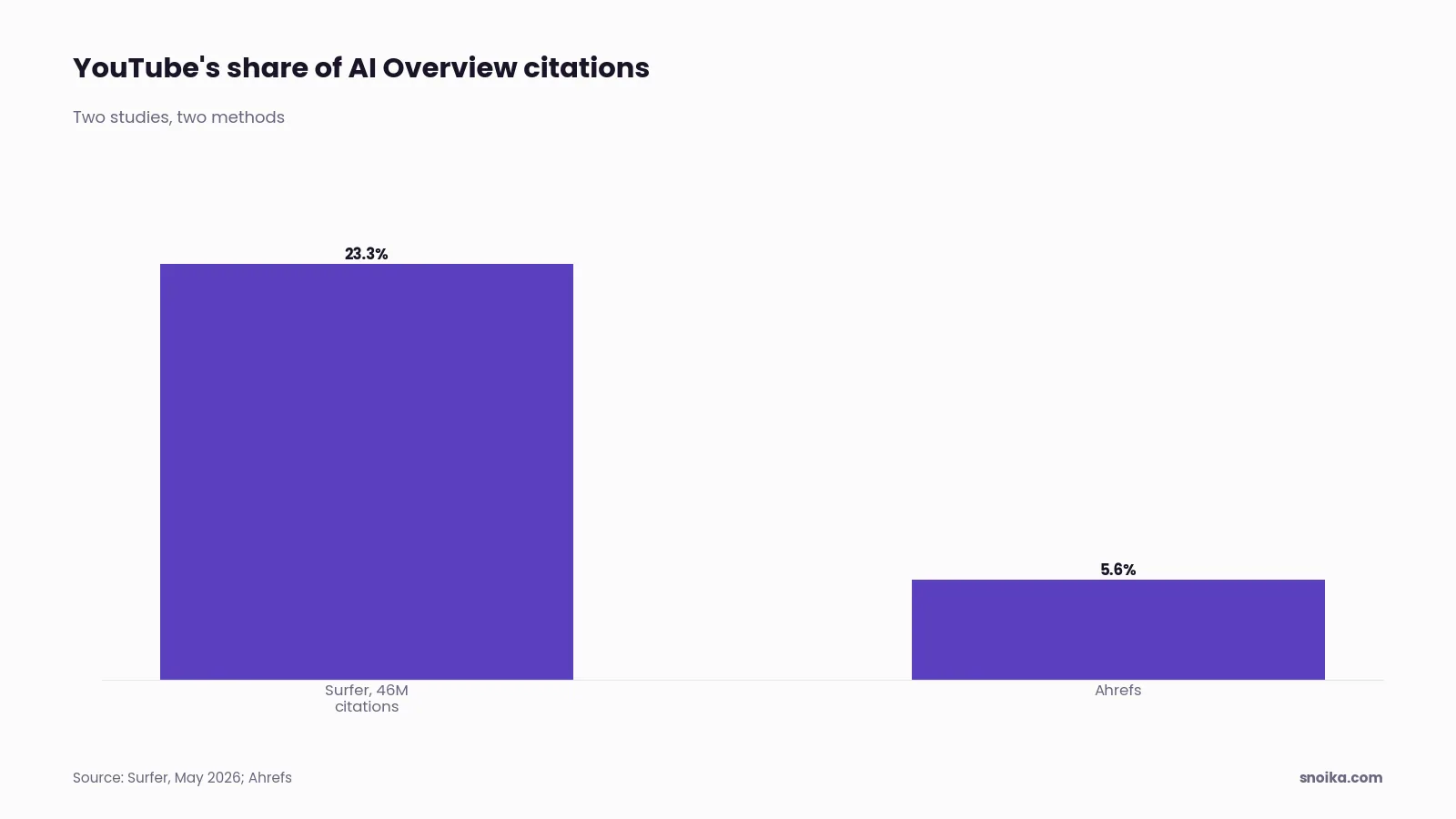
YouTube videos get cited in AI answers far more often than most content plans allow for. Surfer's analysis of 46 million AI Overview citations, published in May 2026, put YouTube at 23.3% of citations. Ahrefs measured a smaller share of about 5.6%, so the exact size depends on the method. Both studies still place YouTube among the most-cited domains. In a follow-up 75,000-brand study, Ahrefs found YouTube mentions beat every other factor for correlation with AI visibility.
Google's surfaces cite YouTube heavily, but Gumshoe's dataset of 1.1 million YouTube citations found OpenAI models accounted for less than 0.1%. A video plan helps you in Google AI Overviews and AI Mode much more than in ChatGPT.
AI systems read video through its transcript and accompanying text. That text covers the title and description as well as labels for individual chapters. Upload an accurate transcript instead of relying on auto-captions. Phrase chapter titles as the questions they answer, and embed each video on the page that covers the same question.
Measuring AI share of voice
AI share of voice is the percentage of answers to a fixed set of prompts that mention your brand, measured on a regular schedule. A single check tells you almost nothing, because answers change from one run to the next. Rand Fishkin and Patrick O'Donnell of SparkToro ran 2,961 prompts and found that fewer than 1 in 100 runs returned the same brand list. Fishkin wrote that "thinking of them as sources of truth or consistency is provably nonsensical." Percentages taken across many runs hold steady even when individual answers don't.
Track these four metrics consistently.
| Metric | What it tells you | How to read it |
|---|---|---|
| Mentions | How often AI answers name your brand | Count across the full prompt set |
| Share of voice | Your mentions as a share of all brand mentions for those prompts | Compare against the same three to five competitors each week |
| Sentiment | Whether answers describe you favorably or with caveats | Read the negative answers for the claim behind them |
| Citations | Which of your pages the answer links as a source | Shows which content earns the mention |
Mentions
- What it tells you
- How often AI answers name your brand
- How to read it
- Count across the full prompt set
Share of voice
- What it tells you
- Your mentions as a share of all brand mentions for those prompts
- How to read it
- Compare against the same three to five competitors each week
Sentiment
- What it tells you
- Whether answers describe you favorably or with caveats
- How to read it
- Read the negative answers for the claim behind them
Citations
- What it tells you
- Which of your pages the answer links as a source
- How to read it
- Shows which content earns the mention
We use weekly prompt sets to track these four metrics in ChatGPT and Google AI Overviews, where most AI search traffic happens. Snoika's founder Anton Vedeshin reported to Startup Reporter 1StopVAT's move from 2.7% to 28.3% ChatGPT visibility in 16 weeks.
When you build your own prompt set, write prompts the way buyers ask questions, without your brand name in them. Keep the set fixed for at least a quarter so the trend means something.
Who runs AI search content
Four kinds of provider can run this work, and they differ mainly in whether they both track AI visibility and produce the content. Agency costs vary widely. In SparkToro's 2025 State of Digital Agencies Survey, 49% of agencies reported average retainers of $1,000 to $5,000 a month. An in-house hire costs more per head, with Glassdoor listing the average senior content manager at $139,924 per year.
| Option | Typical cost (2025–2026) | Tracks AI visibility | Produces and publishes content | Suits |
|---|---|---|---|---|
| Agency | $1,000–$5,000/month retainer for 49% of agencies | Depends on the agency | Yes | Teams that need campaigns and creative work |
| In-house team | About $139,924/year per senior content manager | Needs a separate tool | Yes, up to team capacity | Large brands with steady volume and budget |
| Monitoring-only tool | Subscription, varies by vendor | Yes | No | Teams that already have writers |
| Snoika | Plans on the pricing page | Yes: 1 platform on the 3 on all on | Yes, with human review | Teams that want tracking and production in one place |
Agency
- Typical cost (2025–2026)
- $1,000–$5,000/month retainer for 49% of agencies
- Tracks AI visibility
- Depends on the agency
- Produces and publishes content
- Yes
- Suits
- Teams that need campaigns and creative work
In-house team
- Typical cost (2025–2026)
- About $139,924/year per senior content manager
- Tracks AI visibility
- Needs a separate tool
- Produces and publishes content
- Yes, up to team capacity
- Suits
- Large brands with steady volume and budget
Monitoring-only tool
- Typical cost (2025–2026)
- Subscription, varies by vendor
- Tracks AI visibility
- Yes
- Produces and publishes content
- No
- Suits
- Teams that already have writers
Snoika
- Typical cost (2025–2026)
- Plans on the pricing page
- Tracks AI visibility
- Yes: 1 platform on the 3 on all on
- Produces and publishes content
- Yes, with human review
- Suits
- Teams that want tracking and production in one place
Snoika is an all-in-one SEO platform with GEO and AEO capabilities. It audits sites and tracks brand visibility in Google and AI assistants. It builds researched content maps to guide content creation and publication. It also builds AI-ready websites from scratch. The same team runs the platform and the services, with a human review layer on top of automated workflows. Each engagement starts with onboarding, where we learn your category and who your buyers are. We discuss your goals and ask for access to GA4. Access to Google Search Console and Google Tag Manager is also part of onboarding.
A monitoring-only tool is enough if you already have writers who can act on the data. An agency fits when brand campaigns matter more than AI citations. A platform that tracks and produces suits a team that wants one owner for both jobs.
What to change this quarter
Start with measurement, then put production behind what it shows.
- Build a fixed set of buyer prompts and record your share of voice in ChatGPT and Google AI Overviews as a baseline.
- Rewrite the opening sentence under every heading on your 10 highest-value pages so each one answers its heading on its own.
- Publish one honest comparison page and one pricing page with real figures or ranges.
- Plan one piece of original research with an open methodology page, dated for the year.
- Map one topic cluster and publish the purchase-stage pages as a batch.
- Add transcripts and question-style chapters to your top five videos.
- Rerun the prompt set every week and report the trend next to organic rankings.
What to watch next
Build your prompt baseline this month, before you rewrite anything. Without it, you can't tell whether a new cluster or study changed what AI answers say about you. Then watch for AI search running deeper research on the buyer's behalf. Google's Deep Search already issues hundreds of searches for a single question and returns a cited report. That raises the reward for full topic coverage and makes thin pages easier to skip. Deeper AI research will do more than the other content marketing trends covered here to widen the gap between teams that measure and teams that guess.
FAQ
Prioritize earning AI citations and converting visitors who still click. Applying these content marketing trends means answering detailed buyer questions rather than publishing quick facts alone. Put direct answers under headings and measure leads from AI-referred visits alongside rankings.
AI tools draw on comparison pages and public pricing to answer B2B buying questions. They also check claims against third-party coverage, so keep published figures consistent with the evidence available outside your website.
Build a linked group of pages that answers distinct questions within one topic. Start with purchase decisions, using questions from sales conversations and search data. Keep the pages on one domain and review coverage quarterly as buyer questions change.
Use anonymized product usage data or a customer survey instead of commissioning a large study. Publish the findings on an accessible web page with the methodology. State the sample size and collection dates so readers can assess the evidence.
Check visibility weekly, keeping the same buyer prompts for at least a quarter. Record a baseline before changing content, then compare results across repeated runs. Individual answers vary, so a single mention or omission doesn't establish a trend.